

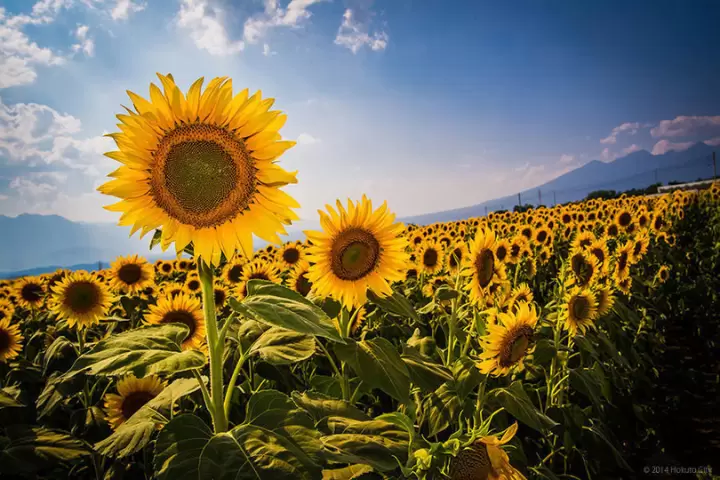
YAMANASHI PREFECTURE, JAPAN — Set against the dramatic, snow-dusted silhouettes of Mount Fuji, the Southern Alps (Minami Alps), and the Yatsugatake mountain range, one of Japan’s most arresting seasonal spectacles unfolds annually. The Hokuto City Akeno Sunflower Festival returned for its 2026 iteration, transforming Akeno Town—an agricultural enclave renowned for boasting some of the longest annual hours of daylight in the Japanese archipelago—into a sprawling, hyper-saturated ocean of gold.
Featuring approximately 400,000 sunflowers staggered meticulously across dual multi-acre zones, the month-long event has solidified its status as a quintessential summer pilgrimage. Just a two-hour transit corridor from the urban density of Tokyo, this year’s festival introduced groundbreaking operational milestones, including its inaugural night-illumination event, an expanded local agri-marche, and an interactive Instagram photography competition designed to boost regional tourism engagement.
![[2 hours from Tokyo] A breathtaking summer landscape of yellow created by 400,000 sunflowers. Hokuto City Akeno Sunflower Park](https://resources.matcha-jp.com/resize/720x2000/2026/07/14-267094.webp)
Executive Overview
The 2026 Hokuto City Akeno Sunflower Festival operated from July 18 through August 16, drawing tens of thousands of domestic travelers, international tourists, and photography enthusiasts. Situated in the highlands of Yamanashi Prefecture, the festival leverages Akeno’s unique meteorological profile—characterized by high solar radiation and well-draining volcanic soil—to cultivate an exceptional array of botanical specimens.
Rather than relying on a singular, simultaneous bloom, organizers strategically staggered planting schedules across the festival’s primary and rural park venues. This methodology guaranteed peak visual impact for roughly 30 days, smoothing visitor traffic and ensuring sustained economic vitality for local purveyors, artisanal food vendors, and regional hospitality networks.
![[2 hours from Tokyo] A breathtaking summer landscape of yellow created by 400,000 sunflowers. Hokuto City Akeno Sunflower Park](https://resources.matcha-jp.com/resize/720x2000/2026/07/14-267097.webp)
Beyond its visual grandeur, the 2026 festival functioned as an exercise in community-led sustainable tourism. With funding tied to participatory "sunflower support donations" and parking contributions, the municipality successfully balanced heavy seasonal foot traffic with the preservation of Akeno’s delicate rural ecosystem.
Detailed Chronology: The Evolution of the 2026 Festival
Planning, cultivation, and execution for the 2026 festival followed a carefully orchestrated timeline designed to maximize agricultural yield and tourist satisfaction.
![[2 hours from Tokyo] A breathtaking summer landscape of yellow created by 400,000 sunflowers. Hokuto City Akeno Sunflower Park](https://resources.matcha-jp.com/resize/720x2000/2026/07/14-267098.webp)
Pre-Festival Phase (Spring to Early July 2026)
Months prior to the public opening, local agricultural associations and municipal planners mapped out the multi-field layout. The venue was partitioned into distinct sectors: the Main Venue (Fields No. 1 through 8, located at Asao, Akeno-cho) and the Rural Park Venue (Fields No. 9 through 12, located at Kamite, Akeno-cho).
Agronomists curated four distinct sunflower cultivars to diversify the visual landscape:
![[2 hours from Tokyo] A breathtaking summer landscape of yellow created by 400,000 sunflowers. Hokuto City Akeno Sunflower Park](https://resources.matcha-jp.com/resize/720x2000/2026/07/14-267112.webp)
- Hybrid: Characterized by towering stalks and exceptionally large, classic yellow blossoms, predominantly planted in fields 6 through 12.
- Tohoku Yae: A multi-layered, voluminous double-petal variety situated in field 3.
- Sunfinity: An innovative high-yield cultivar producing an abundance of flowers from a single root structure, featured in fields 4 and 5.
- Concert Bell: A cluster-blooming variety whose blossoms face outward in a full 360-degree radius, localized in fields 1, 2, 11, and 12.
Opening and Peak Operations (July 18 – August 13, 2026)
The festival officially opened on Saturday, July 18, at 9:00 AM. In its initial weeks, the Main Venue—hosting fields 1 through 8—reached optimal saturation. Visitors navigating the grounds were greeted at the central tourist information hub, where daily status boards indicated which plots were experiencing peak bloom. To foster visitor engagement, the information center distributed complimentary, wearable sunflower headpieces, transforming tourists into living components of the landscape for designated photo-ops against the backdrop of the Minami Alps.
Concurrently, the "Sunflower Marche" opened its stalls, offering localized gastronomy. Culinary offerings included soft-serve ice cream infused with sunflower seed extracts, freshly grilled sweet corn harvested directly from Akeno plots, sliced premium Shinfu peaches, and artisanal shaved ice crafted from regional natural ice paired with seasonal Yamanashi fruit syrups.
![[2 hours from Tokyo] A breathtaking summer landscape of yellow created by 400,000 sunflowers. Hokuto City Akeno Sunflower Park](https://resources.matcha-jp.com/resize/720x2000/2026/07/14-267100.webp)
The Historic Night-Illumination Event (August 14, 2026)
For the first time in the festival’s operational history, organizers orchestrated a one-night-only illumination event on Friday, August 14, commencing at 7:00 PM. Breaking away from traditional daytime-only access, the Main Venue was bathed in specialized warm lighting as dusk transitioned into night. Set against a cloudless highland sky dense with visible constellations, the illuminated petals presented an ethereal, high-contrast aesthetic that drew critical acclaim from landscape photographers and nocturnal visitors alike.
Festival Closure (August 16, 2026)
The month-long event concluded on Sunday, August 16, at 5:00 PM. Final internal municipal reviews indicated strong participation numbers, heavily supported by spontaneous digital sharing via the official event Instagram account (@h.sunfes), which served as the real-time operational clearinghouse for weather updates, traffic advisories, and contest submissions.
![[2 hours from Tokyo] A breathtaking summer landscape of yellow created by 400,000 sunflowers. Hokuto City Akeno Sunflower Park](https://resources.matcha-jp.com/resize/720x2000/2026/07/15-267128.webp)
Supporting Context & Metrics
To fully understand the scale of the Hokuto City Akeno Sunflower Festival, economic and logistical metrics must be examined within the framework of Yamanashi Prefecture’s broader tourism strategy.
Logistical & Financial Parameters
- Duration: 30 days (July 18 – August 16, 2026).
- Total Flower Count: Approximately 400,000 individual stalks.
- Geographic Footprint: Dual-site configuration spanning the Main Venue (Asao) and the Rural Park Venue (Kamite), separated by a convenient 1-minute vehicular transit time or a short regional bus journey.
- Accessibility & Transit:
- By Car: Approximately 15 minutes via the Sutama Interchange on the Chuo Expressway. Automated 24-hour parking lots operated at both venues.
- By Public Transit: Approximately 25 minutes from JR Nirasaki Station via the Yamanashi Kyohoku Kotsu Kayagatake Mizugaki Rural Bus, with direct drop-offs at the "Akeno Tsumitorien" (Main Venue) and "Noson Koen-mae" (Rural Park) stops.
- Admission & Support Donations: General admission remained free, supported by mandatory vehicle environmental donations:
- Main Venue: Regular cars (1,000 JPY), Motorcycles (500 JPY), Buses (5,000 JPY).
- Rural Park Venue: Regular cars (500 JPY), Motorcycles (500 JPY), Buses (5,000 JPY).
Comparative Field Distribution Metrics
| Field Identifier | Cultivar Type | Growth Characteristics & Visual Profile | Primary Bloom Window (Estimated) |
|---|---|---|---|
| Fields 1, 2, 11, 12 | Concert Bell | 360-degree cluster blooms; compact, dense configuration. | Staggered across early & late phases |
| Field 3 | Tohoku Yae | Multi-layered petals; voluminous, decorative texture. | Mid-festival phase |
| Fields 4 & 5 | Sunfinity | High-density branching; multiple blossoms per individual plant. | Mid-to-late festival phase |
| Fields 6 to 12 | Hybrid | Classic large-scale solitary blossoms on thick stalks. | Early-to-mid festival phase |
Official Statements and Stakeholder Perspectives
Municipal authorities and regional tourism boards emphasized the ecological and socio-economic significance of the 2026 event.
![[2 hours from Tokyo] A breathtaking summer landscape of yellow created by 400,000 sunflowers. Hokuto City Akeno Sunflower Park](https://resources.matcha-jp.com/resize/720x2000/2026/07/14-267102.webp)
In statements released prior to the opening, representatives from the Hokuto City Tourism Association highlighted Akeno’s geographical advantages: "The intense ultraviolet exposure and sustained daylight hours in Akeno Town create an optimal biochemical environment for Helianthus annuus. Our agricultural partners have perfected the art of sequential planting, ensuring that travelers experience a dynamic, shifting canvas rather than a static display."
Regarding the introduction of the nocturnal illumination program, event coordinators noted: "The night-illumination event on August 14 was conceived to extend the dwell time of visitors in Hokuto City. By pairing the ethereal glow of illuminated gold petals against a high-altitude starry sky, we have unlocked a new dimension of eco-tourism that honors both our agricultural heritage and our pristine natural night skies."
![[2 hours from Tokyo] A breathtaking summer landscape of yellow created by 400,000 sunflowers. Hokuto City Akeno Sunflower Park](https://resources.matcha-jp.com/resize/720x2000/2026/07/14-267103.webp)
Furthermore, the integration of regional culinary ambassadors—such as local peach orchards and artisanal noodle makers—reinforced a strict farm-to-table ethos. Local merchants reported record-breaking sales of processed agricultural derivatives, validating the municipal strategy of coupling environmental conservation with direct commercial support for regional farmers.
Future Outlook: The Trajectory of Agri-Tourism in Hokuto City
As the echoes of the 2026 Akeno Sunflower Festival fade, regional planners are already turning their attention to future development cycles. The overwhelming success of the inaugural night-illumination event has established a commercial precedent, leading officials to evaluate expanding nocturnal openings for subsequent years, provided ecological impact studies on local insect and flora populations remain favorable.
![[2 hours from Tokyo] A breathtaking summer landscape of yellow created by 400,000 sunflowers. Hokuto City Akeno Sunflower Park](https://resources.matcha-jp.com/resize/720x2000/2026/07/15-267127.webp)
Strategic Initiatives for Upcoming Seasons
- Digital Infrastructure Enhancement: Building upon the success of the 2026 Instagram photo contest—which rewarded viral community participation with local Hokuto specialty baskets—the tourism board plans to integrate real-time, AI-driven bloom-tracking maps directly into the municipal web portal. This will allow international travelers to pinpoint exact daily peak fields down to the square meter.
- Extended Regional Culinary Partnerships: Following the post-festival economic momentum enjoyed by establishments like Handmade Udon Noodles Tiger and Grass (famous for its historic renovated farmhouse setting and seasonal vegetable tempura) and HALENOBON (located within the Gasbon Metabolism art complex, offering ancient wheat baked goods and Yatsugatake spice curries), the city intends to formalize a "Hokuto Culinary Trail." This trail will connect agricultural festival grounds directly with highland cafes and historic dining rooms.
- Environmental Sustainability Protocols: With visitor counts steadily rising year-over-year, future iterations will implement stricter carbon-offset frameworks for parking logistics and waste reduction programs across the Sunflower Marche, ensuring that Akeno’s natural splendor remains uncompromised by its own popularity.
The 2026 Hokuto City Akeno Sunflower Festival has firmly established itself as a benchmark for modern Japanese agri-tourism—seamlessly fusing advanced botanical cultivation, ecological mindfulness, community-driven commerce, and breathtaking natural aesthetics under the watchful gaze of Mount Fuji.






Belum ada komentar. Jadilah yang pertama berkomentar!