

Executive Overview
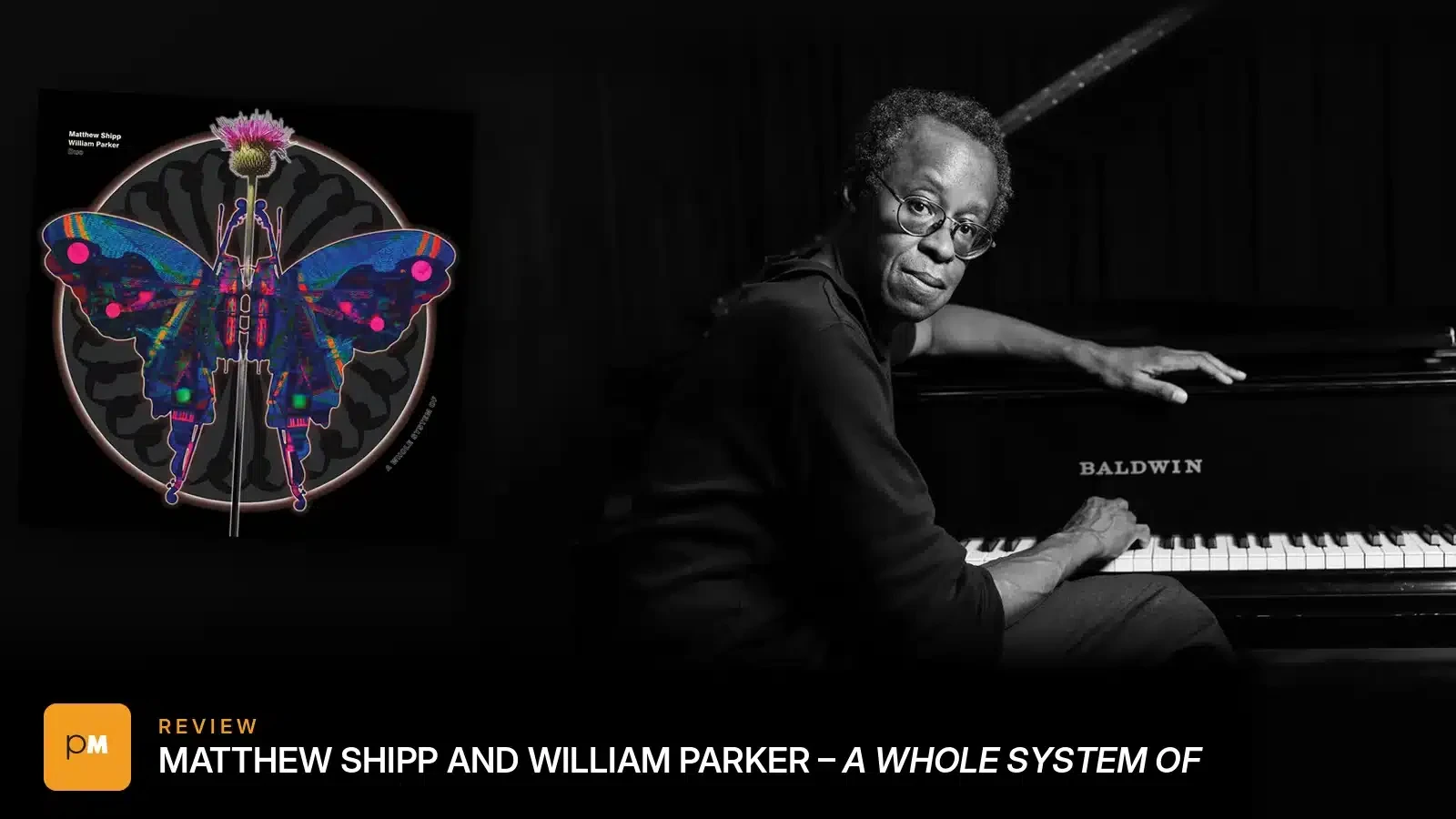
For over four decades, pianist Matthew Shipp and bassist William Parker have occupied a singular, formidable space in contemporary improvised music. Their partnership—forged in the creative crucible of New York City’s downtown loft scene and solidified through decades of relentless exploration—stands as one of the most telepathic and enduring creative unions in the history of modern jazz.
With the release of their latest collaborative masterwork, The Whole System Of, the duo returns to the minimalist configuration of piano and acoustic bass. Yet, despite the stripped-down instrumentation, the music projects a majestic, panoramic scale that rivals the most formidable large-ensemble recordings.
This latest statement arrives at a fascinating historical juncture. It coincides with the ESP-Disk reissue and vinyl debut of Zo, their foundational 1994 debut duo album. Looking back across the 32 years separating these recordings reveals a fascinating trajectory: a transformation from two distinct, fiercely individual voices bouncing off one another into a unified, breathing organism.
Far from abandoning structure, Shipp and Parker employ a rigorous, self-generated musical vocabulary. While they eschew the tired conventions of Tin Pan Alley song forms and traditional bebop changes, their completely improvised performances are governed by an internal logic, a deep command of harmonic tension, and a shared commitment to structural architecture. In an era where genre boundaries remain porous, Shipp and Parker continue to demonstrate that radical freedom and disciplined organization are not mutually exclusive, but rather two sides of the same coin.
Detailed Chronology: Four Decades of Collaborative Innovation
To understand the profound cohesion of The Whole System Of, one must trace the historical lineage of the Shipp-Parker partnership, a journey deeply intertwined with some of the most daring movements in late 20th- and early 21st-century music.
The Pre-Ware Foundation and the 1994 Debut
Long before they anchored the legendary rhythm section of the David S. Ware Quartet, Shipp and Parker were already mapping out a shared musical language in the vibrant New York underground. By 1994, when they entered the studio to record their debut duo album, Zo (originally released to critical acclaim and now receiving a long-overdue vinyl debut via ESP-Disk), Shipp was in his early 34s and Parker was in his mid-40s.
Even at this early stage, their artistic identities were sharp, though still evolving. Zo captured two mature artists testing the structural limits of the duo format. A notable highlight of that session was their radical interpretation of George Gershwin’s "Summertime." Rather than treating the standard as a mere vehicle for blowing, Shipp utilized the familiar melody as a structural anchor—repeating the line persistently while refracting it through shifting left-hand patterns and alternative harmonic colorings. Meanwhile, Parker improvised around and above the piano like an acrobat performing without a safety net, yet entirely secure in the structural integrity of his partner’s foundation.
The David S. Ware Quartet and the Major-Label Breakthrough
By the mid-1990s, Shipp and Parker had joined forces with tenor saxophonist David S. Ware, completing a quartet that would challenge prevailing industry trends. At a time when the jazz establishment was largely preoccupied with looking backward, institutionalizing tradition, and championing retro-swing movements, the David S. Ware Quartet proved that a daring synthesis of avant-garde free improvisation and rigorous architectural structure could capture the public imagination.
The turning point arrived when saxophonist Branford Marsalis—then wielding significant influence and A&R power at Columbia Records—witnessed the quartet live. Recognizing their uncompromising brilliance, Marsalis facilitated a major-label deal that yielded two landmark releases: Go See the World (1998) and Surrendered (2000).
The latter album featured a striking rendition of "Sweet Georgia Bright," a composition by tenor icon Charles Lloyd originating from his 1964 Columbia debut, Discovery!. The Ware Quartet channeled the ferocious, spiritual energy of John Coltrane and Albert Ayler, while simultaneously forging a cultural bridge to contemporary alternative music.
The Indie Rock Convergence
The Ware Quartet’s crossover appeal was not manufactured by record executives; it was earned through a fierce, independent ethos that resonated deeply with the 1990s alternative rock underground. The quartet frequently shared bills with indie-rock royalty like Sonic Youth, while high-profile musicians like Henry Rollins championed their music in mainstream counterculture circles.
For a brief, electrifying moment, it felt as though a mythical bridge had been constructed between the visceral, high-volume intensity of punk rock/grunge and the cerebral, spiritual heights of avant-garde jazz. While Shipp and Parker’s subsequent duo work is entirely acoustic, that same kinetic, battering-ram energy remains encoded in their DNA.
Supporting Context & Metrics: Deconstructing The Whole System Of
Spanning six entirely improvised performances, The Whole System Of represents a milestone in the recorded catalog of Matthew Shipp and William Parker. Far from devolving into formless chaos or abstract atonality, the album presents a meticulously organized system of musical grammar.
The Mechanics of "Deeper Fields"
The opening track, "Deeper Fields," sets an immediate, authoritative tone for the 37-minute journey. Shipp anchors the composition with a descending right-hand melody built on crystal-clear intervals, while his left hand anchors the low end with deep, rumbling harmonic foundations. This frees Parker to deploy a swirling, bowed (arco) improvisation that wraps around the piano lines like a thermal updraft.
As the seven-minute performance builds toward a dramatic, dynamic climax, the listener is reminded that improvisation, in the hands of masters, is not an exercise in random note-generation. It is an act of real-time composition, deeply deliberate and structurally sound.
Harmonic Frameworks and Post-Bop Lineage
If listeners approach The Whole System Of expecting the predictable cadences of Tin Pan Alley, they will be disoriented; however, those attuned to modern jazz harmony will find familiar, if elevated, guideposts. Tracks like "Notions of Order" reveal Shipp operating firmly within the post-bop harmonic tradition pioneered by visionaries like Andrew Hill.
Shipp’s rhythmic phrasing bridges the jagged, angular syntax of contemporary classical "new music" with the deep pulse of old-school swing. Parker, primarily plucking his bass (pizzicato) on this track, remains locked into Shipp’s wavelength, delivering tonal intervals and conversational counter-melodies that maintain a palpable sense of swing even in the absence of a rigid, metronomic time signature.
Form, Texture, and Narrative Episodes
One of the central challenges of entirely improvised music is maintaining distinct formal boundaries between tracks without the safety net of pre-composed melodies or arranged themes. Shipp and Parker overcome this obstacle by leveraging texture, dynamics, and formal architecture as primary narrative devices.
- "A Whole System Of" (The Title Track): This piece unfolds in distinct, episodic movements. It opens with a rigid, military-sounding 4/4 meter that drives a series of rhythmic cells. This gradually transitions into a conventional, swinging pulse before dissolving into a hushed, spacious ballad section. Here, Parker’s bass steps into the foreground, accompanied by Shipp’s sparse, whimsical chordal etudes—evoking the cyclical turning of seasons and shifting weather patterns.
- "The Essential Blue Note": A masterclass in mood and texture, this piece begins with an unaccompanied solo by Parker, abruptly punctuated by a cascading series of dark, descending jazz chords from Shipp. The duo navigates the piece like covert operatives moving through shadows. The tonality is unmistakably blues-infused, yet delightfully skewed—evoking less of a traditional Delta blues feel and more of an unstable collision between the harmonic sophistication of Sonny Clark and the impressionistic lyricism of Bill Evans.
- "Wave Light non Form": Dispelling any notion that acoustic avant-garde jazz lacks physical punch, this track opens with crashing, two-fisted piano chords matched by Parker’s muscular, kinetic basslines. The performance ebbs and flows like ocean tides, utilizing strategic, delicate interludes as the quiet "eyes" of a musical hurricane.
Official Statements and Critical Perspectives
The release of The Whole System Of has prompted reflection from critics, scholars, and the artists themselves regarding the nature of spontaneous composition.
Reflecting on the evolution of their sound over the past 32 years, William Parker has frequently emphasized that true improvisation requires absolute trust and shared vocabulary. In liner notes and interviews surrounding the duo’s recent output, the musicians have stressed that freedom is only meaningful when balanced against discipline.
"People often hear free jazz and assume anything goes," notes jazz historian and critic commentary surrounding the release. "What Shipp and Parker prove is that freedom is the result of extreme discipline. They don’t play without rules; they simply write the rules in real-time."
Furthermore, industry reception of the ESP-Disk reissue of Zo alongside The Whole System Of highlights a growing critical consensus: the Shipp-Parker duo is not merely a historical footnote of the 1990s downtown scene, but a living institution whose contributions continue to redefine the expressive capabilities of acoustic jazz.
Future Outlook
As Matthew Shipp and William Parker look toward the future, their ongoing collaboration serves as a vital blueprint for contemporary creative music. In an industry increasingly dominated by algorithmic curation, safe nostalgia, and hyper-produced pop formats, the uncompromising integrity of The Whole System Of offers a refreshing counter-narrative.
The simultaneous availability of their 1994 debut Zo on vinyl and their cutting-edge 2026 statements creates a continuous loop of artistic development. It proves that adventurous music, when rooted in deep listening and structural mastery, does not age—it merely deepens.
For younger generations of musicians navigating the porous boundaries between jazz, classical improvisation, and indie rock, the Shipp-Parker partnership remains a towering beacon. They are the high-wire acrobats of modern sound—flying without a net, yet soaring with absolute, breathtaking grace.








Belum ada komentar. Jadilah yang pertama berkomentar!