In the continuously shifting landscape of international horror cinema, few subgenres carry the cultural cachet and structural legacy of Japanese horror, or "J-Horror." From the analogue dread of Hideo Nakata’s Ringu (1998) to the digital haunting grounds of Kiyoshi Kurosawa’s Pulse (2001) and Takashi Miike’s One Missed Call (2003), the genre has consistently used contemporary communication channels as conduits for otherworldly terror.
Entering this storied lineage is The Invisible Half (2025), the striking feature-film directorial debut of Masaki Nishiyama. Starring Lisa Siera, Miyu Okuno, and Runa Hirasawa, the film premiered to considerable critical intrigue for its fusion of classic J-Horror tropes with modern socio-cultural commentary.
Rather than relying solely on jump scares or overt supernatural violence, The Invisible Half grounds its terror in the suffocating pressures of institutional conformity, adolescent social dynamics, and the psychological burdens of intersectional and bi-racial identity in contemporary Japan.
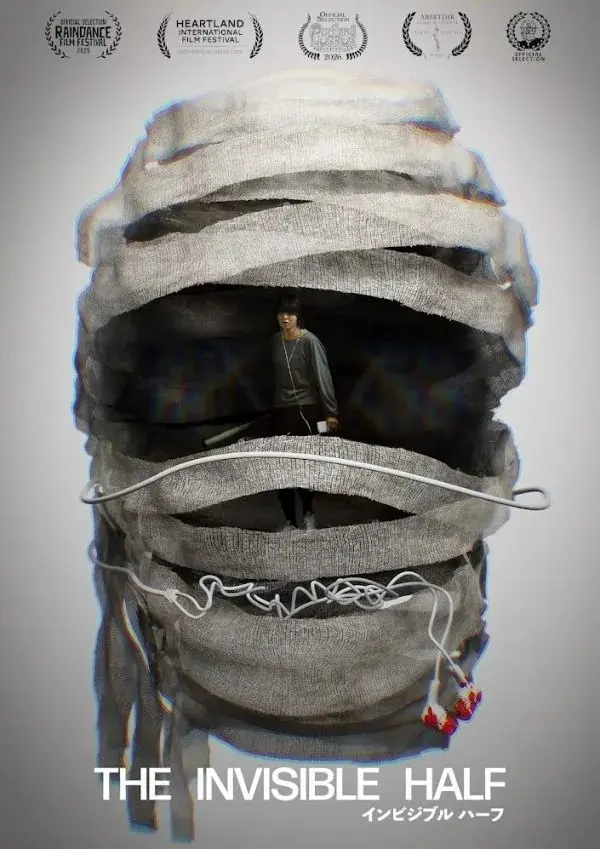
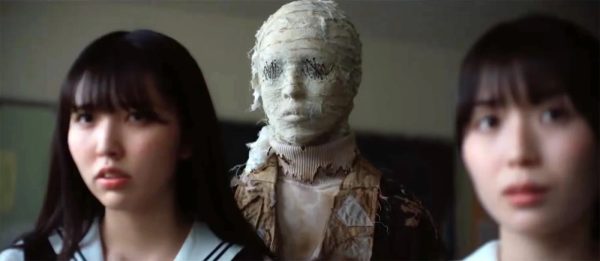
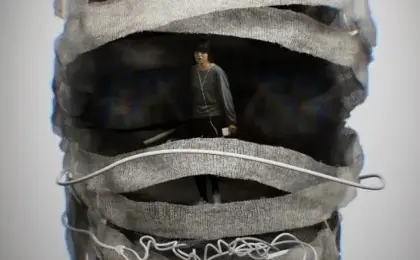
At its core, the narrative follows Elena (Lisa Siera), a vulnerable, bi-racial adolescent navigating a rigid, all-girls Japanese high school following her return from abroad. As Elena struggles to assimilate into an environment violently hostile to deviance from social norms, she discovers a terrifying anomaly: she is being stalked by a slow-moving, bandage-wrapped supernatural entity that can only be perceived through the lens of a smartphone camera and heard through a pair of earphones.
While the film has drawn minor critiques for its deliberate, occasionally languid pacing, it has simultaneously been lauded for its atmospheric cinematography, resonant thematic depth, and nuanced handling of teenage trauma. This review offers a comprehensive look at the production, narrative mechanics, thematic architecture, and broader cultural implications of Masaki Nishiyama’s chilling cinematic statement.
Detailed Chronology: The Narrative Arc of The Invisible Half
Introduction to Alienation: Elena’s Arrival
The film opens with an acutely disquieting atmosphere, establishing the internal and external turbulence faced by its protagonist, Elena (Lisa Siera). Born to a British father and a Japanese mother, Elena returns to Japan bearing fractured memories and a receding grasp of her native English—a linguistic and cultural anchor she is slowly losing. Her domestic life is far from a sanctuary; an uneasy, strained relationship with her mother compounds the immense psychological pressure she feels to belong.
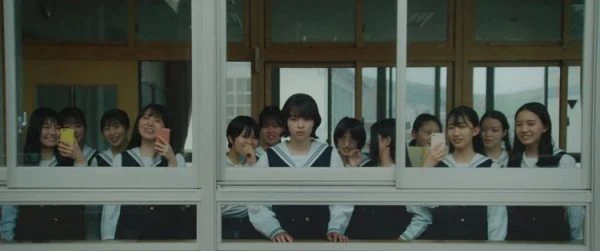
On her first day at an uncompromising, all-girls secondary institution, Elena is seated next to Akari (Miyu Okuno). This seating arrangement serves as the primary emotional catalyst for the first act. Akari, possessing an innate sense of empathy and a grounded moral compass, offers Elena a lifeline in a suffocating ecosystem designed to punish difference. Their burgeoning friendship is rendered with tenderness, providing a much-needed emotional anchor against the clinical coldness of the school hallways.
The Smartphone as a Conduit of Survival
As Elena attempts to navigate the unspoken social codes of her peers, she begins to notice a profound disconnect between herself and the student body. This isolation reaches a supernatural threshold when Elena discovers a hidden glitch in her perception: a grotesque, bandaged entity is trailing her through the school grounds.
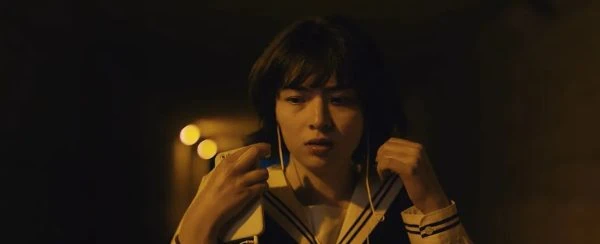
Crucially, the monster defies traditional horror conventions. It is entirely invisible to the naked eye and silent to the open ear. It can only be tracked when Elena looks through the screen of her smartphone, with its audio frequencies decipherable solely through her earphones. This mechanical mediation creates a tense, claustrophobic viewing experience, reminiscent of the relentless, creeping momentum found in modern Western masterpieces like David Robert Mitchell’s It Follows (2014).
Nyan Ito and the Breaking Point
The film’s central thematic mirror to Elena’s plight is embodied by Nyan Ito (Runa Hirasawa). A fellow student seemingly addicted to her mobile device, Nyan is rarely seen without her earphones, appearing visibly resistant to removing them under any circumstance. Nyan harbors her own intense, unspoken burdens—pressures that stem from the relentless demand for perfection within the school’s hierarchical structure.
Without detailing the third-act convolutions, the narrative hinges on Nyan experiencing a severe, visually arresting psychological break. Through Nyan’s harrowing descent, and Elena’s subsequent realization, the film subverts the typical horror trope regarding technology. In The Invisible Half, the smartphone does not invite demonic forces into the victim’s life; rather, it functions as an essential, protective mechanism—a distorted digital sensor required to see, anticipate, and guard against an otherwise inescapable supernatural threat.
Supporting Context & Metrics: The Evolution of Technophobia in J-Horror
To fully appreciate the cinematic framework of The Invisible Half, one must examine the historical trajectory of technological integration within Japanese horror cinema.
The Analogue Era: Ringu and Foundational Dread
In the late 1990s, Hideo Nakata’s Ringu revolutionized global horror by weaponizing everyday analogue technology—the VHS tape. The cursed videotape tapped into society’s growing anxieties surrounding mass media, home video reproduction, and a passive consumer culture. The horror was tactile; it involved rewinding tape, static-filled television sets, and a ticking clock of seven days.
The Digital Shift: Pulse and One Missed Call
As the millennium turned, the threat shifted from magnetic tape to invisible network signals. Kiyoshi Kurosawa’s Kairo (Pulse, 2001) used dial-up internet connections and early desktop interfaces to explore profound existential isolation, famously positing that the afterlife was overflowing and spilling over through cyberspace. Shortly after, Takashi Miike’s One Missed Call (2003) utilized cellular ringtones as death warrants, weaponizing the hyper-mobility of the emerging smartphone generation.
[Analogue Era: Ringu (1998)]
       │ (Cursed VHS Tapes / Media Consumption Anxiety)
       ▼
[Early Digital Era: Pulse (2001) & One Missed Call (2003)]
       │ (Dial-up Internet / Mobile Ringtones / Network Isolation)
       ▼
[Contemporary Era: The Invisible Half (2025)]
         (Smartphones & Earphones / Intersectional Alienation / Augmented Reality Dread)
The Invisible Half in the Modern Ecosystem
Masaki Nishiyama’s The Invisible Half bridges the gap between these foundational works and contemporary anxieties. Today, smartphones are not novel accessories; they are ubiquitous, literal extensions of the human nervous system. By making the smartphone screen the only viewport through which a monster can be seen, Nishiyama updates the J-Horror playbook. The screen acts simultaneously as a cage of digital addiction and the sole instrument of survival, reflecting modern youth culture’s complex, interdependent relationship with personal devices.
Official Statements and Critical Reception
Upon its festival circuit run and subsequent commercial distribution, The Invisible Half attracted critical commentary for its ambitious blending of supernatural horror and social critique.
Industry analysts and genre reviewers have highlighted director Masaki Nishiyama’s deliberate artistic choices. In early promotional notes and interviews regarding his debut feature, Nishiyama noted:
"Horror cinema has always been at its most effective when it mirrors the unspoken societal sicknesses of its time. In designing the entity within The Invisible Half, I wanted to explore how young people today are forced to filter their reality through digital glass. The monster is not just a ghost from the past; it is the physical manifestation of what we refuse to look at directly—our isolation, our intolerance of difference, and the digital armor we construct to survive day-to-day life."
Lead actress Lisa Siera, discussing her role as the bi-racial protagonist Elena, emphasized the emotional core anchoring the supernatural elements:
"Elena’s battle isn’t simply against a bandaged spirit in the corridors; it’s an internal war for identity. Playing a character who is losing her grip on her heritage while trying to fit into a society that demands absolute uniformity required a delicate balance. The horror works because, long before she sees the monster on her phone, Elena already feels completely invisible to the world around her."
Critical reviews have universally praised the film’s atmospheric achievements. Writing for major genre publications, critics noted that while the narrative’s slow burn occasionally tests viewer momentum, the payoff—bolstered by strong performances from Siera, Okuno, and Hirasawa—elevates the film above standard supernatural creature features. The use of shadow, ambient gloom, and sonic design to simulate the claustrophobia of earphones has been singled out as a masterclass in modern mood-building.
Future Outlook: The Trajectory of Masaki Nishiyama and Modern J-Horror
The positive critical reception of The Invisible Half marks a significant milestone for both its principal creators and the broader ecosystem of independent Japanese genre filmmaking.
Directorial Prospects for Masaki Nishiyama
As a feature-film debut, The Invisible Half establishes Masaki Nishiyama as a distinct new voice in psychological horror. By demonstrating a mature restraint—opting for sustained ambient dread over cheap, high-frequency jump scares—Nishiyama has signaled his alignment with the auteur-driven horror movement championed by modern international directors. Industry insiders anticipate that his next projects will likely continue to explore the friction between traditional cultural expectations and modern psychological malaise, potentially on a larger international canvas.
The Rebirth of Technocentric Horror
The success of Nishiyama’s film also points to a healthy appetite for smart, conceptually driven technophobia in horror. As augmented reality (AR), artificial intelligence, and hyper-connected personal devices redefine human interaction, filmmakers have fertile ground to explore new dimensions of digital haunting. The Invisible Half proves that J-Horror’s obsession with screens, static, and signals remains as potent today as it was twenty-five years ago, provided it continues to evolve alongside contemporary social realities.
Ultimately, The Invisible Half stands as a chilling reminder that the most terrifying monsters are often those we construct in our societies, rendered visible only when we dare to look through the precise lenses we use to keep the world at bay.







Belum ada komentar. Jadilah yang pertama berkomentar!