

Executive Overview
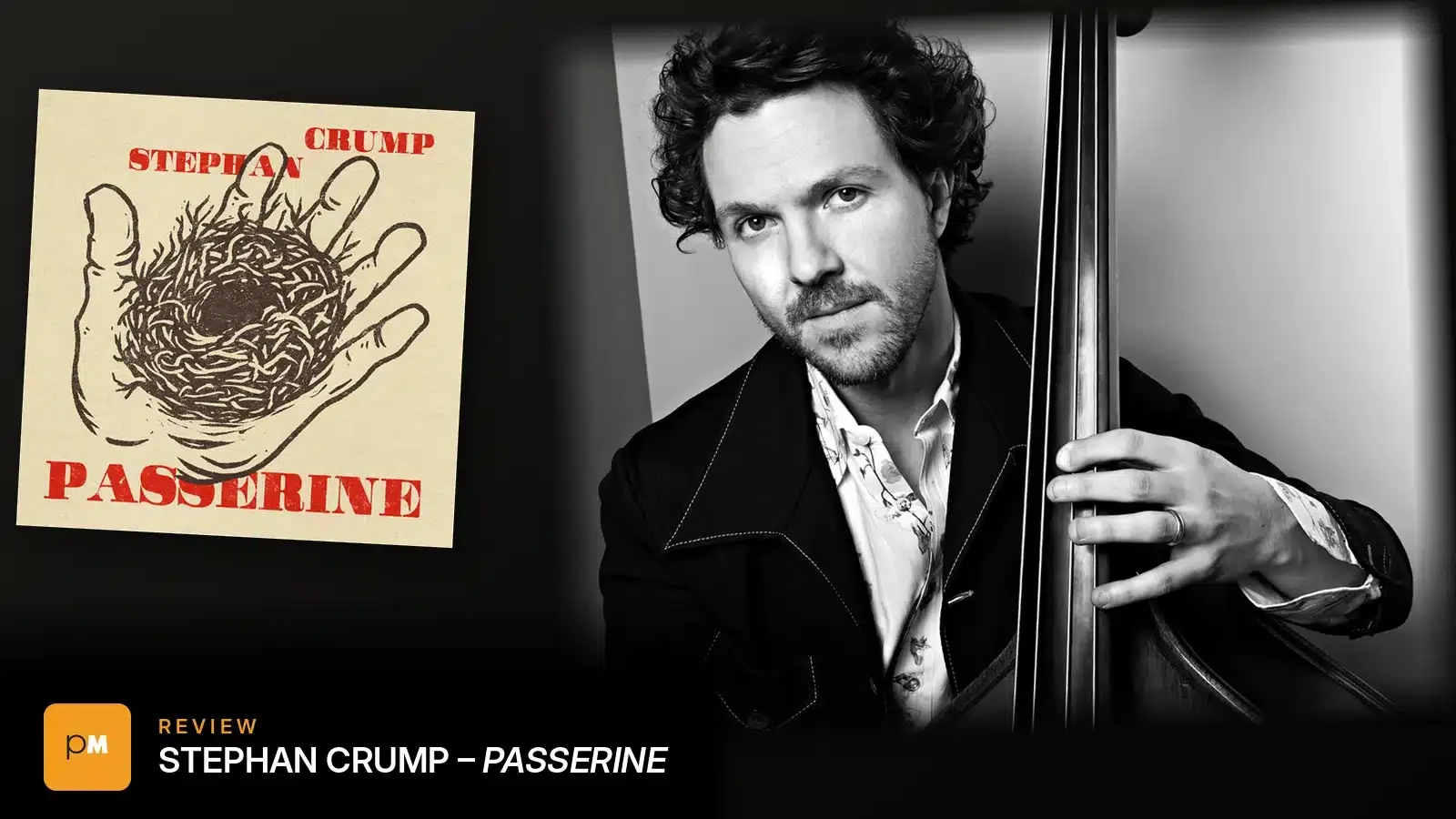
To place the needle on Stephan Crump’s new quartet album, Passerine, is to experience an immediate, weightless suspension. This sensation might initially strike the listener as paradoxical. After all, Crump’s primary role as a bassist—anchoring the ensemble with his warm, woody, cream-toned acoustic bass—is traditionally to tether the music to the earth. Yet, the sonic environment generated across Passerine behaves less like a heavy foundation and more like a temperate, life-giving breeze moving fluidly through high tree branches.
At its core, Passerine is an acoustic exploration rooted in biological inspiration. The album’s title refers to the avian order Passeriformes—encompassing over 6,500 identified bird species, including the humble sparrow—whose specialized toe arrangement facilitates seamless perching and intricate nest-building. Crump, acting as both composer and architect, constructed these original jazz arrangements after deep academic and artistic research into the physics and geometry of bird nest-building techniques.
The resulting recording possesses a rare aural transparency and architectural delicacy. It foregrounds the ingenious playfulness of written compositions alongside the spontaneous invention of free-flowing improvisations. Alongside Crump’s resonant acoustic bass, the ensemble’s signature sound is forged through the gentle, telepathic interweaving of Kenny Warren’s trumpet and David Leon’s flute in the front line. Propelling this melodic interplay is percussionist Ches Smith, who utilizes a radically unconventional, stripped-down drum kit featuring no bass drum, no hi-hat cymbals, cloth-muted toms, an atypical snare, and an array of raw metal implements.
Through Passerine, Crump does not merely pay homage to nature; he translates its structural principles into sound. In doing so, he solidifies his status not only as a master bassist, but as one of the most visionary, versatile bandleaders and composers of our contemporary era—a rightful heir to the avant-garde lineage of bass luminaries like Dave Holland.
Detailed Chronology: Anatomy of an Avian Suite
To understand how Passerine constructs its sonic nests, one must trace the deliberate, step-by-step evolution of its compositions. The album unfolds like a biological ecosystem, each track introducing new textures, rhythmic tensions, and structural developments.
The Awakening: "Twenty-Five" and "Stuck"
The album’s second track, "Twenty-Five," tiptoes into the listener’s consciousness with extraordinary subtlety. Percussionist Ches Smith simulates a creeping dawn, utilizing delicate bells and tapped drums to suggest the very first rays of morning light. Soon after, Stephan Crump enters with a simple, resonant bass line featuring double stops that evoke hesitant, quiet footsteps. Trumpeter Kenny Warren then steps forward, offering a mid-range melody in a direct call-and-response with the bass, before David Leon’s flute enters, unfurling a pipey, winding line that curls around the rhythm.
As the piece develops, the organic metaphor of the "weaver" takes center stage. Just as bits of straw, twigs, and grass are loosely woven into a bird’s nest yet possess astonishing structural integrity, the four voices in "Twenty-Five" flow together in intricate counterpoint. Following an inventive flute solo by Leon, the ensemble locks into a robust parallel harmony, rendering the sonic architecture intensely solid. Warren subsequently solos over a complex, rhythmic vamp figure shared by Crump and Smith—a different kind of dynamic weaving—before the trumpet and flute unite in a fluttering unison figure that resolves into long, harmonized tones floating over a steady groove.
The album’s opening track, "Stuck," establishes an equally hypnotic atmosphere, this time employing Leon on alto saxophone rather than flute. Leon’s saxophone tone is gauzy and textured, buzzing against Warren’s trumpet and locking into rich harmonies with Crump’s arco (bowed) bass at the outset of the tune. Crump establishes a series of shifting rhythmic frameworks—including a three-against-four lope and a rattling percussion pattern beneath a soaring, sermon-like saxophone solo—before settling into a deeper funk groove that remains remarkably light under Smith’s minimalist stewardship.
Dynamic Interplay: "Weavers," "Glide," and "Fly"
True to its title, the track "Weavers" pairs the trumpet and flute in tight counterpoint over an irresistible, off-kilter groove. Smith maintains a sparse approach, proving that restraint can be as vital as bombast, while Crump subverts expectations by placing the range of Leon’s flute beneath the trumpet, deliberately widening the spatial canvas. As the bass melody, flute, and trumpet curve, dodge, and dart around one another—first through written notation and then in spontaneous improvisation—the listener can virtually hear the structural nest coming together piece by piece.
This kinetic playfulness carries over into Crump’s sinuous composition "Glide," which rides on a deeply danceable momentum, and the swaying, mesmerizing track "Fly." On "Fly"—one of two pieces where Leon switches back to the alto saxophone—the ensemble adopts a bobbing 6/8 feel. This relaxed yet driving triple meter gusts steadily beneath the horns as they converse and breathe together. Crump and Smith occasionally pivot into a walking 4/4 meter before effortlessly returning to the compound meter, delivering a masterclass in subtle compositional detail.
Melodic Reflection: "Bryn"
Toward the latter half of the sequence, the mood shifts into deep introspection with "Bryn," a slow, melancholy theme carried primarily by Warren’s trumpet, underscored by Leon’s precise, low-range flute harmonies. In an uncharacteristic move, Crump steps out to deliver the album’s first bass solo on the track. This lyrical, brief pizzicato improvisation acts as a bridge, inviting Leon and Warren to deliver short, patient phrases before the primary melody gently returns.
Supporting Context & Metrics: The Linage of Avant-Garde Quartets
It is virtually impossible to discuss Passerine without acknowledging its profound sonic and structural lineage. Most notably, critics and purists alike have drawn immediate, compelling parallels to classic recordings from the golden era of creative improvised music—specifically, Dave Holland’s watershed 1972 ECM release, Conference of the Birds.
The Chamber-Jazz Blueprint
Like Crump’s modern quartet, Holland’s legendary ensemble operated as a two-horn, bass-and-drums configuration featuring saxophonists/flutists Sam Rivers and Anthony Braxton, alongside drummer Barry Altschul. The title track of Holland’s masterpiece achieved a luminous transparency, delicate beauty, and floating suspension that serves as a clear historical antecedent to Passerine. Furthermore, Holland’s composition "Q & A" allowed Altschul to skitter across the kit, creating atmospheric textures much in the way Ches Smith does on Crump’s new record, opening the sonic sky for horns and bass to swoop, dodge, and dart with unbridled freedom.
Ensemble Metrics & Instrumentation
To fully appreciate the uniqueness of Passerine, one must analyze the physical configuration of the quartet:
- Stephan Crump (Acoustic Bass & Composition): Anchoring the ensemble with a cream-toned, woody resonance, utilizing arco and pizzicato techniques to establish both foundational rhythms and melodic counter-voices.
- Kenny Warren (Trumpet): Operating with a versatile, open-horn style reminiscent of Miles Davis, Lester Bowie, Wadada Leo Smith, and Ron Miles, anchoring the front line with expressive harmonic flexibility.
- David Leon (Flute & Alto Saxophone): Providing agile, breathy textures that blur the line between woodwind lead lines and textural counterpoint, often weaving below the trumpet’s register to expand the group’s spatial dynamics.
- Ches Smith (Percussion): Rejecting traditional heavy-handed drumming in favor of an experimental kit featuring no bass drum, no hi-hats, cloth-muted toms, customized metal implements, and a unique snare sound that mimics environmental rustling.
Official Statements & Artistic Vision
Reflecting on the conceptual origins of the album, Stephan Crump has consistently emphasized the necessity of listening to structural forms found outside the traditional boundaries of Western art and jazz.
"When you look closely at how passerine birds construct their nests—gathering disparate, fragile elements from their environment and weaving them together with tension and structural strength—you realize it is the exact physical manifestation of what we attempt to do in improvised counterpoint," Crump explains. "Every musician must know when to hold tight, when to give space, and how individual threads become a unified architecture."
Drummer Ches Smith elaborates on the deliberate stripping down of his kit for the project:
"Playing without a conventional bass drum or hi-hat forces you to find entirely different ways to drive the music. You aren’t pushing the band from behind with brute force; you are whispering ideas into the room, letting the cogs turn through metallic resonance and muted tones."
Trumpeter Kenny Warren notes the unique collaborative environment fostered by Crump’s leadership:
"Stephan writes music that demands vulnerability. You can’t hide behind volume or excessive technique on these charts. Every note has to mean something because the space surrounding the notes is just as large as the music itself."
Future Outlook: Crump as the Definitive Bassist-Bandleader of Our Era
The release of Passerine forces a broader, critical reassessment within the contemporary jazz landscape. It begs the question: Isn’t it time we recognize Stephan Crump, in the grandest sense, as our era’s Dave Holland—as fine, versatile, and sure-handed a bassist and bandleader as modern creative music has ever produced?
Much like Holland served as an essential rhythmic anchor for Miles Davis during formative creative periods, Crump has spent decades as a vital sideman and collaborator for some of the most brilliant musical minds of his generation, most notably pianist and composer Vijay Iyer. Just as Holland forged legendary rhythm sections alongside drumming titans like Jack DeJohnette, Crump has continually elevated his work through profound partnerships with avant-garde percussionists like Ches Smith and Tyshawn Sorey.
Yet, Crump’s true genius lies in his astonishing stylistic versatility as a composer and bandleader. His discography reads like a masterclass in ensemble curation:
- The Otherlands Trio (Star Mountain): Partnering with saxophonist Darius Jones and drummer Eric McPherson to explore entirely free, unwritten improvisational landscapes.
- The Rosetta Trio: Collaborating with guitarists Jamie Fox and Liberty Ellman to fashion a chamber-jazz aesthetic built on delicate, deeply lyrical interplay.
- The Rhombal Quartet: Spanning generational divides by pairing veteran saxophone visionary Ellery Eskelin with one of the most innovative young trumpeters in modern jazz, Adam O’Farrill.
Across all these diverse settings, Crump operates in the spirit of Duke Ellington: he writes specifically for the distinct individual voices—and the combined sound—of his chosen bandmates. He devises compositions that thrive on a rhythmic push-and-pull, capable of accelerating into fiery intensity or decelerating into languorous meditation.
As Passerine proves, Stephan Crump continues to construct rich, breathing sonic environments where superb improvisers are given the freedom to move, and where listeners are continually invited to experience the profound, natural groove of the world around them. Hailing natively from Memphis, Tennessee, Crump has built a career bridging deep American roots with borderless exploratory art. With Passerine, he has built a masterpiece that will endure in the permanent architectural canon of modern jazz.



Belum ada komentar. Jadilah yang pertama berkomentar!