As the sweltering heat of summer recedes across the Japanese archipelago, the Kansai region undergoes a breathtaking transformation. November 2026 brings the peak of koyo (autumn foliage) to Western Japan, painting the ancient capitals, rugged mountain ranges, and dynamic urban centers of Kyoto, Osaka, Nara, and Hyogo in vivid strokes of crimson, gold, and amber.
Far more than a seasonal transition, November in Kansai represents a living museum of cultural continuity. The region balances centuries-old heritage—ranging from imperial traditions and esoteric Buddhist rituals to geiko artistry—with cutting-edge contemporary spectacles, including state-of-the-art projection mapping, sprawling city-wide light installations, and open-air alpine art exhibitions.
This comprehensive briefing catalogs ten foundational events shaping the cultural and tourism landscape of Western Japan in November 2026. Designed for cultural historians, travel economists, and discerning global travelers, this report provides logistical clarity, historical context, and scheduling insights to navigate Kansai’s premier autumn festival season.
Detailed Chronology of November 2026 Events
1. Gion Odori in Kyoto (November 1–10, 2026)
Location: Gion Kaikan, Kyoto
Historical Significance: While spring is internationally celebrated for the Miyako Odori, autumn in Kyoto belongs exclusively to the district of Gion Higashi. Now in its 67th iteration, the Gion Odori remains the city’s sole public autumn dance performance executed by geiko (Kyoto’s regional term for geisha) and maiko (apprentices). Gion Higashi’s distinct lineage as an administrative and artistic district dates back to 1881.
The Experience: The hour-long theatrical production brings centuries of traditional arts to life. Performers stage elaborate, narrative-driven pieces utilizing richly dyed seasonal kimono, precise choreography, and classic Gion accompaniment—including shamisen, drums, and traditional flute melodies. The performance culminates in a grand ensemble finale that allegorically celebrates the four distinct seasons of the district.
Logistical Details: Performances run daily at 13:30 and 16:00. General admission is 6,000 yen, with a premium tier of 7,000 yen that incorporates a traditional pre-show tea ceremony.
2. Shitennoji Wasso Festival in Osaka (November 1, 2026)
Location: Naniwa Palace Site, Osaka
Historical Significance: Shitennoji Wasso serves as a grand historical pageant commemorating approximately 1,400 years of diplomatic, religious, and cultural exchange between the Japanese archipelago and its continental neighbors on the Asian mainland, notably the Korean Peninsula and China.
The Experience: Hosted at the historic Naniwa Palace Site—the ancient administrative capital of Japan in the 7th and 8th centuries—the festival features an expansive historical procession and stage performances. The afternoon program traces ancient eras through traditional Korean dance forms, dynamic taiko drumming, energetic Awa Odori folk dances, and contemporary cultural expressions like K-pop. It stands as a vital living archive of Osaka’s historical identity as an international port of trade and culture.
Logistical Details: Gates open at 10:30 AM, with performances running from 11:00 AM to 17:00 PM. Note: The event is strictly weather-dependent and will be canceled in the event of rain.
Historical Significance: Locally revered as the "Temple of Winning Luck" (Shoun-ji), Katsuoji has a history spanning over a millennium. The sprawling 264,000-square-meter mountain temple grounds are famous for thousands of daruma dolls—traditional papier-mâché figures symbolizing perseverance, goal-setting, and victory—left by visitors seeking fortune and success.
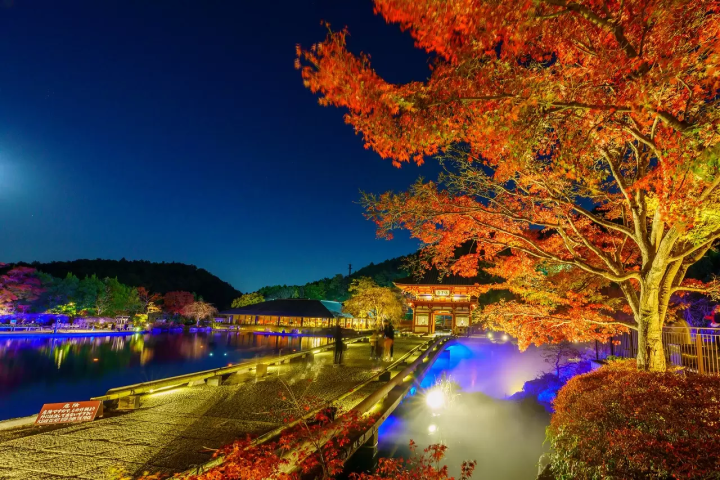
The Experience: Throughout November, the mountain temple transforms as its vast collection of maple trees turns fiery red and deep gold. After sunset, a comprehensive lighting apparatus illuminates the foliage against the deep dark of the surrounding forest. The interplay of glowing autumn leaves, rolling mist drifting across temple ponds, and thousands of red daruma dolls stacked along ancient stone walls creates an otherworldly, contemplative atmosphere.
Logistical Details: Night illuminations operate exclusively on Saturdays, Sundays, and Japanese national holidays from November 1 through November 29, 2026. Hours run from sunset until 20:30 (last entry at 20:00).
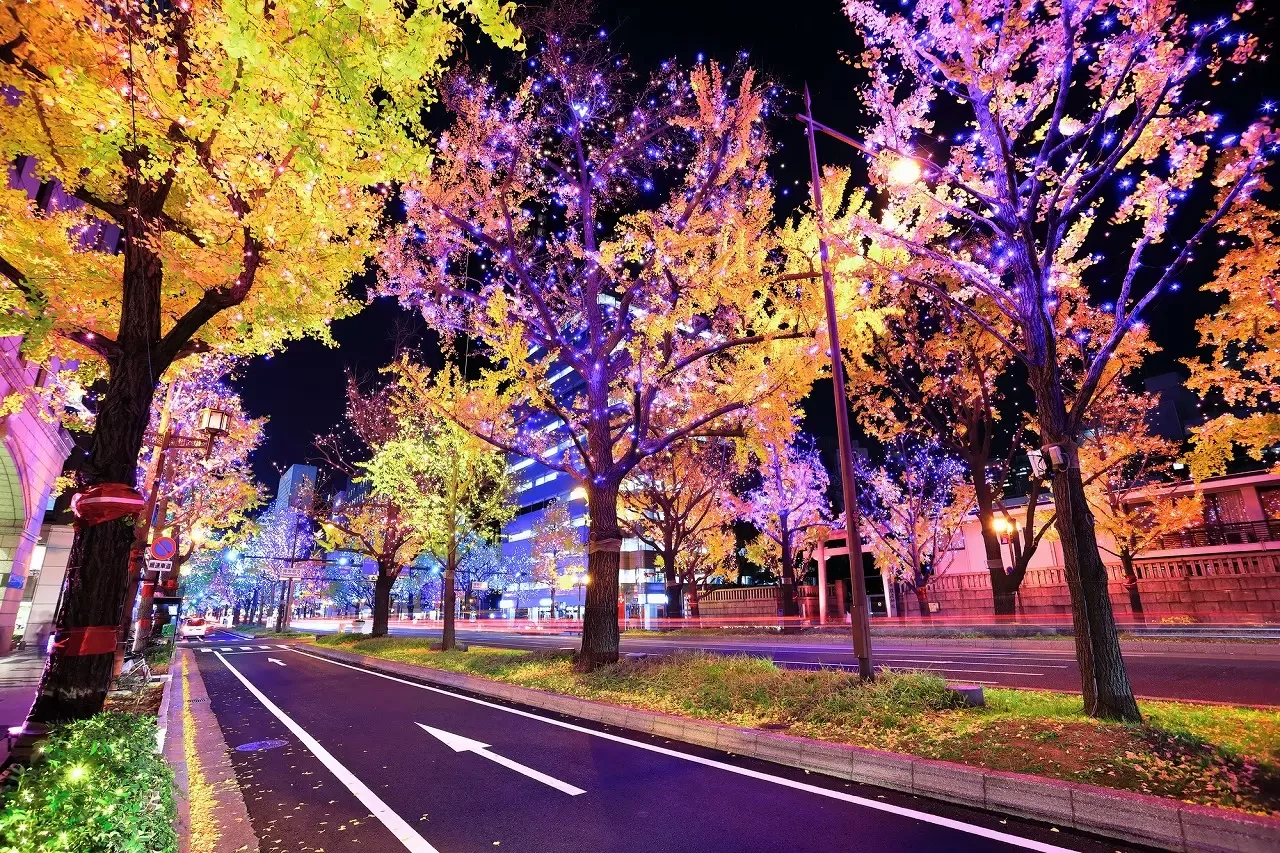
4. Midosuji Illumination in Osaka (November 3 – December 31, 2026)
Location: Midosuji Avenue (Hanshin-mae Intersection to Namba-Nishiguchi Intersection), Osaka
Historical Significance: As one of the two core pillars of the broader Osaka Festival of Lights (alongside the Nakanoshima OSAKA Light Renaissance), the Midosuji Illumination turns Osaka’s premier north-south artery into a world-class urban lightscape.
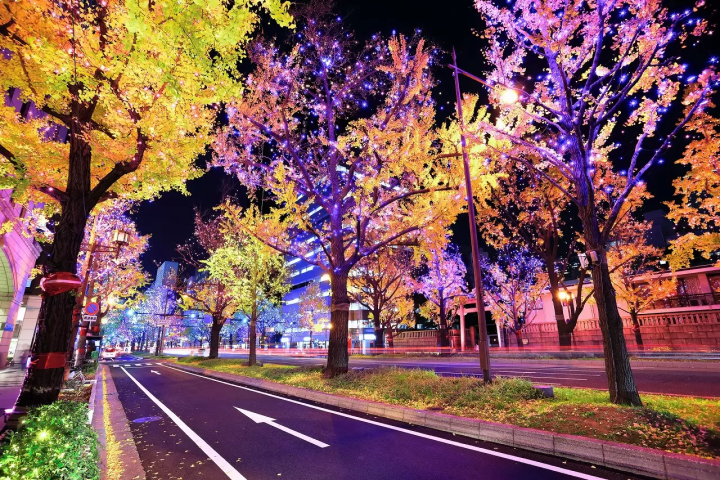
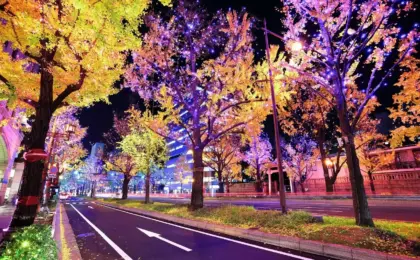
The Experience: A magnificent four-kilometer corridor of mature ginkgo trees stretching from Umeda to Namba is draped in millions of LED lights. The 2026 theme, "LINK—Light moves the city," emphasizes interactive urban design. Visitors encounter motion-responsive light installations, pop-up night markets, and creative workshops embedded directly into the urban fabric, allowing pedestrians to actively participate in the luminous spectacle.
Logistical Details: The illumination shines daily from approximately 17:00 to 1:00 AM. Admission to the avenue is entirely free.
5. Minoh Momiji Matsuri and Waterfall Illuminations (November 14 – December 6, 2026)
Location: Minoh Park Waterfall Trail, Osaka Prefecture
Historical Significance: Located a mere 30 minutes north of downtown Osaka (Umeda), Minoh Park is a designated quasi-national park famous for its dramatic topography and rich botanical diversity.
The Experience: Visitors embark on a scenic 2.7-kilometer paved riverside trail leading to the thunderous 33-meter-high Minoh Falls. Along the route, vendors sell momiji tempura—a unique regional delicacy consisting of maple leaves salt-cured for an entire year, dipped in a sweet, sesame-infused batter, and deep-fried to a golden crisp. During the festival, sunset brings atmospheric illumination to the valley. Five designated "listening points" along the trail allow visitors to stream curated acoustic soundscapes via their smartphones, pairing the visual splendor of illuminated foliage with an immersive auditory experience.
Logistical Details: Illuminations run nightly from sunset until 21:30 throughout the festival duration.
6. Tanzan Shrine Autumn Festival in Nara (October 1 – December 6, 2026)
Location: Tanzan Shrine, Sakurai, Nara Prefecture
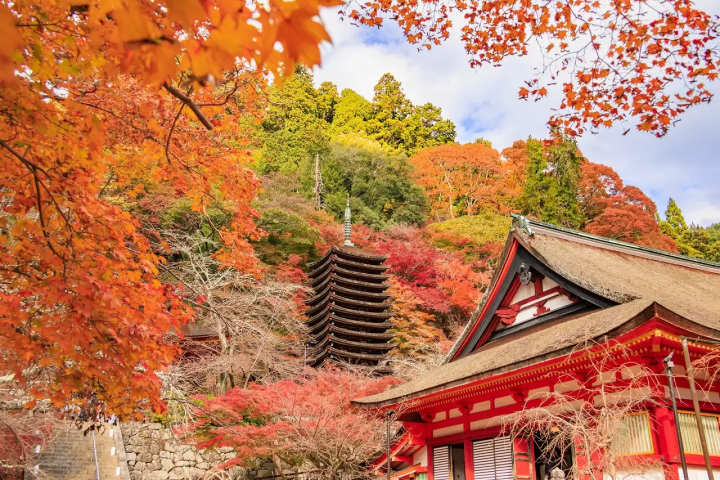
Historical Significance: Often hailed as the "Nikko of the West," Tanzan Shrine is deeply intertwined with the pivotal Taika Reforms of the 7th century. The shrine houses the world’s only surviving wooden thirteen-story pagoda, a masterwork of ancient Japanese architectural engineering. Set within the wooded hills of Sakurai, the shrine grounds encompass over 3,000 mature maple trees.
The Experience: The extensive Autumn Leaves Festival pairs the natural beauty of changing leaves with historic rituals. Key dates feature the Kemari Festival on November 3—where participants don traditional Heian-period court robes to play kemari, an ancient imperial kickball game—alongside the Grand Festival on November 17, and classical gagaku court music paired with the rare Ranryōō mask dance on November 28. Evening illuminations further enhance the historic wooden structures.
Logistical Details: General festival activities run from October 1 to December 6, 2026. Evening illuminations are scheduled nightly from November 14 to December 6, running from sunset to 20:30.
7. Kobe Nunobiki Herb Gardens Autumn Harvest & Garden Fest (September 12 – December 6, 2026)
Location: Kobe Nunobiki Herb Gardens & Ropeway, Kobe, Hyogo Prefecture
Historical Significance: Rising 400 meters above the cosmopolitan port city of Kobe, these expansive mountainside gardens provide a botanical escape blending European garden design with Japanese topography.
The Experience: Access begins via a scenic ten–minute ropeway ride that glides above vibrant autumn slopes, offering panoramic vistas of Kobe and Osaka Bay. Throughout November, the Garden Fest features authentic German-style autumn offerings, including artisan beers, savory herb-infused sausages, and seasonal fruit desserts. Specialized programming includes seasonal picnic packages (running through November 23) and artisanal wreath-making workshops (November 1 and 3). From November 7 onward, holiday decorations debut alongside a daily autumn foliage light-up along the 150-meter pathway leading to the Glass House.
Logistical Details: Daytime operations run daily; extended evening openings are featured on Fridays, Saturdays, and Sundays from November 7 onward.
8. Kobe Rokko Meets Art & Hikari no Mori Night Walk (September 19 – November 29, 2026)
Location: Mount Rokko (ROKKO Forest Sound Museum & Rokko Alpine Botanical Garden), Kobe
Historical Significance: Mount Rokko serves as Hyogo Prefecture’s premier alpine playground. For months leading into late autumn, the mountain transforms into a high-altitude canvas for contemporary expression.
The Experience: The Rokko Meets Art exhibition features site-specific installations by roughly 60 contemporary artists and collectives distributed across 10 distinct mountain venues, seamlessly integrating modern sculpture and conceptual art with rugged alpine gardens and historic architecture. After dark, the exhibition shifts to Hikari no Mori (Forest of Light). This night art walk introduces glowing installations, smile-covered lanterns illuminating the forest canopy, and luminous balloon artworks floating across serene alpine ponds.
Logistical Details: The general art festival runs from August 29 to November 29, 2026. The Hikari no Mori night walk operates on Saturdays, Sundays, and national holidays from September 19 to November 29, 2026, between 17:00 and 20:00. Adult night passes are priced at 2,000 yen.
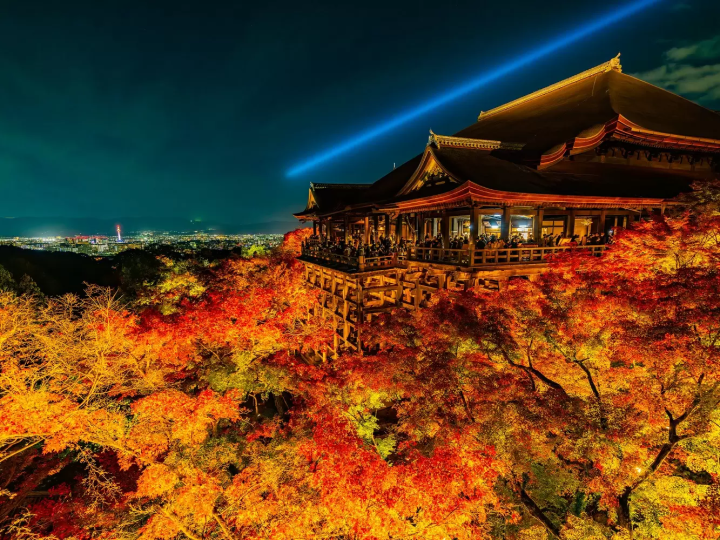
9. Kiyomizu-dera Autumn Night Illumination (November 21–30, 2026)
Location: Kiyomizu-dera Temple, Kyoto
Historical Significance: Founded in 778 CE, Kiyomizu-dera is one of Japan’s most celebrated Buddhist institutions and a UNESCO World Heritage site. Its iconic wooden main hall stage, built entirely without nails over a steep hillside, offers panoramic views of Kyoto framed by cherry blossoms in spring and blazing maples in autumn.
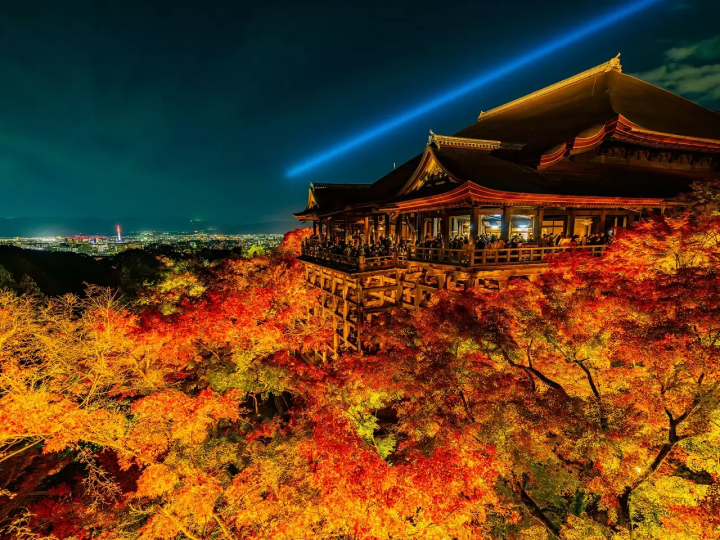
The Experience: The late-November night illumination offers a dramatic visual interpretation of the temple grounds. The wooden stage, the iconic three-story pagoda, and the surrounding ocean of crimson foliage are cast in brilliant light, creating the optical illusion that the temple stage is floating upon a sea of fire. Cutting through the night sky is a sharp, ethereal blue light beam—a striking symbolic representation of the infinite compassion of Kannon, the Bodhisattva of Mercy enshrined within the temple’s inner sanctum.
Logistical Details: Night viewing operates from 17:30 to 21:30 (last admission at 21:00). Admission is 500 yen for adults and 200 yen for elementary and junior high school students.
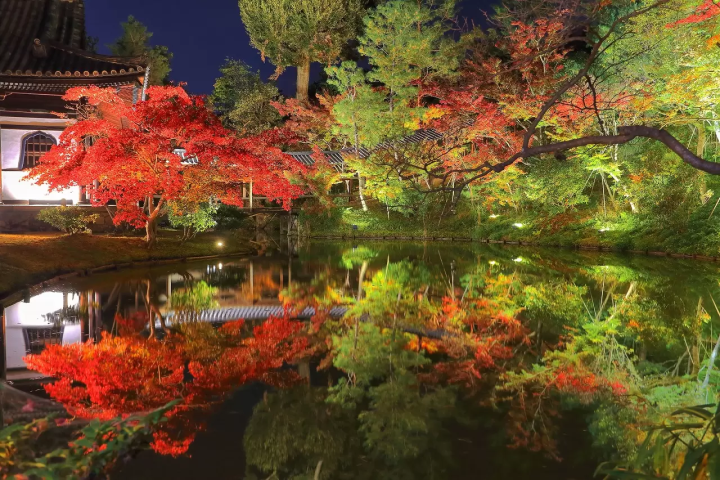
10. Kodaiji Temple Night Light-Up and Projection Mapping (October 23 – December 13, 2026)
Location: Kodaiji Temple, Kyoto
Historical Significance: Established in 1606 by Nene, the influential wife of the unification-era warlord Toyotomi Hideyoshi, Kodaiji is a masterpiece of Momoyama-period temple architecture and garden design.
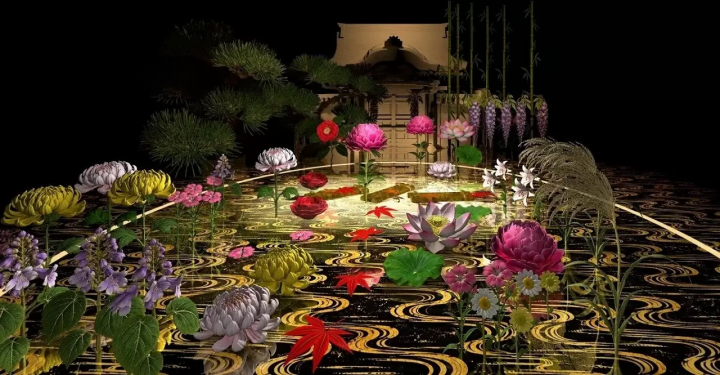
The Experience: Kodaiji excels at blending historic preservation with avant-garde digital artistry. During the autumn viewing window, meticulously sculpted rock gardens and towering bamboo groves glow under ambient illumination, while maple leaves cast intricate reflections across static ponds. The crown jewel of the evening is the temple’s projection mapping show. The 2026 installation, titled Momoyama Ryōran, transforms the Hashin-tei Garden using state-of-the-art digital projection. Drifting golden clouds, vibrant seasonal flora, and rippling water patterns sweep across the historic courtyard, synchronized to an original musical score that bridges classical aesthetics with modern sensory design.
Logistical Details: Night viewings run daily from 17:00 to 22:00 (last entry at 21:30). Admission is 800 yen for adults, 400 yen for junior and senior high school students, and free for elementary-aged children and younger.
Supporting Context & Metrics
The Kansai region’s tourism economy relies heavily on the autumn shoulder season, which serves as a crucial economic counterbalance to the cherry blossom peak in spring. According to regional tourism bureaus in Osaka, Kyoto, Hyogo, and Nara, November consistently ranks as one of the highest-yielding months for hospitality, transit networks, and culinary sectors.
Economic and Logistical Indicators for November 2026:
Foot Traffic Concentration: Prime cultural zones in eastern Kyoto (Gion, Higashiyama, Kiyomizu-dera, Kodaiji) experience daily visitor density spikes of up to 350% above baseline non-peak months, necessitating strict crowd-management protocols by municipal authorities.
Dwell Time Optimization: Night illumination events (such as those at Kiyomizu-dera, Kodaiji, and Katsuoji) have successfully extended visitor expenditure hours well past standard temple operating schedules, driving regional evening dining and hospitality revenue.
Transit Integration: Regional railway operators—including Hankyu Railway, Keihan Electric Railway, Kintetsu Railway, and Osaka Metro—deploy enhanced holiday timetables and integrated digital rail passes to facilitate seamless cross-prefectural transit between Osaka’s urban light festivals and Kyoto’s historic mountain temples.
Official Statements and Institutional Perspectives
Regional tourism authorities and cultural preservation bodies emphasize the delicate balance between international destination marketing and the preservation of sacred heritage sites.
"The November festival calendar in Kansai is not merely a tourism campaign; it is an active celebration of living cultural heritage," notes a representative from the Kyoto Convention & Visitors Bureau. "Whether it is the preservation of Gion Higashi’s 145-year geiko dance lineage or the state-of-the-art projection mapping at Kodaiji, our goal is to invite global travelers to experience how historical reverence and contemporary innovation coexist in modern Japan."
Similarly, municipal planners in Osaka highlight the strategic evolution of urban illumination projects.
"Initiatives like the Midosuji Illumination and the Minoh waterfall soundscapes are designed to redefine how visitors interact with the urban and natural environments," states the Osaka Festival of Lights Executive Committee. "By inviting the public to engage directly with light, motion, and audio-sculpture, we transform familiar public corridors into dynamic, shared cultural spaces."
Future Outlook
Looking toward the remainder of the decade, the autumn festival landscape in Western Japan is poised for continued refinement, driven by sustainable tourism initiatives and advanced digital integration.
As global demand for immersive travel experiences grows, institutions across Kansai are increasingly adopting timed-entry ticketing systems, eco-friendly LED lighting retrofits, and multilingual digital guides to manage crowd density while preserving the contemplative integrity of sacred sites. Future iterations of events like the Rokko Meets Art walk and Kyoto’s temple illuminations are expected to further expand augmented reality (AR) and localized acoustic integration, offering visitors deeper educational insights into the historical strata of Western Japan.
For travelers planning an expedition to Kansai in November 2026, early reservation of accommodations, careful cross-referencing of official ticketing portals, and an openness to blending nocturnal urban light displays with serene daytime mountain pilgrimages will ensure an authoritative, deeply rewarding journey through Japan’s cultural heartland.










Belum ada komentar. Jadilah yang pertama berkomentar!