

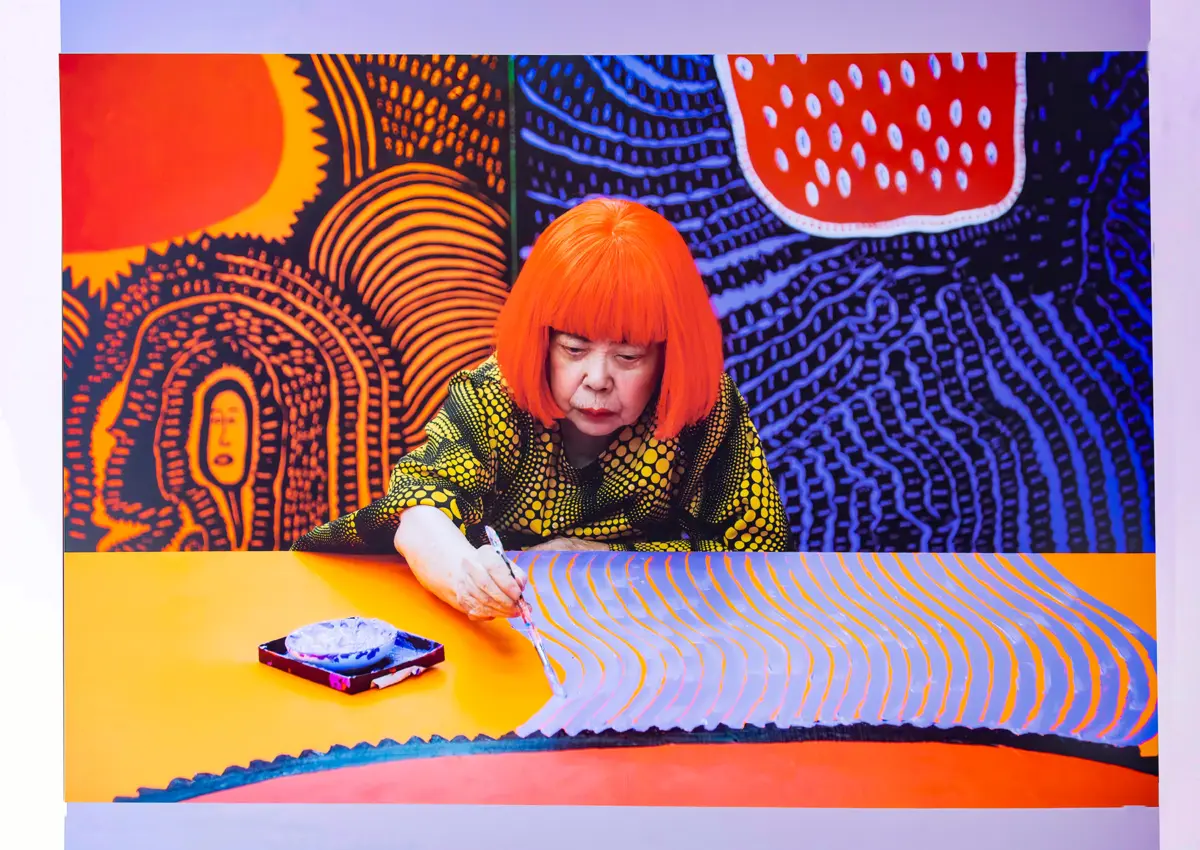
TOKYO — The global art world is mourning the loss of one of its most visionary, influential, and universally recognized luminaries. Yayoi Kusama, the avant-garde pioneer whose mesmerizing polka dots, infinity mirror rooms, and boundless pumpkin installations captivated millions across generations and continents, passed away peacefully on August 14, 2026, at the age of 97.
Kusama’s studio and official representatives confirmed her passing in a solemn announcement released late last month, noting that the legendary artist maintained her commitment to art until her final days. According to close associates, Kusama was actively painting in her studio almost until the very end, embodying a lifetime of relentless artistic production driven by an irrepressible creative compulsion.
Her passing marks the end of an extraordinary era in contemporary art. Over a career spanning nearly eight decades, Kusama defied categorization, effortlessly bridging avant-garde performance art, surrealism, minimalism, pop art, and large-scale immersive installation. Her signature motifs—infinite nets and undulating fields of polka dots—were not merely aesthetic choices, but deeply personal manifestations of her psychological experiences, transforming obsessions into universal symbols of wonder and healing.
Executive Overview: The End of an Infinite Journey
The loss of Yayoi Kusama sends ripples far beyond the borders of Japan, echoing through the halls of major museums, private collections, and public spaces worldwide. Few artists have achieved the rare dual status of being both critical darlings and global pop-culture phenomena. From the streets of Tokyo to New York, London, and Buenos Aires, her works invited viewers to step inside her mind, offering a visceral confrontation with infinity.
Her death at 97 closes a chapter on a life defined by extraordinary resilience. Throughout her decades-long journey, Kusama wrestled with profound personal and mental health challenges, channeling her psychological struggles directly into her creative output. Rather than allowing adversity to silence her, she weaponized her art as a form of therapy, endurance, and survival.
As tributes pour in from international cultural institutions, world leaders, and millions of devoted fans who waited hours in queues just to catch a fleeting glimpse of her mirrored universes, the art world is left to reflect on the immense legacy of a woman who painted the world with boundless imagination.
Detailed Chronology: From Matsumoto to Global Dominance
Early Life and the Genesis of Obsession (1929–1950s)
Born in Matsumoto, Nagano Prefecture, in 1929, Kusama grew up against the backdrop of a strict, conservative family and the turbulent years surrounding World War II. It was during her childhood that she began experiencing vivid hallucinations—visual disturbances where fields of dots and flowers seemed to engulf her surroundings, walls, and own body. To cope with the overwhelming terror of these episodes, she began transferring the visions onto paper and canvas, marking the birth of her lifelong artistic obsession.
Despite facing resistance from her family—who discouraged her artistic ambitions—Kusama studied traditional Japanese painting (Nihonga) in Kyoto. However, feeling constrained by the rigid traditions of the art establishment, she soon set her sights abroad, drawn to the radical artistic freedom of the United States.
The New York Years and Avant-Garde Breakthrough (1957–1973)
In 1957, Kusama made a bold move to New York City, quickly establishing herself as a formidable force in the city’s burgeoning avant-garde scene. Operating alongside contemporaries like Andy Warhol, Donald Judd, and Claes Oldenburg, she pioneered groundbreaking movements in minimalism and pop art.
It was during this period that she introduced her iconic "Infinity Nets"—massive canvases covered in meticulous, hypnotic loops of paint that suggested boundless space—as well as her infamous "soft sculptures," which covered furniture and household objects in phallic fabric protrusions.
Kusama was also a trailblazer in performance art and happenings, frequently staging anti-war demonstrations, body-painting festivals, and fashion events in prominent public spaces like Central Park and the Brooklyn Bridge. Though often overshadowed at the time by her male contemporaries, history has rightfully recast Kusama as a foundational architect of late-20th-century contemporary art.
Return to Japan and Voluntary Institutionalization (1973–1990s)
Facing exhaustion and worsening health, Kusama returned to Japan in 1973. In a courageous and defining decision, she voluntarily checked herself into the Seiwa Hospital for Mental Illness in Tokyo in 1977, where she would reside for the remainder of her life.
Operating out of a dedicated studio nearby, she maintained a grueling, disciplined daily schedule, painting by day and returning to the hospital by night. This period saw her dive deeply into literature, poetry, and sculpture, slowly rebuilding her international profile while maintaining a quiet, monastic lifestyle centered entirely on her craft.
Global Renaissance and the Age of Infinity Rooms (2000s–2026)
The 21st century ushered in an unprecedented global renaissance for Kusama. Propelled by major retrospective exhibitions touring the world’s most prestigious museums, her work struck a profound chord with a new, digitally connected generation.
Her Infinity Mirror Rooms—immersive, mirrored chambers lit by LED lights or glowing lanterns that created an illusion of endless space—became cultural touchstones. Long lines wrapped around blocks outside museums from New York to Singapore, transforming art viewing into an experiential, shared pilgrimage. In 2017, the opening of the Yayoi Kusama Museum in Shinjuku, Tokyo, provided a permanent home dedicated to celebrating her life and continuing influence.
Supporting Context & Metrics: The Scale of Kusama’s Impact
To understand Kusama’s impact is to look at the staggering numbers behind her career:
- Career Span: Nearly 80 years of continuous artistic production.
- Exhibition Reach: Millions of visitors across hundreds of solo and group exhibitions in over 50 countries.
- Auction Records: Kusama holds the record as one of the best-selling living female artists in history, with major paintings fetching tens of millions of dollars at premier auction houses like Christie’s, Sotheby’s, and Phillips.
- Cultural Footprint: High-profile fashion collaborations with luxury houses such as Louis Vuitton introduced her signature polka dots to global retail markets, cementing her status as a bridge between high art and popular culture.
- Literary and Poetic Output: Alongside her visual art, Kusama published numerous volumes of avant-garde poetry, novels, and autobiographical works, establishing herself as a multi-disciplinary literary voice.
Official Statements and Institutional Tributes
Following the announcement of her passing, cultural ministries, museum directors, and fellow artists released heartfelt statements honoring her indelible mark on humanity.
"Yayoi Kusama was a titan of modern art whose courage matched her boundless creativity. She took her deepest personal struggles and transformed them into beacons of light, color, and infinite wonder for the entire world. Her brush may finally be at rest, but her universe will continue to expand forever."
— Representative Statement, Yayoi Kusama Official Site & Studio
Museums worldwide, including the Museum of Modern Art (MoMA) in New York, Tate Modern in London, and the National Art Center in Tokyo, announced plans for commemorative displays and retrospective screenings to honor her memory.
Future Outlook: Preserving an Infinite Legacy
As the art world processes the immense void left by her passing, attention turns immediately to the preservation and continuation of her visionary output. The Yayoi Kusama Museum in Tokyo and the Yayoi Kusama Studio have confirmed that ongoing authentication projects, catalog raisonné publications, and international institutional loans will proceed as planned to ensure future generations can experience her work.
Furthermore, Kusama’s philanthropic efforts and wishes, centered on spreading messages of love, peace, and mental health awareness through art, will be championed by her estate and foundation partners.
Yayoi Kusama leaves behind a world that is undeniably brighter, more colorful, and infinitely more imaginative than the one she entered in 1929. Though she has laid down her paintbrush, the infinite nets she wove across the fabric of contemporary culture will continue to resonate, inspire, and envelop humanity for generations to come.




Belum ada komentar. Jadilah yang pertama berkomentar!