

Executive Overview
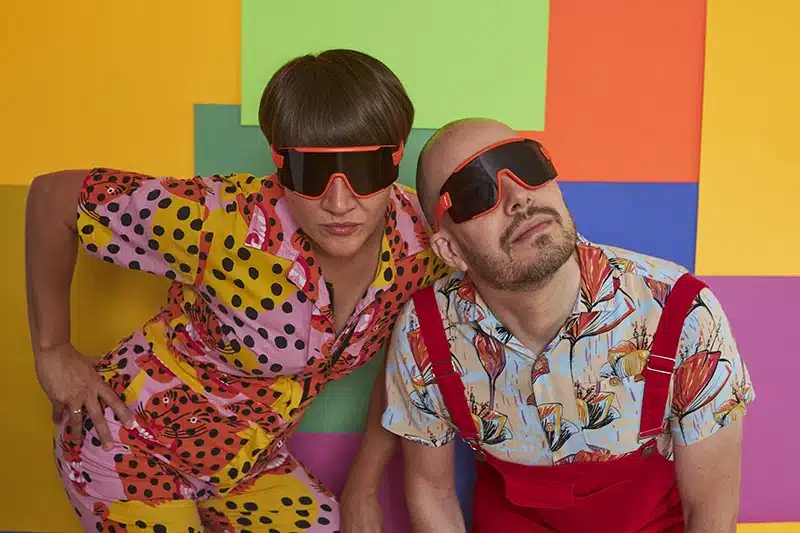
At first glance, the moniker Tönky Hönk and its delightfully irreverent, playfully garish album artwork might lead the casual listener to dismiss the project as a fleeting novelty act. However, beneath this whimsical exterior lies a profound artistic triumph. Tönky Hönk—the avant-garde keyboard duo comprising acclaimed Canadian pianists Madeline Hildebrand and Everett Hopfner—channels its unique, multifaceted instrumental dexterity into The ËP, one of the most unexpectedly moving, deeply textured, and instantly captivating experimental music releases in recent memory.
Rather than relying on the predictable timbres of contemporary digital production, the duo has crafted a deliberate, acoustic-adjacent sonic world. Eschewing synthesizers entirely, Hildebrand and Hopfner dive deep into an eclectic physical arsenal that includes the Fender Rhodes, toy pianos, delicate music boxes, ringing metal bowls, and both conventional and prepared grand pianos. Across this debut release, the duo takes listeners on a boundary-pushing journey through modern contemporary composition, interpreting the challenging works of Adrian Knight, Phyllis Chen, and Julian Beutel.
This analytical review examines the structural architecture of The ËP, tracing the professional lineage of its creators, analyzing its distinct compositions, and exploring its broader implications for the contemporary classical and experimental music landscapes. Through meticulous execution and virtuosic technique, Tönky Hönk successfully bridges the gap between high-art academic rigour and disarming, accessible warmth.
Detailed Chronology & Track Architecture
The narrative arc of The ËP is meticulously planned, operating less like a traditional collection of songs and more as an unfolding sonic installation. The release is anchored and bracketed by the expansive, multi-part compositions of Adrian Knight, while housing the idiosyncratic miniatures of Phyllis Chen and the rhythmic machinery of Julian Beutel in its interior.
Bookending with Knight: The Seven-Part Universe of "Twinlings"
Adrian Knight’s sprawling, multi-part composition "Twinlings" serves as the structural spine of The ËP. The duo splits the piece strategically: the first four parts open the record, setting a meditative, hypnotic tone, while the remaining three parts close out the release, offering a sense of cyclical completion.
From its opening notes, "Twinlings" eschews traditional pyrotechnics in favor of luxurious, deliberately paced chords. Executed on a gently pulsing electric piano—strongly reminiscent of a Fender Rhodes—the notes evoke the warm, open resonance of mallet percussion (such as a marimba or vibraphone) rather than the compressed, static timbres often associated with electric keyboards. There is a breathing quality to the performance; Hildebrand and Hopfner allow space between the chords, letting the natural decay of the instruments bleed into the room acoustics. This creates an immersive, ambient environment that invites the listener into a state of deep, contemplative listening.
Chen’s "Hush": Toys, Gamelan, and Atonal Magic
Moving into the interior of the EP, the listener encounters Phyllis Chen’s compositional contribution, "Hush." If Knight’s "Twinlings" provides a warm, enveloping blanket of sound, Chen’s piece introduces an eccentric, sparkling friction to the record.
The vast majority of "Hush" is performed on a noisy toy piano—an instrument historically relegated to children’s playrooms, yet here elevated to an expressive, high-art vehicle. Chen’s composition introduces sonic traces that closely mimic the shimmering, interlocking textures of an Indonesian gamelan ensemble. The tune expertly straddles the line between the unusual and the exotic, combining a rebellious, clattering physical clank with the pristine, atonal magic of contemporary classical music. The juxtaposition of the toy piano’s inherently limited sonic range with the sophisticated harmonic framework applied by Hildebrand and Hopfner results in a piece that feels simultaneously fragile and ferocious.
Beutel’s "Jam Factory": Mechanical Fervor and Ethereal Drizzle
Julian Beutel’s multi-faceted composition, "Jam Factory," is neatly divided into two distinct sections, each bearing a descriptive subtitle that proves remarkably apt for the listening experience: "[machine: v.21]" and "[rain: v.17]."
- "[machine: v.21]": This section rolls forward with a disciplined, inexorable march tempo. The duo stacks electric and acoustic piano melodies on top of each other in a dense, interlocking polyphonic web. The effect carries a mechanical fervor that directly evokes the minimalist compositional mechanics of Steve Reich. Every note feels synchronized with clockwork precision, driven by a kinetic energy that pulses relentlessly forward.
- "[rain: v.17]": In stark contrast to its mechanical predecessor, the second half of "Jam Factory" adopts a sketchy, desultory, and profoundly ethereal feel. Its overall mood mimics a lazy, contemplative rainy day. A blurry, atmospheric wash of noise in the middle section acts as a sonic cloudburst—a brief, turbulent storm passing quietly amidst an otherwise gentle, persistent drizzle.
Supporting Context & Metrics: The Virtuosos Behind the Keys
To understand the depth of The ËP, one must look closely at the extraordinary academic and performance pedigrees of its creators. Madeline Hildebrand and Everett Hopfner are far from overnight sensations; they are seasoned virtuosos whose careers have been defined by technical precision, fearless experimentation, and deep collaboration with some of the most influential figures in modern music.
| Artist | Notable Achievements & Competitions | Academic Positions | Major Collaborations |
|---|---|---|---|
| Madeline Hildebrand | Past prize winner, Canada’s Eckhardt-Gramatte National Music Competition | Music Faculty, Memorial University (St. John’s, Newfoundland) | Philip Glass, The Kronos Quartet |
| Everett Hopfner | Past prize winner, Canada’s Eckhardt-Gramatte National Music Competition | Former Director, Eckhardt-Gramatte Conservatory of Music (Brandon University) | Philip Glass, The Kronos Quartet |
A Pedigree of Excellence
Both Hildebrand and Hopfner are past prize winners of Canada’s prestigious Eckhardt-Gramatte National Music Competition, an institution renowned for championing contemporary Canadian and international music. Their shared history extends far beyond regional accolades; both have performed alongside legendary contemporary icons such as minimalist pioneer Philip Glass and the trailblazing Kronos Quartet.
This high-level background in contemporary performance informs every artistic choice on The ËP. Their rigorous academic foundations—Hildebrand serving on the Music Faculty at Memorial University in St. John’s, Newfoundland, and Hopfner formerly directing the Eckhardt-Gramatte Conservatory of Music at Brandon University—equip them with the theoretical framework necessary to unpack and elevate challenging modern scores. Yet, rather than retreating into the dry, academic formalism that sometimes plagues contemporary classical music, Tönky Hönk infuses their interpretations with physical joy, theatrical flair, and an unpretentious sense of play.
Official Statements & Artistic Intent
In interviews surrounding the release of The ËP, the duo has been vocal about their mission to dismantle the barriers separating traditional classical audiences from the vibrant world of contemporary composition.
"We wanted to create a space where serious contemporary music could breathe, shed its academic armor, and invite people in not just to analyze, but to feel," the duo noted in a joint project statement. "Using toy pianos, music boxes, and prepared grand pianos isn’t a gimmick—it’s an expansion of our tonal vocabulary. Every instrument, no matter how humble or eccentric, has a voice that deserves to be taken seriously."
This philosophy underpins their deliberate avoidance of synthesizers. While digital synths offer infinite sonic possibilities, Hildebrand and Hopfner deliberately chose the tactile resistance of physical objects. The organic friction of felt hammers striking toy piano metal bars, the rustic twang of music box teeth plucking in real-time, and the wooden resonance of a prepared grand piano provide a human connection that electronic interfaces struggle to replicate. By championing contemporary composers like Knight, Chen, and Beutel through these tactile instruments, Tönky Hönk bridges the gap between the avant-garde avant-text and visceral, living performance.
Future Outlook: The Evolution of Tönky Hönk
As The ËP continues to garner critical acclaim across contemporary music circles, the question turns to what lies ahead for this dynamic duo. The success of their debut proves that there is a thriving, hungry audience for experimental instrumental music that balances intellectual rigor with immediate emotional resonance.
Expanding the Repertoire
Moving forward, Tönky Hönk plans to commission new works specifically tailored to their unique multi-keyboard setup. While The ËP focused on interpreting established contemporary writers, future iterations of the project aim to foster direct collaborations with emerging and established global composers. By expanding their catalogue of bespoke compositions, Hildebrand and Hopfner hope to cement the toy piano, the Fender Rhodes, and the prepared grand piano as a permanent, legitimate chamber ensemble configuration.
Live Performance and Spatial Audio
Translating the intricate tactile soundscapes of The ËP to the live stage presents both a logistical challenge and an artistic opportunity. The duo is currently developing an immersive live concert experience that highlights the physical intimacy of their instruments. By placing the audience in close proximity to the toy pianos, music boxes, and metal bowls—potentially utilizing spatial audio amplification—Tönky Hönk aims to make the physical creation of sound a visual and visceral focal point of their performances.
Conclusion
Ultimately, The ËP is a striking, utterly unique piece of modern music. In an era dominated by digital polish and algorithmic streaming optimization, Madeline Hildebrand and Everett Hopfner have delivered a fiercely independent, proudly idiosyncratic masterclass in keyboard performance. Bringing an oddly comforting warmth, alongside a healthy dose of playful eccentricities, Tönky Hönk has established itself as an essential new voice in contemporary instrumental music—proving that behind the goofy name lies some of the most brilliant, moving musicianship of our time.





Belum ada komentar. Jadilah yang pertama berkomentar!