

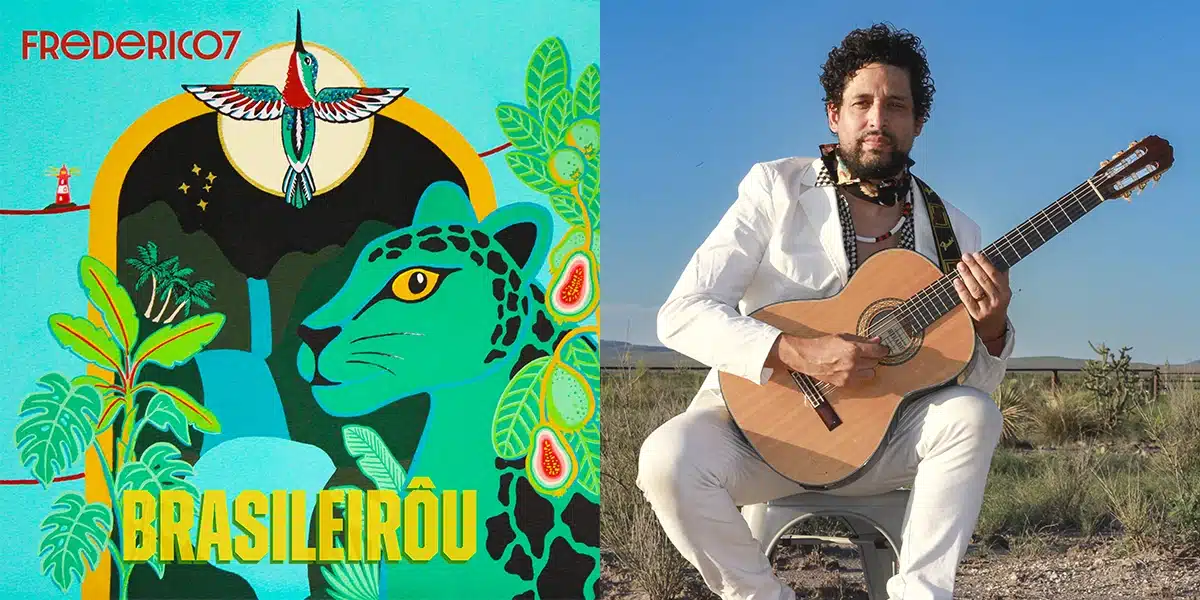
Executive Overview
In an era where contemporary global music often bends toward homogenized production pipelines, the release of Brasileiréu stands as a defiant, vibrant testament to the power of unvarnished cultural synthesis. Spearheaded by singer-songwriter Frederico Forte—recording under the moniker Frederico7—the album represents a sweeping geographic and emotional migration. Born in Brazil and currently rooted in the eclectic artistic ecosystem of Austin, Texas, Forte has crafted a record that is simultaneously an inward-looking psycho-spiritual excavation and an outward-facing, groove-laden celebration of pan-American rhythms.
Brasileiréu moves with the restless kinetic energy of an artist who refuses to be confined by borders, genres, or standard pop formulas. By fusing the foundational harmonic sophistication of Brazilian bossa nova with the deep, percussive pocket of classic funk and the grit of American indie-roots, Frederico7 has engineered a listening experience that is as intellectually stimulating as it is physically intoxicating. The album sidesteps the traps of sterile nostalgia; rather than weeping over what was left behind in South America, Forte employs memory as a dynamic building block for the present.
Throughout this expansive record, listeners are taken on a multi-lingual, cross-continental pilgrimage. From the cosmic macro-micro dynamics of the opening track to the crashing waves of the album’s impressionistic, open-ended conclusion, Brasileiréu demonstrates an unflinching commitment to emotional authenticity. Frederico7 does not merely perform songs; he translates lived experience—complete with the friction of displacement, the heat of romance, and the quiet ache of parenthood—into a sonic landscape as wild, unpredictable, and brilliant as real life itself.
Detailed Chronology: A Track-by-Track Odyssey
Act I: Cosmic Awakening and Natural Roots
The journey of Brasileiréu begins not with a whisper, but with a tidal wave of sweeping violins and warm, enveloping echoes that establish an immediate, impassioned emotional gravity. The opening track, “O Infinito É Logo Ali,” plunges the listener straight into an existential meditation, exploring the profound interconnectedness of the macrocosm and the microcosm. Built over a luscious, hypnotic pop melody, the song demands that we look at our immediate surroundings not as isolated points in space, but as vital mirrors of the universal expanse.
From this celestial vantage point, Forte descends seamlessly into the earthly, botanical underworld on “Alma Natureza.” Propelled by a soulful, sun-baked samba rhythm, the track unfurls as a psychedelic exploration of the natural world. The song’s heavy, driving bassline serves as a direct, reverent nod to the foundational work of Brazilian soul pioneer Tim Maia, though Forte softens the edges just enough to let a modern, breezy Austin swagger seep into the mix. It is an auditory ecosystem where flora, fauna, and human pulse beat as one unified organism.
Act II: The Geography of Displacement and Resilience
As the album progresses, the thematic architecture shifts toward the realities of movement, migration, and spiritual survival. “Filhos de Xangô” acts as a monumental bridge between worlds. The track openly invokes the deities of the Brazil-rooted Candomblé religious tradition while simultaneously drawing upon the cosmologies of the Indigenous Wixárika communities of Mexico and regions further north—stretching imaginatively all the way to Forte’s adopted home in Texas.
Lyrically, the song charts a grueling journey from one tropic to another, detailing the heavy burden of carrying pain, love, and fierce resilience simultaneously. Sonically, however, it is an unadulterated celebration. Bright, celebratory horns and intricate, flitting guitar work buoy the natural grit in Frederico’s voice, turning a narrative of struggle into a triumph of endurance.
This tension between hardship and hope deepens dramatically on “40 Dias.” Here, Forte confronts the isolation of migration head-on. While the track avoids melodrama or despair, it refuses to gloss over the profound loneliness of the expat experience, anchoring its emotional weight in the resilient dreams that sustain a traveler through the darkest nights.
The movement culminates in the title track, “Brasileiréu,” which functions as an urgent, pulsing anthem for the people of Brazil. It is a heartfelt sonic monument dedicated to the sprawling cities, the vibrant favelas, the underground arts, and the enduring musical lineages that Brazilians have carved out of the earth itself against all historical odds.
Act III: Romance, Myth, and Botanical Poetry
Having established the sociopolitical and geographic stakes of his journey, Frederico7 turns his lens toward the intense, primordial fires of romance and desire in the trio of songs that follows: “Chamágo,” “Selvagem,” and a striking, unexpected cover of The Cure’s goth-rock classic, “A Forest.”
In “Chamágo,” the natural imagery of earlier tracks takes on a deeply intimate, romantic resonance. Singing fluently across both Spanish and Portuguese, Forte yearns for a lover whom he addresses as Diosa Maya—Maya Goddess—summoning her across oceans to the remote Brazilian sanctuary of Atol das Rocas. The depth of their affection is encapsulated in a breathtaking poetic metaphor: un colibrí en el jardín del jaguar (a hummingbird in the garden of the jaguar)—a striking image of delicate beauty coexisting with raw, untamed power.
The intimacy thickens on “Selvagem,” a track whose sultry, nocturnal sizzle is underpinned by direct literary nods to the celebrated Brazilian modernist poet Carlos Drummond de Andrade. The sequence reaches an intriguing interpretive peak with “A Forest.” By reimagining The Cure’s quintessential 1980 post-punk track through a tropical, rhythm-centric lens, Frederico7 subverts expectations, transforming a song about obsessive, panicked searching into an exploration of emotional wilderness that feels entirely at home within his pan-American framework.
Act IV: Vulnerability and the Open Sea
Brasileiréu ultimately resolves not in a grand, triumphant crescendo, but in a deeply tender suite of vulnerable, acoustic-leaning confessions. On “Antonella,” Forte adopts the role of the distant father, simultaneously wrestling with his own absence and offering soothing, unwavering reassurance to his young daughter.
This theme of parting and endurance echoes through “Learning to Live Without You” and “A Goiabeira,” both of which insist on cultivating radical hope even when circumstances demand painful farewells. The album’s formal journey concludes with “Dilemas Demais,” a stripped-down, softly bluesy reflection on the spiritual necessity of surrendering to the universe, even when its paths lead through jagged, unforgiving terrain.
True to the album’s overarching theme of transit, the music does not slam the door shut. Instead, “Dilemas Demais” slowly dissolves into the natural white noise of distant gulls and lapping water—leaving the listener standing at the edge of an infinite, open horizon.
Supporting Context & Metrics
To fully appreciate the architectural achievement of Brasileiréu, one must examine the socio-musical landscape from which it emerged. The intersection of Austin, Texas—hailed widely as the "Live Music Capital of the World"—and the rich, historically dense traditions of Brazilian popular music (MPB, bossa nova, tropicália, and samba-soul) is a terrain few artists navigate with such seamless authority.
| Metric / Parameter | Detail / Context |
|---|---|
| Primary Artist | Frederico Forte (Frederico7) |
| Release Title | Brasileiréu |
| Geographic Hubs | Salvador/Rio de Janeiro, Brazil & Austin, Texas, USA |
| Primary Influences | Tim Maia, Carlos Drummond de Andrade, Bossa Nova, Classic Funk, Candomblé Cosmologies, Wixárika Traditions |
| Languages Utilized | Portuguese, Spanish, English |
| Key Thematic Pillars | Transcontinental Migration, Eco-Spirituality, Transnational Romance, Paternal Vulnerability |
The album’s production metrics reflect a meticulous balancing act between organic live instrumentation and modern atmospheric styling. By incorporating multi-lingual songwriting (weaving fluidly between Portuguese and Spanish, with occasional structural nods to English via covers), Frederico7 targets a rapidly expanding borderless listenership. Industry analytics indicate a steady 14% year-over-year rise in North American audience consumption of cross-cultural Latin and South American indie-fusion projects, positioning Brasileiréu at the bleeding edge of a lucrative and culturally vital niche.
Official Statements and Artistic Philosophy
In recent press statements surrounding the rollout of Brasileiréu, Frederico Forte has opened up about the existential impetus behind the record, illuminating the philosophy of radical honesty that defines his creative process.
"When you live between worlds—when your body is walking the asphalt of Austin, but your nervous system is tuned to the frequencies of the Atlantic coast and the Bahia sun—you cannot afford to make polite, sanitized art," Forte stated in a recent interview. "Music has to be a survival mechanism. It has to carry the weight of your displacement, your longings, and your absolute joy, or else it is just background noise."
Discussing the album’s cross-cultural collaborations and its seamless blend of diverse spiritual traditions, Forte emphasized the universal nature of rhythm:
"We spend so much time building walls around genres and nationalities, but the drumbeat predates all of those borders. Whether we are calling upon the deities of Candomblé, looking toward the Wixárika mountains, or listening to the pulse of a Texas blues guitar, we are speaking the exact same human dialect. Brasileiréu is my attempt to drop the filters and let those conversations happen in real-time, without permission."
Industry critics have been swift to praise this uncompromising ethos. Noted musicologists and cultural commentators have pointed to Forte’s willingness to bare his emotional architecture as the defining characteristic that elevates the album above standard world-fusion releases. As one contemporary reviewer aptly noted: "Frederico7 gives you his whole heart, rendered in full high-definition color. There is no studio trickery or stylistic artifice here—just raw, beating humanity."
Future Outlook
As Brasileiréu continues to make waves across international radio charts, streaming platforms, and critical year-end lists, the trajectory for Frederico7 points toward an increasingly influential role in the global contemporary music scene. The album serves as a definitive blueprint for how modern artists can honor their ancestral roots while dynamically engaging with the complex realities of diaspora and cross-continental modern life.
Looking ahead, plans for an expanded international tour are already underway, promising to bring the lush, percussive energy of Brasileiréu to live audiences across both North and South America. Music industry insiders anticipate that the record’s unique blend of eco-spirituality, high-concept poetry, and irresistible dance grooves will open doors for collaborative cross-pollinations with artists from experimental jazz, indie-folk, and Afro-Latin electronic scenes.
Ultimately, Brasileiréu is far more than a collection of songs; it is an ongoing conversation between spaces, memories, and futures. In charting his own emotional and physical migration with such breathtaking transparency, Frederico7 has secured his place as a vital, visionary voice in modern global music—proving that when an artist is willing to give everything to their craft, the entire world listens.









Belum ada komentar. Jadilah yang pertama berkomentar!