While the traditional cinematic landscape is heavily dominated by supernatural entities, masked slashers, and psychological monsters, a distinct and petrol-fueled subgenre has quietly carved out its own legacy: the killer car movie. Unlike human antagonists driven by explicit psychological motives, automotive terrors present an existential paradox. By definition, a motor vehicle is an inanimate object devoid of conscious thought, facial expressions, or complex emotionality. Yet, when placed in the hands of visionary filmmakers, four wheels, a roaring engine, and chassis become instruments of profound, visceral dread.
The mechanics of bringing a vehicular horror film to life are inherently prohibitive. Unlike low-budget indie slashers that rely on rubber masks and prop knives, automotive horror demands tangible, high-risk practical stunts. Real cars must collide, flip, and burn to evoke a genuine sense of peril. The temptation of modern Computer-Generated Imagery (CGI) often threatens the integrity of these films; when weight, speed, and real-world friction are simulated digitally, the stakes dissolve. Consequently, the greatest entries in this subgenre rely on real sheet metal, screaming tires, and heart-pounding stunt work.
This retrospective examines eight foundational pillars of killer car cinema. From Steven Spielberg’s breakthrough television movie to Quentin Tarantino’s grindhouse homage, these films prove that terror doesn’t always wear a human face—sometimes, it takes the form of a polished chrome grille bearing down on you at 90 miles per hour.
1. Duel (1971) — The Birth of Modern Vehicular Dread
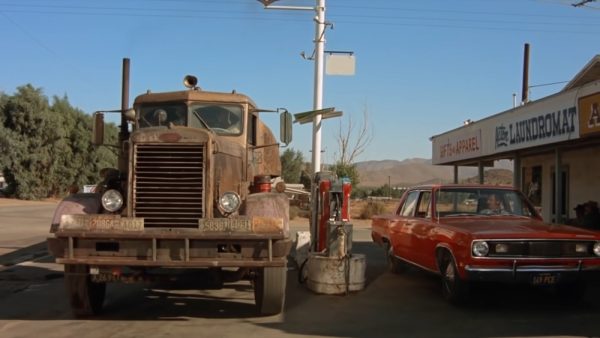
Originally conceived as a humble made-for-television movie for ABC, Duel introduced the world to the directorial genius of a young Steven Spielberg. Adapted from Richard Matheson’s 1971 short story (with the screenplay penned by Matheson himself), the film embraces a devastatingly simple premise: David Mann (Dennis Weaver), a mild-mannered businessman driving a red Plymouth Valiant across the sun-scorched Mojave Desert, finds himself ruthlessly stalked by a battered, rust-streaked Peterbilt 281 tanker truck.
Spielberg understood that the true power of the antagonist lay in total anonymity. The truck driver’s face is never shown, transforming the massive vehicle into an unstoppable, faceless force of nature. There are no convoluted backstories or explanatory monologues about motives; the truck attacks simply because it is there. As the narrative progresses, Weaver’s performance shifts masterfully from passive confusion to desperate survivalism, setting a masterclass template for tension-building that continues to influence thriller directors today.
2. The Car (1977) — The Occult on Four Wheels
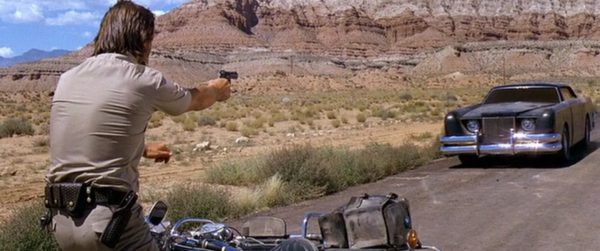
Following the massive success of Jaws, Hollywood quickly searched for fresh ways to terrorize audiences using non-human predators. Enter The Car (1977), directed by television veteran Elliot Silverstein. Substituting the open ocean for a quiet desert town in Utah, the film features a sleek, heavily tinted black 1971 Lincoln Continental Mark III that operates with an apparent demonic consciousness.
Starring James Brolin as Chief Deputy Wade Parent, The Car leans into supernatural territory, implying that the vehicle itself is a vessel for pure evil. While the premise borders on the absurd, Silverstein anchors the film with a surprisingly strong supporting cast (including Ronny Cox) and self-aware B-movie sensibilities. Though largely overlooked during its initial theatrical run, The Car secured its status as a midnight-movie cult classic through VHS distribution and late-night television airings.
3. Christine (1983) — Stephen King’s Jealous Masterpiece
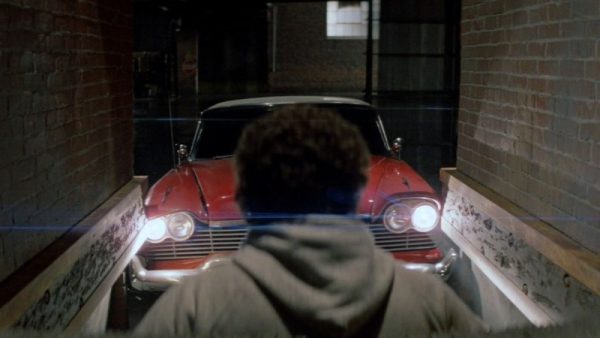
Based on Stephen King’s chilling 1983 novel, Christine centers on a cherry-red and colonial-white 1958 Plymouth Fury with a possessive, murderous personality. When nerdy, bullied teenager Arnie Cunningham (Keith Gordon) purchases the dilapidated classic, he falls under its dark spell, undergoing a chilling psychological transformation that mirrors the car’s murderous restoration.
Director John Carpenter approached the material with the atmospheric restraint of a psychological masterwork. Eschewing the complex backstory of the car’s original owner found in the book, Carpenter framed Christine as a primordial, malignant force. The film is also an incredible technical achievement, famous for its pre-CGI regeneration scenes. Utilizing a combination of internal hydraulics, hidden wire rigs, and reverse cinematography, the crew made the battered car miraculously heal itself on screen, capturing the horrifying illusion of metallic life.
4. Maximum Overdrive (1986) — When Machines Rebel
Stepping behind the camera for the first and only time, horror icon Stephen King attempted to bring his short story "Trucks" to the big screen. The result was Maximum Overdrive, a chaotic, high-energy sci-fi horror in which a passing comet Earth’s orbit causes all machinery—from arcade games and electric carving knives to massive semi-trucks—to turn against humanity.
The production was famously plagued by real-world disasters, including an on-set accident that left cinematographer Armando Nannuzzi without his right eye, and poor box office returns that crippled its $9 million budget. Yet, Maximum Overdrive has endured as a treasured cult classic. Highlighted by the iconic Western Star 4800 truck bearing a massive Green Goblin face on its grille, and propelled by a blistering hard-rock soundtrack by AC/DC, the film stands as an uninhibited, pedal-to-the-metal exercise in pure, guilty-pleasure chaos.
5. Wheels of Terror (1990) — Arizona’s Hidden Slasher
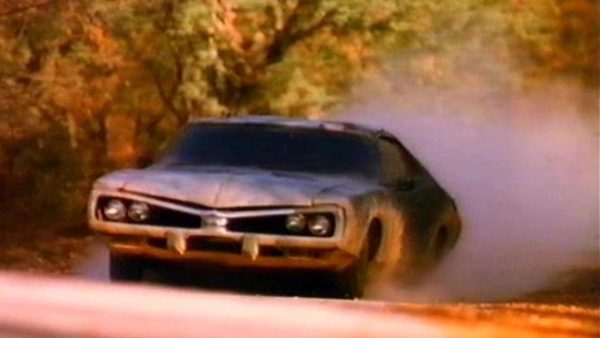
Directed by Christopher Cain (Young Guns), Wheels of Terror is a largely forgotten cable-television gem that infuses the killer-car subgenre with classic slasher tropes. Set in the desolate expanses of Copper Valley, Arizona, the film follows a souped-up, matte-black 1974 Dodge Charger that ruthlessly hunts down local children.
Co-written by Alan B. McElroy (Halloween 4: The Return of Michael Myers), the film maintains a lean, propulsive 85-minute runtime. Much like Duel, the driver remains completely unseen, heightening the eerie mystique. The climax features a harrowing, extended high-speed showdown between the muscle car and a school bus, demonstrating exceptional practical stunt choreography that utilizes the punishing Arizona desert landscape to evoke palpable dread.
6. Highwaymen (2004) — Cyborgs and Muscle Cars
Robert Harmon, director of the seminal 1986 thriller The Hitcher, returned to the asphalt highway with Highwaymen (2004). The film introduces one of the subgenre’s most disturbing antagonists: Fargo (Colm Feore), a mutilated, cyborg-like serial killer who operates a pepper-green 1972 Cadillac Fleetwood Eldorado coupe. Fargo’s perverse obsession is the thrill of vehicular carnage, echoing the automotive fetishism found in J.G. Ballard’s controversial novel Crash.
Starring Jim Caviezel as a grieving husband on a relentless path of vengeance, Highwaymen suffers from studio interference that trimmed its runtime following rocky test screenings. Nevertheless, the tightened 80-minute cut retains a relentless, hard-edged momentum. Harmon’s keen eye for tension ensures that the practical car stunts pack a brutal, visceral punch.
7. Joy Ride (2001) — The CB Radio Cat-and-Mouse
Co-written by J.J. Abrams and directed by John Dahl, Joy Ride (2001) shifts the focus from a possessed machine to a terrifying human operating an intimidating vehicle. Brothers Lewis (Paul Walker) and Fuller (Steve Zahn) embark on a cross-country road trip, pulling a cruel prank via CB radio on an elusive trucker known only as "Rusty Nail."
Voiced with gravelly menace by Ted Levine (Buffalo Bill from The Silence of the Lambs), Rusty Nail turns out to be a dangerous psychopath who weaponizes his massive 1985 Peterbilt 359 semi-truck. Dahl draws heavily upon his mastery of neo-noir and road thrillers (Red Rock West), turning the empty highways of the American West into a claustrophobic trap. The film’s success cemented its place in modern horror history, spawning two sequels.
8. Death Proof (2007) — Tarantino’s Grindhouse Ode
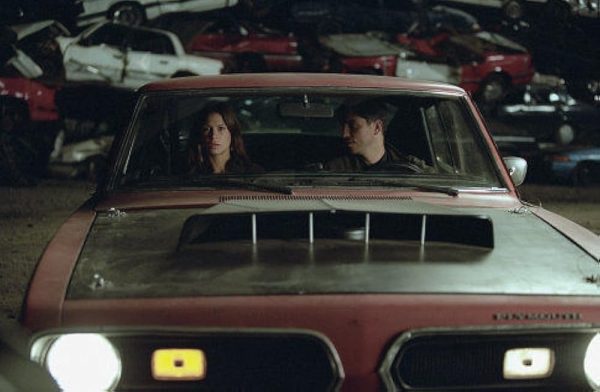
Quentin Tarantino injected high-octane grindhouse energy into the subgenre with Death Proof (2007). Kurt Russell stars as Stuntman Mike, a misogynistic sociopath who uses his specially modified, "death-proof" stunt cars—a 1970 Chevrolet Chevy II Nova and a 1969 Dodge Charger—to stalk and murder unsuspecting women on California highways.
Tarantino subverts traditional slasher plotting by dedicating the film’s first half to slow-burn, dialogue-heavy character building. However, the second half explodes into kinetic action, anchored by legendary stuntwoman Zoe Bell (playing herself/an iteration of her profession), who famously clings to the hood of a speeding Dodge Challenger. Captured entirely on location with zero digital assistance, the vehicular showdown stands as one of the greatest practical stunt sequences in action-horror history.
Supporting Context & Metrics: The Economics of Automotive Horror
Producing a killer car feature requires a distinct set of logistical and financial hurdles that separate it from standard horror filmmaking. An analysis of historical production metrics highlights why this subgenre remains relatively rare:
Stunt and Insurance Costs: Practical vehicular stunts require specialized closed-road permits, precision drivers, and comprehensive safety infrastructure. Insurance premiums for films involving high-speed collisions and rolling vehicles routinely consume substantial portions of indie budgets.
Vehicle Acquisition & Modification: Replicating vehicles like the 1958 Plymouth Fury (Christine) or sourcing multiple vintage muscle cars (such as the Dodge Chargers in Death Proof and Wheels of Terror) requires deep financial investment and automotive restoration expertise. Most productions require "stunt doubles"—multiple identical cars outfitted with reinforced roll cages and modified suspensions to handle brutal crash sequences.
Box Office Viability: Historically, killer car films have experienced mixed box office returns upon initial release, often finding their true financial and cultural longevity through home media, VHS rental culture, and late-night television syndication.
Official Statements and Industry Insights
Reflecting on the unique challenges of directing vehicular terror, legendary filmmaker John Carpenter noted during the press tour for Christine:
"When you work with human actors, you direct performance. When you work with a car like a ’58 Plymouth, you have to direct presence. The machine has to feel heavy, deliberate, and entirely unsympathetic. You cannot reason with sheet metal."
Stunt coordinator and actress Zoe Bell emphasized the necessity of authenticity during the production of Quentin Tarantino’s Death Proof:
"Audiences have a built-in radar for CGI. They can smell fakeness instantly. When you see a body bouncing off the hood of a muscle car at 70 miles per hour in our movie, that’s real asphalt, real speed, and real physics. That’s what makes your stomach drop."
Future Outlook: The Road Ahead for Automotive Horror
As cinema continues to evolve through technological advancements, the killer car subgenre faces a fascinating crossroad. On one hand, the ubiquity of CGI threatens to dilute the tactile, grease-stained realism that defined classics like Duel and Christine. On the other hand, a modern resurgence in practical filmmaking—spurred by audience fatigue with digital effects—has sparked renewed interest in analog stunt work.
Furthermore, as the automotive industry transitions toward electric vehicles (EVs) and autonomous driving technology, the thematic landscape for automotive horror is ripe for reinvention. Future storytellers have an unprecedented sandbox to explore: silent electric motors sneaking up without a warning roar, or rogue artificial intelligence systems hijacking smart-cars.
Yet, regardless of whether the antagonist is a rusted 1970s diesel tanker or a sentient futuristic sedan, the core appeal of the killer car movie remains unchanged. It taps into our primal fear of losing control while hurtling down an open highway at terminal velocity, proving that humanity’s greatest modern invention can easily become our most terrifying executioner.









Belum ada komentar. Jadilah yang pertama berkomentar!