

Nestled in the northwestern reaches of Gunma Prefecture lies Nakanojo Town, a geographic masterpiece characterized by an extraordinary topographical range. Stretching from an altitude of roughly 300 meters to nearly 2,000 meters above sea level, the municipality serves as a microcosm of Japan’s varied highland topography. This dramatic shift in elevation produces a rare climatic phenomenon: an extended autumn foliage season that unfurls across the landscape for approximately two months, beginning in late September and persisting through late November.
![[Gunma, Nakanojo] Shima Blue and the hidden autumn scenery! A tour of spectacular autumn foliage spots](https://resources.matcha-jp.com/resize/720x2000/2026/08/27-269740.webp)
For travelers and landscape enthusiasts alike, Nakanojo presents an immersive visual narrative. The region is defined by a striking chromatic interplay between the fiery hues of changing deciduous canopies and the ethereal, mineral-rich waters of its cobalt-blue lakes—most notably encapsulated by the legendary "Shima Blue." Far from a transient seasonal attraction, Nakanojo’s autumn transformation is a deeply layered ecological event. It encompasses Ramsar Convention wetlands, historic volcanic mountain passes, national natural monuments, and centuries-old therapeutic hot spring (onsen) resorts. This comprehensive guide details the chronologies, topographies, culinary traditions, and infrastructural access points that define Nakanojo Town’s premier autumn destination experience.
![[Gunma, Nakanojo] Shima Blue and the hidden autumn scenery! A tour of spectacular autumn foliage spots](https://resources.matcha-jp.com/resize/720x2000/2026/08/25-269535.webp)
Detailed Chronology of Foliage Progression (Late September to Mid-November)
Because Nakanojo Town’s elevation varies so drastically, the transition from summer green to autumn brilliance does not happen all at once. Instead, the landscape transforms in a rolling cascade, descending from the high-altitude mountain passes down to the river valleys and hot spring towns over an eight-week window.
![[Gunma, Nakanojo] Shima Blue and the hidden autumn scenery! A tour of spectacular autumn foliage spots](https://place.matcha-jp.com/resize/200x2000/2025/01/21-14-30-14-2834f7a325bab904baf3fca47baa66dcf417.webp)
Phase 1: High-Altitude Summits and Wetlands (Late September to Early October)
The autumn transition officially commences at the highest elevations of the town, where alpine flora reacts swiftly to the crisp mountain air.
![[Gunma, Nakanojo] Shima Blue and the hidden autumn scenery! A tour of spectacular autumn foliage spots](https://resources.matcha-jp.com/resize/720x2000/2025/08/15-241367.webp)
- Lake Nozori (Altitude: 1,500m): Often poetically referred to as the "Lake in the Sky," Lake Nozori is the vanguard of Nakanojo’s autumn season. By late September, the surrounding mountain ridges begin to flush with red and gold, creating a vivid contrast against the mirror-like, deep blue surface of the dam lake. Visitors exploring the surrounding hiking trails experience an early, pristine taste of crisp alpine autumn.
- Yoshigadaira Marshland: Registered under the Ramsar Convention in May 2015, this high-altitude wetland ecosystem transforms dramatically as its native rowan trees burn red and local birch colonies turn brilliant gold. Situated near the Shibu Pass, the marshland can be accessed via an intensive 90-minute trek or appreciated from afar near the monument marking the "highest point on a Japanese national highway," where the landscape unfolds below like an intricate botanical diorama.
Phase 2: Volcanic Valleys and Moss Sanctuaries (Mid-October)
As October matures, the wave of vibrant color dips slightly down the mountainsides, illuminating unique geological formations and dense forest canopies.
![[Gunma, Nakanojo] Shima Blue and the hidden autumn scenery! A tour of spectacular autumn foliage spots](https://place.matcha-jp.com/resize/200x2000/2025/01/20-11-31-30-283486e0e09ddeced1c3cf09454bf547ecba.webp)
- Chatsubomigoke Park: Designated as a national natural monument, this area is home to one of East Asia’s largest colonies of Chatsubomigoke (acid-water moss). Thriving exclusively in environments fed by highly acidic mineral springs, the vivid green carpets of moss are starkly contrasted by the surrounding deciduous trees, which erupt into fiery reds and deep yellows by mid-October.
- Shirasuna Valley and National Route 292: Following the curves of National Route 292, the Shirasuna Valley offers an exceptional driving experience. The emerald-green streams cut through steep gorges framed by layered cliffs, where nature has painted a seamless color gradation of autumn foliage. The route naturally guides motorists and cyclists through historical waypoints such as the Akaiwa district, the former Oshi Station, and the cascading waters of Oozen Falls.
Phase 3: Mountain Passes and Forest Canopies (Late October)
By late October, the chromatic wave reaches the mid-level mountain passes and expansive forested slopes, offering serene environments for quiet contemplation.
![[Gunma, Nakanojo] Shima Blue and the hidden autumn scenery! A tour of spectacular autumn foliage spots](https://resources.matcha-jp.com/resize/720x2000/2026/08/27-269749.webp)
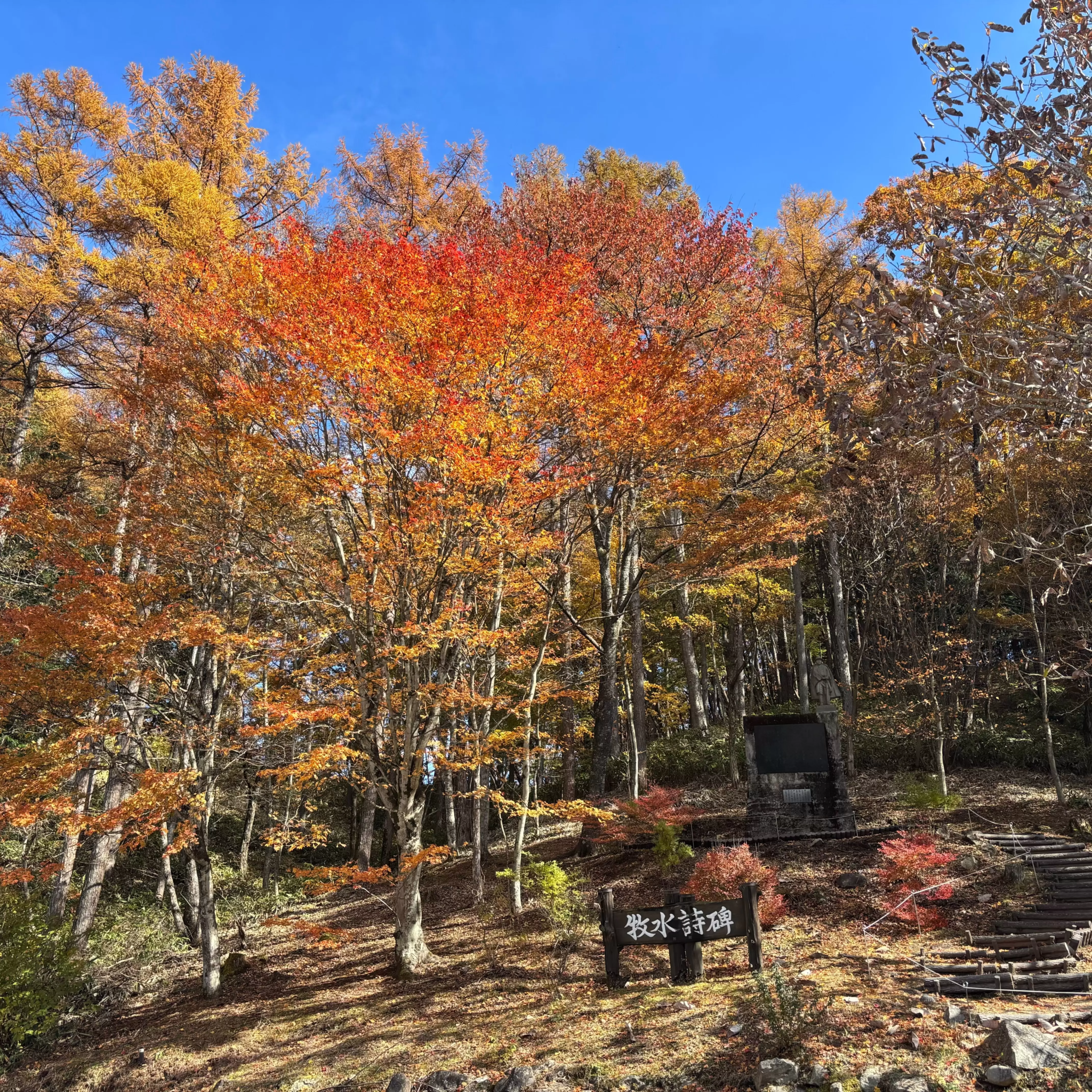
- Historic Mountain Passes: Quiet mountain passes—historically immortalized by renowned Japanese poets such as Wakayama Bokusui—undergo a profound transformation in late October. The dense larch forests lining these high-altitude roads ignite in brilliant shades of amber and gold. Driving or walking through these corridors offers a tranquil sensory experience, where filtered sunlight pierces through a dense, glowing canopy.
- Lake Okushima: Located at the deep interior of the Shima Onsen valley, Lake Okushima is a premier destination for witnessing "Shima Blue." Created by the Shima River Dam, the 4-kilometer circumference lake features water of a miraculous, shifting cobalt and emerald hue. When paired with the surrounding autumn foliage from mid-October to early November, the scene offers an almost surreal visual dynamism that shifts continuously with the angle of the autumn sun.
Phase 4: Hot Spring Resort Towns and River Valleys (Early to Mid-November)
The grand finale of Nakanojo’s autumn season unfolds in November, settling comfortably into the low-lying river valleys and historic hot spring districts.
![[Gunma, Nakanojo] Shima Blue and the hidden autumn scenery! A tour of spectacular autumn foliage spots](https://place.matcha-jp.com/resize/200x2000/2025/01/07-14-08-08-2834c3be61374a312143b8b0ac55e7e51772.webp)
- Shima Onsen Town: Stretching along the crystal-clear currents of the Shima River, the historic hot spring town becomes completely enveloped by yellow and red foliage. Visitors can listen to the gentle murmur of the river while navigating retro streets, soaking in outdoor footbaths (ashi-yu), or relaxing in open-air hot spring baths (rotenburo) that offer direct views of the vibrant canopy overhead.
- Mount Takeyama: Acting as a spiritual and geographic sentinel for the town, Mount Takeyama provides a dramatic backdrop at the close of the season. Viewed from the base at "Michi-no-Eki Mount Reizan Takeyama," the rugged, ancient rock faces of the sacred mountain rise sharply behind forests ablaze with late-autumn colors, providing an inspiring conclusion to the town’s seasonal cycle.
Supporting Context & Metrics
To fully understand the geographical and ecological scope of Nakanojo Town during the autumn tourism window, several vital metrics and contextual frameworks must be considered:
![[Gunma, Nakanojo] Shima Blue and the hidden autumn scenery! A tour of spectacular autumn foliage spots](https://resources.matcha-jp.com/resize/720x2000/2026/08/27-269750.webp)
- Elevation Span: ~300 meters to nearly 2,000 meters above sea level. This ~1,700-meter vertical drop is the primary mechanical driver behind the prolonged, two-month foliage window.
- Climatic Timeline: The season reliably initiates in late September at alpine elevations (such as Lake Nozori at 1,500m) and concludes by mid-November within the lower valley onsen settlements (such as Shima Onsen).
- Ecological Designations:
- Yoshigadaira Marshland: Designated as a Wetland of International Importance under the Ramsar Convention in May 2015, preserving fragile habitats including colonies of cotton grass and diverse alpine flora (iketō ponds).
- Chatsubomigoke Park: Recognized as a National Natural Monument due to hosting the largest contiguous colony of acid-tolerant Chatsubomigoke moss in East Asia.
- Hydrological Phenomena ("Shima Blue"): Lake Okushima and the Shima River display a distinct cobalt-to-emerald coloration. Scientific analyses attribute this phenomenon to high transparency, which maximizes light scattering, combined with microscopic mineral suspensions originating from local volcanic mineral springs. The coloration is particularly pronounced during periods of snowmelt (April–May) and under direct morning sunlight in autumn.
- Recreational Infrastructure: Nakanojo features extensive municipal support for eco-tourism, including designated e-bike rental routes connecting the Shima Onsen district to Lake Okushima, well-maintained hiking networks around Mount Takeyama, and strategically positioned roadside stations (Michi-no-Eki) acting as logistical hubs for travelers.
Official Statements & Regional Insights
Local tourism authorities and municipal administrators emphasize that Nakanojo’s primary strength lies in its ability to offer a diversified, multi-tiered travel experience that prevents overcrowding while maximizing seasonal appreciation.
![[Gunma, Nakanojo] Shima Blue and the hidden autumn scenery! A tour of spectacular autumn foliage spots](https://resources.matcha-jp.com/resize/720x2000/2026/08/27-269753.webp)
"The unique topography of Nakanojo Town allows us to offer something truly rare in Japanese tourism: an autumn season that breathes and evolves over the course of sixty days," notes a regional tourism promotion representative. "A visitor can stand amidst the high-altitude alpine grasses of Yoshigadaira in September, witness the moss-covered volcanic springs of Chatsubomigoke in October, and finally unwind in the steamy, crimson-framed mineral baths of Shima Onsen in November. Every two weeks offers an entirely different destination within the same municipal borders."
![[Gunma, Nakanojo] Shima Blue and the hidden autumn scenery! A tour of spectacular autumn foliage spots](https://resources.matcha-jp.com/resize/720x2000/2026/08/27-269751.webp)
Furthermore, agricultural and culinary stakeholders highlight the integration of seasonal harvests into the travel itinerary. "Autumn in Nakanojo is not merely a visual feast; it is an integrated sensory experience," explains a representative from the Michi-no-Eki Mount Reizan Takeyama administration. "The arrival of the foliage coincides precisely with the harvest of shin-soba (new buckwheat noodles) and the peak ripening of high-altitude apples along our mountain roads. By coupling our natural landscapes with fresh, locally sourced gastronomy, we provide a holistic journey that honors the traditions of our rural heritage."
![[Gunma, Nakanojo] Shima Blue and the hidden autumn scenery! A tour of spectacular autumn foliage spots](https://resources.matcha-jp.com/resize/720x2000/2025/08/14-241251.webp)
Future Outlook & Traveler Recommendations
As global travel trends increasingly lean toward sustainable, slow-paced tourism and regional exploration, Nakanojo Town is well-positioned to attract discerning travelers seeking authentic Japanese landscapes away from metropolitan hubs. Future municipal initiatives are expected to further enhance eco-friendly mobility options—such as expanding e-charging stations for rental bicycles and improving shuttle services to remote trailheads like Lake Nozori and Chatsubomigoke Park—to preserve fragile ecosystems while accommodating growing tourist interest.
Essential Travel Recommendations for Visitors:
- Timing Your Visit: To experience alpine autumn, plan your itinerary between late September and early October. For the classic combination of hot springs and fiery valley foliage, target late October to mid-November.
- Transportation Strategy: While driving via National Route 292 offers unmatched access to scenic vistas, valleys, and mountain passes, eco-conscious travelers are encouraged to utilize rental e-bikes when navigating between Shima Onsen and Lake Okushima to fully absorb the crisp air and river sounds.
- Culinary Exploration: Do not miss the opportunity to sample authentic shin-soba noodles paired with wild vegetable tempura at local establishments during October and November, and take time to visit roadside apple orchards along the routes leading to Shima and Sawatari Onsens.
- Post-Excursion Wellness: Capitalize on Nakanojo’s rich geothermal heritage. Conclude rigorous treks through high-altitude marshlands or lake loops with a restorative soak in the therapeutic, mineral-rich waters of Shima Onsen, Sawatari Onsen, or the unique riverbed-fed springs of Shiriyaki Onsen.








Belum ada komentar. Jadilah yang pertama berkomentar!