

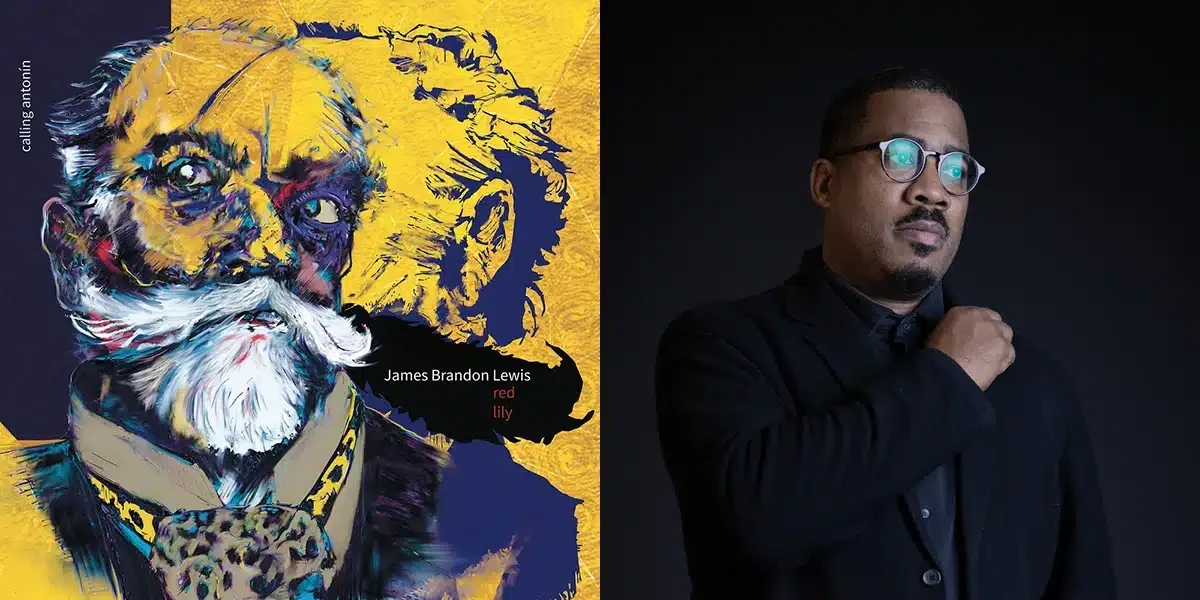
Tenor saxophonist, composer, and conceptual visionary James Brandon Lewis stands as one of the most relentlessly inventive and prolific forces in contemporary creative music. Operating across multiple sonic ecosystems, Lewis maintains an astonishing pace of production. His core quartet—anchored by a traditional piano, bass, and drums rhythm section—delivers incisive statements nearly every year. Simultaneously, he has forged vital collaborative space outside his own leadership banners, notably through standout guest releases with The Messthetics, the dynamic Washington, D.C.-based punk-jazz trio featuring guitar virtuoso Anthony Pirog.
Yet, it is his work with the Red Lily Quintet that represents his most idiosyncratic, conceptually daring, and historically resonant undertaking. Originally conceived as an exploratory vehicle, this expanded ensemble tackled the agricultural and socio-political legacy of George Washington Carver on the widely acclaimed 2021 release Jesup Wagon. They followed this triumph in 2023 with For Mahalia with Love, a profound sonic meditation on the spiritual and cultural imprint of gospel icon Mahalia Jackson.
Now, with the addition of a violin to the ensemble’s acoustic palette, the Red Lily Band has returned with Calling Antonín. This ambitious nine-composition suite addresses the complex musical legacy of Czech composer Antonín Dvořák in America. Rather than yielding to pastiche or academic exercise, Lewis and his collaborators bridge the gap between European classical infrastructure and the deep-rooted soil of American folk, spirituals, and avant-garde jazz. The result is a vibrant, emotionally exposed masterwork that cements Lewis’s status as a vital curator of historical memory and a vanguard practitioner of modern improvised music.
Detailed Chronology: Tracing the Dvořák-to-Coltrane Continuum
To understand the architecture of Calling Antonín, one must trace a historical lineage that spans more than a century. Between 1892 and 1895, Antonín Dvořák lived and worked in the United States, serving as the director of the National Conservatory of Music in New York. During this tenure, he famously premiered his Symphony No. 9 in E minor, "From the New World," at Carnegie Hall. Recognizing the burgeoning identity of American culture, Dvořák made a prophetic observation: he declared that American composers could only forge a truly original national music by turning to the indigenous folk melodies of Black and Native Americans, mirroring how he had leveraged the folk idioms of his native Bohemia. During his time at the conservatory, Dvořák hired Harry T. Burleigh, a pioneering African-American baritone and composer, who introduced him to the profound emotional architecture of the spiritual.
The thread of this legacy did not end in the 19th century. Bassist William Parker eventually drew James Brandon Lewis into composing for the Czechoslovak-American Marionette Theater Company. Through this theatrical collaboration, Lewis discovered that Dvořák’s ideological baton had been passed down through jazz royalty like Duke Ellington and modernist titan Leonard Bernstein.
Lewis seized this historical thread, transforming it into the conceptual foundation for Calling Antonín. The chronology of the project’s creation reveals a meticulous synthesis of archival research and spontaneous composition. Working with his expanded Red Lily roster—featuring cornetist Kirk Knuffke, cellist Tomeka Reid, violinist Melanie Dyer, bassist Joshua Abrams, and drummer Chad Taylor—Lewis spent months sketching frameworks that honored Dvořák’s vision without sacrificing the unbridled freedom of modern jazz.
The chronology of the album’s emotional arc unfolds through distinct compositional phases:
- The Chamber-Jazz Threshold: Tracks like "Spirit of the Living God" initiate the program with through-composed, classically inflected string sections before breaking into rhythmic grooves.
- The Interwar and Mid-Century Modern Synthesis: Pieces like "Dilemma of the Hearts" evoke the harmonic economy and blues-soaked swing associated with Charles Mingus and Duke Ellington.
- The Avant-Garde Climax: Tracks such as "I Want Jesus to Walk With Me" channel the explosive, spiritualized free-jazz eruptions of John Coltrane’s Ascension era.
- The Confessional Denouement: The album concludes with elegiac, stripped-down reflections, culminating in "O’ Rebicku," which leaves the ensemble in a state of naked, unaccompanied communion.
Supporting Context & Metrics: Instrumentation, Lineage, and Structural Analysis
Calling Antonín thrives on a deliberate tension between formal composition and anarchic freedom. While the inclusion of a string trio—violinist Melanie Dyer, cellist Tomeka Reid, and bassist Joshua Abrams—suggests the trappings of a European chamber ensemble, the music resolutely rejects academic stiffness. The ensemble channels the jazz improvisation, polyrhythm, and American folk forms that defined Red Lily’s early recordings, deepening Lewis’s lifelong dialogue with masters such as Duke Ellington, Charles Mingus, and John Coltrane.
Track-by-Track Structural Breakdown
- "Spirit of the Living God": The album opens with an austere, common-time dialogue where violin, cello, and bass bow in unison alongside the horns. For two full minutes, the arrangement plays out with classical precision before a triple-meter groove kicks in, setting off a chain of improvisations from cornet, violin, and tenor saxophone.
- "I Want Jesus to Walk With Me": This track acts as a direct stylistic descendant of Coltrane’s late-period spiritual explorations. Lewis states the primary gospel theme above a turbulent rhythmic sea engineered by drummer Chad Taylor, whose pulse refuses to lock into a straight-ahead tempo. Kirk Knuffke’s loose cornet counterpoint and the strings’ bowed grumbles compress the ecstatic chaos of Ascension into a tight, five-minute crucible.
- "Calling Antonín": The title track opens with chamber-like string textures in 4/4 before Abrams and Taylor pivot into a buoyant 5/4 groove. Lewis and Knuffke trade playful counterpoint on saxophone and cornet, while the re-introduced strings provide warm, harmonic padding reminiscent of a guitar or piano.
- "Ode to P.L.D.": Dedicated to poet Paul Laurence Dunbar, this piece introduces a layer of wordless, harmonized singing. A rising three-note theme contrasts with a playful horn counter-melody before shifting into a yearning second theme. This structural movement culminates in a breathtaking moment of collective improvisation where all six members invent simultaneously, maintaining pristine harmonic balance before fading out as Lewis reads the closing lines of Dunbar’s poem, "The Colored Soldiers."
- "Finale – Humoresque" & "O’ Rebicku": The album’s emotional core anchors its final moments. "Humoresque" transitions from a collective vocal shout into a tender, unaccompanied tenor saxophone improvisation. The final track, "O’ Rebicku," features the entire band rendering a plainsong in unison, allowing each melodic instrument to voice a confessional, deeply honest statement of feeling.
Official Statements and Artistic Philosophy
James Brandon Lewis has consistently articulated an artistic philosophy rooted in empathy, historical continuity, and emotional directness. Discussing his approach to the diverse musical environments he navigates—from his classic piano-trio quartet to his sonic explorations with The Messthetics and the Red Lily Band—Lewis emphasizes the importance of authenticity over stylistic policing.
"When I work with the quartet, I am stepping into a classic lineage, daring listeners to draw lines to Coltrane, David Murray, or David S. Ware, but my goal is ultimately just to be myself," Lewis notes in reflections on his creative process. "When I join The Messthetics, I don’t flinch at being the ‘jazz guy’ entering a punk-infused space from a different angle. With Red Lily, I place myself at the center of a musical circus, sharing the stage with acrobats and trusting the architecture of the band to hold the weight."
Critics and collaborators alike have praised the Red Lily Band for its rare ability to synthesize academic historical inquiry with visceral, populist appeal. Bassist Joshua Abrams and drummer Chad Taylor, who form the bedrock of the rhythm section, provide a flexible yet ironclad pulse that allows front-line players like Knuffke, Dyer, and Reid to pivot seamlessly between strict notation and free-form expression.
Lewis’s overarching goal with Calling Antonín was not to canonize Dvořák through imitation, but to use the Czech master’s American sojourn as a mirror for our current cultural moment. By honoring figures like Paul Laurence Dunbar and Harry T. Burleigh alongside Dvořák, Lewis constructs an inclusive American musical canon that transcends racial and temporal boundaries.
Future Outlook: The Trajectory of Creative Music
As James Brandon Lewis continues to tour and release boundary-pushing projects, Calling Antonín marks a defining milestone in his career. It demonstrates that contemporary creative music does not need to abandon its historical roots to remain avant-garde; rather, by deeply engaging with the historical intersections of European classical thought, African-American spirituals, and jazz improvisation, artists can forge entirely new pathways forward.
Looking ahead, the success of the Red Lily Band’s trilogy—spanning Jesup Wagon, For Mahalia with Love, and now Calling Antonín—raises expectations for Lewis’s future conceptual endeavors. He has proven himself to be a master architect of thematic suites, capable of transforming historical biography into living, breathing, swinging sonic art.
For the broader landscape of creative music, Lewis offers an encouraging blueprint: an artist who balances fierce technical prowess with an expansive, compassionate heart. Whether he is driving a punk-jazz rhythm section, burning through a Coltrane-esque spiritual, or leading his Red Lily "musical acrobats" through intricate Dvořák-inspired terrain, James Brandon Lewis ensures that the future of jazz remains deeply anchored in storytelling, historical consciousness, and uncompromised emotional truth.








Belum ada komentar. Jadilah yang pertama berkomentar!