

Executive Overview
At the heart of the picturesque, high-altitude landscapes featured in international cinema, few recent works have captured the delicate tension between human modern exhaustion and the rugged indifference of the natural world quite as comprehensively as French director Sarah Leonor’s latest feature, D’ici là (From Here There). Premiering to considerable critical intrigue at the Locarno Film Festival, this gentle, three-part triptych drama serves as both a cinematic meditation and a quiet rebellion against the hyper-accelerated narratives of contemporary filmmaking.
Set against the dramatic backdrop of the Vosges mountains in eastern France, D’ici là unfolds across the natural cadence of the seasons—autumn, winter, and spring. The film traces the lives of distinct individuals seeking refuge, meaning, or closure within an ecosystem that acts simultaneously as a sanctuary, a scientific frontier, and a threshold to the outside world. Through an intentional de-escalation of traditional plot mechanics, Leonor crafts a contemplative space that asks its audience not merely to watch, but to listen, idle, and absorb the intrinsic spirit of a landscape that shapes human identity.
This review and comprehensive festival report examine the structural layers of Leonor’s cinematic triptych, contextualizing its aesthetic choices within a broader movement of "spiritual filmmaking." By analyzing the film’s thematic shifts—from solitary withdrawal to communal departure—and contrasting its sonic philosophies with recent documentaries like The End of Quiet, this article offers an authoritative look at one of the most intellectually rigorous and formally daring features to emerge from the European festival circuit.
Detailed Chronology & Narrative Architecture
Structured around a triptych of distinct yet subtly interconnected narratives, D’ici là charts a deliberate geographical and sociological expansion. The film begins in the isolating quiet of the deep woods and gradually moves toward the complicated realities of towns, universities, and human interaction.
Part I: Autumn and the Romantization of Solitude
The film opens with an overture of natural ambience: a soft melody paired with the rustling of leaves, birdsong, and the visual framing of a three-pane window—one pane conspicuously shattered—overlooking a stone arch before opening onto an unimpeded wilderness.
In this autumnal first chapter, we are introduced to Lucien (played with raw vulnerability by Frank Beauvais), a man who has sought total sanctuary in the Vosges forests to live entirely off the land. Having left strict instructions for his girlfriend Laura (Laetitia Dosch) and their friends to come find him if he did not return within a month, Lucien has crossed that threshold. When Laura finally tracks him down, she finds a man utterly disillusioned by the lexicon of modern survival.
"Career change, qualifications, options, I can’t stand those words anymore, Laura," Lucien tells her with quiet exhaustion. When she challenges him on what vocabulary could possibly replace them, his answer cuts to the core of the film’s thesis: "A good reason to get up in the morning."
Leonor relies heavily on diegetic sound in this segment, intentionally omitting non-diegetic musical cues to immerse the viewer in the sensual texture of the Vosges fields, streams, and canopies. Nature is presented here as a reassuring maternal bosom, a place of profound withdrawal from socio-economic pressures.
Part II: Winter and the Observation of the Wild
As the seasons turn to winter, the narrative focus shifts to Aline (Dinara Droukarova), a woman whose engagement with nature is mediated by technology and quiet anxiety. Operating wildlife cameras to track a local wolf population, Aline navigates a strained relationship with her partner, Martin (David Faivre), who works away from home and whom she pointedly declines to visit.
Aline’s narrative is shadowed by uncertainty: an appointment with her physician has left her future health in jeopardy. Facing her birthday with characteristic resistance, she and her friends rebrand the milestone as an "un-birthday," refusing conventional celebrations.
In Aline’s story, the forest transitions from a pure sanctuary of escape to a space of scientific curiosity and personal reckoning. Yet, the woods remain her emotional anchor. The human footprint expands slightly here—bringing the on-screen character count up from a sparse three to roughly seven—while the sonic landscape begins to incorporate subtle musical elements, signaling an encroaching return to human complexities.
Part III: Spring and the Inevitability of Departure
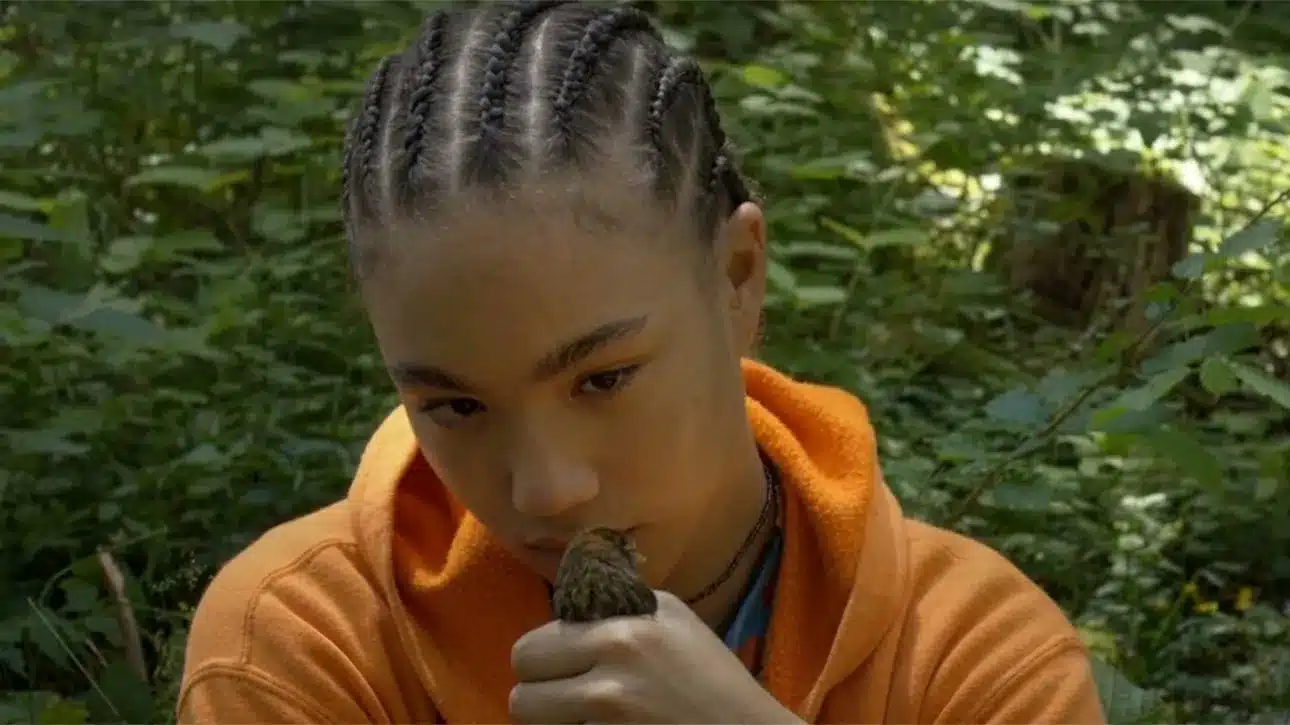
The final chapter of the triptych arrives with spring and centers on Jade (Louiza Aura), a teenager preparing to leave her rural home for university in Paris. While Jade faces the daunting prospect of urban migration, her boyfriend Théo (Dimitri Doré) dreams instead of relocating to Canada.
This concluding segment swells the character count to around ten, fully integrating the viewer into the human world of farmland, makeshift abodes, doctor’s surgeries, and small-town streets. The narrative architecture of D’ici là becomes explicitly about departures, transitions, and the impermanence of place.
Tensions flare when local youths, including Théo, harass a local homeless man who breaks into abandoned homes to steal food—a jarring reminder of the friction inherent in tight-knit rural communities. Each story within the triptych remains deliberately incomplete, capturing a fleeting slice of life rather than driving toward a neat Hollywood resolution. Aline’s narrative emerges as the most fully realized, while Lucien’s remains the most opaque and ambiguous.

Supporting Context & Aesthetic Metrics
To fully appreciate the weight of Sarah Leonor’s artistic choices in D’ici là, one must examine the film’s position within contemporary cinematic movements that question traditional narrative pacing.
The Poetics of Place and "Spiritual Filmmaking"
According to the director’s official statements, D’ici là is designed to convey how human beings absorb the essence and spirit of the landscapes in which they are raised, turning geography into an internalized biological and psychological component. This theoretical framework explains the film’s unhurried rhythm. Leonor’s camera work is disciplined, patient, and uncompromising.
In many ways, the film operates as a cinematic metaphor for botany: Lucien represents the seed planted in the valley floor, putting down radical roots; Aline embodies the fragile, vital growth of the stalk; and Jade represents the blossoming maturity of the plant reaching toward the sky.
Sonic Landscapes: Comparing D’ici là and The End of Quiet
The stylistic choice to prioritize natural, diegetic sound over constructed musical scores invites direct comparison with recent international documentaries exploring humanity’s acoustic footprint. Most notably, D’ici là shares thematic DNA with Swedish director Mikael Lypinski and Danish director Kasper Bisgaard’s 2025 documentary, The End of Quiet.
| Film / Project | Primary Setting | Core Acoustic Philosophy | Central Conflict |
|---|---|---|---|
| D’ici là (2026) | Vosges Mountains, France | Diegetic immersion; absence of traditional non-diegetic score in early acts. | Internal human exhaustion versus the unchanging cadence of nature. |
| The End of Quiet (2025) | Green Bank, West Virginia | Celebration of acoustic sanctuaries and radio silence zones. | The deregulation of digital technology and Wi-Fi encroaching upon natural silence. |
Just as Green Bank in West Virginia once provided a nearly total ban on cellular devices and electronic noise—protecting the world’s largest radio telescope and creating an acoustic sanctuary—Lucien’s forest retreat in D’ici là offers a desperate psychological quarantine from the digital and verbal noise of modern life. When deregulation and modern pressures inevitably breach these boundaries in the film’s later acts, the sonic and thematic shift mirrors the modern loss of pristine quietude.
Official Statements and Critical Reception
The reception of D’ici là at the Locarno Film Festival has sparked vibrant discussions among international critics regarding the purpose and boundaries of narrative cinema.
In her director’s notes distributed at the festival, Sarah Leonor emphasized that the film was constructed as an act of resistance against prescriptive screenwriting formulas. "We are conditioned to look for arcs, resolutions, and transformations," Leonor noted. "I wanted to create a work that mirrors how life actually affects us—in fragments, in environmental impressions, and through the slow, invisible absorption of the places that hold us."
Festival programmers highlighted the film’s audacity in "disregarding the viewer’s immediate gratification in favor of a profound, meditative resonance."
Critics have frequently invoked legendary American film critic Roger Ebert’s famous definition of cinema as an "empathy machine." D’ici là tests the limits of this machine by extending empathy not only to its deeply flawed, searching human characters—Lucien, Laura, Aline, Martin, Jade, and Théo—but equally to the Vosges landscape itself.
Reviewers have noted that while the film demands immense patience and can occasionally alienate viewers accustomed to high-stakes plotting, its emotional dividends compound over time. As one prominent European trade critic observed, "D’ici là is a film one appreciates more than one immediately enjoys; its genuine warmth, austere beauty, and the absolute courage of its director’s convictions linger long after the credits fade."
Future Outlook
As D’ici là completes its anticipated run on the international autumn festival circuit, industry analysts are watching closely to see how distributors position the film for broader theatrical rollouts in France and across international territories.
Given its arthouse pedigree, contemplative pacing, and strong thematic alignment with environmental discourse and rural escapism, the film is expected to find a dedicated audience among institutions specializing in slow cinema, ecological film series, and auteur-driven European dramas. Furthermore, Sarah Leonor’s willingness to subvert conventional narrative structures is likely to influence a younger generation of European filmmakers seeking alternatives to fast-paced streaming aesthetics.
Ultimately, D’ici là stands as a poignant reminder that cinema can still function as a place of stillness. By treating nature not merely as a scenic backdrop, but as an active, breathing participant in the human comedy and tragedy, Leonor has delivered a masterclass in cinematic restraint—a garden of images and sounds well worth cherishing.








Belum ada komentar. Jadilah yang pertama berkomentar!