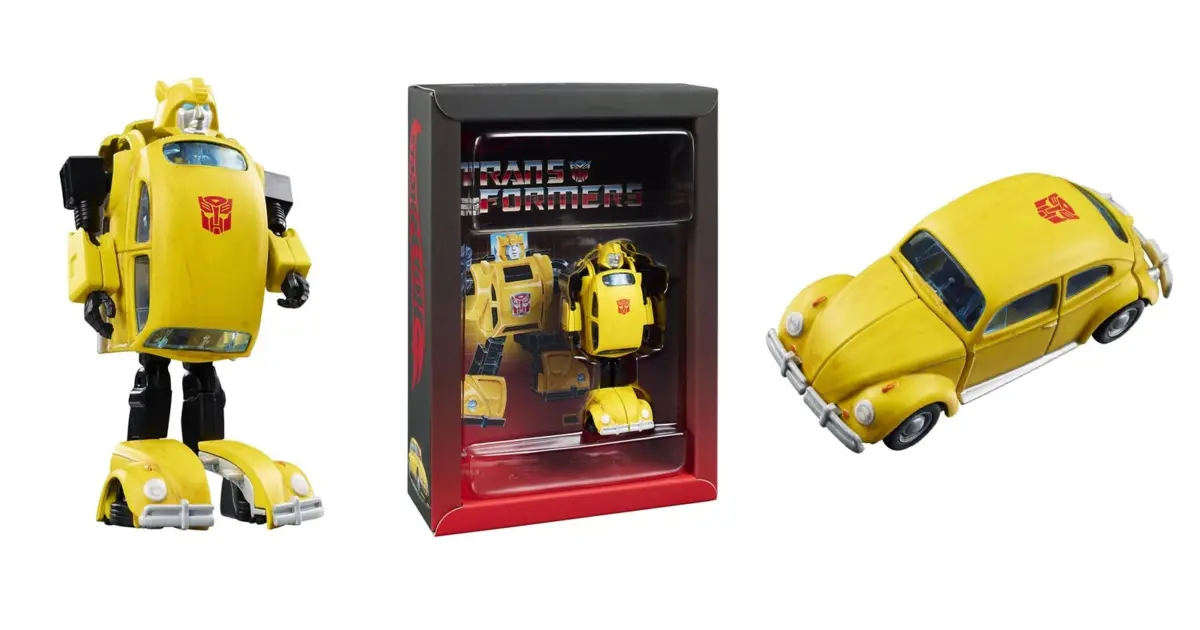
In a rare and triumphant corporate alignment between two of the world’s most dominant toy industry titans, Hasbro and Mattel have officially pulled back the curtain on their latest collaborative masterpiece: the Hot Wheels x Transformers G1 Bumblebee. This meticulously engineered, 1:64 scale collectible seamlessly bridges the nostalgic aesthetic of Generation 1 Transformers with the peerless die-cast craftsmanship synonymous with the Hot Wheels brand.
Slated to roll out for pre-order on September 17th with an accessible retail price point of $65, this release marks the third major 1:64 scale crossover between the two toy giants. However, industry analysts and toy collectors alike are already heralding this particular offering as a high-water mark for miniaturized action figures. Featuring a meticulously weathered 1967 Volkswagen Beetle alt-mode, signature Real Riders wheels, and an astounding 13 points of articulation in its fully functional robot mode, the G1 Bumblebee is engineered to satisfy both hardcore pop-culture nostalgics and high-end die-cast enthusiasts.
As the collectible toy market continues to boom—driven largely by adult collectors nostalgic for 1980s intellectual properties—this cross-company venture underscores a broader industry shift. Competitors are increasingly setting aside historical rivalries to leverage shared cultural capital, resulting in hybrid products that push the absolute technical limits of scale manufacturing.
Detailed Chronology of the Collaboration
The partnership between Hasbro and Mattel did not happen overnight; it represents the culmination of a shifting philosophy in the toy sector regarding intellectual property sharing and cross-branding. For decades, Hasbro (creators of Transformers, G.I. Joe, and Magic: The Gathering) and Mattel (the powerhouse behind Barbie, Hot Wheels, and Masters of the Universe) operated as distinct, fiercely guarded entities within their respective verticals.
The Evolution of Industry Partnerships
Historically, major toy conglomerates kept their crown jewels strictly in-house, viewing cross-pollination as a dilution of brand equity. However, the modern toy ecosystem—heavily influenced by the collector-driven market and the rapid expansion of adult fandoms—has forced a paradigm shift. Limited-edition drops, designer vinyls, and high-end collector lines have proven that adult consumers are willing to invest heavily in products that celebrate multiple nostalgic touchstones simultaneously.
When Hasbro and Mattel first announced their strategic collaboration initiative, it sent shockwaves through the collecting community. The early 1:64 scale crossovers established a framework for how these two distinct design languages could merge. Mattel’s mastery of die-cast metal bodies, tampo printing, and rolling wheel assemblies had to be cleverly integrated with Hasbro’s rigorous demands for transformation engineering and articulation.
The journey to the G1 Bumblebee release required a delicate balancing act between the sleek, aerodynamic expectations of a Hot Wheels vehicle and the blocky, iconic silhouette of the 1984 animated Autobot scout.
The Vehicle Mode: Designers opted for a classic 1967 Volkswagen Beetle chassis. To give it a rugged, battle-tested edge, the vehicle features an intricate weathered paint finish that mimics the wear-and-tear of an ongoing cybernetic war on Earth. Paired with Mattel’s signature Real Riders wheels—which feature authentic rubber tires rather than molded plastic—the car feels remarkably substantial despite its diminutive 1:64 scale.
The Transformation: Perhaps the most astonishing feat of this release is its fully functional transformation mechanism. Converting a car of this scale into a humanoid robot without compromising structural integrity or aesthetic fidelity is an engineering nightmare. Yet, the final product manages to fold out into a classic G1-inspired robot mode boasting 13 points of articulation, allowing collectors to pose the Autobot scout in dynamic action stances that defy its tiny footprint.
Supporting Context & Metrics: The Boom of the Collector Market
To fully appreciate the significance of the Hot Wheels x Transformers G1 Bumblebee, one must examine the broader economic and cultural trends shaping the toy industry today.
The Rise of the "Kidult" Demographic
According to recent data from global market research firms such as Circana (formerly NPD), the toy industry’s primary growth engine is no longer just children. The "kidult" demographic—consumers aged 12 and older purchasing toys and collectibles for themselves—now accounts for a staggering multibillion-dollar share of the global market.
Adult collectors are driving demand for premium, highly detailed, and nostalgic items. They possess greater disposable income and an emotional attachment to intellectual properties born in the 1970s, 1980s, and 1990s. The convergence of Transformers (launched as a toy line by Hasbro and Takara Tomy in 1984) and Hot Wheels (introduced by Mattel in 1968) hits the absolute bullseye of this demographic’s collective childhood memories.
Scale Versus Complexity: The Engineering Challenge
Manufacturing a transforming robot at a 1:64 scale—the standard size for classic Hot Wheels mainline cars, measuring roughly three inches long—presents extraordinary technical hurdles. Most Transformers action figures are produced at much larger scales (Deluxe, Voyager, or Leader classes) to accommodate the intricate hinges, ball joints, and locking tabs required for seamless transformation.
Shrinking this technology down to a pocket-sized die-cast car requires extreme precision. The use of mixed media—combining die-cast metal chassis components with high-grade engineering plastics for the transformable joints—ensures that the figure is durable enough to handle transformation without snapping delicate parts. At a $65 price point, the product is clearly positioned not as a children’s plaything, but as a high-end adult collectible, justifying its cost through material quality, paint application complexity, and engineering ingenuity.
Official Statements and Industry Reception
While official press releases from both Hasbro and Mattel have emphasized the spirit of creative camaraderie, industry insiders have been quick to point out the strategic brilliance of the pairing.
"Bringing together two of the most iconic vehicle-based brands in history is a dream project for our design teams," noted a representative close to the collaborative design initiative. "With Bumblebee, we wanted to honor the rich legacy of Generation 1 Transformers while delivering the premium look, feel, and performance that Hot Wheels collectors expect from every single roll of the wheels."
Fan reception across major collector forums, Reddit communities, and social media channels has been overwhelmingly positive. Early preview images showcasing the weathered paint application and the surprisingly agile robot mode have generated viral traction. Many community members have praised the decision to utilize the 1967 Volkswagen Beetle alt-mode, which serves as a loving nod to Bumblebee’s original vehicular disguise before modern cinematic iterations leaned toward high-end sports cars.
However, some commentators have pointed out the premium pricing. At $65 for a single 1:64 scale vehicle, the price-per-inch ratio is significantly higher than standard Hot Wheels Red Line Club exclusives or mainline Transformers toys. Despite this, pre-order demand is expected to spike aggressively upon opening on September 17th, with scalpers and completionist collectors threatening to trigger immediate sell-outs.
Future Outlook: What This Crossover Means for the Toy Industry
The success of the Hot Wheels x Transformers G1 Bumblebee opens up a fascinating window into the future of the toy and collectible landscape. As traditional retail spaces face increased competition from digital entertainment, physical collectibles are doubling down on experiential value, premium craftsmanship, and cross-brand storytelling.
Potential for Future Line-Ups
Given that this release represents the third iteration of their 1:64 scale collaboration, it is highly unlikely to be the last. Enthusiasts are already speculating on which iconic characters could receive the Hot Wheels treatment next. Will we see an Optimus Prime semi-truck rendered in die-cast metal with a transformative trailer? Could iconic Decepticons like Starscream or Soundwave join the stable in vehicle modes inspired by classic aircraft or cassette players?
The technical precedent established by the G1 Bumblebee proves that almost any classic vehicle-form Transformer can theoretically be adapted into a micro-scale die-cast collectible, provided the engineering budget and collaborative will are present.
A Blueprint for Modern Corporate Synergy
Beyond individual product sales, the Hasbro-Mattel alliance serves as a case study in modern corporate agility. In an era where brand dilution is a constant risk, partnering with a historical rival can actually revitalize mature intellectual properties, inject fresh creative energy into design departments, and capture the elusive attention of modern consumers.
For now, all eyes are fixed on the September 17th pre-order window. For collectors fortunate enough to secure one, the Hot Wheels x Transformers G1 Bumblebee promises to be a crown jewel—a tiny, metallic monument to 1980s pop culture that proves great things truly do come in small, highly articulated packages.










Belum ada komentar. Jadilah yang pertama berkomentar!