

Executive Overview
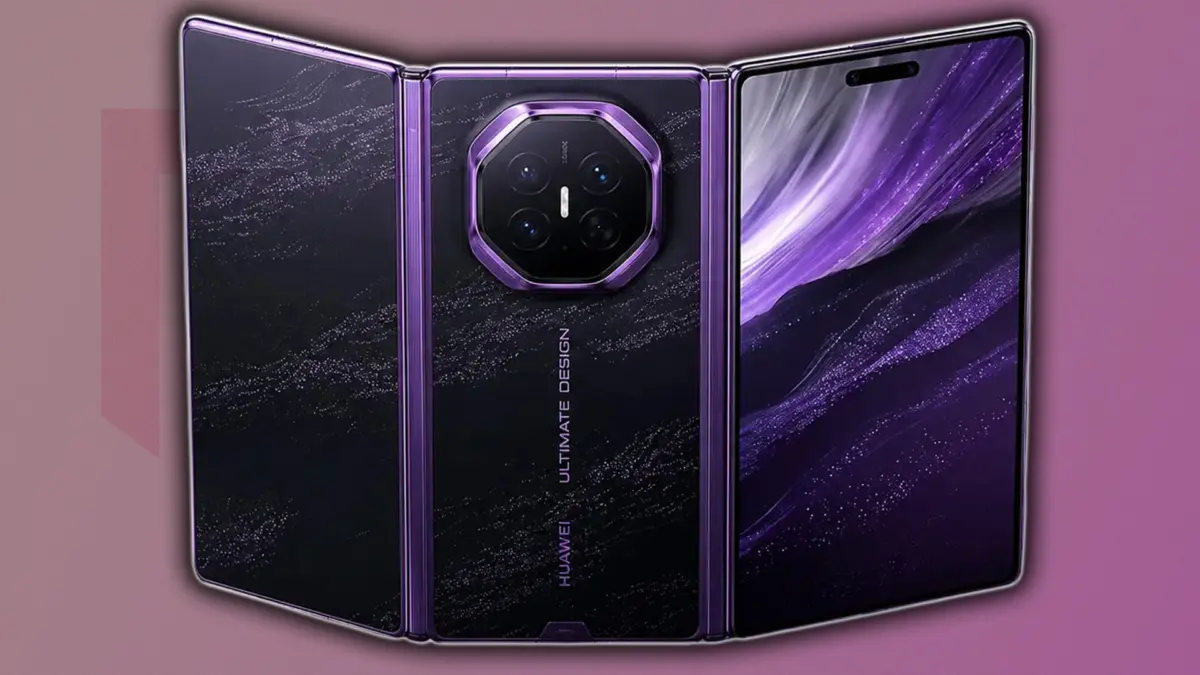
In a calculated play for technical superiority within the premium mobile market, Huawei Technologies Co. has officially unveiled its third-generation tri-fold flagship, the Huawei Mate XT 2. Arriving just 48 hours prior to Apple Inc.’s scheduled September 9 hardware presentation—where the Cupertino titan is widely expected to preview its long-rumored single-fold iPhone—Huawei’s announcement signals a deliberate effort to set the technological narrative.
The Mate XT 2 is not merely an incremental update; it represents a significant engineering leap in ultra-premium mobile hardware. Moving beyond standard dual-panel foldable designs, the device utilizes a dual-hinge mechanism that expands a conventional 6.5-inch smartphone footprint into a fully contiguous 10.2-inch workstation-class tablet display. Beneath the hood, the device introduces the proprietary Kirin 9050 Pro system-on-chip (SoC), which Huawei claims delivers a 42% raw performance improvement over its previous generation, underscoring domestic silicon progress despite ongoing international supply chain restrictions.
+-----------------------------------------------------------------------------------+
|                            HUAWEI MATE XT 2 AT A GLANCE                           |
+----------------------+------------------------------------------------------------+
| Form Factor          | Tri-Fold (6.5" Smartphone -> 10.2" Tablet)                |
| Thickness            | 12.3 mm (Folded) | 3.5 mm - 4.0 mm (Unfolded)              |
| Weight               | 299 grams                                                  |
| Processor            | Kirin 9050 Pro (42% performance uplift)                    |
| Primary Display      | 10.2" LTPO OLED (3,184 x 2,232 resolution @ 90Hz/120Hz)    |
| Cover Display        | 6.5" LTPO AMOLED @ 120Hz                                   |
| Camera System        | 50MP Main + 40MP Ultrawide + 50MP Periscope Telephoto      |
| Battery & Power      | 5,600 mAh | 66W Wired | 50W Wireless                       |
| Ingress Rating       | IP59 Dust and Water Resistance                             |
| Pricing (China)      | Base Model: $2,980 (£2,200) | Top Tier 1TB: $3,725 (£2,750)  |
+----------------------+------------------------------------------------------------+
With price tags ranging from $2,980 to $3,725, Huawei is targeting a highly lucrative, low-volume tier of high-net-worth consumers and enterprise power users. By establishing a commercial footprint for a multi-fold device while competitors prepare initial entries into the foldables sector, Huawei is consolidating its position in the domestic high-end market and demonstrating the viability of its high-tier hardware pipeline.
Detailed Chronology: Strategic Timing and Market Cadence
The timing of Huawei’s launch highlights the high-stakes scheduling game between Shenzhen and Silicon Valley. For months, supply chain tracking and patent filings suggested Huawei was finalizing its third-generation multi-fold hinge geometry, while late-stage architectural leaks hinted at a new Kirin application processor engineered to resolve performance bottlenecks present in earlier silicon nodes.
     TIMELINE OF EVENTS (SEPTEMBER 2026)
     ===================================

     [Sept 7] ---------------------------- Huawei unveils Mate XT 2
        |                                  (Tri-fold, Kirin 9050 Pro)
        |
     [Sept 9] ---------------------------- Scheduled Apple Keynote
        |                                  (Anticipated ~7.8" Foldable iPhone reveal)
        |
     [Sept 12] --------------------------- Official China Retail Availability
                                           (Mate XT 2 commercial rollout)
The sequence of events leading up to this release emphasizes Huawei’s aggressive cadence:
- Late 2025 – Early 2026: Supply chain intelligence indicates tape-out completion for the Kirin 9050 Pro, alongside rumors of advanced polarization techniques designed to enable single-touch privacy masking on flexible OLED panels.
- Late August 2026: Regulatory filings with China’s Ministry of Industry and Information Technology (MIIT) confirm dual eSIM capability, IP59 environmental ratings, and advanced wireless communication protocols across the prospective device family.
- September 7, 2026: Huawei officially reveals the Mate XT 2, establishing hardware specifications, retail pricing, and an in-person launch date for the domestic market.
- September 9, 2026: Apple holds its annual autumn media showcase, where market analysts anticipate the debut of a single-fold iPhone featuring a ~7.8-inch interior panel and an estimated price point exceeding $2,000.
- September 12, 2026: The Mate XT 2 enters retail channels across mainland China, beating Apple’s commercial availability window in the region.
By launching two days prior to Apple’s keynote, Huawei effectively anchored industry discussions around its tri-fold design, framing Apple’s impending release as a entry into a category where Huawei is already deploying its third iteration.
Technical Deep-Dive: Specs, Engineering, and Metrics
Next-Gen Silicon: The Kirin 9050 Pro Architecture
The internal engine of the Mate XT 2 is the Kirin 9050 Pro. Huawei claims this platform yields a 42% increase in total computational throughput compared to the Kirin 9000-series processors used in prior hardware generations.
While Huawei remains disciplined regarding specific foundry processes, thermal imaging and architectural metrics point to enhanced packaging technologies and an optimized micro-architecture. The 42% uplift is felt primarily in real-time multi-window processing, AI-driven optical signal pipeline handling, and localized, on-device large language model (LLM) execution. The SoC manages three distinct UI display states smoothly, adjusting rendering pipelines dynamically as the physical screen toggles between single, dual, and triple panel configurations.
PROCESSOR & PERFORMANCE UPGRADES
========================================================================
Feature                    Kirin Predecessor       Kirin 9050 Pro
------------------------------------------------------------------------
Performance Uplift         Baseline                +42% Throughput
Multi-Window Scaling       Dual-panel optimized    Tri-panel hardware dynamic
AI/NPU Capabilities        Standard processing     Real-time LLM execution
Thermal Dissipation        Standard vapor chamber  Multi-hinge liquid cooling
========================================================================
Display Engineering, Hinge Kinematics, and Privacy Panels
The display technology of the Mate XT 2 represents one of its most complex engineering elements. Unfolded, the main display operates as a 10.2-inch LTPO OLED workspace outputting a resolution of 3,184 x 2,232 pixels at a 90Hz refresh rate on base variants. The top-tier 1TB model upgrades this main panel to a 120Hz high-refresh rate panel equipped with an electro-optical privacy filter.
               CROSS-SECTION: DISPLAY CONFIGURATION

   [Panel 1: 6.5" Outer]  ===Hinge 1===  [Panel 2: Mid]  ===Hinge 2===  [Panel 3: End]
   +--------------------+               +---------------+               +---------------+
   | 120Hz LTPO Cover   |               |               |               | Top-tier 120Hz|
   | AMOLED Screen      |               |  Inner OLED   |               | Panel + Active|
   | (12.3mm folded)    |               |  Workspace    |               | Privacy Filter|
   +--------------------+               +---------------+               +---------------+
   |<--------------------------- Unfolded: 10.2" Workspace --------------------------->|
   |<--------------------------- Thickness: 3.5mm - 4.0mm -------------------------->|
This active privacy feature employs integrated liquid-crystal or polarimetric layers within the display stack. At the touch of a soft key or a physical shortcut, the display selectively narrows its light diffusion vector, restricting viewing angles beyond 30 degrees off-axis. This system allows users to view sensitive financial or corporate data on a broad 10.2-inch surface in public environments without risking visual eavesdropping.
From an ergonomic and structural perspective, the device manages its expanded footprint through thin packaging:

- Unfolded Thickness: 3.5mm to 4.0mm across its main structural plane (excluding the camera island).
- Folded Thickness: 12.3mm when fully collapsed into a three-layer sandwich.
- Mass: 299 grams, achieving structural stability through a custom composite shell and dual carbon-fiber hinge assemblies.
- Outer Display: A 6.5-inch LTPO AMOLED screen operating at 120Hz with high-frequency PWM dimming for reduced eye strain during closed use.
Imaging System & Optical Hardware
Despite the spatial constraints of a chassis that measures under 4mm when extended, Huawei has integrated a multi-camera array:
                  REAR CAMERA MODULE BREAKDOWN
    +-------------------------------------------------------+
    |  50 MP Main Sensor (Variable Aperture, OIS)           |
    |  40 MP Ultrawide Angle Lens (Macro Capabilities)       |
    |  50 MP Periscope Telephoto Lens (Extended Optical Zoom)|
+-------------------------------------------------------+- 50MP Primary Camera: Features a physically variable aperture mechanism and optical image stabilization (OIS), configured to handle high-dynamic-range scenes across varying light levels.
- 40MP Ultrawide Sensor: Serves as both an ultra-broad landscape lens and a macro optics module for close-range industrial scanning.
- 50MP Periscope Telephoto: Employs folded optics to provide long-range optical zoom without exceeding the overall depth profile of the main chassis module.
Power Systems, Enclosure, and Connectivity
Powering three display zones requires a high-density energy source. Huawei utilizes a high-capacity 5,600mAh silicon-carbon anode battery system split across the device’s three structural chassis segments. Charging is handled via 66W wired SuperCharge or 50W wireless SuperCharge protocols, minimizing downtime for power users.
Connectivity and environmental durability metrics include:
- Ingress Protection: Certified IP59, offering high-level defense against dust ingress alongside protection against close-range, high-pressure, and high-temperature water jets—an achievement for a dual-hinge articulation mechanism.
- Wireless Standards: Integration of Wi-Fi 7 protocols and Bluetooth 6.0 for lower latency, higher bandwidth, and improved power efficiency.
- Cellular & SIM Infrastructure: Native dual eSIM hardware support alongside physical SIM slots, allowing global roaming flexibility for international business travellers.
Official Statements and Commercial Positioning
Industry analysts interpret the strategic launch of the Mate XT 2 as an effort by Huawei to claim the technical high ground in consumer electronics innovation. While the company’s executive team highlighted the device’s technological milestones during its announcement, market commentators point out that the aggressive pricing structure reflects its positioning as an ultra-luxury, technology-showcase product.
                    PRICE POINT MATRIX & COMPETITIVE LANDSCAPE
+------------------------+-------------------+-----------------+-----------------------+
| Device                 | Entry Price (USD) | Top Price (USD) | Screen Real Estate    |
+------------------------+-------------------+-----------------+-----------------------+
| Huawei Mate XT 2 (Base)| $2,980            | -               | 6.5" Cover / 10.2" In |
| Huawei Mate XT 2 (1TB) | -                 | $3,725          | 10.2" 120Hz w/ Privacy|
| Expected Apple Foldable| ~$2,000 (Est.)    | Unknown         | ~7.8" Inner (Rumored) |
+------------------------+-------------------+-----------------+-----------------------+
The commercial rollout is structured through distinct phases:
- China Market Debut: Scheduled for September 12, 2026. The base configuration launches at $2,980 / £2,200, while the flagship 1TB variant featuring the 120Hz panel and integrated privacy mode reaches $3,725 / £2,750.
- Global Availability: Huawei has not confirmed an international release schedule. Market watchers attribute this caution to foreign trade compliance hurdles, localized distribution logistics, and high component assembly costs that favor initial domestic concentration.
This strategy establishes a clear distinction between Huawei and Apple:
             COMPLEXITY & FORM FACTOR COMPARISON

    HUAWEI MATE XT 2                     RUMORED APPLE FOLDABLE
    +-----------------------+            +-----------------------+
    | [Panel] [Panel] [Panel]            |    [Panel]  [Panel]   |
    | Tri-Fold Architecture |            |   Single-Fold Design  |
    | 10.2" Total Display   |            |  ~7.8" Total Display  |
    | Dual Hinge System     |            |   Single Hinge System |
    | Integrated Privacy    |            | Standard Screen Stack |
    | $2,980 - $3,725       |            |   >$2,000 (Target)    |
    +-----------------------+            +-----------------------+
While Apple is expected to focus its initial foldable strategy on a mainstream single-hinge, ~7.8-inch design aimed at broader consumer adoption, Huawei is targeting the high-margin extreme premium segment. By introducing a $3,000+ tri-fold device, Huawei aims to capture market share among enterprise executives and technology enthusiasts seeking a single device that serves as a phone, folded reader, and full-scale tablet.
Future Outlook: Industry Implications and Form Factor Evolution
The arrival of the Huawei Mate XT 2 marks a key shift in the trajectory of flexible screen technology. By proving that a 10.2-inch tri-fold device can be engineered down to a folded thickness of 12.3mm and a weight under 300 grams, Huawei has provided a viable blueprint for the next wave of ultra-mobile computing.
               FOLDABLE MARKET FORM-FACTOR DYNAMICS

   Generation 1 (2019-2022)       Generation 2 (2023-2025)       Generation 3 (2026+)
  +------------------------+     +------------------------+     +------------------------+
  | - Clamshell / Book-Type|     | - Thinner Profiling    |     | - Tri-Fold Multi-Hinge |
  | - High Crease Visibility|    | - Structural Durability|     | - Tablet Replacements  |
  | - >15mm Thickness      |     | - <10-12mm Folded      |     | - Active Privacy Layers|
  +------------------------+     +------------------------+     +------------------------+
This launch raises several key questions for the broader mobile market:
- Supply Chain Scaling: The yield rates for complex dual-hinge mechanisms and three-part flexible OLED displays remain low compared to traditional rigid panels. How quickly domestic supply chains can scale production to lower unit costs will determine whether tri-fold devices remain niche halo products or expand into broader consumer segments.
- Developer Ecosystem Adaptation: The transition from a 6.5-inch smartphone display to a 10.2-inch tablet aspect ratio requires software optimization. Android application developers and HarmonyOS engineers must optimize layout scalability to ensure smooth user transitions between folded, semi-unfolded, and fully expanded modes.
- Competitive Response from Cupertino: Apple’s rumored entry into the single-fold market with a ~7.8-inch inner panel will validate the commercial potential of foldables globally. However, Huawei’s deployment of a functional tri-fold platform pressures rivals to accelerate their long-term hardware roadmaps beyond simple single-hinge designs.
As the mobile device market enters a era characterized by specialized hardware and dynamic displays, the Mate XT 2 establishes a key benchmark. Huawei’s move demonstrates that even amidst ongoing trade restrictions and geopolitical head winds, the company retains the engineering capability to drive hardware innovation—setting up a compelling competitive landscape for high-end smartphones in the years ahead.









Belum ada komentar. Jadilah yang pertama berkomentar!