

Executive Overview
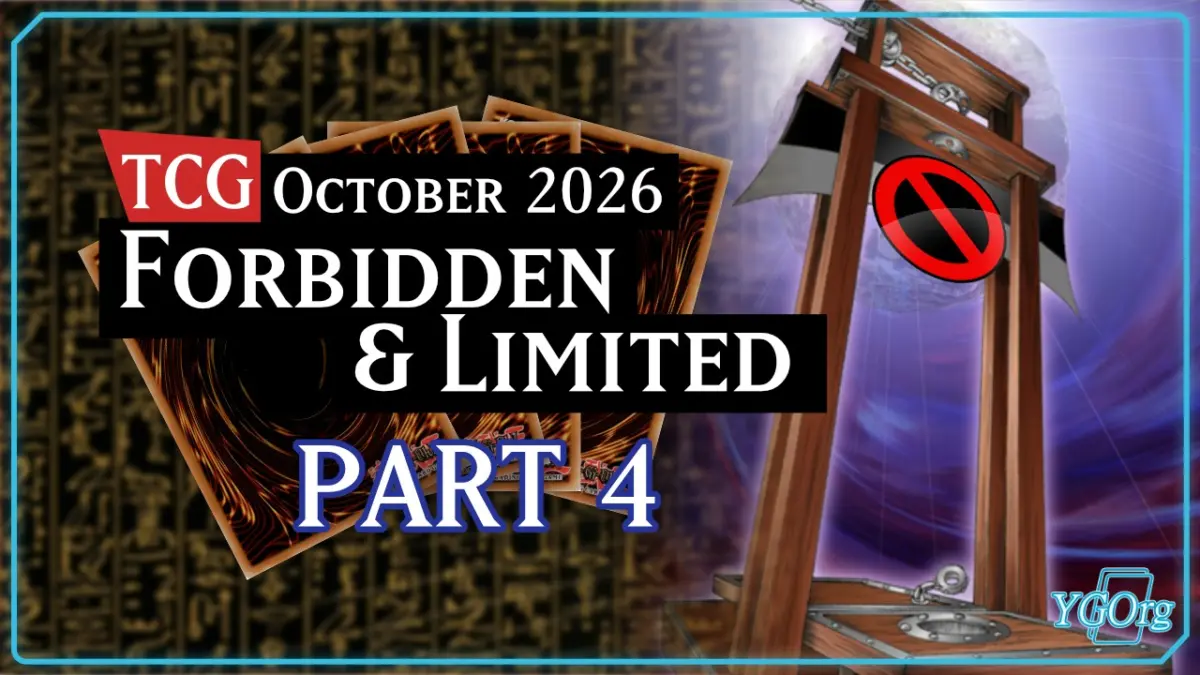
The competitive Yu-Gi-Oh! Trading Card Game (TCG) landscape stands on the precipice of a monumental transformation. Broadcasted live from the bustling convention center floor during the high-stakes weekend of YCS Houston 2026, Konami’s Organized Play team dropped a bombshell update to the Forbidden & Limited List. Set to officially go into effect on Monday, October 19, 2026, this sweeping adjustment targets some of the most ubiquitous, game-altering generic staples, floodgate monsters, and combo enablers that have defined competitive deckbuilding for years.
For months, the meta has been locked in an escalating arms race of high-roll combo boards, resource looping, and oppressive floodgate deployment. The October 2026 update makes it explicitly clear that the design philosophy moving forward favors interaction, hand-trap flexibility, and fairer resource trading over absolute, unmitigated board state dominance. By targeting pillars of modern deck construction—such as Magicians’ Souls, Spell Canceller, Crystal Wing Synchro Dragon, F.A. Dawn Dragster, Naturia Beast, Number 41: Bagooska the Terribly Tired Tapir, and Number 60: Dugares the Timeless—Konami has effectively dismantled the safety blankets that many tier-one and tier-two strategies relied upon to survive through opponent turns.
Furthermore, the restructuring of high-impact utility cards like Griffoh and Superdreadnought Rail Cannon Gustav Max into the "Limited" category signals a calculated effort to curb explosive damage outputs and infinite-loop enablers without outright eradicating entire archetypes. As duelists scramble to re-evaluate their side decks, extra decks, and core strategies ahead of the October 19 enforcement date, this report provides a comprehensive, investigative breakdown of the list, analyzing the historical context, card-by-card competitive impacts, and the long-term outlook for the professional Yu-Gi-Oh! circuit.
Detailed Chronology: The YCS Houston Revelation
The atmosphere inside the main hall at YCS Houston 2026 was palpable. Tens of thousands of concurrent viewers tuned into the official stream, while hundreds of competitors paused their deck-building preparations to catch the mid-tournament announcement. Historically, major Premier Events serve as the ultimate stage for meta-shaking announcements, but few attendees anticipated an intervention of this magnitude so late in the competitive cycle.
The Buildup to the Announcement
In the weeks leading up to YCS Houston, community sentiment had reached a boiling point. Tournament conversion rates heavily favored decks that could reliably establish multi-negate boards backed by continuous floodgates. Players voiced growing frustration over the sheer density of generic disruptions accessible to almost any strategy with minimal investment. The meta had devolved into a game of drawing specific board-breakers—such as Dark Ruler No More or Evenly Matched—or watching helplessly as an opponent locked down monster effects, spell cards, and activations entirely.
When the stream cut away from the feature match layout to display the updated Forbidden & Limited graphic, the live chat erupted, and immediate shockwaves rippled through the venue tables. The announcement was direct, devoid of lengthy preamble, listing seven high-profile cards targeted for outright prohibition and two prominent tactical utilities restricted to a single copy.
The Breakdown of the Changes
The exact text and rulings dictated by the October 19, 2026 list encompass a radical realignment of competitive priorities:
-
Forbidden (0 Copies Allowed):
- Magicians’ Souls
- Spell Canceller
- Crystal Wing Synchro Dragon
- F.A. Dawn Dragster
- Naturia Beast
- Number 41: Bagooska the Terribly Tired Tapir
- Number 60: Dugares the Timeless
-
Limited (1 Copy Allowed):
- Griffoh
- Superdreadnought Rail Cannon Gustav Max
This precise selection of cards targets every corner of the competitive spectrum: from hyper-consistent draw engines and ancient floodgates to modern extra deck powerhouses and explosive OTK (One-Turn-Kill) enablers.
Supporting Context & Metrics: Analyzing the Casualties
To truly understand the weight of the October 19, 2026 list, one must examine the specific roles these cards played in the competitive ecosystem and why Konami deemed them detrimental to the game’s health.
1. Magicians’ Souls (Forbidden)
Long heralded as one of the most versatile and explosive consistency tools in the history of the game, Magicians’ Souls transcended its original dark spellcaster roots. While initially designed to support "Dark Magician" strategies, its ability to send up to two Level 6 or higher Spellcasters from the deck to the graveyard to draw cards—combined with its self-summoning effect by sending cards from the hand or field to the graveyard—made it an omnipresent engine piece.
In recent formats, rogue and tier-one combo decks alike splashed small packages just to exploit its free graveyard setup and card filtering. By sending Magicians’ Souls to the graveyard, players triggered cascading resource loops. Removing it from the picture drastically curtails the raw consistency of multiple spellcaster-adjacent strategies and forces deckbuilders to rely on honest, archetype-locked starter cards.
2. Spell Canceller (Forbidden)
A relic from the early eras of Yu-Gi-Oh!, Spell Canceller experienced a renaissance in recent formats due to modern summoning mechanics that allowed players to cheat high-level monsters onto the field with minimal effort. Its continuous effect—which dictates that neither player can activate or set Spell cards—acts as an absolute, game-ending floodgate against a vast majority of the card pool.
In a modern game where Spells dictate engine flow, board breaking, and search capabilities, resolving or cheating out Spell Canceller frequently translated to an instant concession. Its placement on the Forbidden list reflects Konami’s ongoing crusade against oppressive floodgates that demand exact, hyper-specific counter-draws to out.
3. Crystal Wing Synchro Dragon & F.A. Dawn Dragster (Forbidden)
The twin hits to the Extra Deck synchro toolbox represent a major blow to mid-range and combo decks that rely on flexible Level 8 disruption.
- Crystal Wing Synchro Dragon has been a premier boss monster for years, offering monster effect negation, attack boosts based on the victim’s original attack, and devastating retribution against Level 5 or higher monsters. Its ease of summoning via generic tuners made it a staple defensive option across countless boards.
- F.A. Dawn Dragster, a Level 7 Synchro monster, served as an easily accessible Spell/Trap negation safety valve. Because it could be slotted into lower-level investment lines, players frequently ended their turns with both Crystal Wing and Dawn Dragster guarding against nearly any form of interaction.
Banning both effectively strips generic Synchro-heavy strategies of their default insulation, forcing duelists to think more critically about their extra deck allocations and defensive sequencing.
4. Naturia Beast (Forbidden)
Few cards in the history of the TCG have elicited as much groaning from opponents as Naturia Beast. Requiring an Earth Tuner and non-Tuner Earth monsters, this seemingly innocuous Level 5 Synchro monster possessed an un-once-per-turn effect allowing players to send the top cards of their deck to the graveyard to negate the activation of a Spell card and destroy it. Against decks heavily reliant on Spells (which includes almost every competitive strategy), a resolved Naturia Beast was an impenetrable wall.
Even though summoning it occasionally required creative Earth-engine splashes, its payoff was disproportionately high for the resource investment. Its ban removes one of the most polarizing and deterministic floodgates from the competitive card pool.
5. Number 41: Bagooska the Terribly Tired Tapir (Forbidden)
If there was a universal panic button in the XYZ toolbox, it was Number 41: Bagooska the Terribly Tired Tapir. Placed in Defense Position, this Rank 4 generic monster forced all face-up monsters on the field into Defense Position and negated their activated effects if they were in Defense Position, while also providing protection against card destruction.
Bagooska served a dual purpose: it was a premier "Plan B" when a player’s primary turn was interrupted (allowing them to sit on a defensive wall and pass), and it was a devastating floodgate deployed proactively to lock opponents out of playing the game. Its removal dismantles the safety net that allowed substandard hands to miraculously stall out superior plays.
6. Number 60: Dugares the Timeless (Forbidden)
Explosivity has been the defining trait of modern combo decks, and Number 60: Dugares the Timeless was the undisputed king of accelerated lethality. Offering three distinct, game-altering effects—drawing two cards and discarding one, special summoning a monster from the graveyard with doubled attack, or skipping the next draw phase to double a monster’s attack—Dugares enabled innumerable OTK scenarios and broken board states.
By removing Dugares, Konami is actively reigning down the ceiling of OTK potential, making matches longer, more tactical, and less reliant on abruptly ending games out of nowhere through auxiliary Rank 4 plays.
7. Griffoh & Superdreadnought Rail Cannon Gustav Max (Limited)
Moving from the Forbidden category to the Limited category, Griffoh and Superdreadnought Rail Cannon Gustav Max face strict rationing.
- Gustav Max, a massive Rank 10 monster capable of inflicting 2,000 points of damage directly to the opponent’s opponent, was frequently abused in loops and burn-heavy strategies to close out games without entering the battle phase, or to fuel subsequent Rank 11 extensions like Superdreadnought Rail Cannon Liebe. Restricting it to one copy curbs degenerate looping while keeping the card technically viable for its intended casual and localized applications.
- Griffoh, a tactical adjustment, joins the restricted tier to curb specific resource looping loops that have surfaced in recent deep-dive combo analysis.
Official Statements and Industry Reception
Reactions from top-tier competitive players, content creators, and judges at YCS Houston were immediate and deeply polarized. While casual players and anti-floodgate advocates celebrated the dismantling of oppressive lock pieces, hard-core combo players faced an immediate paradigm shift in how they construct their side decks and extra decks.
Competitor Perspectives
Speaking on condition of anonymity, a prominent member of a top-tier North American competitive team noted:
"The October 19 list changes the arithmetic of Yu-Gi-Oh! completely. For the past year, you could rely on generic safety nets like Bagooska and Crystal Wing to bail you out of suboptimal opening hands. Now, precision and pure engine efficiency are the only paths forward. You can’t just hide behind generic floodgates anymore; you have to play actual interactive Yugioh."
Conversely, creators specializing in rogue and unconventional strategies expressed anxiety over the collateral damage inflicted by sweeping bans. Archetypes that relied on Magicians’ Souls for basic functionality now find themselves pushed further down the viability ladder, demanding urgent support or total creative reinvention.
The Judges’ and Konami’s Design Philosophy
From an operational standpoint, tournament organizers have expressed quiet optimism. Floodgates and infinite-loop enablers have historically contributed to protracted match times, leading to time-extension bottlenecks and table congestion at premier events. By systematically pruning cards that stall game states or end interactions prematurely, the tournament structure itself stands to benefit from smoother, more timely rounds.
Konami’s overarching design philosophy—as signaled through this list—is a deliberate pivot toward empowering hand-trap interaction and strategic combat over static board establishment. The message to the community is unmistakable: the era of the universal, one-size-fits-all extra deck toolbox is drawing to a close.
Future Outlook: Navigating the Post-October 19 Meta
As players pack their deck boxes and leave the exhibition halls of YCS Houston, the collective focus shifts toward the immediate horizon: Monday, October 19, 2026. Adapting to this new meta requires a comprehensive overhaul of traditional competitive habits.
1. The Death of the Generic Board
With Crystal Wing, Dawn Dragster, Naturia Beast, and Bagooska removed from the equation, Extra Deck space has suddenly opened up. Players can no longer default to the same standardized defensive package regardless of their main archetype. Innovators will need to unearth specialized, archetype-locked boss monsters and defensive interactions that require deeper resource commitments.
2. Engine Purity vs. Consistency Reductions
The loss of Magicians’ Souls forces spellcaster-adjacent and rogue strategies to recalibrate their consistency metrics. Builders will have to experiment with alternative draw engines, search spells, and starter cards. This creates a fertile environment for rogue deck discovery, as players search for hidden gems previously overshadowed by the sheer dominance of Souls-driven packages.
3. A Return to Mid-Range Interaction
By eliminating oppressive floodgates like Spell Canceller and game-ending speed tools like Dugares, the average length and complexity of tournament matches are projected to shift. Duels will likely feature extended back-and-forth exchanges, placing a higher premium on resource management, card advantage tracking, and precise side-decking.
Conclusion
The Forbidden & Unrestricted List update unveiled at YCS Houston 2026 marks a watershed moment for the Yu-Gi-Oh! Trading Card Game. By decisively dismantling the pillars of generic floodgate play, excessive consistency engines, and hyper-accelerated OTK tools, Konami has signaled a bold commitment to the long-term health and interactivity of competitive play.
As the October 19, 2026 effective date rapidly approaches, duelists across the globe face an exhilarating period of transition. The playground has been leveled, the safety nets have been burned, and the true masters of the game will now be defined not by how well they hide behind unbreakable boards, but by how skillfully they navigate the dynamic, unpredictable waters of a truly revitalized meta.





Belum ada komentar. Jadilah yang pertama berkomentar!