

Executive Overview
In the contemporary landscape of recorded music, listeners are frequently caught in the undertow of an endless archival tide. We live in an era defined by deluxe box sets, high-resolution streaming availability, and the relentless excavation of historical vaults. From Bob Dylan’s staggering 39-CD monumental chronicle The Rolling Thunder Revue: The 1976 Live Recordings to the Beatles’ multi-disc commemorative editions of canonical albums like Revolver, the music industry has pivoted heavily toward retrospective luxury. For the modern consumer, the central dilemma is rarely whether the historical material holds inherent artistic value. Rather, it is a practical calculation of bandwidth: how much time, emotional investment, and financial capital can a listener reasonably dedicate to parsing the discarded, the unfinished, and the alternate versions of history?
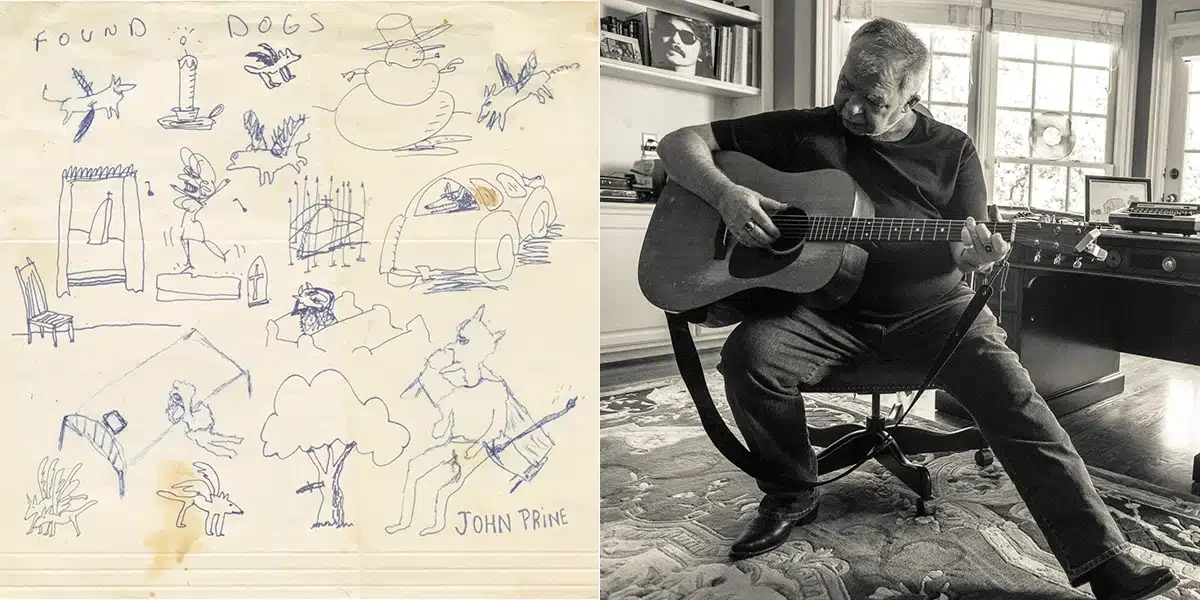
Into this crowded landscape steps Found Dogs, a newly issued, carefully curated archival companion celebrating the 30th anniversary of singer-songwriter John Prine’s 1995 studio LP, Lost Dogs & Mixed Blessings. Spanning a career of nearly five decades that yielded 18 studio albums and 12 live records, Prine’s catalog is a towering monument in American roots music. While some entries in his discography stand as undisputed masterpieces and others offer a handful of brilliant cuts amid uneven tracklists, his estate’s latest archival release aims straight for the heart of his creative evolution.
Found Dogs gathers an engaging assortment of alternate takes, intimate solo acoustic performances, early demos, and previously unreleased compositions originating from the pivotal Lost Dogs & Mixed Blessings sessions. Rather than functioning as a mere cash-grab for completists, the release serves as a fascinating window into a master songwriter’s workshop. It illuminates a transitional era in Prine’s artistic trajectory, providing both die-hard devotees and curious newcomers with a deeper appreciation of his singular poetic voice.
Detailed Chronology: The Road to Lost Dogs and Beyond
To fully grasp the significance of Found Dogs, one must contextualize the era from which it springs. By the mid-1990s, John Prine was well into the second act of a storied career that had begun in the early 1970s under the championing of Kris Kristofferson and the banner of Atlantic Records. Having survived throat cancer scares, the grueling cycles of independent touring, and the establishment of his own pioneering artist-owned label, Oh Boy Records, Prine had cemented his status as a patron saint of American songwriting.
The 1995 Landscape and Lost Dogs & Mixed Blessings
Released in 1995, the original Lost Dogs & Mixed Blessings album captured Prine at a juncture of stylistic expansion and emotional reckoning. Produced by Howie Epstein of Tom Petty and the Heartbreakers, the record leaned into a slightly more expansive, electric-driven sound than the stripped-down acoustic frameworks of his foundational 1970s releases. It was a project that embraced sonic textures, dense storytelling, and a broader canvas of human experience, touching on domestic turbulence, political absurdity, and spiritual melancholy.
However, the sessions that birthed Lost Dogs & Mixed Blessings yielded far more material than could fit onto a single compact disc. Vaults were populated with alternate arrangements, experiments in acoustic minimalism, and fully realized songs that, for reasons of sequencing or stylistic cohesion, were left on the cutting-room floor.
Excavating the Vaults: The Genesis of Found Dogs
Three decades later, the archival team behind the Prine estate has sorted through these reels to assemble Found Dogs. The release functions as a companion piece, tracing the chronological and creative breadcrumbs left behind during those 1995 sessions.
The timeline of Prine’s career is thus enriched by this retrospective glance. By isolating the transitional phase of the mid-90s, Found Dogs demonstrates how an artist who had already written some of the most enduringly poignant vignettes in American folk and country music continued to stretch his structural and narrative boundaries. The chronology of the project highlights an artist refusing to coast on past glories, instead actively deconstructing and rebuilding his craft in real-time.
Supporting Context & Metrics: The Anatomy of the Archives
The release of Found Dogs arrives during a fascinating period for the music economy, where physical archival box sets and digital-exclusive rarities compete for consumer attention. Analyzing the metrics of modern music consumption reveals a bifurcated market: while casual listeners gravitate toward curated, algorithmic playlists, dedicated fans increasingly demand deep-dive physical artifacts that offer tangible connections to legacy artists.
The Prine Catalog by the Numbers
To understand the weight of Found Dogs, one must look at the broader metrics of John Prine’s recorded output:
- Career Span: Nearly 50 years of active songwriting, touring, and recording (from his self-titled 1971 debut through his final studio work).
- Studio Albums: 18 canonical releases showcasing his evolution from acoustic troubadour to elder statesman of Americana.
- Live Albums: 12 officially released live documents capturing the inimitable warmth, humor, and communal spirit of his concert performances.
- The Oh Boy Records Legacy: As one of the first major artists to successfully launch an independent artist-run label, Prine’s catalog governance remains a masterclass in creative autonomy.
Breaking Down the Tracklist: Highlights and Curiosities
Found Dogs is not a monolithic block of outtakes; it is structured to showcase the various facets of Prine’s creative process during the mid-90s.
The Evolution of "Lake Marie"
Chief among the historical triumphs featured on the album is the early demo of "Lake Marie," widely regarded as one of Prine’s most mysterious and ambitious masterpieces. In his earlier decades, Prine’s songwriting genius often relied on concise, character-driven vignettes—single-story portraits of loneliness, aging, and working-class struggle ("Angel from Montgomery," "Sam Stone," "Illegal Smile").
"Lake Marie," however, shattered those structural boundaries. The song weaves together disparate narratives: local folklore, sensationalist crime reportage, Native American history, and intensely personal memory, fusing them into a singular spiritual and creative whole. It is packed with dark humor, high melodrama, and haunting, cinematic details. One need look no further than the chilling line delivered with casual gravity:
"You know what blood looks like in a black and white video? / Shadows, shadows! That’s what it looks like."
Even in its stark demo form on Found Dogs, the performance reveals Prine’s total emotional commitment to the strange, sprawling world he constructed. It offers listeners a rare blueprint of a masterpiece mid-construction.
The Unreleased Discoveries
For longtime aficionados, the primary draw of Found Dogs lies in the excavation of three original songs that have never seen the light of day in any recorded format:
- "World Without Love"
- "Dogs in Burlington"
- "My God Thank You John"
These three cuts serve as a fascinating stylistic cross-section, demonstrating how comfortably Prine’s idiosyncratic writing style intersected with other traditions of American songwriting. "World Without Love" radiates a classic, romantic yearning that feels spiritually adjacent to the working-class epics of Bruce Springsteen. Meanwhile, "Dogs in Burlington" and "My God Thank You John" channel a distinct affection for idiosyncratic places and colorful characters—evoking the coastal storytelling of Jimmy Buffett coupled with the rollicking, barrelhouse piano traditions of New Orleans.
Crucially, despite these stylistic echoes, all three tracks remain unmistakably and stubbornly John Prine songs. By 1995, his vocal delivery and lyrical voice were so fully formed that external influences ceased to sound like derivations; instead, they registered as points of connection within a shared American musical continuum.
Alternate Takes and Curiosities
The album also rounds out its runtime with alternate studio versions of tracks like "Ain’t Hurtin Nobody" and "Quit Hollerin at Me," alongside intimate acoustic readings of "All the Way With You" and "Humidity Built the Snowman." For the uninitiated, these alternate arrangements might blend seamlessly with the previously released versions, but for the discerning ear, they highlight the dynamic interplay between studio polish and organic songcraft.
Conversely, inclusions like the Johnny Horton cover "All for the Love of a Girl" and the previously unreleased novelty sketch "Hey Ah Nothin’" function more as archival curiosities—fascinating footnotes rather than essential narrative breakthroughs.
Official Statements and Industry Perspective
The stewardship of John Prine’s musical estate has been handled with a delicate balance of commercial mindfulness and fierce artistic preservation since his passing in April 2020. Representatives from Oh Boy Records and the Prine family have consistently emphasized that archival releases must honor the integrity of his writing room rather than simply exploit his name for commercial gain.
In statements accompanying the rollout of Found Dogs, representatives noted that the 30th-anniversary milestone of Lost Dogs & Mixed Blessings presented a natural inflection point to revisit a record that often gets overshadowed by his celebrated 1970s output and his late-career Grammy-winning triumph, The Tree of Forgiveness (2018).
Industry analysts have praised the curation of Found Dogs, noting that it avoids the common archival pitfall of burying the listener in endless, redundant variations of the same three songs. By keeping the tracklist tightly focused on the specific thematic and stylistic pivot of the mid-90s sessions, the estate has provided a masterclass in how legacy acts can manage their historical assets. Musicologists and critics alike have lauded the release for proving that even Prine’s "outtakes" possess a literary and melodic depth that many modern songwriters struggle to achieve in their prime album cuts.
Future Outlook: The Legacy of the Singing Mailman
As the music industry continues to digitize and archive every corner of twentieth-century recorded history, the question of sustainability in legacy curation becomes increasingly paramount. Will listeners suffer from archival fatigue, or will thoughtfully curated releases like Found Dogs continue to carve out a vital space in the cultural conversation?
For John Prine’s enduring legacy, the outlook is robust. The "Singing Mailman" remains one of the most beloved figures in American music history, a writer whose empathy, humor, and devastating eye for human truth transcend generations. Found Dogs proves that his creative well was practically bottomless. Even the material left on the cutting room floor holds treasures that outshine the standard output of lesser contemporaries.
Recommendations for Listeners
For those navigating this latest archival offering, a clear roadmap emerges:
- For the Devoted Fan: Found Dogs is an essential addition to the shelf—a rewarding treasure trove of hidden gems, radical songwriting blueprints, and never-before-heard studio experiments that deepen our understanding of a master at work.
- For the Newcomer: While the unreleased cuts and alternate takes offer immense charm, listeners just beginning their journey into Prine’s world are best advised to start with the parent record itself—Lost Dogs & Mixed Blessings—and treat Found Dogs as a rich, illuminating companion volume to be explored once the foundational geography of his catalog has been charted.
Ultimately, Found Dogs succeeds because it does not feel like a cynical exercise in archival archaeology. It feels like an invitation to sit on the porch a little longer, listen a little closer, and marvel once more at the effortless magic of John Prine.









Belum ada komentar. Jadilah yang pertama berkomentar!