At Gamescom 2026, NVIDIA delivered a watershed keynote outlining the next evolutionary phase of graphical realism, artificial intelligence integration, and cloud-based hardware optimization. As the intersection of machine learning and real-time rendering continues to accelerate, NVIDIA’s announcements focused squarely on squeezing maximum fidelity from its hardware ecosystem while democratizing advanced graphic tools for legacy and next-generation titles alike.
The marquee reveal of the showcase was DLSS 4.5 Ray Reconstruction, an upgraded neural rendering pipeline leveraging dual-Transformer architectures to redefine how light, shadow, and reflection data are processed. Alongside DLSS 4.5, NVIDIA spotlighted expansions to its NVIDIA ACE (Avatar Cloud Engine) developer framework, significant upgrades to the modding toolkit RTX Remix, the newly detailed RTX Spark hardware ecosystem, and broad platform extensions for GeForce NOW.
By cementing deeper integrations across industry-standard development pipelines—ranging from Unreal Engine to the Streamline SDK—NVIDIA is signaling that the future of interactive entertainment will be entirely shaped by artificial intelligence.
Detailed Chronology: Key Announcements and Technological Breakthroughs
DLSS 4.5 Ray Reconstruction: The Next Frontier in Neural Rendering
The cornerstone of NVIDIA’s graphics presentation was the formal introduction of DLSS 4.5 Ray Reconstruction. Building upon the foundations of earlier DLSS iterations, DLSS 4.5 integrates a secondary Transformer network specifically dedicated to ray reconstruction (neural shading and denoising).
Traditional ray tracing pipelines have historically struggled with the computational overhead required to calculate pristine lighting in complex scenes without introducing ghosting or heavy blur. DLSS 4.5 solves this by training neural models on ultra-high-definition reference data, replacing traditional hand-coded denoisers with a multi-frame inference engine.
[Traditional Pipeline]: Ray Generation -> Denoising Filter -> Hand-Coded Shaders -> Output
[DLSS 4.5 Pipeline]   : Ray Generation -> Dual-Transformer AI Core -> Neural Denoising & Shading -> Pristine Output
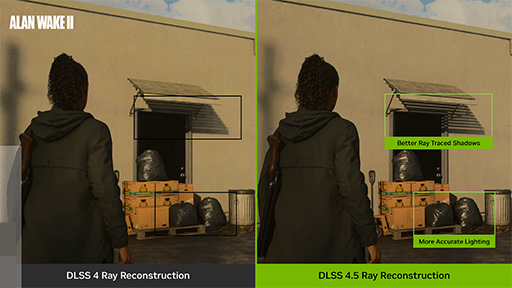
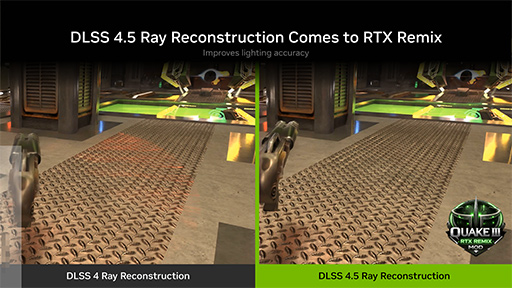
NVIDIA demonstrated this technology using critically acclaimed titles like Alan Wake 2, showcasing drastic reductions in ghosting artifacts, vastly improved specular stability, and crisper temporal coherence during fast camera movements.
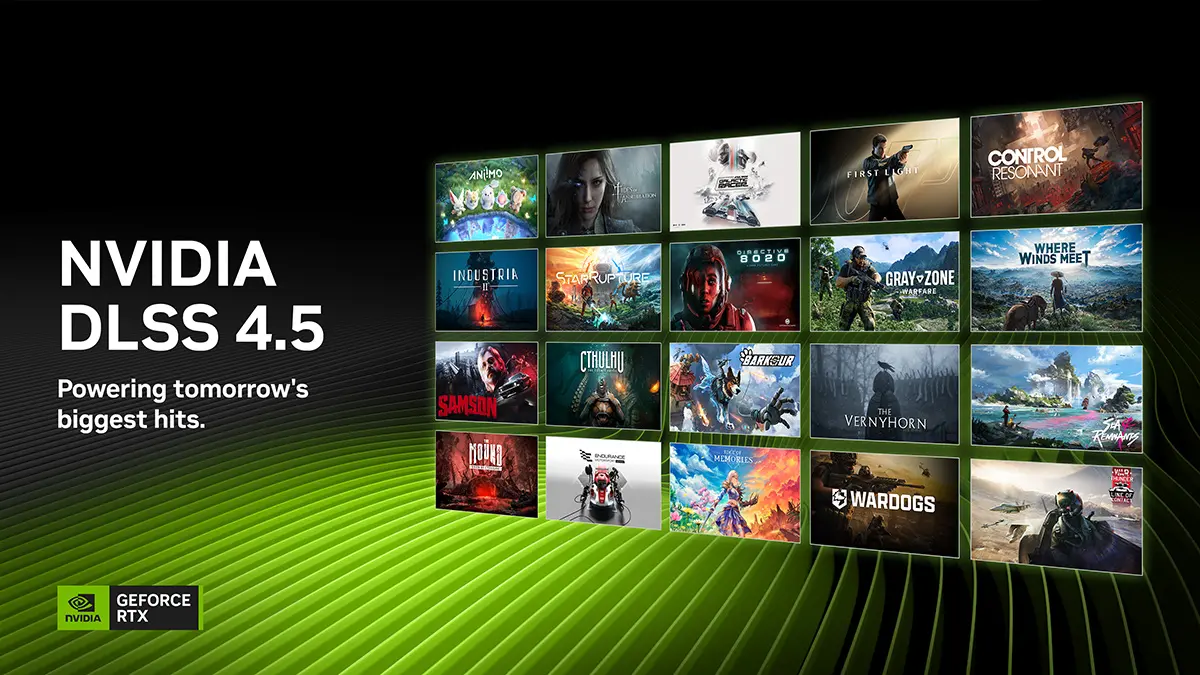
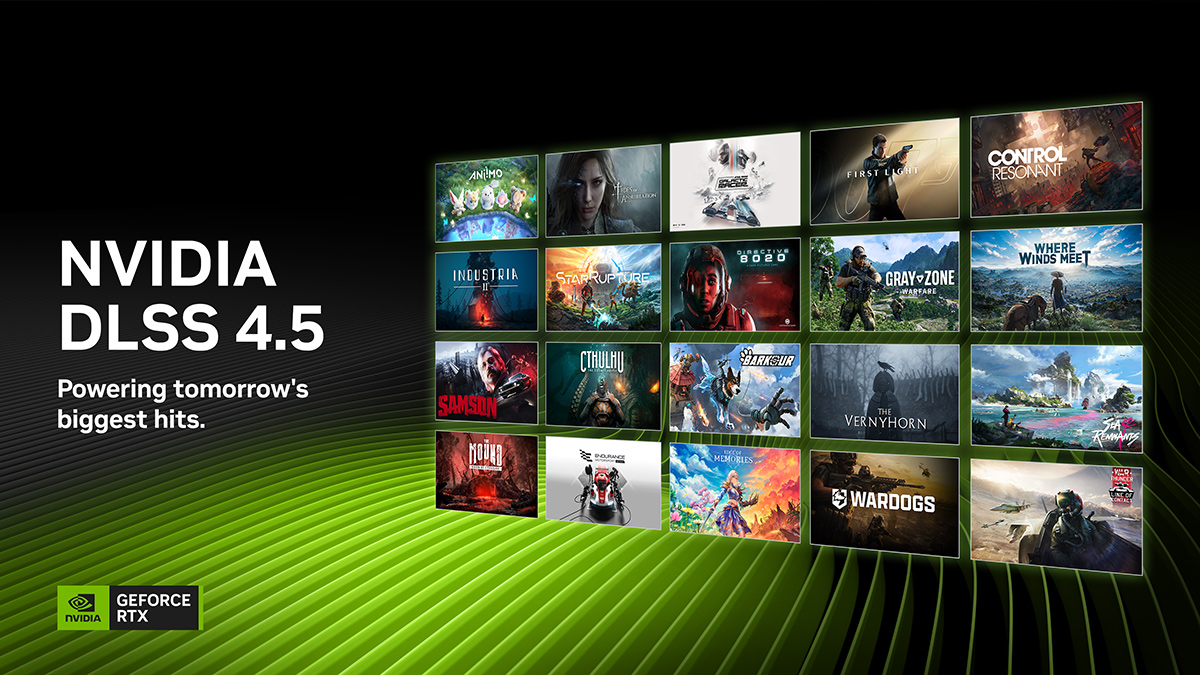
Gamers will be able to manage DLSS 4.5 Ray Reconstruction globally via updated profiles within the NVIDIA App, which now features deep overrides for DLSS preset configurations. Furthermore, upcoming major titles have committed to day-one support:
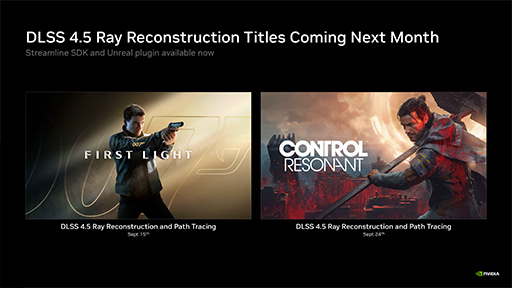
007 First Light (Scheduled for release on September 15)
CONTROL Resonant (Scheduled for release on September 24)
RTX Remix Expansion: Resurrecting Classics with Modern AI
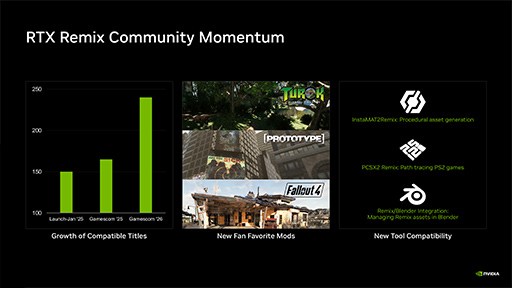
The modding community’s favorite toolset, RTX Remix, received massive feature updates designed to streamline the modernization of classic video games. NVIDIA announced that RTX Remix pipelines have been integrated with Blender, allowing modders to execute high-fidelity asset replacements directly within industry-standard DCC tools.
Perhaps the most surprising integration is PCSX2 Remix, a specialized pipeline merging the PlayStation 2 emulator PCSX2 with RTX Remix technology. This allows classic PS2 titles to leverage full path-tracing, DLSS 4.5, and modern asset streaming. Additionally, the introduction of InstaMAT2Remix automates material generation, massively cutting down the labor hours required to overhaul legacy geometry.
Notable RTX Remix mods highlighted during the showcase include:
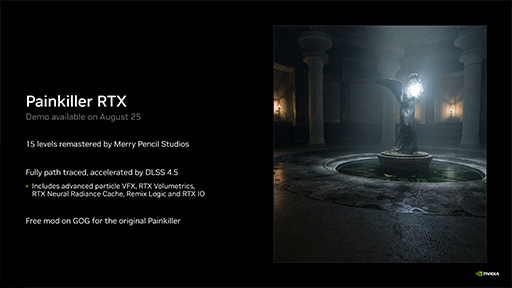
Painkiller RTX Edition: Merry Pencil Studios’ ambitious overhaul of the 2004 cult-classic FPS. The mod leverages RTX Volumetrics, RTX Neural Radiance Cache, and RTX IO to modernize the title, which launched via GOG on August 25.
Morrowind RTX: A comprehensive graphical reimagining of The Elder Scrolls III: Morrowind, bringing full ray tracing and DLSS 4.5 to key settlements like Seyda Neen, Balmora, and the Mages Guild.
NVIDIA ACE and Small Language Models (SLMs)
NVIDIA’s initiative to populate virtual worlds with intelligent, responsive NPCs took a massive leap forward with the expansion of NVIDIA ACE for Games.
PUBG: BATTLEGROUNDS: KRAFTON announced the integration of Small Language Models (SLMs) to power in-game companion systems. Utilizing localized voice recognition and text-to-speech pipelines managed by on-device AI, players can interact with AI sidekicks such as the "Ally Duo" system, which reacts dynamically to tactical changes in real time.
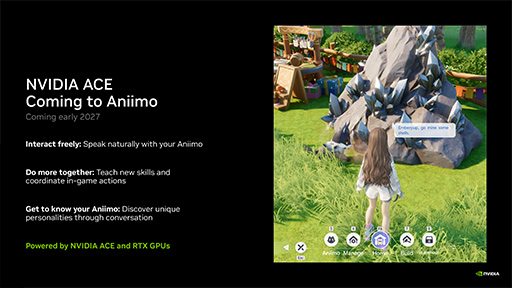
Aniimo: Developed by Pawprint Studio, this upcoming creature-collector RPG slated for a 2027 release will deeply integrate NVIDIA ACE. The game utilizes SLMs to allow players to hold natural language conversations with non-player characters and creatures, fundamentally altering quest progression and immersion.
Supporting Context & Metrics
The technological leaps showcased at Gamescom 2026 are underpinned by rigorous hardware and software optimizations designed to scale from localized desktop GPUs to distributed cloud networks.
Technology / Feature
Target Hardware / Platform
Key Performance Metric / Benefit
DLSS 4.5 Ray Reconstruction
GeForce RTX 50-Series (and compatible RTX GPUs)
Dual-Transformer neural denoising with minimal performance overhead.
RTX Spark
Windows PC with NVIDIA SoC
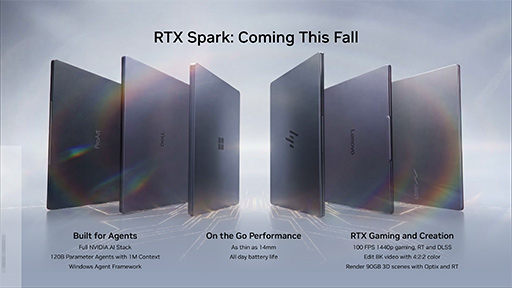
Delivers 1440p at 100fps using AI rendering optimizations; handles 90GB 3D assets via NVIDIA OptiX.
GeForce NOW Ultimate
Cloud Streaming (Fire TV Stick, Web Browsers)
Server-side DLSS 4.5, Dynamic Frame Generation, and Ray Reconstruction streamed to low-powered devices.
Streamline SDK / Unreal Engine
Game Developers
Standardized integration plugins for rapid deployment of DLSS and RTX technologies.
The Rise of RTX Spark
A surprise introduction at the conference was RTX Spark, a specialized NVIDIA SoC and software framework optimized for Windows PCs. RTX Spark utilizes advanced neural co-processors to cache massive 3D assets on the fly. Utilizing NVIDIA OptiX, RTX Spark can load and render complex 90GB 3D scenes seamlessly while maintaining high frame rates (e.g., 1440p at 100fps).
Crucially, major anti-cheat developers—including Electronic Arts with their EA Javelin Anticheat—have announced compatibility with RTX Spark, clearing the path for competitive titles like Apex Legends to utilize the platform securely at the kernel and hypervisor levels. Embark Studios also confirmed full RTX Spark integration for ARC Raiders and THE FINALS.
GeForce NOW: Cloud Gaming Reaches the Living Room
Cloud gaming received a major quality-of-life boost as NVIDIA confirmed that its premium GeForce NOW Ultimate tier now supports server-side DLSS 4.5. Gamers can stream titles equipped with DLSS Super Resolution, Dynamic Frame Generation, and Ray Reconstruction directly to lightweight devices.
Expanding its hardware compatibility footprint, GeForce NOW has integrated native support for Steam Machine, Steam Controller, and modern web browsers like Firefox. Furthermore, in partnership with Amazon, GeForce NOW is now natively accessible on Fire TV Stick 4K Select, allowing living-room gamers to experience max-settings PC titles without local hardware investments.
Official Statements and Industry Reception
The announcements at Gamescom 2026 drew praise from major publishing partners and hardware manufacturers alike. Industry leaders emphasized that the shift toward neural rendering and AI-driven development is no longer an experimental venture, but the baseline requirement for modern game development.
"We are entering a phase where the boundaries between real-time graphics and pre-rendered cinematics are effectively dissolving," noted a representative during NVIDIA’s developer panels. "By placing transformer models at the core of ray reconstruction and NPC logic, developers can finally focus on narrative depth and expansive world-building without being bottlenecked by traditional rasterization limits."
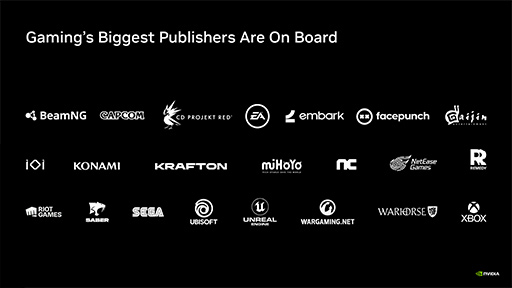
Partners such as CD PROJEKT RED, KRAFTON, Riot Games, Ubisoft, and Xbox have all expanded their long-term framework agreements with NVIDIA, signaling that upcoming software pipelines will be built natively around Streamline SDK and RTX tooling from day one.
Future Outlook
As Gamescom 2026 draws to a close, NVIDIA’s roadmap points toward a fully integrated, AI-centric gaming ecosystem. With DLSS 4.5 rolling out to early adopters via the NVIDIA App, and tools like RTX Remix empowering independent modders to breathe new life into legacy codebases, the historical barriers to high-fidelity graphics are rapidly evaporating.
Looking forward to 2027 and beyond, titles like Aniimo and the continuous updates to live-service giants like PUBG and CONTROL Resonant will test the limits of what localized and cloud-based AI can achieve. If NVIDIA’s Gamescom presentation is any indication, the next era of gaming will not merely look better—it will think, adapt, and respond with an unprecedented level of intelligence.






Belum ada komentar. Jadilah yang pertama berkomentar!