


Executive Overview
The landscape of desktop computing and high-end digital entertainment is undergoing a seismic transformation. For decades, the Mac ecosystem—despite its reputation for powerhouse performance, sleek design, and dominance in creative industries—has occupied a frustratingly sidelined position within the multi-billion-dollar PC gaming market. Historically, Mac users have faced a persistent deficit: AAA blockbuster titles either bypassed macOS completely or trickled onto the platform months, sometimes years, after their initial PC and console debuts, often hamstrung by lackluster optimization and poor architectural porting.
However, the upcoming release of Crimson Desert—developed by renowned South Korean studio Pearl Abyss—is poised to systematically dismantle this historical narrative.
Scheduled for release on March 19, Crimson Desert is not merely coming to the Mac; it is launching day-and-date alongside versions for Windows PC, PlayStation 5, and Xbox Series X|S. This simultaneous multi-platform rollout represents a monumental watershed moment for Apple’s silicon strategy. It validates years of aggressive hardware engineering and software evangelism by Apple, proving that the company’s proprietary M-series architecture—bolstered by advanced custom graphics toolkits—can stand shoulder-to-shoulder with traditional Windows-based gaming rigs and dedicated home consoles.
As Apple prepares to unveil its latest hardware iterations, including anticipated MacBook models powered by cutting-edge M5-family processors, Crimson Desert stands as the definitive litmus test for modern macOS gaming. Priced at $69.99 for the Standard Edition and $79.99 for the Deluxe Edition via Steam, this high-stakes open-world action-adventure is more than just a new entertainment option—it is the tip of the spear for Apple’s calculated push to turn the Mac into a first-class gaming destination.
Detailed Chronology: From Whispers to a Day-One Reality
To fully understand the gravity of Crimson Desert launching on macOS, one must examine the painstaking, years-long evolution of Apple’s gaming initiatives and Pearl Abyss’s development pipeline.

The Genesis of a Technological Partnership
The trajectory toward this historic March 19 launch began in earnest long before developer Pearl Abyss officially stamped the calendar. For years, Apple quietly laid the groundwork for high-end gaming by pivoting away from aging Intel processors toward its own ultra-efficient Apple Silicon. With the introduction of the M1, M2, M3, and M4 chip architectures, Apple baked dedicated hardware-accelerated ray tracing, unified memory architecture (UMA), and powerful integrated graphics pipelines directly into every consumer and professional device it shipped.
Despite this hardware foundation, skepticism remained rampant among core gamers and software developers. The turning point occurred in the summer of 2025. During a major platform showcase, Apple officially pulled back the curtain on a slate of nine major upcoming gaming debuts slated for macOS. Among the marquee announcements was Crimson Desert, signaling that Pearl Abyss—a studio globally celebrated for its technical wizardry and massive multiplayer worlds—was actively building a native Mac version utilizing Apple’s proprietary graphics APIs.
The Long Road to March 19
Initially unveiled as an ambitious spin-off within the Black Desert universe before pivoting into a standalone, single-player open-world action-epic, Crimson Desert has endured a notoriously complex development cycle. Delayed multiple times as Pearl Abyss refined its proprietary BlackSpace Engine, the game transitioned from a vaporware concern into one of the most visually staggering projects in modern video game history.
Throughout late 2025 and early 2026, tech enthusiasts scrutinized every piece of telemetry emerging from Apple and Pearl Abyss. Unlike historical Mac ports that relied on resource-heavy emulation layers like Apple’s Game Porting Toolkit or third-party wrappers, Crimson Desert was developed with native macOS integration in mind from a remarkably early stage.
The convergence of these timelines culminates this month. While next week promises a flurry of hardware announcements from Apple—including refreshed MacBook portfolios—the true focal point for the digital entertainment community is March 19. On this single day, the barrier that traditionally isolated Mac users from the global cultural conversation surrounding major gaming releases will officially crumble.

Supporting Context & Metrics: Under the Hood of Apple Silicon
The viability of a sprawling, graphically demanding AAA title like Crimson Desert on macOS is not an accident of good fortune; it is the direct result of deliberate, deeply integrated hardware and software engineering choices made by Apple over the past half-decade.
The Power of MetalFX Upscaling and Ray Tracing
Running an expansive, photorealistic open-world game requires immense computational throughput. Apple achieved parity with Windows platforms by leaning heavily into its custom graphics framework, Metal.
Specifically, Crimson Desert leverages MetalFX Upscaling, Apple’s proprietary spatial and temporal upscaling technology. Similar to NVIDIA’s DLSS or AMD’s FSR, MetalFX allows the game to render at a lower internal resolution before intelligently reconstructing the image to crisp 4key fidelity. This process drastically reduces the load on the GPU while preserving visual clarity, ensuring smooth frame rates even during chaotic, spell-slinging combat sequences.
Furthermore, Apple’s incorporation of hardware-accelerated ray tracing into the M3 and M4 chip families plays an indispensable role. In Crimson Desert, ray tracing governs complex lighting interactions, hyper-realistic shadows, and dynamic reflections across wet surfaces, armor, and sprawling landscapes. Because Apple Silicon features a unified memory architecture—where the CPU, GPU, and neural engine share a single, ultra-high-bandwidth pool of RAM—the game can stream massive textures and open-world assets instantly without the latency bottlenecks traditionally plaguing discrete desktop graphics cards.
System Requirements and Financial Commitments
Prospective players eager to dive into the war-torn continent of Pywel on their Macs must ensure their hardware meets the rigorous specifications outlined by Pearl Abyss. While optimization is stellar, the game demands modern silicon:
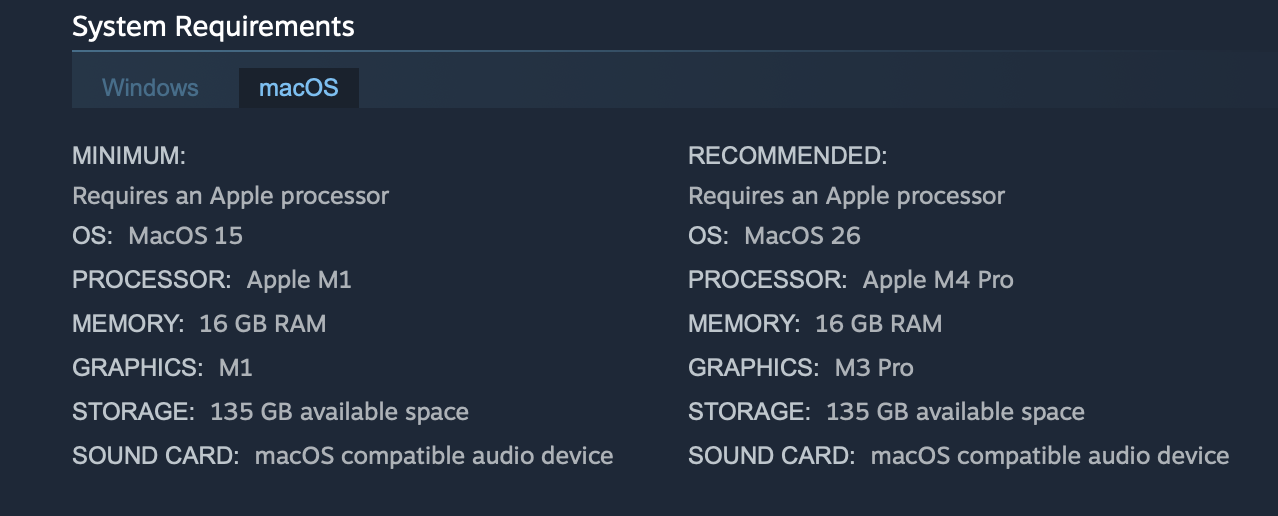
- Operating System: macOS Sequoia or later
- Processor (CPU): Apple M3 family or Apple M4 family (with specific requirements scaling upward for Pro, Max, and Ultra variants)
- Memory (RAM): Unified Memory starting at baseline requirements, with higher tiers recommended for maximum texture fidelity.
- Storage: Substantial SSD storage space (matching the massive asset footprints seen on PC and console editions).
Gamers can already pre-order Crimson Desert via Steam, with the Standard Edition retailing at $69.99 and the Deluxe Edition commanding $79.99. This pricing strategy confirms that Pearl Abyss and major publishers view the Mac consumer base not as an afterthought or a budget market, but as a premium audience willing to pay full price for top-tier digital entertainment experiences.
Official Statements and Industry Implications
The ripple effects of a day-one AAA macOS release extend far beyond a single video game. Industry analysts, software developers, and executive leadership at Apple view Crimson Desert as a foundational proof-of-concept.
Pearl Abyss’s Technical Ambition
Pearl Abyss has long prided itself on pushing the bleeding edge of technological fidelity. In statements surrounding the game’s engine capabilities, studio representatives have emphasized that the BlackSpace Engine was explicitly built to scale across diverse hardware topologies without compromising artistic vision.
"Our goal with Crimson Desert was to construct a living, breathing world that reacts dynamically to the player’s choices and actions," lead development leads noted during past technical briefings. "Bringing this level of fidelity to macOS required close collaboration with platform engineers. Apple’s modern graphics architecture and unified memory model allowed our technical teams to achieve performance parity on the Mac that would have been unimaginable just a few years ago."
Apple’s Strategic Pivot
For Apple, the arrival of Crimson Desert represents the culmination of a multi-year evangelism campaign. For decades, critics pointed to the "Mac gaming tax"—the historical reality that Macs were productivity powerhouses unequipped for modern entertainment.

By actively courting AAA studios, providing robust developer toolkits, and highlighting games like Crimson Desert during keynote presentations and hardware launches, Apple is systematically rewriting its brand identity. No longer content with being the undisputed king of video editing, music production, and software development, Apple is aggressively carving out territory in the high-performance gaming sector.
Industry observers note that the timing of this release—bookending an anticipated wave of M5-powered Mac hardware announcements—is a masterclass in product synergy. By demonstrating that unreleased or brand-new hardware can instantly run the most graphically demanding game of the season, Apple creates an irresistible value proposition for prosumers and enthusiasts alike.
Future Outlook: A New Dawn for Mac Entertainment?
As the countdown to March 19 ticks away, the broader implications for the video game industry are becoming increasingly clear. Crimson Desert is not operating in a vacuum; it arrives on the heels of other major conversions and stands alongside a curated pipeline of high-end titles slated for Apple platforms.
What This Means for Future AAA Development
The success or failure of Crimson Desert on macOS will likely dictate the calculus for other major third-party publishers currently sitting on the fence. For years, game executives hesitated to invest the capital required to port complex C++ and custom-engine games to macOS due to a perceived lack of an addressable market and architectural friction.
If Crimson Desert achieves strong day-one sales figures and critical acclaim on the Mac App Store and Steam for macOS, it will shatter those lingering executive hesitations. It proves unequivocally that Mac owners do buy AAA games when they are delivered on time, at parity, and with uncompromised quality.

The Road Ahead
We are standing on the precipice of a new era for desktop computing. The old dichotomy—where users were forced to maintain a dedicated Windows PC for gaming while relying on a MacBook for professional workflows—is slowly dissolving.
As Apple Silicon continues its relentless upward march in performance-per-watt efficiency, raw computational power, and advanced ray-tracing capabilities, the hardware excuses for ignoring the Mac have officially expired. On March 19, when Mac users step into the unforgiving, beautiful open world of Crimson Desert right alongside their PC and console counterparts, it will mark the permanent end of an era—and the dawn of a truly unified gaming future.








Belum ada komentar. Jadilah yang pertama berkomentar!