

Executive Overview
The opening ten minutes of Don’t Look Back in Anger—the sprawling, chaotic new documentary chronicling the life, death, and resurrection of Britain’s most combustible musical export—offer a masterclass in direct, unflinching narrative pacing. Directorially, there is no sugarcoating the catastrophic, ego-driven implosion that brought Oasis to a screeching halt in the backstage dressing rooms of Paris’s Rock En Seine festival in August 2009. Archival footage immediately thrusts viewers back into that surreal, tense atmosphere, capturing the hapless festival announcer forced to break the news to a confused, booing crowd that Noel and Liam had traded blows once more, the band was finished on the spot, and the headlining slot was permanently cancelled.
From that terminal low point, the documentary logically has only one place to go: forward toward the miraculous, highly lucrative, and deeply scrutinized 2025 reunion. Yet, the filmmakers seem determined to take the most meandering, unfocused route possible to reach that inevitable destination.
In truth, even at the height of their 1990s imperial phase, Oasis albums were notoriously overlong, packed with B-sides and album tracks that could have benefited from a ruthless editorial trim. Don’t Look Back in Anger suffers from that exact same structural bloat. Even the most fanatical, blinkered devotees will find themselves spotting calorie-free cuts that could have been trimmed to create a far leaner, more muscular cinematic work. Despite this, the film maintains a relentless, undeniable optimism.
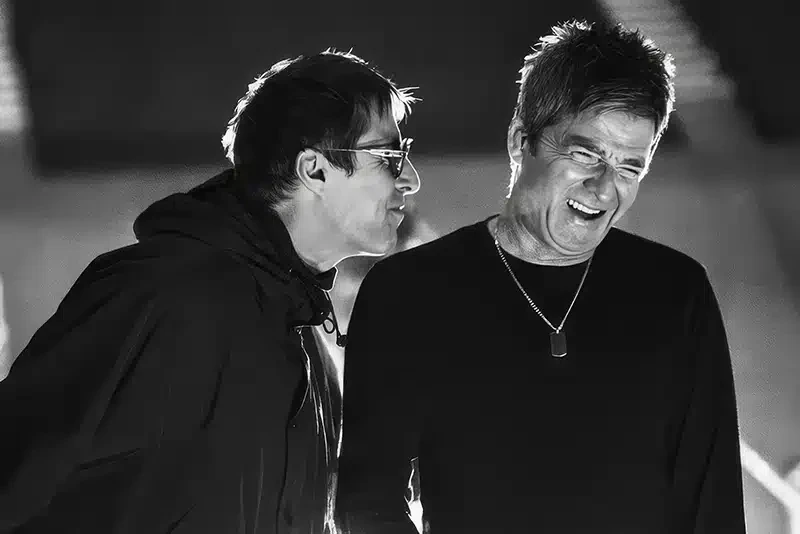
The documentary is single-handedly saved from becoming a tedious cinematic endurance test by its two irrepressible subjects. Every time Noel or Liam open their mouths, they reaffirm their status as a filmmaker’s dream—brimming with sharp wit, quotable observations, and an innate, unpretentious poeticism. While the film frequently trips over its own ambitious feet, attempting to wear too many hats at once, the sheer gravitational pull of the Gallagher brothers ensures that it remains an essential, if frustrating, watch for music aficionados.
Detailed Chronology
The Anatomy of a Breakup and the Mystery of the Reunion
The documentary’s structural challenges stem largely from its identity crisis. It attempts to function simultaneously as a straightforward concert film, a backstage rehearsal and interview compilation, a sociological study of global fandom, and a grandiose historical essay attempting to tie Oasis’s cultural footprint to the turbulent geopolitical landscape of the past two decades.
This multi-pronged approach results in a breathless, disjointed chronology. The film breezes past the delicate diplomacy and financial negotiations that led to the band agreeing to bury the hatchet. While pre-breakup sibling rivalry is well-documented territory, the film misses a trick by omitting their comedic, caustic social media skirmishes and post-2009 interview highlights. The underlying suspicion lingers—hinted at playfully through the subtext of the edit—that the reunion was catalysed by a combination of Noel’s high-profile, expensive divorce in early 2023 and a massive, generational financial payout.
Into the Rehearsal Room: Tension and Triumph
Following this fast-footed narrative leap, the documentary offers a tantalizingly brief look into the band’s rehearsal spaces. We see the core creative unit—Noel and Liam, alongside guitarists Paul "Bonehead" Arthurs and Gem Archer, bassist Andy Bell, and drummer Joey Waronker—feeling their way back into the sonic architecture of their classic catalog.
This section represents some of the film’s finest cinematography. The pristine sound design allows the audience to hear the individual musical shapes within each song, highlighting the dynamic interplay between veteran musicians. Watching Noel in an intimate studio environment, performing a stripped-down acoustic rendition of a trademark tune, reminds viewers of his underrated, ear-worm melodic genius.
The dramatic narrative truly ignites with Liam’s arrival on day two of rehearsals. The room shifts instantly; the band members appear simultaneously nervous and visibly pleased to see him. True to form, Liam plays the part of the difficult rock star—casually flicking a bottle cap toward the camera while pulling a face of utter disdain.
Yet, when the film features a clip of Noel praising Liam for "not giving a fuck," Liam delivers a sharp voiceover counter-narrative. He explains that the opposite is true: he cares profoundly about the music, noting that "it takes a lot of caring to not give a fuck." The visible tension between the semi-reconciled brothers, coupled with Liam’s aggressive, throat-shredding vocal takes, makes for riveting, high-stakes cinema.
The Cardiff Comeback: Black Magic and Sibling Estrangement
Before the viewer can fully digest the studio dynamic, the film transports us to July 4, 2025, at the opening comeback gig in Cardiff. The audio design here is particularly striking: the roar of an expectant, riled-up stadium audience contrasts sharply with the dead silence of the backstage loading bay. It creates a palpable sense of the psychological pressure-cooker facing musicians who are desperately hoping not to implode on international television.
In a retrospective interview, Noel candidly admits that his primary character flaw is an inability to forgive those who have wronged him. Walking out onto the Cardiff stage, that historic divide remains visibly etched in their body language. Liam, hyper-aware of the ecstatic crowd, attempts to throw an arm around a completely stiff, indifferent Noel, who refuses to acknowledge the gesture. When Liam forcibly grabs his brother’s arm to raise their hands in unity, tension peaks; viewers half expect Noel to violently jerk away before they have even reached their stage positions.
Yet, the moment the band strikes up the opening chords of "Hello," the arena detonates. The resulting sequence is pure, transcendent chaos. Backstage after the show, a still-wired Noel describes his brother’s vocal performance as an act of "black magic sorcery"—a moment that somehow reversed time thirty years, resurrecting the defiantly beautiful voice of his younger self.
Supporting Context & Metrics
The Fan-Centric Flaw
Despite these moments of genuine cinematic gold, Don’t Look Back in Anger falls into the oldest cliché in the music documentary playbook: over-indexing on archival footage of fans. Roughly half of the film’s runtime is consumed by shots of devotees outside venues, tearful concertgoers, and vox-pops detailing personal connections to the band’s music.
While the sentiment—acknowledging that a band is nothing without its audience—is undeniably true, devoting the majority of the runtime to generic crowd scenes asks too much of an audience. The film relies heavily on geographical shorthand to prove global impact, jumping from country to country to show weeping, howling masses. These moments bypass original critical commentary in favor of emotional manipulation, utilizing default tropes—children, animals, and personal trauma recovery narratives—to manufacture cheap tears.
The Manchester Anthem
One poignant exception to this formula involves the adoption of "Don’t Look Back in Anger" as an anthem of resilience for Manchester following the tragic 2017 arena bombing. The song became a cultural shield, refusing to let the violence of extremists justify further hatred.
Addressing this cultural phenomenon on camera, Noel firmly contextualizes the ethos of his songwriting:
"It’s not some fucking right-wing thing. All are welcome. It’s all about ‘we’ and ‘us’."
This inherent hopefulness has always been Oasis’s greatest redeeming quality, transcending the tabloid drama of its creators.
Official Statements
While traditional press junkets surrounding the reunion have been tightly managed, both Gallagher brothers have offered illuminating insights into the documentary’s creation and the realities of their 2025 return.
- Noel Gallagher, on the band’s cultural legacy:
"I knew early on that I was never going to match that initial streak of fire that made my name as a songwriter. You accept that, and you just try to steer the ship without crashing it into the rocks again."
- Liam Gallagher, on the physical demands of rock longevity:
"Look at poor ol’ Mick Jagger, still prancing about at 83 every single night. We aren’t built for a static, boring stage show. When we go out there, we go to make some noise."
- The Directors, on capturing the reunion dynamic:
"You could feel the electricity in the room from the moment they walked into the same building. The challenge wasn’t finding drama; it was containing it within a coherent two-hour narrative."
Future Outlook
As Oasis embarks on the next phase of their monumental reunion era, Don’t Look Back in Anger serves as a flawed yet fascinating artifact of their cultural persistence. Financially and commercially, the reunion has shattered box office and ticketing records, proving that public appetite for the Gallagher brothers’ distinct brand of British rock remains unquenched.
Culturally, the film demonstrates that while Oasis may never recapture the innocent, lightning-in-a-bottle magic of 1995, their enduring appeal lies in the friction of their coexistence. For future filmmakers wishing to tackle the Oasis phenomenon, the lesson of this documentary is clear: trim the fat, remove the generic sociological padding, and simply point the camera at Noel and Liam. In the end, nobody tells the story of Oasis better than the two men who built it—and nearly burned it to the ground.






Belum ada komentar. Jadilah yang pertama berkomentar!