

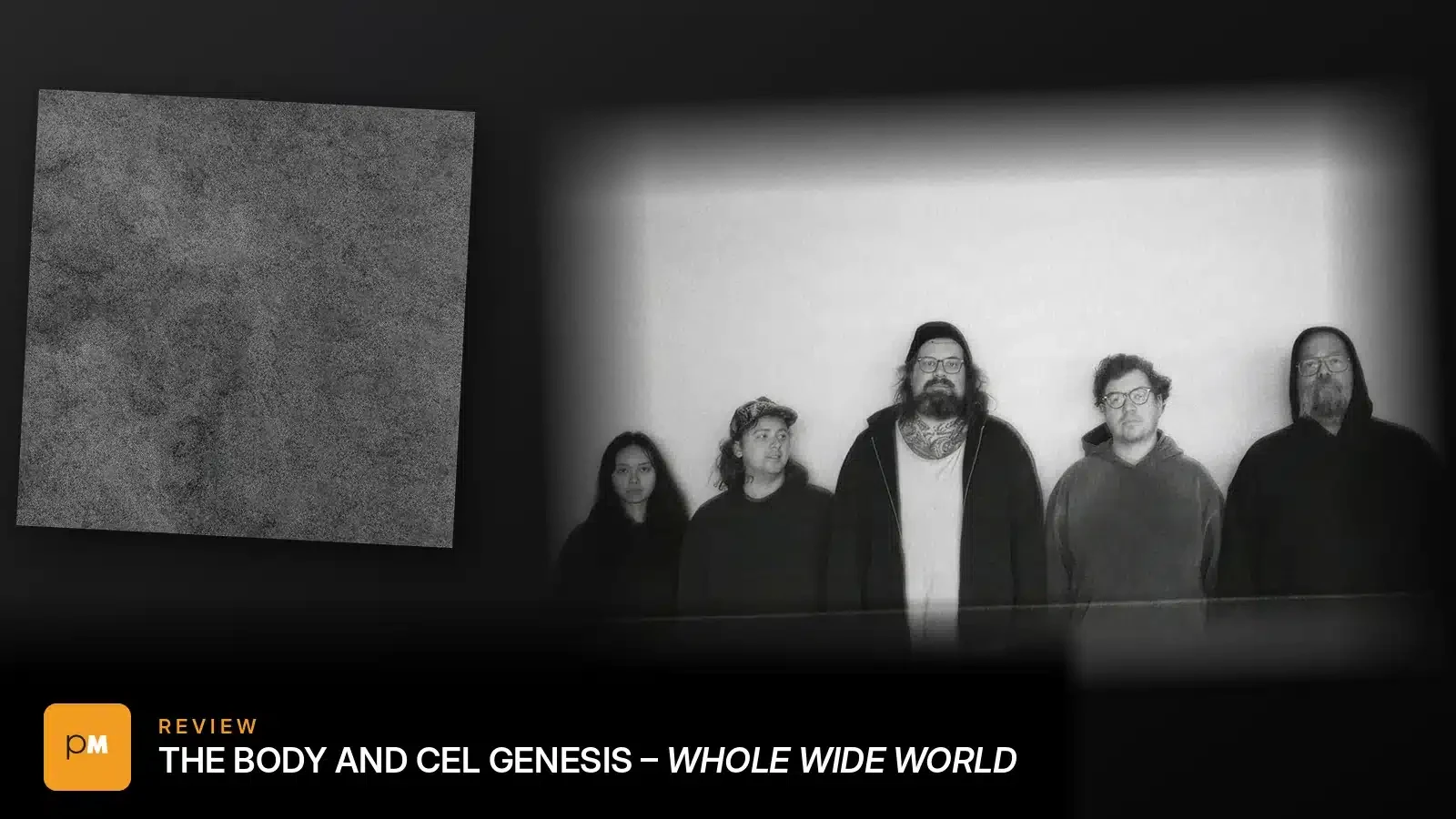
Executive Overview
In the sprawling, often insular landscape of extreme contemporary music, few releases arrive with the unyielding, apocalyptic friction of Whole Wide World. Released via Thrill Jockey, the collaborative effort between experimental metal stalwarts The Body and electronic disruptor Cel Genesis is, at first encounter, a terrifying sonic monolith. The record sounds like an intentional, catastrophic mess. Its vocals are almost continuously screamed at the edge of human capacity, its mix is persistently pushed far beyond the red line of digital and analog audio distortion, and its tonal palette is so unremittingly hostile that standard descriptors like "abrasive" or "harsh" feel wholly inadequate.
Yet, beneath this violent, roaring facade lies a paradox: a deeply methodical, structurally rigorous, and oddly orderly sonic blitzkrieg anchored by a deceptively classical rock-and-roll apparatus—two drummers.
Whole Wide World is not merely an album; it is a meticulous exercise in structural demolition disguised as unhinged chaos. By bridging the colossal, subterranean gravity of experimental metal with the hypnotic, kinetic pulse of techno and industrial music, creators Lee Buford (The Body) and Nick Cowman (Cel Genesis) have constructed a world where irreconcilable sounds violently collide until their boundaries completely dissolve. This article examines the anatomy of that collision, tracing the origins of the collaboration, the mechanics of its dual-drum architecture, the painstaking production processes that birthed it, and its significant implications for the future of heavy electronic music.
Detailed Chronology: The Genesis of a Noise Empire
The story of Whole Wide World is one of cross-pollination, patience, and mutual sonic fascination. While The Body has spent decades redefining the outer limits of doom metal, sludge, and electronic noise—collaborating with everyone from full choirs to ambient soundscapers—their partnership with Cel Genesis represents a distinct evolutionary leap.
The Seeds of Collaboration
The initial spark for the project began long before the master files reached Thrill Jockey. Nick Cowman, operating under the moniker Cel Genesis, had been quietly dismantling and rebuilding electronic rhythms through a lens that favored texture, physical weight, and relentless repetition over traditional dancefloor structures. Lee Buford, meanwhile, was searching for ways to stretch The Body’s foundational rhythmic framework outside the standard parameters of guitar-and-drum arrangements.
The two artists began trading audio files across distances, a digital exchange that gradually transformed into an intensive, multi-session workshop. Rather than relying on simple file-sharing where one artist finished a track and sent it to the other for overdubs, Buford and Cowman engaged in a deeply reciprocal editorial loop. Cel Genesis supplied raw electronic foundations—pulses, synth patches, and foundational loops—while Buford, alongside contributing collaborators, tracked live acoustic drums.
The Editing Phase: Joyful Destruction
What makes the chronology of Whole Wide World fascinating is the inversion of traditional recording psychology. Typically, meticulous editing is associated with sterile perfectionism or the sanitization of a performance. Here, meticulous editing was deployed in the service of total, joyful destruction.
Over multiple studio sessions, the pair tore into each other’s contributions. They rearranged structures, chopped up live acoustic takes to mimic programmed sequences, and forced electronic pulses to grind against organic skin-and-metal percussion. What began as a series of disparate experimentations slowly cohered into a unified artistic statement. According to those close to the sessions, the creation of the album—despite the bleakness of the resulting music—was characterized by a profound sense of liberation and joy. The pleasure lay precisely in the friction: the ongoing discovery that two seemingly incompatible musical worlds could not only occupy the same physical space, but actually elevate one another.
Supporting Context & Metrics: The Anatomy of Double Drumming and Distortion
To understand the sonic architecture of Whole Wide World, one must examine the lineage of its most striking feature: the dual-drum attack. The history of rock, jazz, and experimental music contains various philosophies on how two percussionists can share a single space. Buford and Cowman’s approach on this record does not neatly align with any single historical precedent; instead, it synthesizes several radical traditions at once.
Historical Precedents of Dual Percussion
- The Psych-Rock Dialogue: In their full-on, far-out psychedelic pomp, Bill Kreutzmann and Mickey Hart of the Grateful Dead turned the relationship between two drummers into an intricate, conversational musical language. They played around and through one another, creating a sprawling canvas of polyrhythms.
- The Functional Shift: In James Brown’s legendary rhythm sections, master funk drummers Clyde Stubblefield and Jabo Starks took turns or locked in depending on what served the pocket, ensuring the groove remained unbreakable and hyper-syncopated.
- The Physical Overload: The Melvins famously utilized two drummers to transform percussion into something physically crushing, turning the stage into an arena of sonic bludgeoning.
Whole Wide World manages to synthesize all three impulses simultaneously. Lee Buford and Nick Cowman do not sound like two musicians simply doubling the same beat in unison. Instead, a distinct division of labor emerges across the tracks:

- The Primitive Heavy-Metal Pulse: One drum stream provides the low-end thump characteristic of The Melvins or traditional doom metal—a persistent, foundational heartbeat that anchors the entire mix in physical space.
- The Electronic Breakbeat: Against this heavy foundation, the other stream supplies intricate, jittery James Brown-style breakbeats. Initially, these rhythms sound mechanical and programmed, but as they weave through the distortion, they take on a chilling, organic vitality.
+-----------------------------------------------------------------+
|                    DUAL-DRUM ARCHITECTURE                       |
+---------------------------------+-------------------------------+
|       LEO BUFORD (Acoustic)     |     NICK COWMAN (Electronic)  |
+---------------------------------+-------------------------------+
| • Heavy-metal low-end thump     | • Intricate breakbeats        |
| • Primitive, tectonic weight    | • Metronomic industrial pulse |
| • Physical foundation           | • Shifting, chromatic color   |
+---------------------------------+-------------------------------+
The Synthesizer as Machinery
Equally critical to the album’s illusion of chaos is the treatment of synthesizers. On conventional electronic or rock records, synths often provide harmonic decoration, atmosphere, or melodic relief. On Whole Wide World, they are stripped down to their most brutal, physical qualities.
The low-frequency pulses repeat with the metronomic, unfeeling regularity of heavy industrial machinery. Elements that would normally act as "musical glue"—pads, chords, or melodic bridges—are systematically absorbed into an overwhelmingly percussive sound world. The distortion is pushed so far into the red that frequency ranges begin to bleed into one another, creating a wall of sound where individual instruments sacrifice their autonomy for the greater good of the sonic onslaught.
Official Statements and Critical Perspectives
The release of Whole Wide World has prompted widespread discussion among critics and fans of extreme music, particularly concerning how the record navigates the emotional tightrope between despair and exhilaration.
In promotional materials and early critical assessments from outlets like PopMatters, the record has been framed not as a nihilistic exercise, but as a surprisingly life-affirming document. The thematic undercurrents of the songs confront heavy, difficult subjects: nostalgia, lost hope, the death of possibility, and the crushing weight of modern existence. Yet, the execution of the music stands in stark, defiant contradiction to those themes.
"The music itself feels like an argument for possibility," notes the critical consensus surrounding the release. "Take the distortion further, make the drums heavier, push the electronics harder, and see what survives."
This sentiment encapsulates the core ethos of both The Body and Cel Genesis. For decades, Lee Buford has operated under the assumption that beauty in heavy music is often found on the other side of total aesthetic exhaustion. By partnering with Cel Genesis, that philosophy has been supercharged. The resulting statements from the creators emphasize that the album was never intended to be a comfortable listen; it is an endurance test designed to awaken the listener through sheer sonic intensity.
Future Outlook: Redefining the Boundaries of Heavy Electronic Music
As the shockwaves of Whole Wide World continue to ripple through the underground and experimental music communities, its long-term implications are becoming clear. The record arrives at a time when the traditional boundaries separating guitar-based heavy metal, industrial noise, and club-oriented techno are increasingly porous. Artists are no longer content to stay within stylistic silos, but the success of such crossovers depends entirely on execution.
Blurring Genre Lines
Whole Wide World offers a masterclass in true integration. It avoids the common pitfall of "collaboration albums"—where two distinct artists simply append their respective sounds to alternating tracks—and instead forces a genuine chemical reaction. By melting the physical weight of experimental metal together with the rhythmic intelligence and obsession with repetition found in techno, Buford and Cowman have mapped out a new blueprint for extreme music.
What Lies Ahead?
For The Body, this release further cements their status as the premier shape-shifters of heavy music, proving that after numerous acclaimed collaborations, they are still capable of reinventing their core mechanics. For Cel Genesis, the album serves as a definitive breakout moment, introducing a wider audience to a unique approach to sound design that treats rhythm as a physical bludgeon.
Looking forward, the influence of Whole Wide World is likely to be felt across the broader experimental landscape. As producers and instrumentalists look for ways to make electronic music heavier and metal music more rhythmically dynamic, they will inevitably return to this masterclass in controlled chaos. It proves that with enough vision, patience, and a willingness to embrace total sonic destruction, even the most discordant elements can be forged into something vital, enduring, and strangely triumphant.








Belum ada komentar. Jadilah yang pertama berkomentar!