

Executive Overview
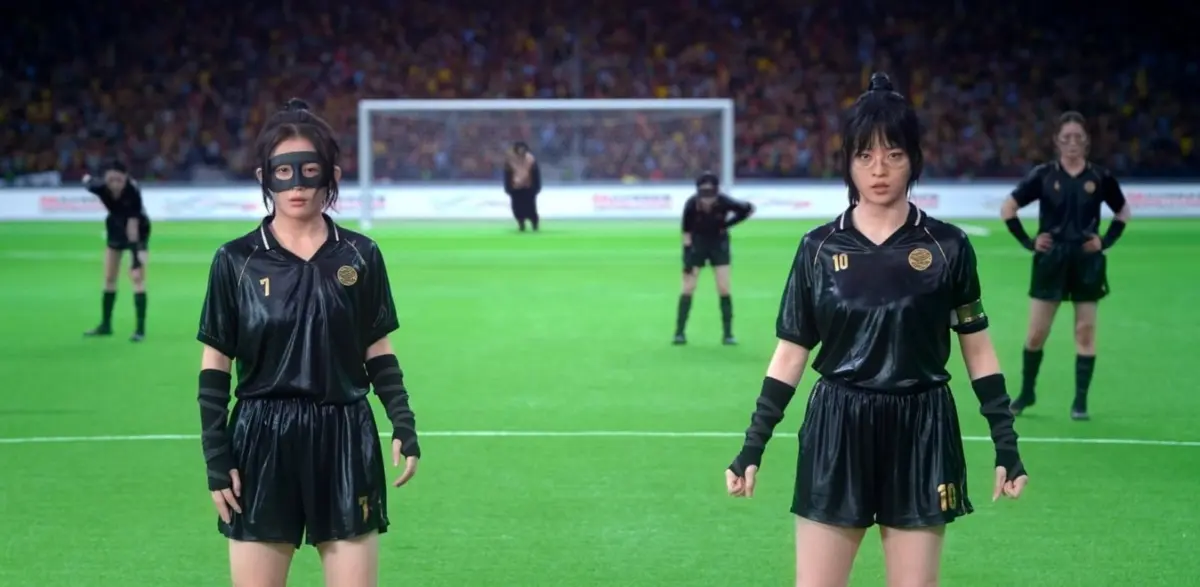
Two decades after the international phenomenon Shaolin Soccer cemented legendary Hong Kong filmmaker Stephen Chow as a master of high-energy, absurdist martial arts cinema, the auteur has returned to the pitch. Released in 2026, Kung Fu Soccer acts as a spiritual successor to his earlier triumph, pivoting the comedic lens from a down-on-their-luck men’s squad to the high-stakes, hyper-kinetic world of the Asian Women’s Champions League.
Directed by Chow and starring a powerhouse pan-Asian cast featuring Zhang Xiaofei, Dilraba Dilmurat, Lay Zhang, Carina Lau, and Takeru Satoh, the film leans heavily into Chow’s signature Mo Lei Tau (無厘頭) aesthetic. Translating roughly to "making no sense" or "coming from nowhere," this Cantonese comedic style treats logic as an afterthought, opting instead for relentless, gag-driven chaos where physical comedy, slapstick, and martial arts collide.
Yet, Kung Fu Soccer arrives as a paradoxical cinematic entry. While its comedic set pieces and breakneck pacing deliver moments of laugh-out-loud brilliance and visceral, wincing practical effects, the film struggles beneath the weight of its own narrative thinness. Sacrificing deep thematic exploration and character development for rapid-fire gags, Chow delivers a production that functions less like a cohesive narrative feature and more like a dazzling, disjointed reel of high-concept sketches. This review breaks down the trajectory, thematic missteps, technical accomplishments, and cultural resonance of one of the most eccentric cinematic releases of 2026.
Detailed Chronology: The Rise and Fall of the Emei Underdogs
The Underdog Ascent
The narrative core of Kung Fu Soccer centers upon the Emei team, a women’s football squad entering the grueling arena of the Asian Women’s Champions League. Initially dismissed by pundits, rival organizations, and betting markets alike, the team is completely unfavored. However, their fortunes transform when captain Shuangshuang—brought to life with grounded determination by Zhang Xiaofei—receives clandestine assistance from her estranged senior brother, Xu Feng (played by Lay Zhang).
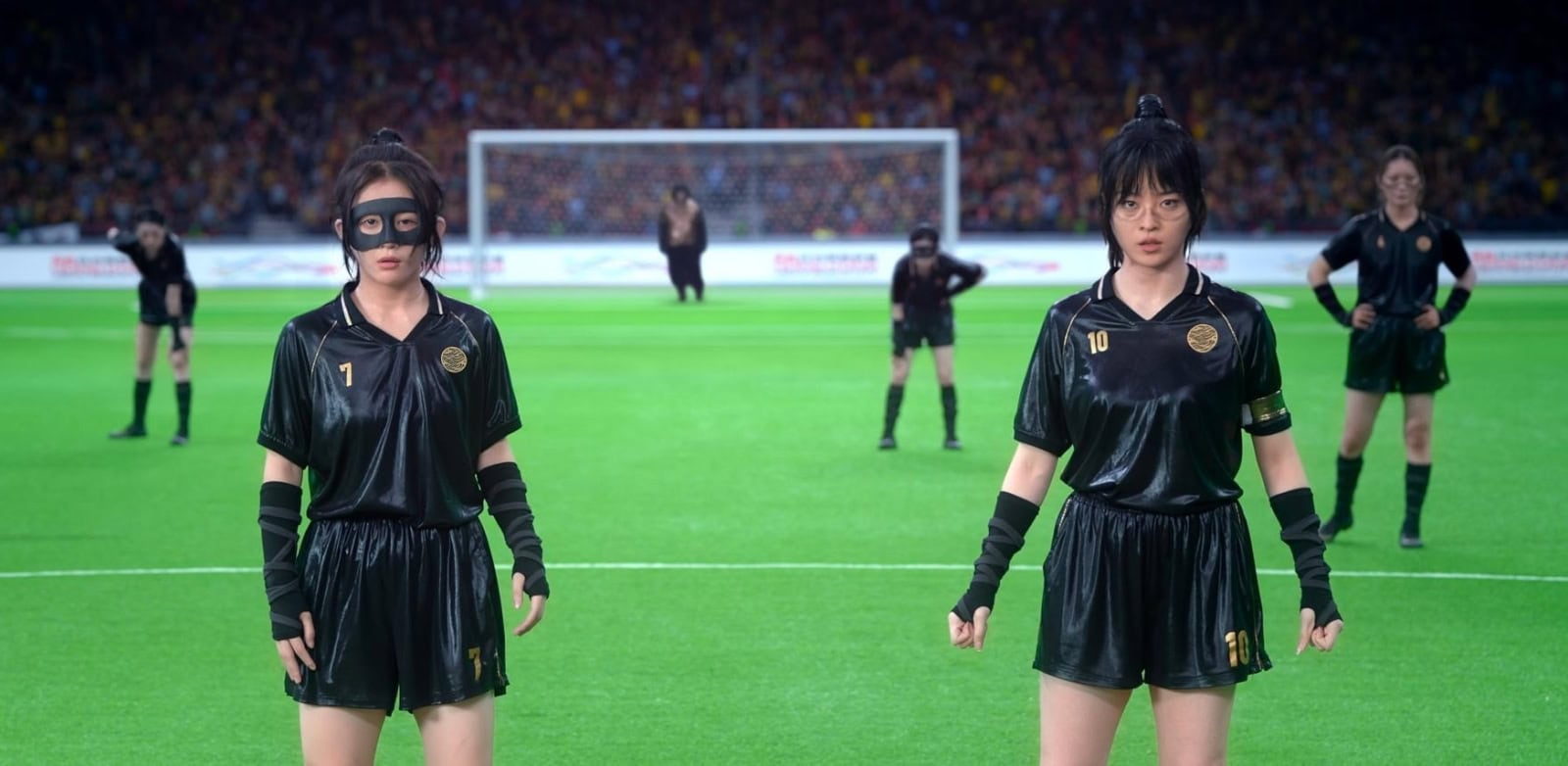
Empowered by Xu Feng’s martial arts tutelage, the Emei players become practically invincible on the pitch. The early matches are a masterclass in Chow’s trademark escalation: opposing players are physically blown backward by the sheer velocity of Emei’s strikes, bodies fly across the turf in gravity-defying arcs, and conventional soccer strategy is entirely supplanted by ancient kung fu disciplines.
The Rift and the Rivals
Despite their soaring success, the Emei team’s momentum is threatened by internal strife. A bitter dispute fractures the fragile alliance between Shuangshuang and Xu Feng, leading the latter to orchestrate a dramatic heel turn. Xu Feng transforms from an invaluable mentor into a formidable adversary, leaving the Emei team to navigate the remainder of the tournament without their secret weapon.
Along the way, the tournament introduces an array of eccentric opponents designed to test the limits of Chow’s comedic imagination. Notable among them is Team Ewha, an opposing squad that weaponizes psychological manipulation, distraction tactics, and a provocative reliance on conventional beauty standards to bend the referee’s decisions in their favor. The narrative builds toward an inevitable, high-stakes final boss showdown against an elite, highly coordinated Japanese team, serving as the ultimate test of Emei’s martial arts prowess and psychological resilience.
Supporting Context & Metrics: The Mo Lei Tau Tradition and Its Discontents
The Legacy of Stephen Chow’s Comedy
To understand Kung Fu Soccer, one must contextualize Stephen Chow’s historic footprint in global cinema. While icons like Jackie Lee and Bruce Lee popularized martial arts through earnest action or dramatic choreography, Chow weaponized comedy to subvert the genre. Works like Shaolin Soccer (2001) and Kung Fu Hustle (2004) bridged a cultural gap, finding unprecedented international audiences through major studio acquisitions by Miramax and Columbia Pictures, respectively.

Mo Lei Tau relies on absolute subversion of expectation. In Kung Fu Soccer, this philosophy dictates that everything is a potential punchline. The film treats physical trauma, sports officiating, geopolitical rivalries, and romantic subplots with the exact same level of irreverent absurdity. A sequence featuring a player inadvertently swallowing her own shattered tooth is both viscerally repulsive and undeniably hilarious—a testament to Chow’s ability to trigger simultaneous physical disgust and comedic delight.
The Missteps of Satire and Character Depth
However, the Mo Lei Tau approach comes with a steep creative tax. When every narrative beat is treated as a joke, the film lacks emotional anchor points. This is most acutely felt in its handling of gender dynamics. Shifting the focus from a male team to a women’s football league presented Chow with a golden opportunity to explore systemic disparities, institutional neglect, or the under-resourcing of women’s sports in a satirical framework. Instead, the film glosses over these realities, operating in a universe where women’s football commands the exact same cultural and financial weight as its male counterpart, completely bypassing the potential for sharp sociological commentary.
Furthermore, the character writing is glaringly skeletal:
- Shuangshuang (Zhang Xiaofei): Defined almost entirely by an over-the-board aversion to losing, her primary arc reduces a seasoned team captain to a one-note personality driven by a frantic need to rediscover her passion for the game.
- Jade (Dilraba Dilmurat): Co-lead Jade suffers an even more regressive arc. Initially depicted as having abandoned professional sports for the sake of a romantic relationship, her character only returns to the pitch after that relationship spectacularly collapses—reinforcing outdated tropes about women in sports.
- Xu Feng (Lay Zhang): As the sole character given any narrative arc, Xu Feng’s trajectory is ultimately frustrating. Lacking strong narrative foils, his sudden alignment shift feels less like a natural evolution of character motivations and more like a lazy, mechanical narrative device engineered to force plot progression between matches.
Official Statements and Production Insights
While major press junkets for Kung Fu Soccer have remained relatively tightly controlled, production notes and behind-the-scenes leaks emphasize Stephen Chow’s unwavering commitment to practical stunts blended with stylized digital augmentation.

Industry insiders noted that Chow spent months workshopping the choreography of the matches, ensuring that the physical comedy remained the anchor of the production. The film’s technical crew highlighted the deliberate decision to lean into "gnarly" practical effects—particularly regarding sports injuries—to maximize the audience’s visceral reaction.
Composer Raymond Wong, a frequent collaborator with Chow, addressed the musical identity of the project in pre-release interviews, emphasizing that the score was meticulously designed to evoke the nostalgic brass-and-percussion motifs of Kung Fu Hustle. Wong noted that the music was crafted to keep the audience’s adrenaline elevated, acting as the connective tissue bridging the film’s chaotic comedic set pieces.
Future Outlook: The Commercial and Cultural Impact of 2026’s Sports Comedy
As Kung Fu Soccer completes its theatrical run and transitions to streaming platforms, its long-term legacy within Stephen Chow’s filmography is becoming clear. It is unlikely to achieve the universally revered status of Kung Fu Hustle or the fresh, genre-defining novelty of the original Shaolin Soccer. The lack of narrative depth, underwritten female leads, and an over-reliance on episodic gag structures prevent it from reaching masterwork status.
Yet, the film proves that Chow’s directorial eye and comedic timing remain sharper than most working today. The action direction is relentless, the practical gag execution is fearless, and the sheer audacity of its cinematic choices guarantees that viewers will not easily forget it.

For international audiences and die-hard fans of Hong Kong cinema, Kung Fu Soccer offers a wildly entertaining, popcorn-munching spectacle. It is a film that demands to be viewed not with a critical eye for narrative structure, but with an open willingness to embrace cinematic absurdity. While it leaves a few too many goals unscored on the dramatic front, its chaotic, high-kick charm ensures it remains an undeniably fun ride.
Flickering Myth Rating:
- Film: ⭐️⭐️⭐️ (Out of 5)
- Movie: ⭐️⭐️⭐️⭐️ (Out of 5)
— By Robert Ewing







Belum ada komentar. Jadilah yang pertama berkomentar!