

Executive Overview
Sibling rivalries are a universal facet of the human experience, spanning continents, cultures, and socioeconomic backgrounds. Yet, few sibling relationships manifest with the institutionalized grandeur, geographic eccentricity, and dramatic flair of the enduring bond between Tokyo’s Sumida Ward and Taito Ward. Linked as official sister wards since 1977, these central Tokyo neighbors have spent decades cooperating on civic matters, cultural exchanges, and urban planning. However, beneath the polished veneer of municipal harmony lies a deeply competitive, fiercely territorial spirit.
Rather than channeling this rivalry through bureaucratic negotiations or zoning laws, the two wards have chosen a uniquely physical battlefield: the waters of the historic Sumida River. Since 2024, Sumida and Taito have convened annually for the Sumida River Tug-of-War Tournament (Sumida-gawa Tsunahiki Taikai), an event where civic pride, bragging rights, and symbolic sovereignty are physically dragged across the pedestrian span of the Sakurabashi Bridge.
While Tokyo’s metropolitan government maintains strict administrative oversight—ensuring that the boundary-shifting consequences of the tournament remain purely symbolic—the stakes feel entirely real to the participants and spectators. Following two consecutive years of defeat, during which Taito Ward successfully expanded its symbolic footprint by a cumulative two meters into traditionally Sumida territory, the upcoming November 15 tournament promises to be a high-tension rematch. Complete with localized team selections, a dramatic 13-match format to break ties, and live on-site color commentary courtesy of local high school broadcasters, this quirky municipal tradition has evolved into a beloved cultural spectacle that merges community engagement with the electrifying energy of a classic sports anime.
Detailed Chronology: The Evolution of the Sumida River Border War
Historical Roots and Sister Ward Diplomacy
To understand the whimsical nature of the Sumida River Tug-of-War Tournament, one must first examine the relationship between Sumida and Taito Wards. Established within Tokyo’s sprawling 23-ward special ward system, both municipalities boast rich histories deeply intertwined with the Edo period, traditional craft culture, tourism, and riverside commerce. Taito Ward houses historic cultural hubs like Asakusa and Ueno, while Sumida Ward proudly anchors the modern skyline with the towering presence of the Tokyo Skytree.
Despite their differing identities, the two wards formalized their partnership in 1977. For decades, this alliance manifested in conventional ways: joint disaster-preparedness drills, cultural showcases, and tourism initiatives. Yet, municipal leaders and community organizers recognized an underlying appetite for something more dynamic—a public-facing competition that could channel inter-ward competitive energy into a constructive, highly entertaining community tradition.
The Inception of the Bridge Battle (2024)
The primary logistical hurdle facing any territorial dispute between Sumida and Taito Wards is the physical barrier separating them: the Sumida River itself. Neither ward could realistically contest territory on solid ground without violating municipal law or disrupting dense urban neighborhoods. The solution lay suspended above the water: the Sakurabashi Bridge.
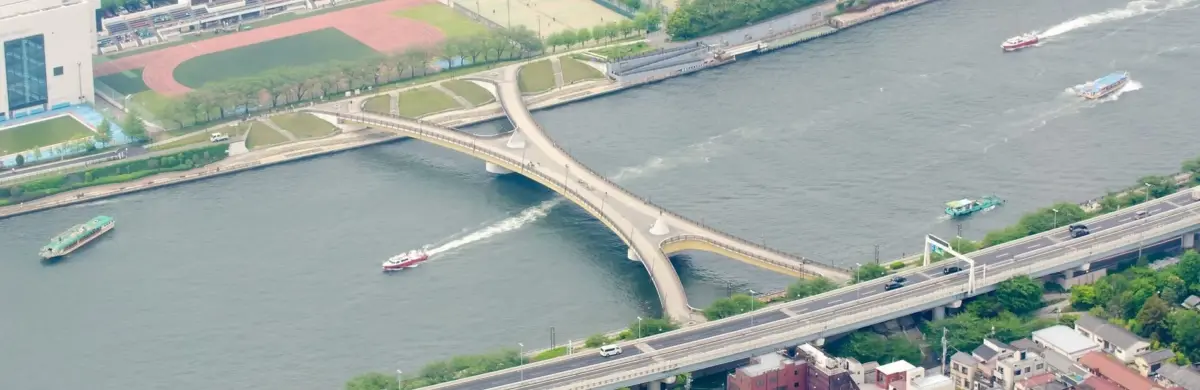
Built as a pedestrian-only bridge connecting the banks of both wards, Sakurabashi features a unique X-shape and boasts a precise mid-point that serves as one of the few publicly accessible convergence zones along their shared border. In 2024, organizers seized upon this geographic quirk to launch the inaugural Sumida River Tug-of-War Tournament.
The rules established during this inaugural event were disarmingly simple yet brilliantly conceived: representative teams from both wards would pull against one another across the bridge’s centerline. For every victory secured by a ward, the symbolic border between Sumida and Taito would shift by precisely one meter (3.3 feet) in the direction of the losing ward, effectively expanding the victor’s symbolic domain for the coming year.
The Taito Ascendancy (2024–2025)
The early chapters of this aquatic border conflict have been dominated entirely by Taito Ward. In both the 2024 and 2025 tournaments, Taito’s athletic representatives demonstrated superior strength, coordination, and stamina, steadily pushing the symbolic boundary line deeper into Sumida territory.

Cartographic documentation maintained by tournament organizers highlights this progressive shift:
- The Baseline (Pre-2024): Represented by a neutral yellow line directly bisecting the Sakurabashi Bridge.
- The 2024 Shift: Represented by a dotted red line, reflecting Taito’s initial territorial gains following their inaugural victory.
- The 2025 Shift: Represented by a solid red line, charting Taito’s consecutive defense and further expansion of their symbolic footprint.
For Sumida Ward—whose side of the river proudly hosts the soaring Tokyo Skytree—these back-to-back losses have cultivated a palpable desire for redemption. As the 2026 tournament approaches, local pride is on the line, and Sumida residents are mobilizing to reclaim their lost meters.
Supporting Context & Metrics: Anatomy of the Tournament
Executing a high-profile territorial tug-of-war across a public suspension bridge requires meticulous planning, precise regulations, and structured community participation. The event is far from a spontaneous brawl; it is a carefully curated athletic showcase underpinned by rigorous community involvement.
Participant Selection and Team Composition
Rather than fielding pre-existing athletic clubs or corporate teams, the tournament fosters grassroots community participation through an open application process:
- Individual Applications: Residents from both wards apply individually through the official tournament portal, ensuring that participants represent a true cross-section of the local population.
- Team Structure: Organizers assemble 12 distinct teams per ward, comprising 10 members each.
- Youth Involvement: Crucially, the tournament is not limited to adults. Among the 12 squads fielded by each ward, two dedicated children’s teams participate, fostering multi-generational civic engagement and planting the seeds of lifelong inter-ward rivalry.
Match Formats and the Tie-Breaking Protocol
To ensure a definitive outcome and prevent ambiguous results, the tournament utilizes a rigorous competitive format:
- Best-Two-Out-of-Three: Opposing ward teams face off across the bridge in a traditional best-two-out-of-three pull format.
- The 13th Match (All-Star Showdown): With 12 regular teams competing per side, there is a distinct mathematical possibility of a 6–6 stalemate. To eliminate this scenario, each ward constructs an all-star team composed of standout members from their respective 12 squads. This elite unit clashes in a high-stakes 13th match to break any potential tie and secure ultimate victory for the day.
Geographic and Logistical Realities
While the event carries the playful framing of an imperial conquest, the realities of municipal governance ensure that no actual land ownership is transferred. Tokyo’s special ward system operates under the overarching administration of the Tokyo Metropolitan Government, meaning internal boundaries cannot be arbitrarily redrawn by citizens pulling on a rope.
Furthermore, the physical length of the Sakurabashi Bridge ensures that neither ward will ever reach the opposing riverbank through tug-of-war prowess alone—unless a highly localized, multi-generational protein deficiency suddenly strikes one side of the river. Instead, the true prize is civic solidarity, bragging rights, and the communal celebration that invariably follows the competition. Per tradition, the grueling athletic contest concludes with a joint, highly amicable celebration hosted at a scenic riverside terrace, bridging the divide between rivals over food, drink, and shared laughter.
Official Statements & Cultural Impact
The unique charm of the Sumida River Tug-of-War Tournament has transformed it from a localized neighborhood novelty into a viral cultural phenomenon, attracting regional media coverage, tourism board promotion, and widespread public interest.
Community Engagement and Tourism Promotion
Local authorities have actively embraced the event as a celebration of riverside heritage. Representatives from the Sumida Tourism Association and municipal cultural offices note that the tournament serves a vital dual purpose: it injects vitality into the local economy while strengthening social cohesion among residents who might otherwise remain isolated in Tokyo’s hyper-dense urban environment.

"The tournament is an embodiment of Tokyo’s neighborhood spirit (shitamachi)," notes a local community organizer involved in the event’s planning. "It allows us to celebrate our geography, our history, and our friendly rivalry with Taito in a way that brings people outdoors and unites families across generations."
The Anime-Esque Spectacle of 2026
The upcoming tournament, scheduled to commence at 10:30 a.m. on November 15, introduces an exciting new element that has sent shockwaves of anticipation through local fan communities: live broadcast coverage.
For the first time in the event’s history, the broadcasting club of Taito’s Iwakura High School will be on-site at the Sakurabashi Bridge, providing live color commentary and play-by-play analysis. Observers have enthusiastically remarked that adding high school student broadcasters to an already eccentric, high-stakes territorial bridge battle injects the entire affair with unmistakable "crazy anime series sports episode" energy. Spectators can expect impassioned rhetorical flourishes, dramatic underdog narratives, and perhaps a touch of theatrical hyperbole as student commentators narrate the struggle for every single meter of concrete.
Future Outlook: The Battle for the Bridge
As the date of the tournament rapidly approaches, the atmosphere along the banks of the Sumida River is charged with anticipation.
For spectators wishing to witness history—or geography—in the making, the logistical details are straightforward. The Sakurabashi Bridge is easily accessible, situated roughly a 15-minute walk from Asakusa Station (on the Taito Ward side) or Oshiage Station (on the Sumida Ward side). Admission is entirely free, and no tickets are required for the public. While Sumida Ward has kept its application portal open for aspiring pullers hoping to wear the municipal colors, visitors are equally welcome simply to line the bridge, soak in the festive atmosphere, and cheer on their preferred side—or both.
What Lies Ahead?
The overarching trajectory of the Sumida River Tug-of-War Tournament points toward continued growth and institutionalization. As Taito Ward defends its two-year winning streak, the psychological pressure on Sumida Ward to reverse its fortunes has never been higher.
Whether Sumida’s intensive recruitment yields a triumphant resurgence, or Taito succeeds in cementing its territorial dominance by claiming a third consecutive meter of symbolic asphalt, one outcome is certain: the residents of Tokyo’s most iconic sister wards have successfully reimagined civic engagement. By transforming a simple stretch of rope and a pedestrian bridge into a theater of friendly conquest, Sumida and Taito have proven that the best way to resolve a sibling rivalry isn’t to stop fighting—it’s to make the battlefield as entertaining as possible.




Belum ada komentar. Jadilah yang pertama berkomentar!