

Executive Overview
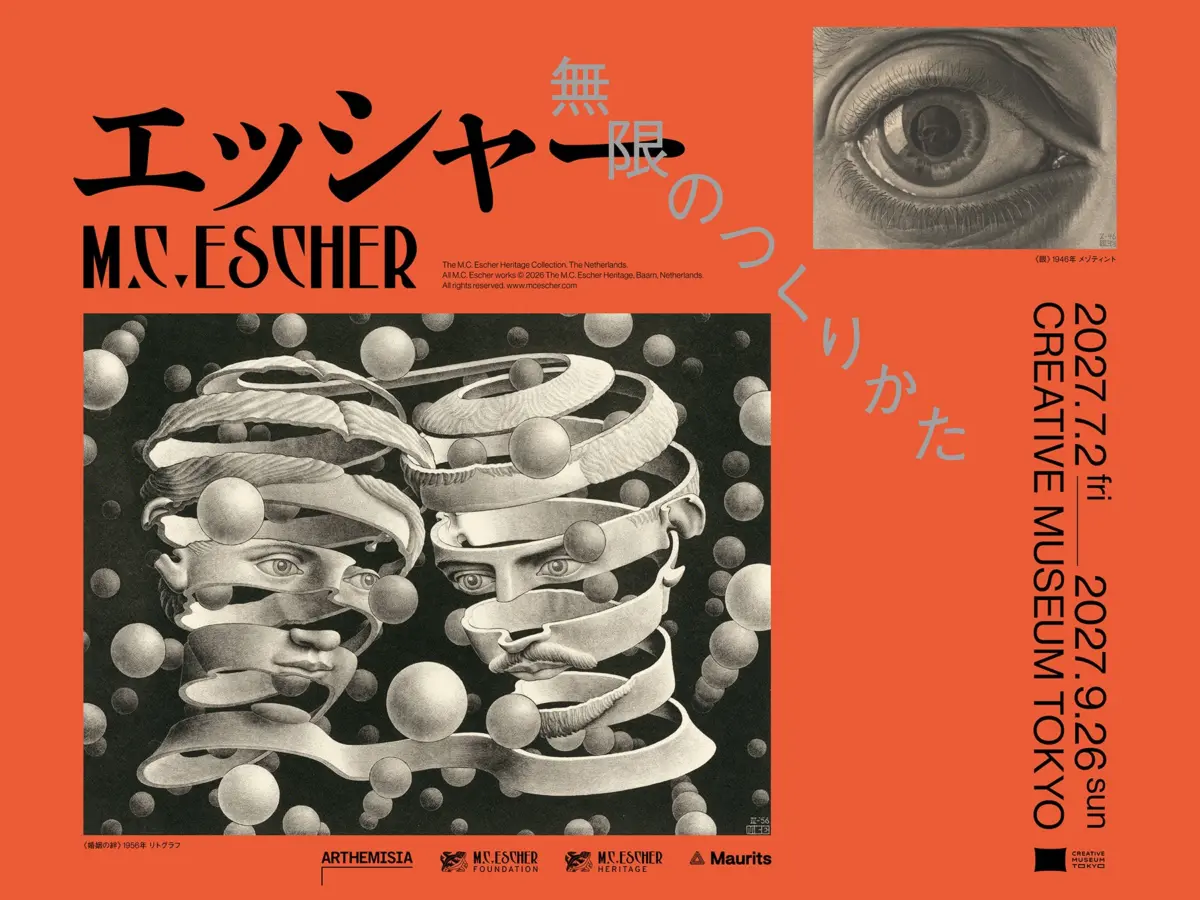
In what is poised to be one of the most anticipated cultural events of the late 2020s, a massive, comprehensive retrospective dedicated to the legendary Dutch master of optical illusions, Maurits Cornelis Escher, has been officially announced for Japan. Scheduled to run across multiple prominent venues starting in the summer of 2027, the exhibition promises an unprecedented deep dive into the mathematical, philosophical, and visually confounding universe of an artist who fundamentally redefined how humanity perceives space, dimension, and reality.
Co-organized by leading cultural institutions, media conglomerates, and the official M.C. Escher Heritage based in Baarn, the Netherlands, the upcoming exhibition will bring together roughly 200 foundational works. This staggering collection will span Escher’s entire creative trajectory—from his early, precise Italian landscape studies and lesser-known botanical engravings to his iconic, mind-bending masterpieces featuring impossible architecture, tessellations, and infinite loops.
As contemporary culture becomes increasingly fascinated by the intersections of digital art, immersive environments, and cognitive science, Escher’s hand-drawn paradoxes feel more relevant than ever. This retrospective is not merely a display of historical artifacts; it is a multi-sensory journey designed to challenge the viewer’s perceptual faculties, urging audiences to question the very fabric of visual logic. The exhibition will kick off at Creative Museum Tokyo in the summer of 2027 before embarking on a highly anticipated nationwide tour, touching down in major cultural hubs including Osaka and Fukuoka through 2028.
Detailed Chronology and Exhibition Itinerary
Planning for an exhibition of this magnitude requires years of meticulous curation, international transport logistics, and venue coordination. The M.C. Escher Heritage has worked in close collaboration with Japanese partners to establish a robust, multi-city timeline that will allow art lovers across the country to experience the collection firsthand.
Phase 1: The Tokyo Premiere at Creative Museum Tokyo
- Dates: July 2 – September 26, 2027
- Venue: Creative Museum Tokyo
The retrospective will make its grand world debut in the heart of Tokyo at the Creative Museum Tokyo. Running for nearly three months during the peak summer season, this inaugural leg will serve as the flagship presentation of the tour. Curators have designed the Tokyo installation to maximize the architectural potential of the space, creating specialized viewing chambers that mirror the recursive geometry found in Escher’s prints. Visitors can expect immersive introductory galleries that contextualize Escher’s life against the backdrop of 20th-century European art before plunging into the labyrinthine world of his mature graphic works.
Phase 2: The National Tour and Regional Expansion
Following the Tokyo showcase, the collection will transition into a comprehensive nationwide tour, ensuring that regional audiences outside the capital have access to world-class fine art.
-
Osaka Leg (Autumn 2027):
- Dates: October 9 – December 8, 2027
- Venue: Osaka Culturarium at Tempozan (tentative translation/local partner venue)
Moving to the Kansai region, the exhibition will occupy a major cultural venue in Osaka. Known for its vibrant contemporary art audience, Osaka is expected to host specialized programming, including academic symposiums linking Escher’s work to modern Japanese graphic design and manga.
-
Fukuoka Leg (2028):
- Dates: Early 2028 (Exact scheduling to be finalized)
- Venue: Fukuoka Prefectural Museum of Art / Regional Partners
The tour will conclude its primary Japanese run in Fukuoka, serving as a gateway for international visitors from neighboring East Asian countries. The Fukuoka installation will feature localized educational modules aimed at younger audiences and students of mathematics and architecture.
Supporting Context & Metrics: The Scale of the Escher Phenomenon
To fully appreciate the significance of the 2027–2028 retrospective, one must examine the sheer scale and composition of the exhibition. Bringing together approximately 200 works requires unprecedented cooperation from international lenders, private collectors, and the Baarn-based foundation.
The Anatomy of the Collection
- The Early Years (1922–1936): Long before he was drawing interlocking birds and cascading waterfalls that defy gravity, Escher was a meticulous draftsman. The exhibition will feature rare early woodcuts and lithographs documenting his travels through Italy, Spain, and the Amalfi Coast. These works reveal an artist deeply enamored with the natural world, capturing Mediterranean light, architectural ruins, and intricate olive groves with traditional precision.
- The Metamorphosis and Tessellations: A cornerstone of the exhibition will be Escher’s exploration of periodic tilings of the plane—what he referred to as "regular divisions of the plane." By manipulating biological forms like fish, lizards, and birds into interlocking geometric patterns, Escher bridged the gap between organic life and abstract mathematics.
- The Masterworks of Impossible Space: Visitors will stand face-to-face with vintage prints of iconic pieces such as Relativity, Ascending and Descending, Waterfall, and Drawing Hands. These works are celebrated not just for their technical execution as lithographs and woodcuts, but for their profound philosophical implications regarding infinity, paradox, and human perception.
The Intersection of Art, Mathematics, and Modern Technology
While M.C. Escher famously considered himself an artist rather than a mathematician, his work has long been celebrated by the global scientific community. Mathematicians, crystallographers, and topologists have spent decades analyzing the rigorous geometric foundations of his prints.
In an era dominated by digital rendering, CGI, and generative AI, the upcoming Tokyo retrospective places special emphasis on the analog mastery behind Escher’s illusions. Every impossible staircase, every looping waterfall, and every symmetrical transformation was calculated and executed by hand using traditional printmaking techniques—wood engraving, woodcut, and lithography.
Industry analysts predict that the exhibition will draw massive crowds, crossing demographic lines to appeal to traditional art historians, contemporary graphic designers, architecture students, and tech enthusiasts alike. Interactive digital installations, planned as complementary elements to the physical prints, will allow visitors to step inside Escher’s worlds, manipulating perspective and geometry in real-time.
Official Statements and Curatorial Vision
The announcement has sent ripples through the international arts community. Representatives from the M.C. Escher Heritage in Baarn, Netherlands, have expressed immense enthusiasm regarding the partnership with Japanese cultural organizers.
"M.C. Escher possessed a rare gift: the ability to visualize the invisible laws of the universe through artistic expression," noted a spokesperson for the Escher Heritage. "Japan has always demonstrated a profound cultural appreciation for precision, balance, and philosophical inquiry. We cannot think of a more fitting stage than Tokyo to present this comprehensive retrospective, which honors not only his iconic optical illusions but the lifelong intellectual curiosity that drove him."
Curatorial teams involved in the planning stages emphasize that the exhibition aims to demystify the artist. While pop culture has ubiquitously adopted Escher’s motifs on t-shirts, album covers, and posters, seeing the original prints in person offers an entirely different visceral experience. The subtle textures of the ink on paper, the fine lines of the woodblock carvings, and the sheer scale of monumental prints like Metamorphosis reveal an artisan of uncompromising dedication.
Furthermore, educational workshops are currently being developed in tandem with Japanese universities. These programs will explore how Escher’s visual paradoxes anticipated modern theories in cognitive psychology, optical science, and digital spatial design.
Future Outlook: A Cultural Milestone for 2027 and Beyond
As the art world looks ahead, the 2027–2028 M.C. Escher retrospective stands out as a landmark international cultural exchange. In a global landscape often fractured by rapid technological shifts and socio-political complexities, Escher’s work offers a universal language—one rooted in wonder, symmetry, and the exploration of infinite possibilities.
Tickets are expected to go on sale internationally in early 2027, accompanied by exclusive catalog releases and merchandising partnerships with leading design institutions. For collectors, scholars, and everyday admirers of optical wonder, the summer of 2027 cannot arrive soon enough.
For continuous updates, ticketing information, and press releases regarding the upcoming exhibition, visitors are encouraged to monitor the official portal at mcescher202728.jp as well as the official M.C. Escher foundation network at www.mcescher.com.









Belum ada komentar. Jadilah yang pertama berkomentar!