

Executive Overview
By 2026, the industrial metal landscape has crossed an unprecedented conceptual threshold. In an era where digital permanency and biological fragility collide, legacy acts like Fear Factory and Static-X present a fascinating case study in modern musical survival. Decades after establishing the blueprints for cyber-metal, both institutions continue to tour, record, and project a unified front under their original monikers. Yet, their classic eras belong firmly to the past. The architects who originally forged these sonic identities—such as founding frontman Burton C. Bell of Fear Factory and the late, irreplaceable Wayne Static—are no longer steering the vessels.
Instead, both bands have entered unmapped chapters steered by distinct configurations, fresh vocal talents, and complex legal frameworks. This transformation raises an investigative question that extends far beyond standard rock-and-roll lineup disputes: What happens when a band’s corporate and cultural identity becomes permanently larger than the mortal human beings who created it?
For Fear Factory and Static-X, this question is not merely theoretical; it is foundational. Both groups built their aesthetic and sonic architectures around technology itself. Their classic works integrated programming, electronics, mechanical loops, and industrial production, while their lyrical themes constantly interrogated the shifting boundary between human and machine. Today, that very boundary has migrated inward, manifesting directly within the operational anatomy of the bands themselves.
As the music industry navigates the rapid normalization of generative artificial intelligence, high-profile virtual tours (such as ABBA’s ABBA Voyage), and the perpetual legal chess of trademark ownership, these industrial pioneers serve as a mirror to our own changing relationship with media, art, and immortality. The "machine" was always their subject—now, it has become their successor.
Detailed Chronology: From Organic Origins to Managed Assets
To understand how Fear Factory and Static-X arrived at their current operational states in 2026, one must examine the chronological dismantling and reconstruction of their original lineups.
[1991–1999: Golden Era & Industrial Blueprint]
       │
       ▼
[2014–2021: Fractures, Departures & Tragic Loss]
       │   ├── Wayne Static passes away (2014)
       │   └── Burton C. Bell departs Fear Factory (2020)
       ▼
[2022–2025: Rebuilding the Machine via Proxies]
       │   ├── Static-X deploys "Xer0" (Fronted by Edsel Dope)
       │   └── Fear Factory introduces Milo Silvestro
       ▼
[2026 & Beyond: The Age of Post-Human Legacy & AI Integration]
The Genesis of Cyber-Metal (1991–1999)
During the 1990s, Fear Factory and Static-X established distinct, highly influential niches within heavy music. Fear Factory, anchored by guitarist Dino Cazares and vocalist Burton C. Bell, released milestone records like 1995’s Demanufacture and 1998’s Obsolete. These albums married extreme metal percussion with mechanized precision, heavily referencing dystopian sci-fi cinema. Concurrently, Static-X—led by the late Wayne Static, bassist Tony Campos, guitarist Koichi Fukuda, and drummer Ken Jay—pioneered "evil disco," a rhythmic, groove-heavy industrial metal fusion highlighted by 1999’s platinum-selling Wisconsin Death Trip.
The Fractures and Tragic Losses (2014–2021)
The structural integrity of both bands faced catastrophic stress tests in the 2010s. The death of Wayne Static in November 2014 initially appeared to close the chapter on Static-X permanently. Meanwhile, Fear Factory endured years of internal friction, legal battles over trademarks, and creative fatigue, culminating in Burton C. Bell’s formal departure in late 2020. For conventional bands, these developments would spell the end of the line. However, the commercial and institutional weight of the brand names demanded continuity.
The Era of the "Factory Managers" (2022–2025)
Enter the custodians of the legacy: Dino Cazares for Fear Factory and Tony Campos for Static-X. Operating as functional "Factory Managers," these veteran musicians assumed the responsibility of keeping the engines running. Static-X engineered an elaborate resurrection, returning to the stage with a mysterious masked frontman known as "Xer0" (later revealed via industry reports and visual cues to be Dope Team frontman Edsel Dope, working alongside manager Matt Zane). Fear Factory, after a prolonged search, introduced Italian vocalist Milo Silvestro to shoulder the daunting task of replacing Bell’s multi-octave vocal range.
The 2026 Inflection Point
By 2026, both bands have fully normalized these configurations, yet they continue to push the boundaries of what a replacement singer signifies. Recent promotional materials from Fear Factory—most notably an August 2026 photograph featuring Milo Silvestro clad in a half-cyborg rig for an upcoming music video—signal a pivot toward an overtly mechanical visual identity. The historical trajectory has shifted from merely replacing a missing member to fundamentally redesigning the human component of the band to mirror the machines they sing about.
Supporting Context & Metrics: The Mechanics of Legacy
The viability of a legacy rock band in the 21st century relies on a delicate balance between brand equity, fan sentiment, and live-circuit economics.
| Metric / Attribute | Fear Factory (2026 Status) | Static-X (2026 Status) |
|---|---|---|
| Founding Core Remaining | Dino Cazares (Guitar) | Tony Campos (Bass) |
| Frontman Status | Milo Silvestro (Human Successor, Bell-esque aesthetic) | Xer0 / Edsel Dope (Masked Identity / Mechanical Persona) |
| Lyrical/Visual Theme | Dystopian automation, cybernetic integration | Industrial horror, sci-fi techno-thriller |
| Catalog Rights & Trademarks | Retained and actively monetized | Retained and aggressively toured worldwide |
| Primary Survival Strategy | Replicating vocal fidelity + evolving physical cyborg imagery | Complete stylistic anonymization via character mask |
The economic engine driving these bands is reinforced by modern nostalgia cycles and streaming analytics. Both Fear Factory and Static-X retain substantial digital footprints, pulling millions of monthly listeners across global platforms who consume albums recorded over 25 years ago. When these legacy acts embark on co-headlining tours, audiences are not simply paying to see living human beings; they are paying to participate in a ritualistic celebration of a frozen cultural epoch.
However, this reliance on historical catalogs creates an identity paradox. As philosopher-critics of the music industry note, when a trademark outlives its original creators, the performance transforms from an authentic act of artistic creation into a curated reenactment. The metric of success is no longer pure innovation, but rather the seamless preservation of illusion.
Official Statements and Industry Perspectives
The stakeholders guiding these industrial institutions have been forced to articulate public justifications for how their respective bands operate today.
Dino Cazares has frequently addressed the necessity of Fear Factory’s evolution, emphasizing that the entity of the band is a body of work larger than any single individual. In interviews surrounding the recruitment of Milo Silvestro, Cazares highlighted the importance of vocal authenticity—finding someone who could not only hit the notes of Demanufacture and Digimortal but also respect the heavy atmospheric legacy built over three decades.
On the Static-X front, the handling of Wayne Static’s memory has been defined by a narrative of reverence mixed with theatrical modernization. Through statements released via publicist and collaborator Matt Zane, the band has maintained that Xer0 is not meant to be a literal impersonator, but a tribute vehicle that allows the music to live on in a live setting. Edsel Dope’s involvement—acting both behind the scenes as a managerial/creative catalyst and through the persona of Xer0—demonstrates a pragmatic approach to brand stewardship: if the original icon cannot be replaced organically, the replacement must be framed as a stylized entity.
Industry analysts point out that these strategies reflect a broader shift in heavy metal. As classic rock and metal icons age, retire, or pass away, the corporate structuring of band names as intellectual property will only accelerate. The official consensus among these camp leaders is clear: the show must go on, provided the machinery of production remains compliant with market expectations.
Future Outlook: The "Digimortal" Horizon and AI
As we look deeper into the latter half of the 2026 landscape, the questions facing Fear Factory and Static-X open up terrifying and fascinating vistas regarding artificial intelligence, digital cloning, and copyright law.
The Prophecy of Digimortal
Fear Factory’s 2001 album title, Digimortal, sounds increasingly prophetic. The term—implying digital immortality—captures the inevitable endgame of modern media preservation. Musicians die, band members depart, but the recordings, logos, merchandise, and master tapes persist. Eventually, even the second-generation musicians (Milo and Xer0) will fade into history, leaving the brand name completely untethered from biological human memory.
[Biological Originators] ──► [First-Gen Successors (Milo / Xer0)] ──► [AI / Synthetic Re-creation] ──► [Perpetual Trademarks in Perpetuity]The AI Frontier and Post-Human Bands
No established indicator currently suggests that Fear Factory or Static-X are utilizing generative AI to compose their current studio output. Both bands continue to rely on human musicianship, sweat, and physical performance. Yet, the technological capability exists right now. With voice cloning software capable of perfectly replicating Burton C. Bell’s 1995 snarl or Wayne Static’s high-register rasp, and virtual avatars proving commercially viable via projects like ABBA Voyage, the barrier to entry for synthetic continuation is practically zero.
If the trademark holder of Fear Factory or Static-X decides in the year 2040 to commission an entirely AI-generated studio album using the band’s official likeness and neural-net models trained on decades of classic riffs, it will legally be Fear Factory or Static-X. It will not be a bootleg; it will be an officially sanctioned product backed by copyright law.
The Ultimate Definition of "Band Is Obsolete"
This brings us to the ultimate philosophical crisis highlighted by the trajectory of these industrial titans: The traditional definition of a band is becoming obsolete.
Historically, a band is defined as a collective of living human beings who gather to write, perform, and share a creative journey. But if the human creators are gone and the name, catalog, visual identity, and sonic parameters are sustained by software, algorithms, and hired-gun proxy performers, the band ceases to be a human social unit. It transforms into an autonomous corporate entity—an immortal corporate ghost wearing the skin of industrial metal.
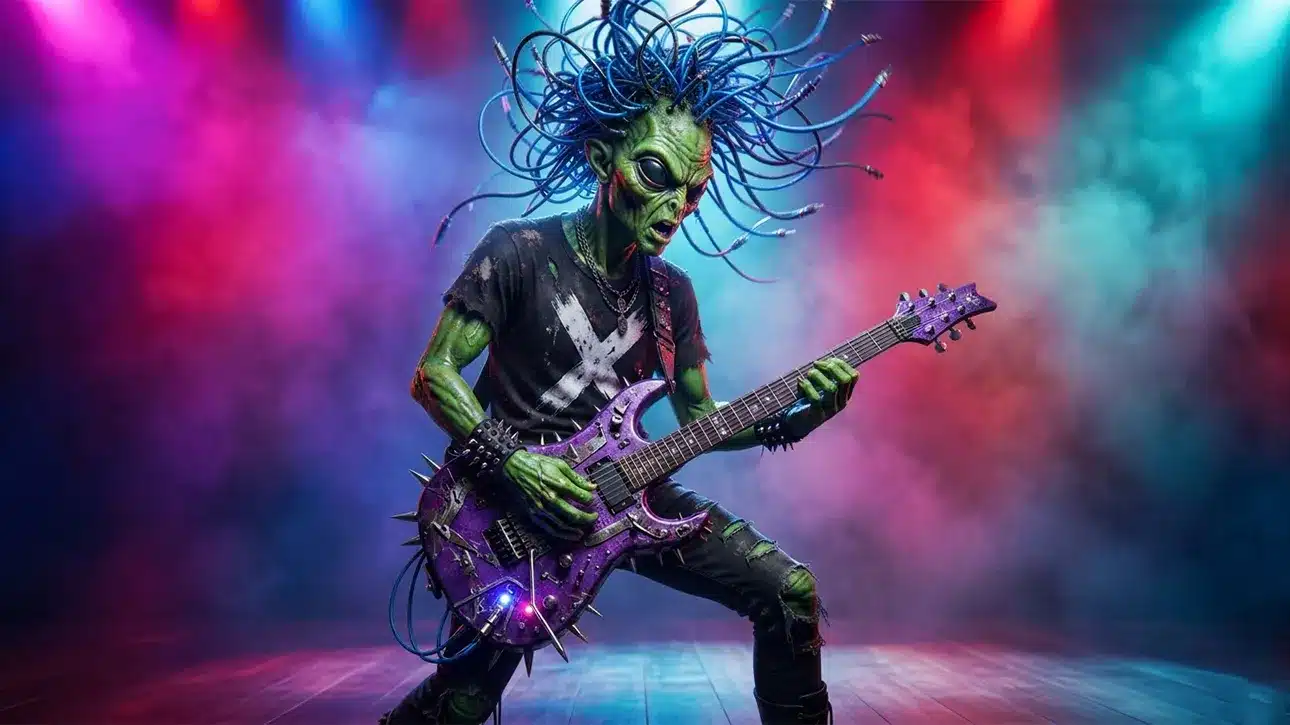
And perhaps, in the grand cosmic scheme, even that distinction is temporary. Imagine, fifty thousand years from now, a post-human or alien civilization unearthing the digital debris of Earth. They stumble upon a preserved logo—the iconic, mechanical "X" of Static-X or the rusted industrial typography of Fear Factory. Stripped of all human context, historical meaning, and sonic association, the symbol is repurposed simply because an alien aesthetic designer "liked how it looked" on a commercial container.
That may ultimately be the truest form of industrial immortality: not being remembered accurately by living fans, but being misinterpreted, repurposed, and echoed eternally by the universe at large, long after the last human machine has powered down.




Belum ada komentar. Jadilah yang pertama berkomentar!