

Executive Overview
For decades, the global arcade landscape was dominated by Japanese giants such as Capcom, Konami, and SNK, alongside American powerhouses like Midway and Atari. Yet, tucked away in the vibrant, smoky arcades of Southern Europe during the early 1990s, regional developers were crafting their own distinct visions of interactive entertainment. Among these was the Spanish studio Gaelco. While largely celebrated within its home territory and remembered globally only by the occasional breakout hit like World Rally, Gaelco’s catalog remains a treasure trove of undiscovered, quarter-munching history.
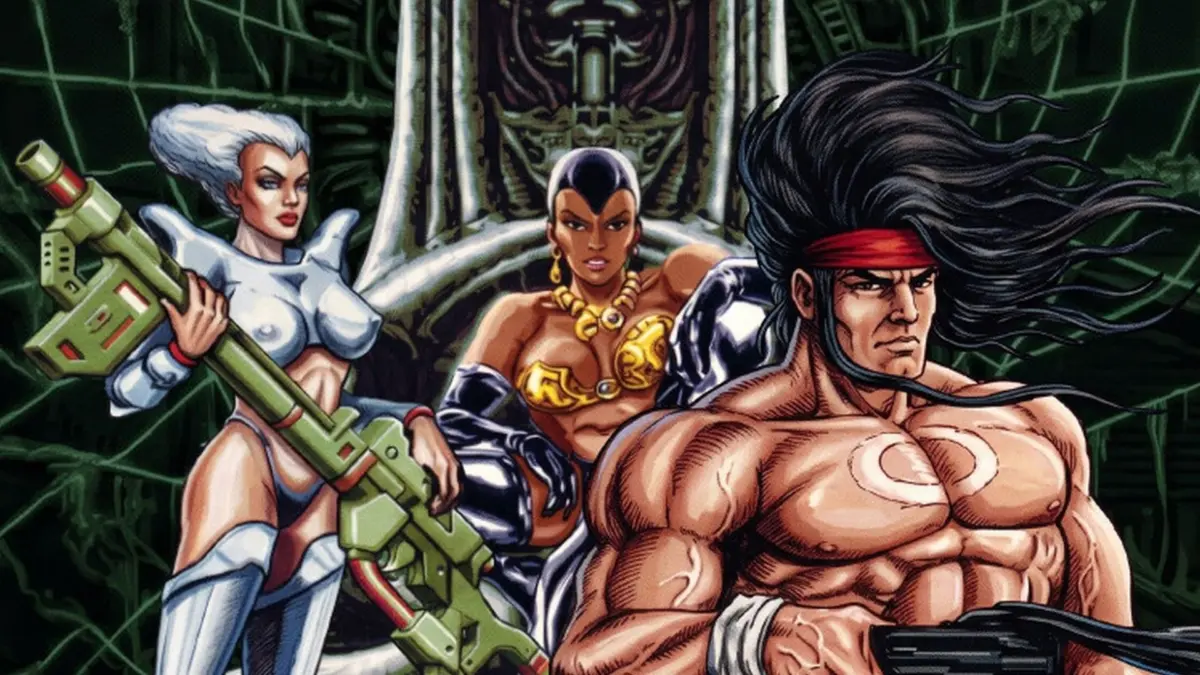
Now, the retro preservation specialists at QUByte Interactive are pulling back the curtain on two of Gaelco’s most obscure titles. This year, the publisher is bringing Thunder Hoop and its sequel, TH Strikes Back, to modern platforms via Steam under the Thunder Hoop Collection. Scheduled for release on October 8, this compilation introduces contemporary players to a delightfully chaotic era of game design where the aesthetic sensibilities of Dragon Ball Z collided head-on with the body-horror sci-fi of Ridley Scott’s Alien.
Featuring the titular, genetically engineered protagonist blasting his way through hordes of mutants, latex-clad villains, and cosmic threats, the Thunder Hoop Collection is more than a simple port—it is an act of archaeological preservation. Complete with modern quality-of-life additions such as save states, rewinding mechanics, and customizable CRT filters, this release bridges a thirty-year gap, allowing a new generation of PC gamers to experience a wild chapter of European arcade history.
Detailed Chronology: The Evolution of Thunder Hoop (1992–1994)
To understand the cultural significance of the Thunder Hoop series, one must trace its development across the mid-1990s arcade boom, a period when developers frequently iterated rapidly on hardware capabilities and shifting player tastes.
1992: The Birth of a Teenage Mutant Hunter
Released in 1992, the original Thunder Hoop established the foundational lore and gameplay loop of the franchise. Players stepped into the shoes of the titular hero—a genetically modified teenage protagonist possessing energy-blasting capabilities. The narrative premise was straightforward yet wonderfully absurd: a nefarious mastermind known as Dr. Genbreak has unleashed an army of grotesque, cartoonish mutants upon a sprawling metropolis.
From a design perspective, the original Thunder Hoop was a traditional side-scrolling platformer. Navigating through the urban sprawl required precise jumping and constant offensive output. True to the arcade conventions of the era, the level design forced Thunder Hoop through varied environments, including the obligatory grimy sewer systems and disorienting underwater stages.
While the game featured charmingly chunky sprite work and tight controls, its multiplayer mode was limited to alternating turns rather than simultaneous cooperative play—a technical limitation of the hardware or design philosophy at the time that Gaelco would seek to rectify in the sequel.
1994: TH Strikes Back and the Escalation of Absurdism
By 1994, the arcade industry was aggressively pivoting toward faster-paced action, flashier graphics, and more adult-oriented aesthetics, heavily influenced by the rise of fighting games and gritty sci-fi properties. Gaelco responded in kind with the sequel, TH Strikes Back.
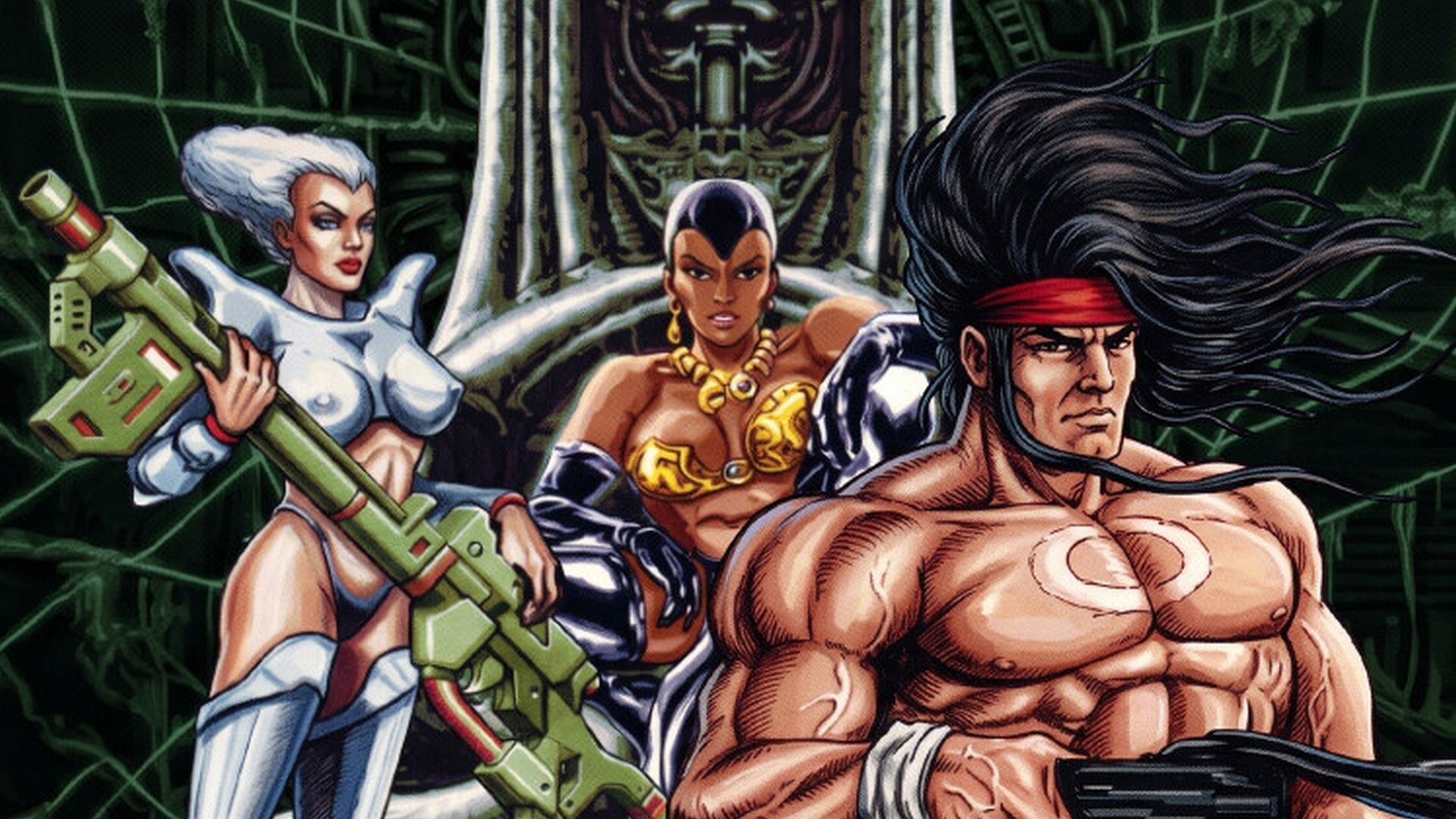
In a classic trope of 90s video game sequels, the protagonist was abruptly aged up into a muscle-bound adult. Eschewing shirts entirely—seemingly operating under the logic that chest-baring musculature is a tactical advantage against extraterrestrial threats—the older Thunder Hoop faced a markedly different enemy roster. The cartoonish monsters of the first game were swapped out for a bizarre pastiche of high-concept sci-fi tropes, most notably armies of women clad in head-to-toe black latex, fighting alongside bio-mechanical monstrosities clearly indebted to H.R. Giger’s Alien designs.
The gameplay shifted from a deliberate platformer to an aggressive run-and-gun spectacle. Furthermore, TH Strikes Back ramped up the narrative and visual absurdity by incorporating direct nods to anime culture. Most famously, the game features a sequence where Thunder Hoop achieves a glowing, blonde-haired transformation unmistakably inspired by the Super Saiyan phenomenon of Dragon Ball Z, before launching directly into space for a sudden shift into a Gradius-style horizontal scrolling shooter. To cap off these improvements, the sequel introduced full local cooperative multiplayer, allowing two players to team up against Dr. Genbreak’s forces.
Supporting Context & Metrics: The Gaelco Legacy and QUByte’s Preservation Model
Unearthing Spain’s Arcade Heritage
Gaelco’s footprint in the history of interactive entertainment is a fascinating study in regional industry dynamics. Founded in Barcelona in 1985, the company initially focused on electronic dartboards before transitioning into coin-operated video games in the early 1990s. While international markets occasionally caught glimpses of their output—most notably through World Rally (1993), which achieved moderate global distribution and is still remembered for its top-down racing mechanics and digitized driver speech—the vast majority of Gaelco’s cabinet library remained confined to European arcades and domestic Spanish venues.
Titles like Thunder Hoop represent a distinct era of European development that operated independently of the rigid corporate pipelines of Sega, Capcom, or Nintendo. These games possessed a distinct stylistic flavor: a willingness to mash disparate pop-culture touchstones together without hesitation. Merging the kinetic martial arts tropes of Akira Toriyama’s seminal manga with the slick, bio-mechanical dread of cinematic space horror created an aesthetic dissonance that is uniquely charming in hindsight.
The Modern Retro Renaissance: Quality-of-Life Integration
Preserving arcade games on modern digital storefronts requires a delicate balance between authenticity and accessibility. Traditional arcade cabinets were designed to drain quarters through brutal difficulty spikes and unforgiving checkpoint systems—design choices that do not always translate well to home PC gaming environments where players expect continuous progression and flexible play sessions.
QUByte Interactive has addressed these challenges by outfitting the Thunder Hoop Collection with a comprehensive suite of modern quality-of-life tools:
- Save States: Players can instantly save and load their progress anywhere in the game, mitigating the notorious "quarter-eater" barrier to entry.
- Rewind Functionality: Mistimed a jump over a hazardous pit or took unexpected damage from a latex-clad assassin? Players can instantly rewind gameplay frame-by-frame to correct tactical errors.
- CRT Filters and Visual Customization: To recreate the authentic aesthetic of 90s arcade monitors, the collection features customizable scanline filters and aspect ratio adjustments, ensuring the vibrant pixel art renders faithfully on high-definition displays.
- Control Mapping: Full support for modern gamepads and keyboards allows for seamless input configuration, replacing the directional microswitch sticks of yesteryear with modern digital precision.
Official Statements and Industry Reception
While traditional press releases for retro re-releases often lean heavily on corporate nostalgia, the reception from retro enthusiast communities and specialized outlets has highlighted the unique historical value of rescuing titles that otherwise risked being lost to hardware decay and proprietary obscurity.
Industry analysts note that the commercial viability of retro bundles has shifted significantly over the past decade. No longer confined to major multi-franchise anthologies from conglomerates like Capcom or Konami, the digital distribution model on platforms like Steam has allowed niche publishers like QUByte to curate deep-cut historical libraries. By focusing on regional oddities such as Gaelco’s catalog, these companies provide a valuable service to digital archivists and video game historians.
Commentators within the retro gaming community have been particularly vocal about the aesthetic whiplash of the Thunder Hoop series. The transition from the more grounded, colorful platforming of the 1992 original to the high-octane, leather-and-sci-fi excess of 1994’s TH Strikes Back is frequently cited as a textbook example of the hyper-aggressive escalation trends that defined the mid-90s arcade sector.
Future Outlook: The Ongoing Imperative of Digital Game Preservation
The launch of the Thunder Hoop Collection on October 8 marks another milestone in the ongoing crusade for digital game preservation. As physical arcade hardware continues to age out of operational status—with capacitors failing, CRT tubes fading, and original motherboards succumbing to component degradation—software emulation and digital re-releases remain the primary bulwarks against historical erasure.
QUByte Interactive’s continued commitment to dredging up forgotten regional catalogs suggests a promising outlook for other lost arcade titles. The success of collections like this demonstrates that a passionate global audience exists for games that were once trapped behind geographical and hardware barriers.
For modern PC gamers, the collection offers a potent dose of interactive anthropology. Whether approached as a nostalgic artifact of 90s excess, a bizarre collision of Dragon Ball Z and Alien tropes, or simply a pair of fast-paced action games to burn through on a lazy afternoon, Thunder Hoop and TH Strikes Back are finally stepping out of the shadows of Spanish arcades and into the global spotlight they have long deserved.





Belum ada komentar. Jadilah yang pertama berkomentar!