

Executive Overview
It is an enduring maxim of cinema that a film is only as good as its soundtrack. Among the most celebrated auditory touchstones in American film and television, the motifs associated with the antagonist frequently outshine those of the hero. From Darth Vader’s imposing, brass-heavy “Imperial March” in The Empire Strikes Back to the Machiavellian showstoppers belted by Disney villains like Scar (The Lion King) and Ursula (The Little Mermaid), cinematic wickedness has long enjoyed a rich, memorable sonic vocabulary.
Yet, Hollywood’s predilection for pairing villainy with high-art musical traditions extends far beyond original cinematic scoring. For nearly a century, American filmmakers have turned to the established masterworks of Western art music—and European opera in particular—to characterize their most formidable foes.
Centuries before the invention of the moving image, opera successfully combined visual spectacle, theatrical staging, and aural storytelling. Like modern film, it is renowned for the psychological depth and memorability of its villainous arias, such as Iago’s chilling "Credo in un Dio crudel" in Verdi’s Otello or the Queen of the Night’s vengeful "Der Hölle Rache" in Mozart’s The Magic Flute.
When imported into American visual media, these pre-existing musical works perform complex dramatic functions. They serve as rich intertextual references, provide ironic subtext against scenes of brutal violence, and draw heavily upon deep-seated American perceptions of European intellectualism, cultural prestige, and elitism. Ultimately, the trope of the opera-loving villain exposes a fascinating cultural dichotomy: while the average cinemagoer may miss the nuanced plot connections embedded within the music, they instantly recognize the sonic markers of refined, calculated evil.
Detailed Chronology: From the Silver Screen to Modern Prestige Television
The marriage of Western art music and cinematic menace is not a modern invention; it dates back to the dawn of sound in film. Tracing the evolution of this trope reveals how directors have consistently used classical compositions to elevate the stakes of their narratives.
The Foundation: Early Horror and Psychological Thrillers (1931–1979)
Among the earliest and most chilling examples of Western art music weaponized in film occurs in Fritz Lang’s expressionist masterpiece M (1931). Peter Lorre portrays serial killer Hans Beckert, who compulsively whistles Edvard Grieg’s lighthearted "In the Hall of the Mountain King" (from the 1875 incidental music to Henrik Ibsen’s Peer Gynt) whenever he is stalking a child. The film binds the character so tightly to the melody that, toward the climax, Beckert’s terrifying presence is signaled entirely by his off-screen whistling.
As decades progressed, this technique evolved into a staple of Hollywood grammar. Stanley Kubrick famously deployed classical pieces for psychological disorientation, but it was Francis Ford Coppola’s Apocalypse Now (1979) that weaponized opera on a grand, terrifying scale. During a helicopter assault on a fortified Vietnamese village, American forces blast Richard Wagner’s "Ride of the Valkyries" (Die Walküre, 1870) from loudspeakers. Serving as a diegetic form of psychological warfare, the bombastic Germanic music not only mocks the villagers but also exposes the hollow, mythological self-delusion of the invading forces.
The Prestige Villain Era (1980–2000)
By the late 20th century, linking sophisticated criminals to classical repertoires became a hallmark of prestige filmmaking.
- 1980: Martin Scorsese utilized the sweeping "Intermezzo" from Pietro Mascagni’s Cavalleria Rusticana (1890) over the credits of Raging Bull, subtly telegraphing themes of adulterous betrayal and fatal jealousy.
- 1987: In Brian De Palma’s The Untouchables, Robert De Niro’s Al Capone attends a performance of Canio’s wrenching aria "Vesti la giubba" from Ruggero Leoncavallo’s Pagliacci (1892), a moment that juxtaposes high-art leisure with ruthless mob execution.
- 1991: Jonathan Demme introduced cinemagoers to Dr. Hannibal Lecter in The Silence of the Lambs, famously setting Lecter’s savage prison break to the hyper-rational, mathematically precise strains of Glenn Gould playing Bach’s Goldberg Variations.
- 1993: Steven Spielberg’s Schindler’s List featured a chilling scene where a Nazi officer casually performs Bach on a piano while his subordinates round up and execute prisoners, cementing classical music as the soundtrack of clinical, unfeeling atrocities.
- 1998: In the action classic Die Hard, Alan Rickman’s intellectual terrorist Hans Gruber and his crew operate against the backdrop of Beethoven’s "Ode to Joy," signaling their view of themselves as high-minded revolutionaries rather than common thieves.
The Modern Prestige Television Landscape (2010–Present)
In the 21st century, the trope migrated seamlessly to long-form prestige television, where complex anti-heroes and erudite villains require deeper characterization.
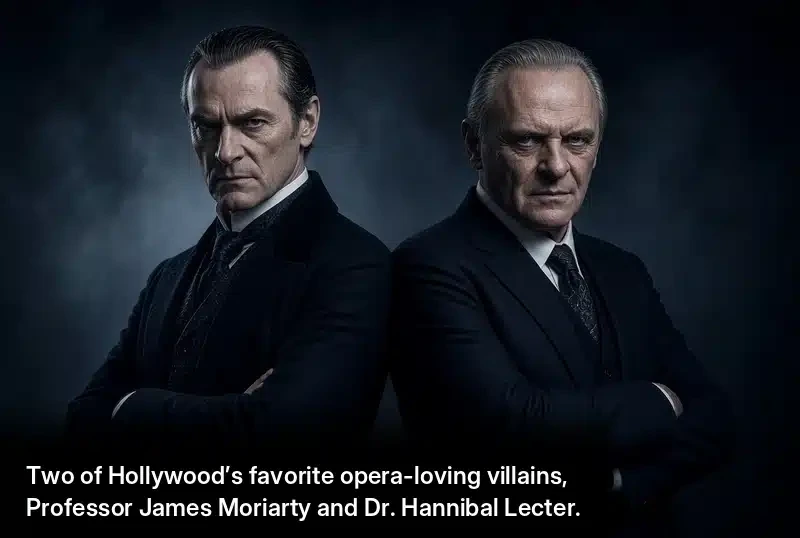
- In the BBC adaptation Sherlock (2010–2017), criminal mastermind Jim Moriarty is frequently accompanied by sophisticated classical cues, listening to Rossini’s La gazza ladra (The Thieving Magpie) while breaking into the Tower of London—a brilliant nod to the thematic core of theft.
- Similarly, NBC’s psychological thriller series Hannibal (2013–2015) transformed Mads Mikkelsen’s Dr. Lecter into a walking masterclass of musicology. Throughout the series, Lecter’s culinary and murderous exploits are underscored by arias from Handel’s Giulio Cesare in Egitto and Mozart’s Don Giovanni, framing his cannibalism not as base savagery, but as an expression of elite aestheticism.
Supporting Context & Metrics: Decoding the Appeal of Western Art Music
Why do filmmakers consistently rely on classical music and opera to denote villainy? The answer lies in a combination of practical production economics and deep-seated cultural psychology.
Practical and Economic Factors
From a purely practical standpoint, much of the Western classical canon is in the public domain, offering producers recognizable, high-status musical material at little or no licensing cost. Furthermore, centuries-old compositions have stood the test of time, possessing structural hooks and emotional resonance that require no introduction. Designed as tuneful centerpieces within larger operatic works, individual arias represent the most memorable and affective components of their parent scores.

Dramatic Functions and Narrative Subtext
Instrumental music, lacking a concrete linguistic plot, relies entirely on its inherent affective power. When paired with visual media, it creates extra-diegetic exposition.
Depending on the genre, opera serves vastly different narrative roles:
- In Romances: Pieces like Puccini’s "Chi il bel sogno di Doretta" (Gianni Schicchi) establish emotional moods while foreshadowing narrative arcs, such as a young woman transformed forever by a kiss (A Room with a View, 1985).
- In Comedies: Bizet’s lively "Habanera" (Carmen) is juxtaposed against mundane daily routines in Pixar’s Up (2009) for comedic effect, while Rossini’s breakneck "Largo al factotum" (The Barber of Seville) in Mrs. Doubtfire (1993) cleverly foreshadows the protagonist’s cross-dressing disguise.
- In Crime Dramas: The inclusion of European art music introduces an aural friction. By juxtaposing heinous acts of violence against the refined, polite timbres of symphonic strings and soaring vocalists, filmmakers make the villain’s actions appear deliberate, calculating, and rational rather than emotionally impulsive.
Perspectives & Cultural Analysis: The "Sophisticated European" Trope
The frequent alignment of operatic tastes with villainy is intimately tied to American cultural perceptions of Europe. Historically, the United States has wrestled with a cultural inferiority complex stemming from the dominance of European art traditions over early American artistic development.
As cultural historians have frequently noted, American artistic tastes until the late 19th century were largely derivative of Old World models. Early American popular music—ranging from minstrel shows and Tin Pan Alley ballads to Broadway standards—drew heavily on the folk and dance traditions imported by European immigrants. Even early American classical composers labored for generations under the long shadow of the European master tradition, striving to unearth a truly indigenous sound rooted in American soil (a quest famously fulfilled only with the rise of jazz in the early 20th century).
Despite achieving global hegemony in economy, military might, and popular culture, the American public has never shaken its deep fascination with European heritage as a marker of identity and prestige. In US entertainment culture, European markers—whether French and Italian fine art, German philosophy and engineering, or British literature and Received Pronunciation—consistently denote intellectualism, elegance, and refinement.
When Hollywood casts foreign or foreign-coded actors (such as Jared Harris, Anthony Hopkins, or Mads Mikkelsen) as intellectual antagonists like Moriarty or Lecter, and scores their scenes with Italian or German opera, they are tapping into a deeply ingrained national mythos: that true sophistication is inherently linked to the Old World, and that intellect unmoored from moral constraint easily shades into aristocratic malevolence.
Future Outlook: The Niche Status of Opera in Modern Mass Media
Ironically, the very feature that makes opera so effective as a cinematic shorthand for villainy—its elite, non-mainstream status—is also the primary reason it remains obscure to the modern masses.
Despite valiant outreach efforts by modern opera houses, including live high-definition cinema broadcasts, digital streaming initiatives, and educational programming, opera remains a niche art form in the 21st century. Several structural barriers prevent its mass adoption:
- The Language Barrier: Major operatic works are predominantly sung in Italian, German, or French, creating an immediate linguistic hurdle for English-speaking audiences.
- Format and Attention Spans: The sprawling, multi-hour format of traditional opera stands in stark contrast to contemporary media consumption habits, where streaming algorithms favor brevity and rapid pacing.
- Economic Barriers: With ticket prices at premier European and American opera houses routinely scaling into the hundreds of dollars, the art form retains a real-world association with wealth and socioeconomic exclusivity.
Because the average cinema audience member is relatively unfamiliar with the intricate plots of works like Don Giovanni or Pagliacci, explicit plot connections—such as Don Ottavio’s loyalty in Don Giovanni mirroring Hannibal Lecter’s complex protection of Will Graham—are almost entirely lost on casual viewers.
Yet, this exact obscurity is what preserves the trope’s cinematic utility. Because the audience does not need to know the plot of the opera to feel its emotional weight, the music functions purely as a potent semiotic signifier. It whispers to the viewer that the villain on screen is not a common thug, but a brilliant, cultured, and terrifyingly sophisticated adversary. As long as Hollywood seeks to portray intellectual evil with grand theatricality, the soaring notes of European opera will remain the ultimate anthem of cinematic darkness.




Belum ada komentar. Jadilah yang pertama berkomentar!