

Executive Overview
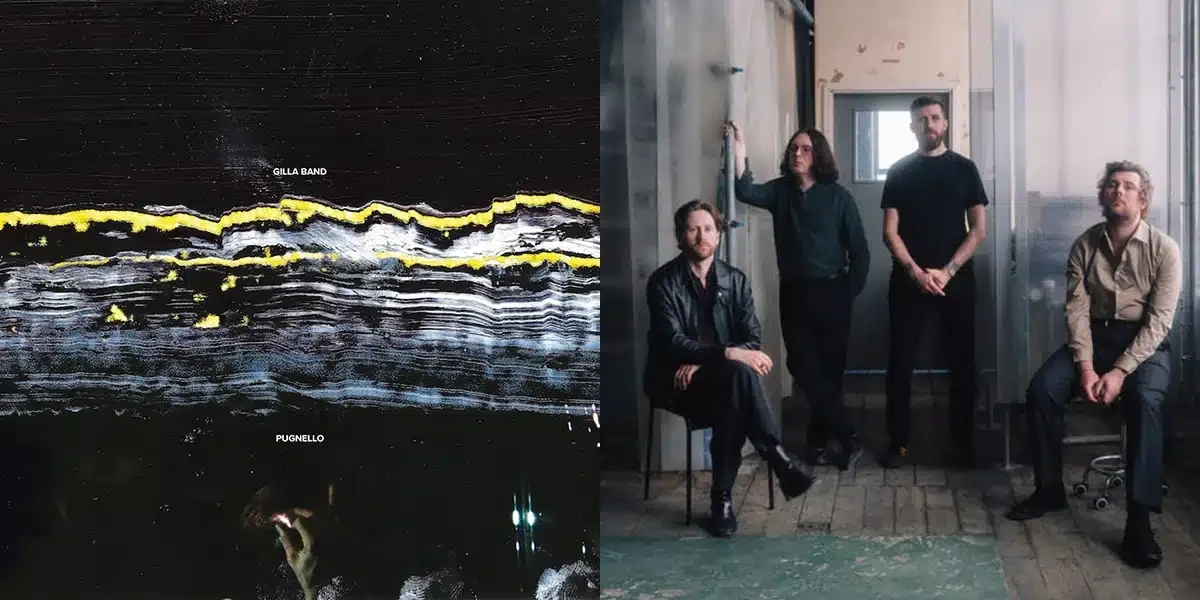
For over a decade, Dublin’s noise-rock provocateurs Gilla Band have occupied a singularly abrasive corner of the contemporary musical landscape. Across their celebrated catalog, the quartet—comprising vocalist Dara Kiely, guitarist Alan Duggan, bassist Daniel Fox, and drummer Adam Faulkner—has trafficked in jagged, lurching, and fragmented sonic excursions. Their music is not merely heard; it is endured, analyzed, and felt as a visceral physical reaction to the pressures of the modern world.
With their fourth full-length studio album, Pugnello, the band pushes these boundaries further into the red. If Kiely methodically fleshed out his agitated, hyper-vigilant persona on 2022’s Most Normal, he cranks the collective panic volume up several notches here. Operating as a frantic, modern-day trickster who juggles wry observations, glossolalic confessions, and meme-like nonsensicalities, Kiely gyrates amidst the digital and cultural artifacts of contemporary life.
Behind him, Duggan, Fox, and Faulkner have honed their caustic pivots, razor-sharp textures, and serrated crescendos to a terrifying point of efficiency. The result is a defining record for our cultural moment—a seamless navigation of darkly comedic yet fatalistic gestalts that revels in tableaux pointing to both high-brow intellectualism and tortured-slacker apathy. As society reels under the weight of hyper-polarization, digital solipsism, and terminal irony, Pugnello positions Gilla Band not merely as musical outliers, but as the unwilling, twitching spokespersons for an age of universal alienation.
Detailed Chronology: A Track-by-Track Descent into Pugnello
To understand the architecture of Pugnello is to trace a map of 21st-century psychological decay. From its opening moments to its apocalyptic conclusions, the album operates as a disjointed audio-verité documentary of contemporary life.
The Overture of Dislocation: "The Angelus" and "Placeholder"
The album’s opening track, "The Angelus," sets an immediately bruising tone. Duggan’s flanger-soaked guitar sounds less like a traditional instrument and more like an industrial saw tearing through sheet metal. Over this metallic onslaught, Kiely adopts a self-consciously mordant delivery, invoking post-capitalistic dislocations and societal depravities. When he refers to an unnamed Western nation as "the nation of elbow grease," the implication is clear: a bitter nod to systemic financial inequalities and the endless, unrewarded exploitation of the working class.
As the track deepens, Kiely weaves in terms like "goody two-shoes" and "red herrings," signaling a reality defined entirely by performance and distraction. The instrumentation swells in tandem, mimicking wires shorting out, buildings collapsing, and rubble being aggressively bulldozed. The resulting effect collapses tedium and apocalypse into a singular amalgam of cosmic drama and mundane earthly boredom.
This theme bleeds directly into "Placeholder," a track that strives to make apathy and resignation look paradoxically cool. Gilla Band’s cacophonous, driving rhythms merge with Kiely’s slapstick self-portraiture ("I’m very shy / I’m that kind of guy / I’m a little bipolar") to evoke comparisons to contemporaries like Model/Actriz and their 2023 breakthrough, Dogsbody. Yet, while Dogsbody drew a sultry, club-adjacent energy from the New York dance scene to explore queer identity and sexuality, Gilla Band remain deliberately, uncompromisingly abrasive. Kiely’s persona here is markedly unromantic—frequently projecting a sense of asexuality and clinical anhedonia.
The Burden of Routine: "Alogia" and the Unreliable Narrator
Titling a song "Alogia"—a clinical term describing the inability to speak fluently due to mental distress—is a characteristically bleak move for Gilla Band. Set against a backdrop that is simultaneously funky and violently clangorous, Kiely launches into a brilliant piece of self-parody:
"Fantasize what it’s like to be accountants / A steady structure, routine and purpose / That kind of life would be so perfect / Especially ’cos I’m a schizophrenic."
Rather than leaning into standard indie-rock tropes of lamenting loneliness (à la Mandy, Indiana) or crafting a straightforwardly heartbreaking political rant about mental health care (territory often explored by Chat Pile), Kiely uses sardonic deflections. His mercurial nonchalance casts him as the quintessential 21st-century "unreliable narrator." The band’s harsh, jarring instrumentation mirrors this mental instability, ensuring the listener never quite feels secure on solid ground.
The Uncanny Valley: "Jacobsons," "The Megazord," and "Computer Sadness"
As Pugnello progresses, Gilla Band begin to sound genuinely futuristic, occasionally resembling an artificial intelligence programmed to generate a caricature of human anxiety. "Jacobsons" plays out like a meta-mix of raw data sonifications and off-the-wall Zen mantras forced through an industrial blender. It is easy to picture a cinematic dystopia—perhaps Arthur Fleck dancing jerkily while waving a knife in an empty corridor.
Similarly, "The Megazord" interweaves quirky vocal accents with monstrous, guttural moans and Faulkner’s deceptively buoyant percussion. It functions as the audio equivalent of a funhouse mirror. On "Computer Sadness," heavy, distorted rhythms are crossed with ambient choral chanting that conjures images of an angry, disembodied mob. The listener is left wondering: has the band descended into the darkest pits of ego death during an ill-advised ayahuasca ceremony?
The Eerie Climax: "Giraffe"
Perhaps the album’s most chilling moment arrives with "Giraffe." Anchored by a sprawling wall of noise and a relentless, metronomic beat, Kiely delivers a series of reflections that wouldn’t feel out of place in an episode of The Twilight Zone or Black Mirror: "Yesterday the world fell asleep without me," he mutters, before observing, "The creature in your pupils / Teaching you shit skills … teaching you shit."
As the track builds toward its climax, the mix dissolves into anarchic urgency. Kiely rapidly cycles through a series of distinct vocal personas: an aggressive hip-hop MC, an individual on the absolute brink of a nervous breakdown, and an out-of-touch academic specializing in Instagram algorithm trends. "Giraffe" serves as the definitive anchor of Pugnello, perfectly balancing the satirical and the tragic, the hyper-authentic and the melodramatically absurd.
Supporting Context & Metrics: Mapping the 2026 Cultural Zeitgeist
To evaluate Pugnello strictly as a musical artifact is to miss its broader sociological weight. Gilla Band’s fourth LP serves as an acute diagnostic tool for the cultural climate of 2026—an era defined by acute paradoxes.
Culturally, society has never been more outspoken, yet simultaneously paralyzed by profound apathy. We swing wildly between public self-glorification and private self-loathing, executing dizzying mental leaps between grandiosity and paralyzing despair. Boredom has become an existential enemy, and any frustration of our instant-gratification cravings triggers panic.
Furthermore, structural polarizations and the systematic "flattening" of nuance across social media platforms have ensured that subjective emotion has decisively eclipsed objective reality. Regardless of political alignment or sociocultural background, modern society has fully internalized the concept of "alternate facts." Science, data, and institutional truth are championed only insofar as they validate pre-existing personal beliefs.
Consequently, humanity has retreated into private, invitation-only virtual realities. We broadcast our customized truths into the digital ether via heavily curated filters, desperately seeking out small enclaves of validation. With Pugnello, Gilla Band have captured this zeitgeist of radical solipsism. Through musical deconstruction, they lampoon our collective descent into digital echo chambers, offering a stark underlying thesis: if we cannot learn to laugh at our own systemic absurdity, we are entirely doomed.
Official Statements & Creative Perspectives
While Gilla Band have traditionally shied away from over-explaining their deeply complex, visceral compositions, interviews surrounding the rollout of Pugnello offer vital insight into their collective mindset.
Speaking on the conceptual evolution from Most Normal to Pugnello, guitarist Alan Duggan noted that the band’s primary objective was to push their sonic tension to structural breaking points without sacrificing groove. "We aren’t interested in making noise for the sake of being noisy," Duggan explained in a recent press brief. "It has to reflect the actual friction of existing right now. Every sound choice—whether it’s a flanger pedal mimicking a buzzsaw or a fractured drum pattern—is designed to mirror how messy, loud, and overloaded our collective nervous systems have become."
Frontman Dara Kiely has similarly addressed the darkly comedic, self-deprecating nature of his lyrical approach. Rather than positioning himself as a political commentator looking down from an ivory tower, Kiely views his role as an active participant in the chaos.
"If you look at the world right now, taking yourself completely seriously is a trap," Kiely shared regarding the thematic undercurrents of tracks like Alogia and Placeholder. "We’re all walking contradictions. We want stability, but we crave chaos. We feel intensely lonely, yet we push everyone away behind screens. If the songs sound unhinged, it’s because the reality they’re reflecting back at you is unhinged. You either laugh at the absurdity of it all, or you let it swallow you whole."
Future Outlook: The Legacy of Pugnello and Modern Noise Rock
As Pugnello cements its place as one of the most vital experimental releases of the decade, the question turns to what comes next for Gilla Band and the broader genre they help define.
For years, noise rock and post-punk have experienced a global resurgence, with bands attempting to capture the socio-political anxieties of a post-pandemic, algorithm-driven world. However, few acts possess Gilla Band’s rare capacity to merge high-art textural experimentation with the visceral, physical urgency of underground club music. By refusing to offer easy resolutions, comforting melodies, or moralizing political lectures, Gilla Band have carved out a lane entirely their own.
Looking forward, Pugnello is likely to be viewed retrospectively as a high-water mark for 2020s alternative music—a terrifyingly prescient snapshot of a society fracturing under the weight of its own digital output. As long as the modern world continues its chaotic descent into hyper-individualism, algorithmic anxiety, and cognitive dissonance, Gilla Band will remain the essential, blaring alarm bell warning us of the wreckage ahead.








Belum ada komentar. Jadilah yang pertama berkomentar!