At Gamescom, few titles manage to cut through the sensory overload of flashing lights, thunderous audio, and bustling crowds quite like Hellraiser: Revival. Developed through a collaborative effort between Saber Interactive and Boss Team Games—and developed with the explicit blessing of horror icon Clive Barker—the game represents an ambitious attempt to translate one of cinema’s most complex, sadomasochistic horror franchises into an interactive survival horror experience.
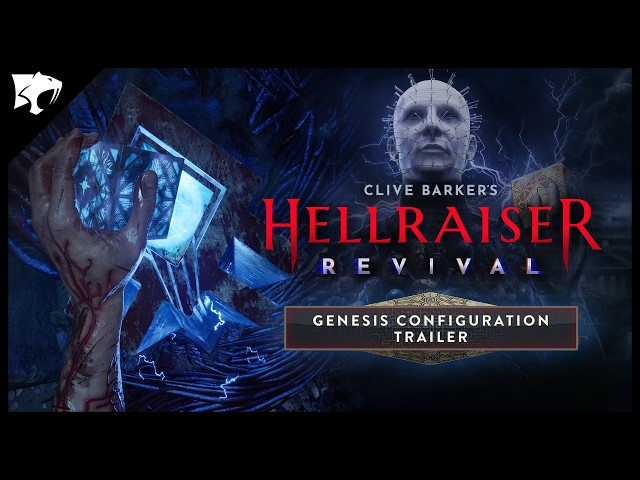
Rather than relying on cheap jump scares or sensationalized gore, Hellraiser: Revival positions itself as a cerebral, deeply unsettling journey into the nature of desire, guilt, and emotional trauma. Players assume the role of an original protagonist, Aidan Lynch, an ordinary man plunged into the horrific extradimensional realm known as the Labyrinth to rescue his missing girlfriend, Sunny. Armed with the Genesis Configuration—an enigmatic puzzle cube akin to the legendary Lament Configuration—Lynch must navigate shifting environments, solve spatial puzzles, and evade or withstand horrific manifestations, all while contending with the skin-peeling horrors of Pinhead and his Cenobite order.
+-------------------------------------------------------------------------+
|                        HELLRAISER: REVIVAL                              |
|                                                                         |
|  Developer: Boss Team Games              Publisher: Saber Interactive   |
|  Franchise Creator: Clive Barker         Target Release Window: October |
|  Protagonist: Aidan Lynch                Key Item: Genesis Configuration|
|  Genre: Psychological Survival Horror    Visual Influence: Robin Vidgeon|
+-------------------------------------------------------------------------+
Based on extensive hands-on playtime during a private Gamescom appointment and insights from narrative director Antony de Fault, Hellraiser: Revival stands out as an exceptionally polished, unapologetically mature entry in the modern horror revival. It honors the visual and thematic lineage of Barker’s universe while carving out its own identity within the interactive horror genre.
Detailed Chronology: Hands-On Experience and Mechanics Breakdown
The hands-on demonstration begins not in the hellish geometry of the Labyrinth, but within the oppressive confines of a stylish, deteriorating nightclub. The environmental storytelling immediately communicates a palpable sense of grime and decadence. Floorboards are strewn with discarded paraphernalia, used condoms, and pooled blood, establishing an atmosphere where hyper-sexuality and brutal violence bleed into one another.
This sordid setting serves as a transitional buffer before players are cast into the Labyrinth itself. The visual fidelity of the environment immediately communicates that the development team is not pulling punches. The ambient lighting paints an unsettling contrast between lush, warm interior hues and cold, subterranean darkness, setting a tone of deep psychological unease long before a Cenobite ever appears on screen.
Combat Mechanics: The Deliberate Friction of an Amateur
Gameplay within Hellraiser: Revival draws clear mechanical inspiration from modern survival horror benchmarks, particularly Capcom’s recent Resident Evil reimaginings. However, the game introduces a distinct layer of mechanical friction designed to reflect Aidan Lynch’s background. Lynch is not a battle-hardened soldier or a trained operative; he is a desperate human driven solely by love and guilt.
Firearm Dynamics: Handling handguns or submachine guns feels intentionally unwieldy. Aim recoil is pronounced, reload animations convey urgency rather than military efficiency, and weapon sway reflects Lynch’s rising panic.
Enemy Resilience: Antagonists—ranging from distorted cultists to horrific flesh-sculpted entities—frequently possess heavy armor or near-invulnerable hit zones. A standard firearm sequence often proves insufficient to neutralize a threat, compelling players to weigh the cost of spending precious ammunition against strategic retreats.
Resource Management: Tactical conservation of resources is paramount. While a crafting system exists within the inventory interface, the demo emphasizes evasion and environmental spatial awareness over direct combat confrontation.
Reality-Bending Puzzles and Environmental Loops
Where Hellraiser: Revival truly distinguishes itself is in its spatial and psychological puzzle design, anchored by the Genesis Configuration.
Architectural Manipulation: Certain puzzle segments within the Labyrinth require players to manipulate the Genesis Configuration using controller thumbsticks. Rotating the device alters physical geometry in real time, shifting hallways, revealing hidden passages, and aligning fractured staircases.
Psychological Terror and the Influence of P.T.: The absolute highlight of the demonstration occurs within a distorted, repeating simulation of Aidan Lynch’s domestic residence. Heavily evoking the spatial looping and oppressive atmospheric dread of Hideo Kojima’s P.T., this sequence forces players to confront Lynch’s internal psyche.
Grounding Human Relatability: Inside Lynch’s home, intimate framed photographs and retro Nokia 3310-inspired cellular text messages detail his romantic history with Sunny. The inclusion of semi-humorous, deeply personal text conversations grounds the character’s struggle, establishing a foundation of genuine human connection amid the surrounding grotesque imagery.
Supporting Context, Aesthetic Fidelity, and Genre Metrics
The Visual Legacy of Robin Vidgeon
To capture the distinct visual tone of the original 1987 film, the development team meticulously studied the cinematography of Robin Vidgeon, the director of photography behind Hellraiser and Hellbound: Hellraiser II.
The game avoids the monochrome gray palettes common in contemporary horror titles, embracing saturated deep crimsons, amber glows, and heavy, velvety shadows. This cinematic lighting strategy enhances the sense of tactile filth while maintaining high visual readability, ensuring that the morbid beauty of Clive Barker’s world translates faithfully into modern rendering engines.
Survival Horror Market Positioning
The decision to adapt Hellraiser as an authoritative single-player survival horror experience marks a significant pivot from recent trends in asymmetric multiplayer horror adaptations.
By prioritizing narrative depth, intricate environmental puzzles, and slow-burn atmospheric dread over wave-based action or competitive dynamics, Saber Interactive and Boss Team Games are targeting a growing demographic of horror gamers seeking mature, story-driven experiences akin to Silent Hill 2, Alan Wake 2, and Resident Evil 7: Biohazard.
Official Statements and Philosophical Narrative Design
The intellectual foundation of Hellraiser: Revival rests on its willingness to explore themes that conventional game development often sidesteps: sadomasochism, bodily autonomy, obsession, and the thin boundary between pleasure and torment.
"Art generally, especially horror, is a safe place for people to explore
 topics and process things... to inoculate ourselves against those things."

                                             — Antony de Fault, Narrative Director
In a post-demo interview, Narrative Director Antony de Fault articulated the studio’s philosophical approach to adapting Barker’s world without reducing it to shock value:
"It was very liberating, and it prompts a lot of self-discovery, I think, genuinely. If you’re working on a new IP or something, it’s quite hard to justify the inclusion of such heavy and mature themes."
Addressing the core motivations behind the narrative design, de Fault emphasized that the game’s darkness stems from real human emotions rather than superficial gore:
"We’re not just trying to shock you. It was important that they all came from a position of truth—from something that was a lived experience for at least one person on the team. We had a lot of conversations where you have to really dig deep and channel a dark part of yourself that you don’t really allow out in polite society, and definitely not in a professional context under normal circumstances."
De Fault expanded on the broader psychological utility of horror as a storytelling medium:
"I very much see art generally, especially horror, as a safe place for people to explore topics and process things. That’s the function of why I think we’re motivated to spend time with horror, as if to inoculate ourselves against those things, so if we ever encounter them in our real life, we’re better prepared to handle them."
Market Position and Future Outlook
Accessibility for Horror Newcomers
A central challenge facing Hellraiser: Revival is its reliance on a niche cinematic franchise that originated nearly four decades ago. While core horror enthusiasts and Barker loyalists represent a dedicated baseline audience, capturing a broader contemporary demographic requires a narrative structure that does not depend heavily on prior lore knowledge.
The Gamescom preview indicates that Boss Team Games has successfully mitigated this barrier. By centering the narrative on Aidan Lynch’s personal emotional journey, the game introduces the mechanics of the Genesis Configuration and the lore of the Cenobites organically. Players do not need an encyclopedic knowledge of the film franchise to comprehend the emotional stakes; the universal themes of grief, romantic devotion, and psychological vulnerability provide a clear narrative anchor.
Technical Performance and Polish
Across the demo session, Hellraiser: Revival exhibited an exceptional degree of technical stability and graphical refinement:
Frame Rate Stability: Smooth rendering performance even during complex lighting transitions and environmental shifting sequences.
Audio Engineering: Immersive spatial audio design, where distant metal clangs, skin-tearing squitches, and whispered Cenobite dialogues enhance directional awareness and paranoia.
Platform Scalability: Demonstrating strong optimization across target platforms, including high-end consoles, PC, and dedicated hardware configurations such as the Nintendo Switch.
Final Assessment
Hellraiser: Revival emerged as one of the most compelling and polished preview experiences at Gamescom. By rejecting surface-level shock tactics in favor of psychological depth, authentic cinematic lighting, and deliberate survival mechanics, Saber Interactive and Boss Team Games are preparing to deliver an authentic horror title.
With its scheduled release window approaching this October, Hellraiser: Revival promises not only to honor Clive Barker’s iconic vision, but also to set a new standard for how classic horror intellectual properties are reimagined for modern video game audiences.













Belum ada komentar. Jadilah yang pertama berkomentar!