Nostalgia has long been weaponized by the horror genre, transformed from a comforting blanket into a suffocating shroud. Yet, few recent cinematic endeavors have dissected the eerie, uncanny valley undertones of late-20th-century children’s television with the razor-sharp precision of Buddy. Directed and written by visionary filmmaker Casper Kelly, Buddy takes the foundational aesthetics of classic preschool television—reminiscent of icons like Barney & Friends and Bananas in Pajamas—and plunges them into a visceral, blood-soaked nightmare.
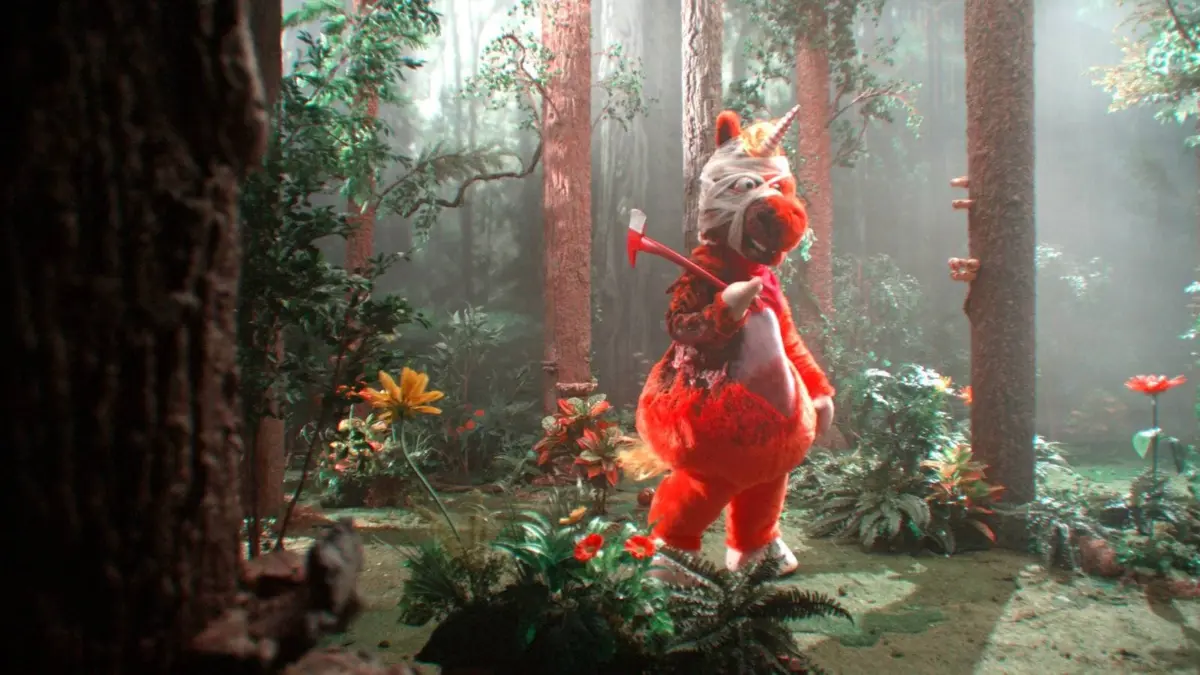
At the center of this pastel-hued descent is Buddy, a bright orange, perpetually smiling unicorn whose wholesome facade conceals an insatiable darkness. When the fictional television program It’s Buddy!—a sanctuary of song, dance, and saccharine life lessons—encounters a child who refuses to participate in the mandatory joy, the illusion shatters. What follows is a masterclass in subversion, blending biting social commentary, avant-garde production design, and a powerhouse central performance that has critics hailing it as a defining horror film of the decade.
Boasting an all-star ensemble cast featuring Cristin Milioti, Delaney Quinn, Patton Oswalt, Michael Shannon, Topher Grace, and Keegan-Michael Key, Buddy transcends the standard "killer mascot" trope popularized by recent independent horror cinema. Instead, Kelly crafts a deeply unsettling psychological landscape that interrogates the forced compulsory optimism of modern media, the commodification of childhood innocence, and the terrifying consequences of nonconformity. Now playing in cinemas, Buddy is not merely a cinematic release; it is a cultural litmus test for an audience raised on manufactured cheer.
Detailed Chronology: From Nostalgia to Nightmare
To understand the profound impact of Buddy, one must trace the cinematic journey orchestrated by Casper Kelly, whose narrative structure defies conventional genre expectations and keeps audiences perpetually off-balance.
Act I: The Warm Embrace of the Pastel Panopticon
The film opens with a deliberate, aggressive dose of manufactured nostalgia. Viewers are immediately dropped into the hyper-saturated, primary-colored world of It’s Buddy!. The set design—characterized by oversized foam furniture, painted paper-mâché clouds, and a relentless, synthetic brightness—mirrors the aesthetic hallmarks of early-90s educational television. Buddy, the towering, anthropomorphic orange unicorn, bounds onto the screen with high-pitched enthusiasm, flanked by a rotating cast of children whose eyes carry a subtle, glass-eyed obedience.
In these opening sequences, Kelly establishes the rules of Buddy’s universe: happiness is not an emotion; it is an obligation. Songs about sharing and emotional regulation are belted out with a frantic, martial cadence. The viewer is lulled into a false sense of security, assuming the film will rely on predictable, ironic detachment. Instead, Kelly plays the sincerity of the horror straight, making the cheerfulness far more terrifying than any overt threat.
The narrative pivot arrives when a young participant, portrayed with haunting realism by breakout star Delaney Quinn, simply refuses to play along. In a world where dissent is mathematically impossible, non-participation is treated as an existential heresy.
Buddy’s perpetual smile begins to twitch; the cheerful synthesized soundtrack distorts into abrasive, industrial noise; and the comforting pastel walls of the studio begin to feel less like a stage and more like a padded cell. Kelly orchestrates this descent with meticulous pacing. The psychological tension mounts as the supporting adult characters—played with unsettling zeal by a stacked supporting cast including Patton Oswalt, Michael Shannon, Topher Grace, and Keegan-Michael Key—attempt to "correct" the child’s behavior through increasingly coercive, surreal psychological conditioning.
Act III: The Grand Guignol Unraveling
When psychological compliance fails, the true nature of Buddy is revealed. The final act abandons all pretenses of children’s television educational programming, transforming into an unrelenting, high-stakes survival horror. The production design shifts from hyper-bright to strobe-lit claustrophobia, utilizing practical effects, visceral body horror, and nightmarish creature mechanics that evoke the classic era of practical monster features.
Anchored by a ferocious, unflinching performance from its lead "final girl" (Delaney Quinn), the climax is a grueling testament to human resilience against systemic indoctrination. It is an anarchic, blood-soaked reckoning that subverts every cliché of the home-invasion and creature-feature subgenres, leaving audiences breathless and fundamentally altered by the experience.
Supporting Context & Metrics: The Anatomy of a Modern Horror Phenomenon
The success of Buddy is not an isolated creative accident; it is the culmination of shifting cultural appetites and precise industrial positioning within the modern horror landscape.
The Evolution of "Trauma Nostalgia"
Over the past decade, horror has increasingly turned its gaze toward the sacred cows of childhood. From analog horror web series to feature-length cinematic adaptations, creators have recognized that the things that comforted us as children often contained latent, deeply unsettling undertones. Shows designed to teach empathy and social cues frequently relied on surveillance-state aesthetics, uncanny mascot costumes, and absolute emotional conformity.
Buddy elevates this subgenre from viral internet concept to high art. By investing heavily in a multi-million-dollar production budget, top-tier cinematography, and an A-list ensemble, the film proves that "childhood nostalgia horror" can carry the thematic weight and aesthetic ambition of prestige cinema.
Production Design as a Psychological Weapon
A critical pillar of Buddy’s success lies in its Academy-contender-level production design. Under the direction of Casper Kelly and his design teams, every prop, costume, and lighting cue serves a dual purpose. The bright orange hues of Buddy’s fleece hide jagged, unforgiving mechanical frames; the oversized play structures double as inescapable labyrinths.
Industry metrics and early audience reception trackers indicate that the film’s meticulous attention to tactile, analog detail—favoring practical puppetry and physical sets over green-screen shortcuts—has resonated deeply with audiences fatigued by digital homogenization.
The Star-Studded Ensemble Dynamics
While newcomer Delaney Quinn anchors the film’s emotional core as the definitive final girl of the decade, the surrounding cast delivers career-redefining turns. Cristin Milioti brings a chilling, Stepford-esque warmth to her role as a figure tied to the television show’s production history. Meanwhile, powerhouse actors like Michael Shannon and Patton Oswalt lean into the absurdity and menace of their characters, creating an adult ensemble that acts as both enablers and victims of the monstrous corporate machine that spawned Buddy.
Official Statements and Creative Insights
Speaking on the genesis of Buddy, writer-director Casper Kelly has opened up about the blurred lines between comforting media and psychological control during his own upbringing.
"We grew up watching these giant, smiling entities that demanded absolute happiness from us," Kelly noted in a recent promotional roundtable. "There was something inherently totalitarian about the cheer of 90s educational television—the idea that sadness or anger was a technical malfunction that needed to be immediately corrected. I wanted to take that premise to its logical, terrifying conclusion. What happens when a god of manufactured joy discovers a mortal who simply refuses to smile?"
Lead actress Delaney Quinn, whose harrowing performance has dominated post-release critical discourse, discussed the intense physical and emotional demands of bringing the film’s protagonist to life:
"Playing a character who refuses to submit in an environment where everyone else is gaslighting you into smiling was exhausting, but deeply empowering," Quinn shared. "Casper didn’t want a typical victim. He wanted someone whose survival was rooted in critical thinking and stubborn individuality. Buddy isn’t just a monster in a suit; he’s an entire system. Fighting back meant breaking the system from the inside."
Cinematic analysts and industry insiders have echoed these sentiments, pointing to Kelly’s distinct voice—honed through prior avant-garde comedy and horror-adjacent short-form work—as the vital catalyst that transforms a high-concept premise into a cohesive, terrifying cinematic triumph.
Future Outlook: The Legacy of Buddy in Contemporary Cinema
As Buddy continues its theatrical run, its cultural ripple effects are already being felt across the entertainment industry. The film has effectively established a new benchmark for elevated satirical horror, proving that subversive genre filmmaking can balance profound social commentary with visceral, white-knuckle thrills.
Redefining the "Final Girl" Archetype
For years, the horror genre has sought the next definitive iteration of the final girl—a character who transcends mere survival to become an icon of resistance. In Delaney Quinn’s performance, Buddy has delivered a masterclass in modern resilience. By substituting physical brawn with psychological defiance against institutional gaslighting, the film sets a new template for how protagonists will navigate systemic horrors in contemporary cinema.
Casper Kelly’s Directorial Trajectory
With Buddy, Casper Kelly transitions definitively from a cult-favorite auteur of subversive short-form media to a powerhouse feature-film visionary. Industry projections suggest that the film’s commercial viability and critical acclaim will grant Kelly unprecedented creative freedom for future projects. His ability to fuse uncanny comedy with genuinely harrowing terror marks him as one of the most distinctive and dangerous voices working in modern horror today.
The Return to Practical Mastery
Finally, Buddy serves as a clarion call to the film industry regarding the power of practical filmmaking. By investing in tangible sets, intricate costume puppetry, and rich color palettes rather than relying on murky digital effects, the production has created a timeless visual identity. As audiences flood cinemas to experience the terrifying charm of the bright orange unicorn, Buddy cements its place not just as a must-see horror film of the year, but as a watershed moment for the genre at large.








Belum ada komentar. Jadilah yang pertama berkomentar!