

Executive Overview
At the Goldman Sachs Communacopia + Technology conference, Nvidia founder and CEO Jensen Huang delivered a masterclass in market confidence, projecting a continuation of his company’s historic, record-breaking growth trajectory through the end of next year. Facing a chorus of Wall Street skeptics and burgeoning competition from tech giants and agile startups alike, Huang dismissed concerns regarding an impending end to Nvidia’s artificial intelligence market dominance. Instead, he painted a portrait of a corporation intrinsically woven into the very fabric of the global technology ecosystem—one that possesses such deep operational visibility that its leadership can essentially "see the future."
Huang’s address comes at a pivotal crossroads for the tech sector. While hardware competitors—ranging from hyperscale cloud providers like Amazon, Microsoft, and Google to specialized contenders like Cerebras and Etched—vie for a piece of the lucrative AI chip market, Nvidia continues to command the lion’s share of enterprise budgets. During his fireside chat, Huang challenged outdated perceptions of his company as a mere component vendor, reframing Nvidia as the foundational architect of the modern industrial revolution.
Backing up this lofty rhetoric with staggering projections, Huang reiterated Nvidia’s astonishing revenue guidance for the upcoming fiscal year. Having previously signaled that the company could achieve a mind-boggling 70% year-over-year revenue growth, Huang doubled down on these figures. With analysts anticipating Nvidia to close its current fiscal year at approximately $400 billion in revenue, a 70% expansion would catapult the company into uncharted financial territory near $680 billion.
Yet, as the tech world marvels at these astronomical numbers, questions linger regarding long-term market maturation, infrastructure efficiency, and the sustainability of Nvidia’s financial web. This deep-dive report examines Huang’s statements, evaluates the underlying metrics of Nvidia’s unprecedented expansion, analyzes the competitive landscape, and scrutinizes the structural health of the contemporary AI gold rush.
Detailed Chronology: Huang’s Masterclass at Communacopia
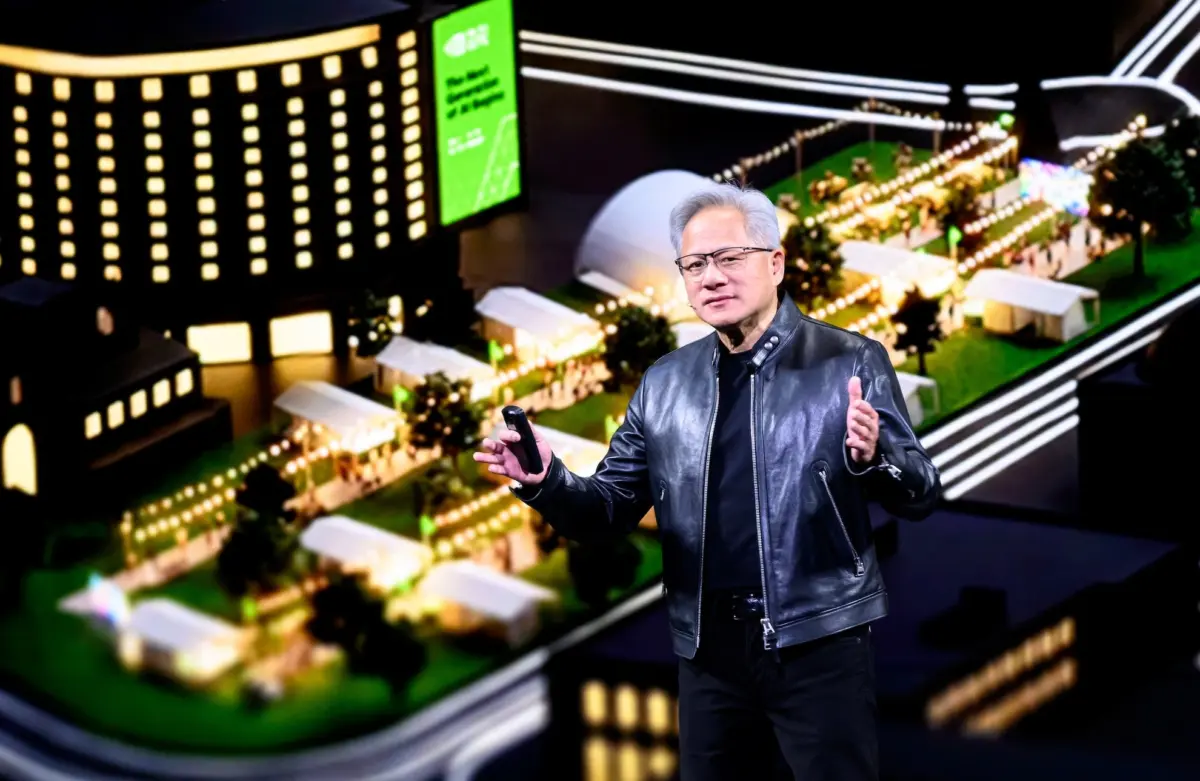
The setting was the Goldman Sachs Communacopia + Technology conference on a Thursday that has since sent shockwaves through financial markets. Jensen Huang, donning his signature leather jacket and radiating unbridled enthusiasm, took the stage to address institutional investors, analysts, and tech executives who have spent the better part of two years attempting to forecast the peak of the artificial intelligence infrastructure boom.
The Morning Address: Redefining the GPU
The session began with Huang addressing the persistent narrative that Nvidia is nearing the top of a cyclical wave. For months, market watchers have pointed to the inevitable saturation of graphics processing unit (GPU) demand, drawing parallels to historical semiconductor cycles where explosive growth is invariably followed by a painful correction.
Huang systematically dismantled this comparison by reframing what a modern Nvidia product actually is.
- The Historical Context: He reminded the audience of Nvidia’s roots, originating as a company that built discrete GPUs primarily sold to consumers to enhance PC gaming experiences at price points hovering around $399.
- The Modern Paradigm: "Most people think Nvidia builds a chip. I mean, you need airplanes to ship what we build," Huang remarked. He pointed out that a modern enterprise deployment is no longer a solitary piece of silicon, but a sprawling, interconnected supercomputing architecture. "One GPU now is not $399. It’s $8.5 million dollars. That’s one GPU, all connected with NVLink, 2 million parts, right? 250,000 kilowatts. That’s a GPU, and we ship thousands of them."
Afternoon Projections: Reaffirming the 70% Growth Target
Later in the discussion, the conversation pivoted to financial guidance. Last month, during a quarterly earnings call that shattered Wall Street expectations yet again, Nvidia dropped a bombshell forecast: the company anticipates top-line revenue growth of roughly 70% for the next fiscal year.
Rather than walking back or softening this aggressive guidance—as many conservative chief executives might do to manage Wall Street’s expectations—Huang leaned entirely into it. "I think we could grow 70% year over year. We’re confident about that," he told the Goldman Sachs audience.
Addressing the Ecosystem and Supply Chain
Huang used the remainder of his time on stage to emphasize that Nvidia’s visibility into future demand is not the result of guesswork, but of absolute market saturation. By maintaining deep relationships across every tier of the technology stack—from memory chip foundries and original equipment manufacturers (OEMs) to neocloud providers and AI-native startups—Nvidia has positioned itself at the absolute center of gravity for the digital economy. The chronology of the event underscored a singular message: Nvidia is not merely participating in the AI wave; Nvidia is engineering the channel through which the wave flows.
Supporting Context & Metrics: The Anatomy of a $680 Billion Juggernaut
To understand the sheer magnitude of Nvidia’s projections, one must examine the hard data underpinning the company’s operational pipeline. The numbers cited by Huang and verified by industry analysts reveal an industrial scaling event without historical precedent.
The GB200 NVL72 Phenomenon
At the heart of Nvidia’s current commercial dominance is its next-generation system architecture. During the conference, Huang highlighted the unprecedented demand for the GB200 NVL72, a data center computing system that combines 36 Grace CPUs with 72 Blackwell GPUs into a single, unified liquid-cooled rack.
According to internal metrics shared by the CEO, orders for this specific product are currently experiencing a staggering 27% month-to-month sales growth. This metric alone illustrates that enterprise and hyperscale customers are not slowing down their capital expenditures; rather, they are accelerating their transition to multi-node, high-density AI clusters designed to train the next generation of frontier models.
Financial Projections and Market Cap Implications
- Current Fiscal Year Ending Estimates: Wall Street consensus estimates place Nvidia’s revenue for the current fiscal year at approximately $400 billion.
- Projected Next Fiscal Year Revenue: Applying Huang’s projected 70% year-over-year growth rate yields an estimated top-line revenue of roughly $680 billion for the subsequent fiscal year.
To put these figures into perspective, a single-year revenue expansion of nearly $280 billion exceeds the total annual market capitalization of many long-standing Fortune 500 enterprises.
The Global Infrastructure Footprint
Huang attributed this growth to unprecedented visibility into global resource allocation. When asked how Nvidia can predict demand so accurately, he explained that the company monitors virtually every physical input required for artificial intelligence deployment:
- Power and Real Estate: "We’re tracking every single gigawatt of land, power, shell around the world. Literally everything on the planet," Huang stated, utilizing the term "shell" to describe the concrete and steel structures of data centers before they are populated with server racks.
- Network Feedback Loops: Through a dense web of partners—including neoclouds, traditional cloud service providers, OEMs, and pure-play AI research labs—Nvidia receives real-time operational data. "We’re working with everybody, and so we kind of know where everything is," he noted.
Official Statements: Navigating Competition and "Circular Deals"
Despite its dominant market share, Nvidia faces an increasingly vocal group of critics who question the sustainability of its business model. During the Goldman Sachs conference, Huang addressed two of the most pressing narratives surrounding the company: the rise of internal chip development by hyperscalers and startups, and allegations regarding "circular financing."
The Multi-Front Competition Dilemma
For years, skeptics have argued that Nvidia’s margins must inevitably compress as its largest customers—namely Amazon (AWS), Microsoft (Azure), and Google Cloud—design and deploy their own custom AI silicon (such as AWS Trainium, Microsoft Maia, and Google TPUs). Furthermore, specialized AI research labs like OpenAI and Anthropic are exploring proprietary hardware initiatives, while well-funded hardware startups like Cerebras (which recently secured significant enterprise traction) and Etched (which hit a $5 billion valuation on the back of $1 billion in sales) challenge Nvidia’s architectural monopoly.
Huang’s response to this competitive pressure was pragmatic and expansive. He pointed out that Nvidia’s hardware is platform-agnostic in the eyes of the consumer: "Nvidia runs every model. Every single lab can use us." Whether a developer is building on Anthropic’s Claude, OpenAI’s GPT architecture, Google’s Gemini, or an open-weight model from the global open-source community, the underlying computational heavy lifting almost universally relies on Nvidia’s CUDA software ecosystem. "We are a foundational platform of the AI ecosystem, foundational platform of the AI industry," Huang emphasized.
Addressing the "Circular Deals" Controversy
Perhaps the most contentious line of questioning during the fireside chat revolved around Nvidia’s investment strategy. Industry analysts have frequently raised eyebrows over Nvidia’s practice of investing venture capital into emerging AI startups and neoclouds that subsequently turn around and allocate a significant portion of those funds to purchase Nvidia hardware.
Skeptics have drawn uncomfortable parallels to the "circular financing" and vendor-financing schemes that famously contributed to the collapse of internet infrastructure suppliers like Lucent Technologies during the dot-com bust.
Huang’s response was characteristically blunt, blending casual humor with aggressive business realism:
"Well, it’s not circular because we put a little bit of money in, and a lot of money comes back. I look at the spreadsheet, we put in $1 and $100 comes back in. Is that circular? If that is, let’s do more of that."
Jokes aside, Huang defended the integrity of these financial arrangements by emphasizing strict contractual due diligence. He asserted that before Nvidia deploys capital into any ecosystem partner, the recipient must demonstrate legitimate, executed commercial contracts that guarantee revenue generation from end-users.
Touting a verified pipeline of $100 billion worth of such contracts, Huang dismissed the notion that Nvidia is exposed to speculative startup risk. "I’m not taking any risks," he stated firmly. "I need a sure thing."
Future Outlook: The Horizon of Efficiency and Disruption
As the tech industry looks toward the horizon, the ultimate question remains: Can Nvidia’s ironclad grip on the artificial intelligence market persist indefinitely?
The Inevitability of Tech Disruption
Economic history dictates a sobering rule: all massive technology build-outs eventually face maturity, normalization, and disruption. Even Jensen Huang acknowledges that a substantial portion of current AI spending is being driven by "AI-native startups" that raise unprecedented amounts of venture capital and immediately reinvest the majority of that liquidity into infrastructure and compute tokens.
As the broader AI industry matures from an experimental gold rush into an efficiency-driven enterprise utility, market dynamics are bound to shift. Enterprises will inevitably demand higher operational efficiency, squeezing token costs and forcing optimizations in how AI models utilize hardware infrastructure.
Nvidia’s Long-Term Defensive Moat
Nevertheless, Nvidia enters this next phase of market evolution from a position of profound structural strength. By expanding its purview beyond isolated GPUs into full-stack data center engineering, proprietary networking (NVLink and InfiniBand), and software lock-in (CUDA), Nvidia has transformed from a cyclical semiconductor vendor into an indispensable public utility for the digital age.
Whether Huang’s prediction of $680 billion in revenue next year materializes precisely as forecasted will depend on global power grid expansions, macroeconomic stability, and the continued monetization velocity of enterprise artificial intelligence. Yet, for the moment, Nvidia’s finger remains firmly in every pie—and the baking is far from finished.








Belum ada komentar. Jadilah yang pertama berkomentar!