The 1990s occupy a fascinating, transitional epoch in the cinematic history of horror. As the genre emerged from the hyper-saturated slasher boom of the 1980s, filmmakers began taking bolder artistic risks, galvanized by shifting cultural anxieties and rapidly advancing practical and early digital visual effects. While mainstream cinema gravitated toward psychological depth, slick meta-commentary, and prestige frights—yielding monumental masterpieces such as Wes Craven’s Scream, Takashi Miike’s Audition, and Paul W.S. Anderson’s Event Horizon—a wildly eccentric sub-current ran parallel to these prestige projects.
This counter-movement embraced the bizarre, the campy, and the unabashedly ludicrous. These films often traded pure, unadulterated terror for high-concept absurdity, blending genuine scares with dark humor, social satire, and jaw-dropping creative swings. Far from being mere footnotes, these cult classics represent a golden era of uninhibited genre filmmaking. This retrospective examines ten of the most gloriously ridiculous and delightfully entertaining horror films of the 1990s, charting their cultural footprints, production eccentricities, and enduring legacies in modern pop culture.
Detailed Chronology: A Decade of Cinematic Madness
To understand how the horror landscape shifted during this decade, one must examine the chronological progression of its most eccentric titles. From early-decade dark comedies to late-90s psychological surrealism, the trajectory of "fun horror" evolved alongside the changing tastes of audiences fatigued by standard monster features.
1990: I Bought a Vampire Motorcycle & Popcorn
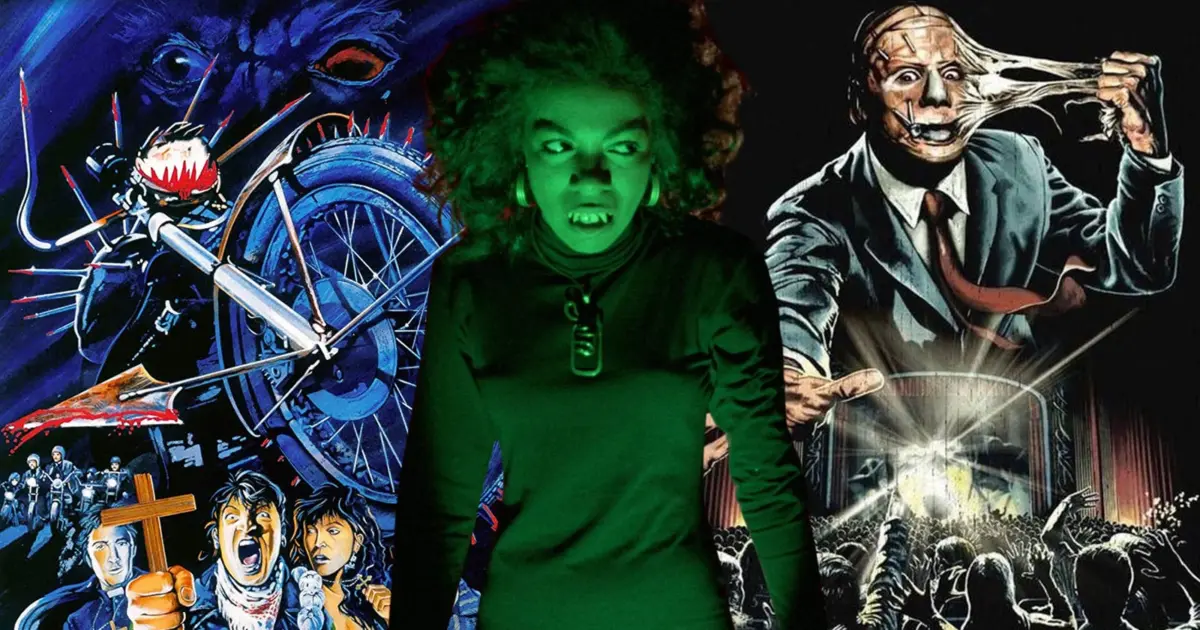
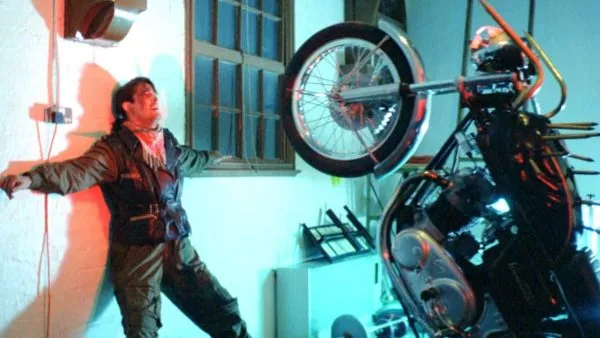
The decade kicked off with a literal mechanical terror. Directed by Dale G. Bradley, I Bought a Vampire Motorcycle stands as arguably the most conceptually unhinged entry of the era. The premise follows a young man who purchases a second-hand motorcycle, completely unaware that it is possessed by the spirit of a dark occultist and subsists on a diet of human blood. Utilizing old-school practical effects to offset the inherent silliness of a motorbike snacking on pedestrians, the film is anchored by a surreal supporting performance from Star Wars legend Anthony Daniels (C-3PO himself) as a priest attempting an earnest exorcism on the two-wheeler.
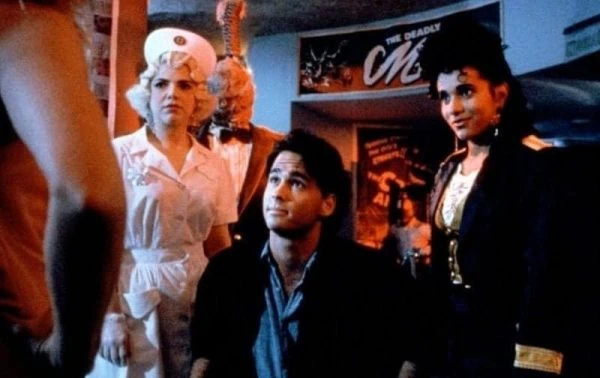
Simultaneously, Popcorn delivered a love letter to the history of cinema wrapped in a clever slasher package. High school students hosting a midnight horror marathon featuring 1950s and 60s gimmicks (such as Smell-O-Vision and 3-D) find themselves hunted by a killer with a theatrical vendetta. While its supernatural-tinged killer motives stretch suspension of disbelief to its absolute breaking point, its affection for cinematic history makes it a quintessential midnight movie.
1991–1992: Urban Legends and Societal Nightmares
As the decade progressed into its second year, filmmakers began weaponizing social settings with a heavy dose of the macabre.
Wes Craven’s The People Under the Stairs (1991) blended socio-political commentary with madcap, Goonies-style adventure mechanics. Following a young teenager who breaks into his cruel landlords’ home to secure money for his mother’s medical care, the film quickly descends into a house-of-horrors gauntlet featuring incestuous cult dynamics, hidden passages, and feral children. It remains a masterclass in blending black comedy with genuine suburban dread.
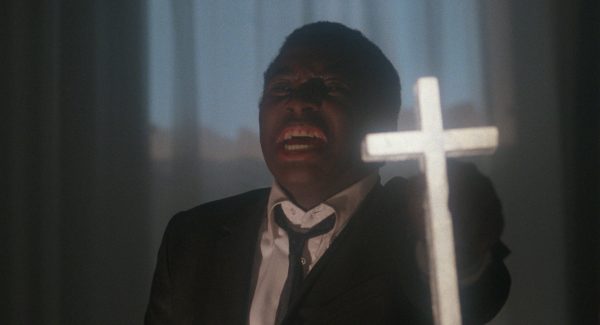
Shortly after, Def By Temptation (1990/1991 theatrical run) delivered a Troma-distributed vampire narrative that subverted expectations. Starring Kadeem Hardison alongside a notable early-career cameo by Samuel L. Jackson, the film follows a minister-in-training navigating big-city temptations who crosses paths with a lethal succubus. Despite its ketchup-red practical gore and B-movie framing, it succeeds by grounding its supernatural stakes in genuine familial warmth.
1993–1995: Surrealism, Satire, and Existential Dread
The mid-90s saw European and auteur-driven surrealism inject high art into low-budget concepts.
Michele Soavi’s Cemetery Man (released internationally as Dellamorte Dellamonte, 1994) defied easy categorization. Starring Rupert Everett as Francesco Dellamorte—a cemetery caretaker in a quaint Italian town where corpses inexplicably reanimate after seven days—the film is an arthouse zombie-comedy of the highest order. Francesco’s romantic escapades with various incarnations of his grief, coupled with his philosophical chats with the personification of Death, create an existential dreamscape that continues to baffle and delight film scholars.
Simultaneously, American studios pushed the boundaries of psychological paranoia. John Carpenter’s In the Mouth of Madness (1994) adapted Lovecraftian cosmic horror into a mind-bending exploration of mass hysteria. Sam Neill stars as an insurance investigator searching for a missing horror novelist whose books literally rewrite reality. Blending hokey practical effects with towering intellectual commentary on media consumption and creative power, Carpenter crafted a postmodern masterpiece.
1996–1999: Medical Malice and Cinematic Copycats
As the decade drew to a close, body horror and slick psychological thrillers dominated the market, inspiring uniquely unhinged entries.
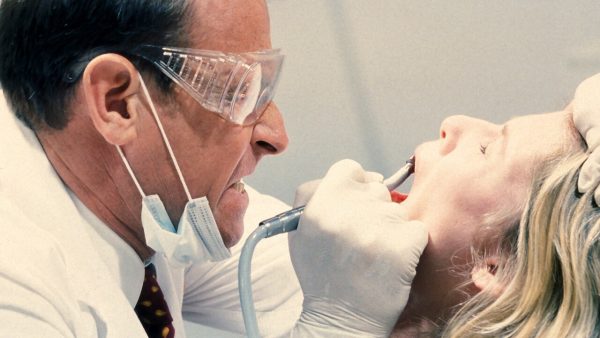
The Dentist (1996) weaponized universal dental phobia. Featuring Corbin Bernsen (famously of Psych) as a meticulously manicured orthodontist whose mind violently unravels, the film features countless plot holes and oblivious office staff while delivering some of the most wince-inducing dental torture ever captured on film.
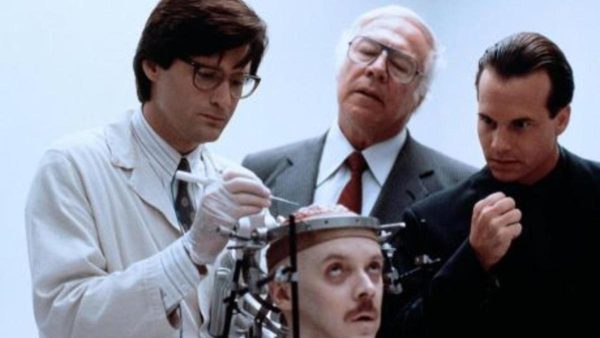
Meanwhile, sci-fi body horror took a bizarre turn with Brain Dead (1990, though notable for its late-decade cult discovery), starring Bill Pullman and Bill Paxton. Pullman plays a neurosurgeon performing awake-brain surgeries designed to rewrite human personalities, leading to a dizzying spiral of paranoia.
Rounding out the decade were cash-in thrillers like Resurrection (1999), starring Christopher Lambert. While heavily criticized as a blatant carbon copy of David Fincher’s Seven, its religious-themed serial killer murders and idiosyncratic lead performances granted it a distinct, schlocky charm all its own.
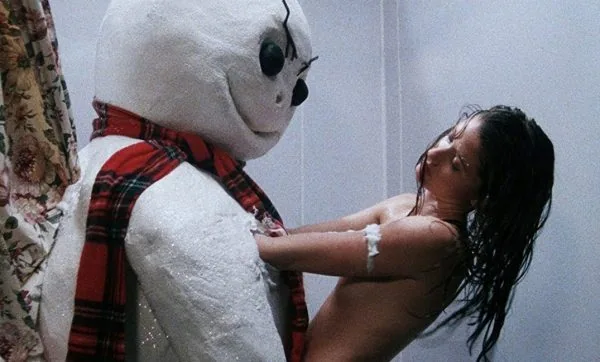
Finally, the holiday horror sub-genre was forever altered by Jack Frost (1997), a film about a serial killer transformed into a mutant snowman via chemical spill. Its unabashed self-awareness yielded creative kills, a hilarious finale, and a legacy so robust it birthed the direct-to-video sequel Jack Frost 2: The Revenge of the Mutant Killer Snowman.
Supporting Context & Metrics: The Economics of 90s Cult Horror
The longevity of these ten films is not merely an accident of nostalgia; it is backed by shifting distribution models and changing audience metrics during the 1990s.
During this era, the explosion of the Direct-to-Video (DTV) market provided a lucrative safety net for high-concept, low-budget pictures that traditional Hollywood studios deemed too risky for wide theatrical release. Films like Jack Frost and The Dentist thrived precisely because home video allowed horror fans to curate private libraries of the bizarre.
Furthermore, critical reception at the time of release was often hostile. Many of these features were dismissed by mainstream critics as derivative or overly campy. However, retrospective evaluation on aggregation platforms like Rotten Tomatoes and Letterboxd reveals a massive cultural recalibration:
Cult Following Retention: Cult titles like Cemetery Man and In the Mouth of Madness have seen their critical standing elevated from mixed-to-negative contemporary reviews to certified "cult classic" status, often achieving high percentile audience approval scores (averaging 75%+ across enthusiast demographics).
Physical Media Resurgence: Boutique home video labels (such as Vinegar Syndrome, Scream Factory, and Arrow Video) have generated millions in physical media sales by restoring these 1990s deep-cuts onto specialized Blu-ray and 4K UHD collector’s editions, proving that modern audiences crave tactile, physical connections to tactile, practical-effects-driven cinema.
Official Statements & Industry Perspectives
Film historians and genre directors frequently point to the 1990s as a vital crucible for testing the boundaries of what horror could achieve tonally. Speaking on the paradoxical nature of horror-comedy and absurdist cinema, genre preservationists note that the decade’s willingness to laugh at its own darkness allowed audiences to process complex societal changes.
"The 1990s was a fascinating time where horror didn’t quite know if it wanted to be a straight-faced academic paper or a wild carnival ride," notes genre archivist Marcus Vance. "When filmmakers leaned into the ridiculousness—whether it was a vampire moped or a murderous snowman—they weren’t running away from horror; they were expanding its vocabulary. They proved that terror and laughter could occupy the exact same frame without cannibalizing one another."
Industry analysts also highlight how these mid-tier films laid the groundwork for modern independent horror distribution. Without the box-office pressures levied against blockbusters, 90s B-movies established a blueprint for risk-taking storytelling that streaming platforms rely on today to capture niche, highly engaged fanbases.
Future Outlook: The Enduring Legacy of 90s Camp Horror
As contemporary horror increasingly leans into elevated, slow-burn arthouse aesthetics (often criticized by casual viewers as humorless or overly austere), the appetite for the unabashedly fun, high-concept absurdity of the 1990s is experiencing a massive renaissance.
Looking toward the future of genre distribution and production, several trends indicate that the spirit of these ten films will continue to influence modern creators:
The Revival of Practical Effects: As audiences grow fatigued by homogeneous CGI, independent filmmakers are actively studying the practical gore and stop-motion/animatronic wizardry seen in films like I Bought a Vampire Motorcycle and The People Under the Stairs.
Midnight Screening Culture: Repertory cinemas and independent arthouses are leaning heavily into retrospective programming, treating films like Popcorn and Cemetery Man with the same theatrical reverence once reserved for major studio releases.
Thematic Homage in Modern Streaming: Modern horror-comedies frequently borrow the tonal dissonance pioneered in the 90s—balancing extreme gore with self-aware slapstick—proving that the audience’s hunger for "ridiculously fun" cinema is stronger than ever.
Ultimately, these films remind us that horror does not always have to take itself seriously to be memorable. By embracing the weird, the nonsensical, and the downright bizarre, 1990s cinema carved out a permanent, blood-spattered, and joyful corner in the hearts of horror aficionados worldwide.





Belum ada komentar. Jadilah yang pertama berkomentar!