

Executive Overview
In a surprising yet calculated move to revitalize the budget and mid-range laptop sectors, NVIDIA has officially expanded its mobile graphics processing unit (GPU) portfolio. Nearly three years after the initial rollout of the RTX 20-series architecture, the technological giant has breathed new life into the aging lineup by announcing three distinct graphics processors: the GeForce RTX 2050, alongside two productivity-and-gaming-oriented entry-level cards, the GeForce MX570 and GeForce MX550.
For years, consumers shopping in the budget and affordable performance tiers have had to compromise on outdated hardware. Laptops under the sub-$800 to $1,000 price brackets have predominantly relied on legacy architectures, most notably the GTX 1650 and the MX450. While these older chips adequately handled casual tasks and esports titles, they struggled immensely with modern graphical demands, real-time ray tracing, and intensive creative workloads.
NVIDIA’s introduction of the RTX 2050, MX570, and MX550 aims to bridge this technological gap. By bringing modern computational features—such as NVIDIA DLSS (Deep Learning Super Sampling) and real-time ray tracing—down to more accessible price points, the company is fundamentally shifting what consumers can expect from entry-level portable workstations and gaming laptops. This in-depth report explores the architectural nuances, performance expectations, strategic market positioning, and broader industry implications of NVIDIA’s latest hardware drop.
Detailed Chronology and Architectural Evolution
To truly understand the significance of the RTX 2050, MX570, and MX550, one must examine the timeline of NVIDIA’s architectural deployment. When the RTX 20-series debuted in late 2018 (culminating in widespread laptop implementations through 2019), it introduced the world to Turing architecture, real-time ray tracing cores (RT Cores), and Tensor Cores for AI processing. However, these features were historically locked behind premium price barriers.
As the industry transitioned to the Ampere-based RTX 30-series, entry-level users were left in a state of technological limbo. Budget buyers either had to pay a steep premium for an RTX 3050/3060 machine or settle for non-RTX GTX cards devoid of modern AI-driven upscaling.
The timeline leading to the announcement of the RTX 2050 highlights a clever repurposing of silicon and architectural blending:
- Late 2018 – 2019: NVIDIA launches the Turing-based RTX 20-series, establishing real-time ray tracing as the industry standard for high-end gaming.
- 2020 – 2021: The rollout of the Ampere-based RTX 30-series dominates the market, leaving budget laptops reliant on older Pascal (GTX 16-series) and entry-level Turing (MX450) architectures.
- December 2021: NVIDIA officially pulls back the curtain on the GeForce RTX 2050, MX570, and MX550, bridging a crucial gap in its mobile product stack.
- Spring 2022 and Beyond: The hardware officially hits the consumer market, integrated into thin-and-light notebooks from major manufacturers just ahead of and following the CES trade circuit.
The Architectural Paradox: An RTX Card Built on Ampere
Paradoxically, despite bearing a "20-series" moniker that implies a Turing lineage, the GeForce RTX 2050 is actually constructed upon the Ampere architecture. This places it in the same architectural family as the higher-end RTX 30-series cards rather than its nominal predecessors like the RTX 2060.
This decision brings distinct advantages and structural limitations. By utilizing Ampere, the RTX 2050 inherits improved power efficiency and refined execution pipelines, yet it operates under specific constraints designed to segment it safely away from the RTX 3050.
Supporting Context, Specifications, and Performance Metrics
A granular look at the hardware specifications reveals how NVIDIA has carefully calibrated these three new graphics processors to target specific use cases, ranging from student productivity to lightweight competitive gaming.
1. GeForce RTX 2050: The Mid-Range Contender
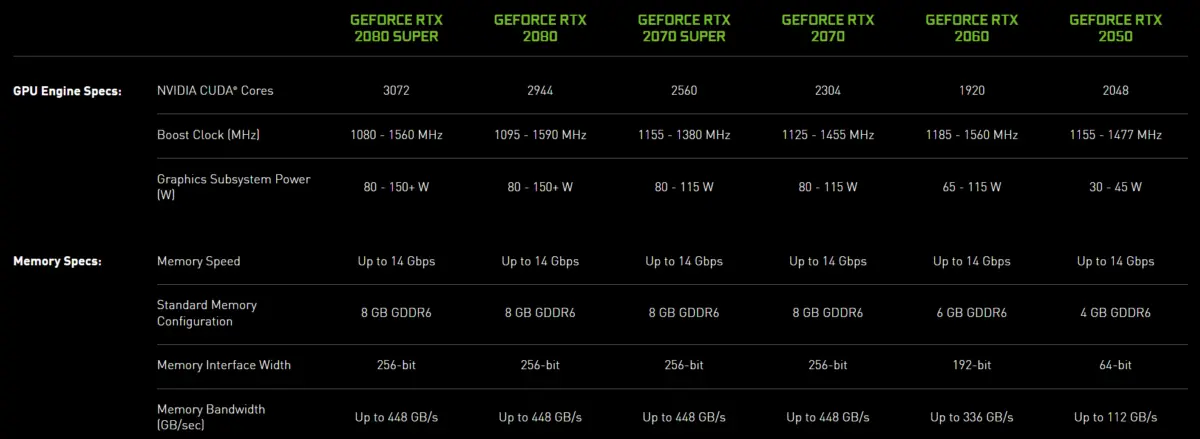
The crown jewel of this announcement is the GeForce RTX 2050. Aimed squarely at mainstream gamers and creative professionals shopping on a strict budget, the card’s specifications paint a fascinating picture of engineering compromise:
- CUDA Cores: 2,048 (Matching the core count of the RTX 3050)
- VRAM: 4GB GDDR6
- Memory Bandwidth: 112 GB/s
- Memory Bus Width: 64-bit interface
- Thermal Design Power (TDP): 30W – 45W
While matching the RTX 3050 in raw CUDA core count sounds impressive on paper, performance bottlenecks prevent the RTX 2050 from overtaking its nominal successor. The primary culprit is the 64-bit memory interface width, which severely restricts memory bandwidth compared to the wider buses found on higher-tier cards.
Consequently, users should not expect flagship-tier performance. However, the inclusion of 4GB of GDDR6 VRAM ensures that the card can comfortably handle modern texture streaming requirements at 1080p.
Crucially, the RTX 2050 supports:
- Real-Time Ray Tracing: Allowing entry-level users to experience basic ray-traced lighting effects in supported titles.
- Deep Learning Super Sampling (DLSS): A vital inclusion, as DLSS can dramatically boost frame rates in demanding games by rendering them at a lower internal resolution and upscaling via AI Tensor cores.
- NVIDIA BatteryBoost: Optimizing power consumption to extend battery life during mobile workflows.
Note on omissions: NVIDIA has deliberately excluded G-Sync and VR Ready certifications from the RTX 2050 spec sheet, signaling that this card is intended for traditional, non-VR, standard-refresh-rate panel gaming.
2. GeForce MX570: The Pinnacle of the MX Line
Moving into the realm of productivity-first graphics, the GeForce MX570 steps in as the most powerful MX-series GPU NVIDIA has ever produced. Designed for thin-and-light laptops where thermal headroom is severely limited, the MX570 focuses on maximizing efficiency.
- Core Architecture: Utilizes more power-efficient CUDA cores than previous generations.
- Memory Performance: Features significantly faster memory speeds compared to older MX chips.
- Primary Focus: Optimized for simultaneous multitasking, heavy web workloads, content creation suites (such as Adobe Premiere Pro and Photoshop), and light gaming sessions during downtime.
3. GeForce MX550: The Creative Successor
Succeeding the ubiquitous MX450, the GeForce MX550 is tailor-made for everyday creators and casual users who need a step up from integrated graphics (such as Intel Iris Xe or AMD Radeon Vega graphics).
- Primary Focus: Accelerating photo and video editing tasks within creative applications.
- Gaming Capability: Equipped with an increased count of CUDA cores, allowing it to handle casual esports titles (such as League of Legends, CS:GO, and Dota 2) at respectable frame rates without breaking a sweat.
Official Statements and Industry Context
In statements accompanying the hardware reveal, NVIDIA emphasized its commitment to empowering the broader consumer base. For years, the entry-level laptop market has been flooded with machines relying on integrated graphics or aging discrete chips like the GTX 1650. By introducing the RTX 2050, MX570, and MX550, NVIDIA is providing original equipment manufacturers (OEMs) with modern building blocks that do not compromise battery life or thermal integrity.
Industry analysts have noted that this release is a direct response to shifting market demands. With remote work, hybrid learning, and casual gaming becoming permanent fixtures of modern consumer behavior, the demand for affordable, versatile laptops has skyrocketed. Consumers no longer view laptops as mere tools for word processing; even budget-conscious buyers expect their machines to handle video conferencing, 4K video playback, content creation, and modern gaming.
Furthermore, integrating DLSS and ray tracing into the sub-flagship tier democratizes advanced rendering technologies. While hardcore enthusiasts will continue to gravitate toward the RTX 3070, 3080, and newer 40-series hardware, the everyday student or entry-level creator stands to benefit immensely from having AI-accelerated features at a lower price point.
Future Outlook and Market Implications
As these chips roll out globally across Spring 2022 and beyond, several key trends are expected to shape the laptop market:
- Phase-Out of Legacy Chips: The widespread adoption of the RTX 2050, MX570, and MX550 will finally spell the end of the line for deeply outdated components like the GTX 1650 in new retail configurations, modernizing the baseline standard for entry-level laptops.
- Price-to-Performance Shifts: Consumers can look forward to sub-$800 laptops that offer legitimate productivity acceleration and DLSS-enabled gaming, lowering the financial barrier to entry for modern PC gaming.
- OEM Integration: Major laptop manufacturers—including ASUS, Lenovo, Dell, HP, and Acer—are positioned to update their mainstream consumer and student lineups, offering versatile configurations powered by NVIDIA’s newest silicon.
Ultimately, NVIDIA’s strategic expansion proves that older architectures—when re-engineered with modern process nodes and paired with intelligent software features like DLSS—still have a vital role to play in the ever-evolving ecosystem of personal computing.









Belum ada komentar. Jadilah yang pertama berkomentar!