

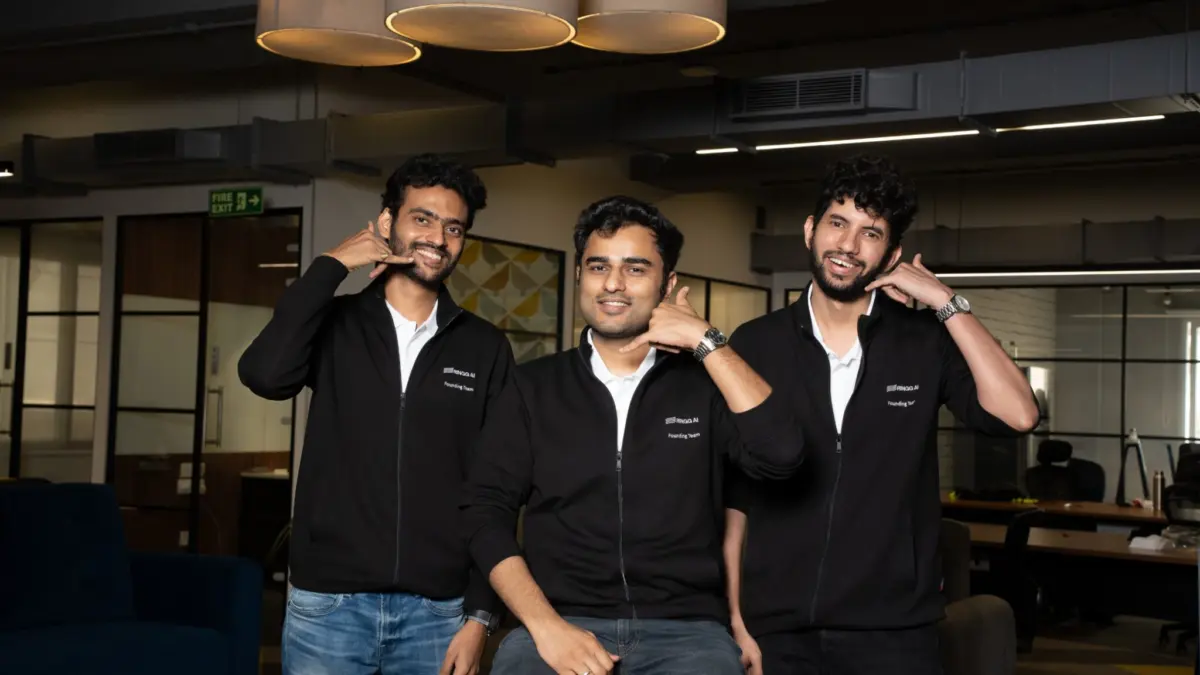
Executive Overview
The intersection of generative artificial intelligence and voice communication is rapidly reshaping enterprise operations across emerging markets, and India is leading this charge. Recent data underscores that more than 76% of Indian consumers prefer speaking directly to businesses over voice calls rather than navigating text-based chatbots or asynchronous messaging menus. This deep-seated consumer habit has created a multi-million-dollar whitespace for automated customer support, outreach, and operational workflows.
Capitalizing on this massive market demand, Ringg, a prominent enterprise-focused voice AI startup, has announced a $10 million capital injection led by Peak XV Partners. This funding functions as an extension of Ringg’s Series A financing round, closely following a $5.5 million raise earlier this year and lifting the company’s total Series A proceeds to an impressive $15.5 million.
Currently processing an astonishing 20 million call attempts every month, Ringg is positioning itself not merely as a voice bot provider, but as a comprehensive outcome-driven automation platform. By migrating away from low-margin, high-volume transactional calls toward complex enterprise workflows—ranging from healthcare appointment scheduling to multi-step fintech onboarding—Ringg is redefining how businesses interact with millions of consumers at scale.
This deep-dive report explores Ringg’s evolution from a text-to-speech laboratory into an enterprise orchestration powerhouse, its strategic maneuvers within India’s hyper-competitive AI landscape, and its roadmap for international expansion via Global Capability Centers (GCCs).
Detailed Chronology: From DesiVocal to Enterprise Orchestration
Ringg’s journey to becoming a cornerstone of India’s enterprise voice AI infrastructure is a textbook example of a startup pivoting to find product-market fit in a resource-intensive technology sector.
The Origins: DesiVocal and the High Cost of Speech Models
The venture originally launched under the moniker DesiVocal, operating as a specialized text-to-speech (TTS) startup. In its early days, the founding team focused heavily on training proprietary speech models tailored to the nuances of Indian languages, accents, and tonal expressions.
However, the team quickly encountered a formidable economic roadblock: training and maintaining custom-built foundational speech models from scratch is exceptionally expensive and computationally demanding. Recognizing that raw model training left thin margins and little structural defensibility for an early-stage company, the founders boldly decided to move up the technology stack. Rather than selling raw audio synthesis, they shifted their focus toward building intelligent, conversational voice AI agents specifically designed to solve complex operational challenges for large enterprises.
Securing Early Validation
The pivot proved prescient. Indian fintech pioneer Cred stepped in as Ringg’s inaugural enterprise customer, validating the startup’s ability to handle secure, high-stakes customer interactions. Buoyed by this initial success, Ringg rapidly expanded its client roster, onboarding some of the country’s most prominent consumer tech giants, including Flipkart, Practo, Groww, and PolicyBazaar.
Refining the Product Strategy
Initially, Ringg captured market share by executing straightforward, high-volume, low-complexity use cases. These included routine outbound calling, preliminary lead qualification, and basic loan collection reminders.
However, co-founder Siddharth Tripathi and his team quickly realized the limitations of this approach. In an interview, Tripathi noted:
"At the start, we were doing high-volume, low-complexity use cases like outbound calling, lead qualification, loan collection, and more. We quickly realized these are not sticky use cases, and so it’s always going to be a price game."
To escape the race-to-the-bottom pricing pressures typical of basic call-center automation, Ringg intentionally pivoted toward deeply integrated, higher-value workflows. Today, the platform orchestrates sophisticated tasks such as automated appointment booking and post-visit follow-ups for healthcare networks, abandoned-cart recovery for e-commerce platforms, and rigorous onboarding and KYC (Know Your Customer) verifications for financial institutions.
Supporting Context & Metrics: The Scale of Voice AI in India
The macroeconomic and behavioral indicators underpinning Ringg’s growth are robust. To understand why investors are pouring millions into voice infrastructure startups in India, one must examine the intersection of consumer preference, technical maturation, and business economics.
Consumer Behavior and Voice Dominance
According to comprehensive industry data from Truecaller’s State of Business Calling report, voice remains the undisputed king of consumer communication in India. More than 76% of Indian consumers explicitly prefer talking over the phone when resolving issues or engaging with brands. This preference is driven by linguistic diversity, varying literacy levels in digital interfaces, and a cultural comfort with telephonic interactions.
Operational Footprint and Metrics
Ringg’s core business metrics reflect this massive addressable market:
- Monthly Call Volume: The startup currently processes over 20 million call attempts every month.
- Healthcare Penetration: Ringg’s voice agents are actively deployed across 1,200 clinics for the healthcare super-app Practo, handling critical patient touchpoints like booking confirmations and post-operative care instructions.
- Omnichannel Expansion: While voice calls still constitute over 70% of Ringg’s total business, the company has diversified its service layer to include chat and WhatsApp integrations. For global enterprises like energy giant Shell, Ringg also automates complex browser-based support requests.
- Team Growth: Driven by surging demand, Ringg has rapidly expanded its workforce to 40 employees, having added more than 15 team members in the span of just three months.
Official Statements and Strategic Vision
The $10 million Series A extension led by Peak XV Partners validates Ringg’s unique architectural positioning in the market. Rather than chasing the hype of building standalone foundational models, Ringg acts as a sophisticated orchestration layer.
Shifting from "Voice Agents" to "Outcome Platforms"
Siddharth Tripathi emphasizes that Ringg’s ultimate value proposition goes far beyond simple speech-to-text conversion. The company aims to redefine enterprise software paradigms:
"We are trying to position ourselves as a platform for agents that bring outcomes or get things done rather than voice agents for enterprises."
This distinction is crucial. Enterprise buyers do not want software that merely "speaks"; they want software that closes tickets, secures collections, verifies customer identities, and drives measurable revenue outcomes with minimal human intervention.
Technical Depth and End-to-End Execution
Rishen Kapoor, a principal at Peak XV Partners, highlighted that Ringg’s roots as a research lab give it a distinct technical advantage when executing complex, mission-critical workflows. Kapoor noted:
"Because of the technical capabilities, they can actually do these hard-won enterprise workflows end to end. They can complete these higher-value tasks like merchant onboarding, like L1 and L2 support, with quality and with consistency."
While Ringg continues to build proprietary speech recognition and generation models for specific tasks, the company pragmatically functions as an orchestration layer for its day-to-day operations. When a client initiates a request, Ringg’s architecture dynamically routes the task to the most efficient and cost-effective foundational model available, balancing latency, accuracy, and expenditure.
The Global Capability Center (GCC) Playbook
Geographically, the vast majority of Ringg’s current client base is anchored in India, with selective deployments across the Middle East and the United States. However, the startup has devised a unique go-to-market strategy for Western markets.
Instead of engaging in costly, direct-to-consumer sales cycles inside the U.S., Ringg is partnering with Global Capability Centers (GCCs) headquartered in India. These massive offshore hubs—increasingly utilized by multinational corporations to manage back-office operations and customer support—are prime environments for integrating Ringg’s voice automation capacity alongside human support agents.
Future Outlook: Navigating a Crowded Competitive Landscape
As Ringg deploys its newly secured $15.5 million in total Series A capital, it enters a fiercely contested market. The global and regional voice AI ecosystem is crowded with well-funded heavyweights vying for enterprise dominance.
The Competitive Arena
- Global Model Makers: Heavyweights like Deepgram, ElevenLabs, and Cartesia are continuously pushing the boundaries of speech synthesis speed, emotional inflection, and infrastructural efficiency.
- Local Champions: In India, homegrown AI unicorns like Sarvam AI (which recently secured a massive $234 million funding round led by HCLTech) and ultra-fast voice startups like Smallest.ai are establishing formidable local benchmarks.
- Orchestration & Sector Peers: Direct orchestration competitors like Bolna and Blue Machines are chasing the exact same middleware layer that Ringg occupies. Meanwhile, vertical-specific players such as Gnani and Arrowhead focus intensely on the lucrative financial services sector.
The Ultimate Battleground: Owning the Outcome
Industry analysts note that the true battleground in enterprise AI is shifting away from raw model creation and toward the application and orchestration layers. Defensibility and long-term enterprise value increasingly belong to whichever platform successfully owns the customer relationship and guarantees verifiable operational outcomes.
To maintain its competitive edge, Ringg is actively hiring for specialized roles, including forward-deployed engineers who combine deep technical architecture skills with product management acumen. Additionally, the company is expanding its internal research teams to continually drive down the inference and operational costs of running complex voice models at scale.
Conclusion
With consumer preference overwhelmingly favoring voice communication in high-growth markets like India, Ringg’s strategic pivot toward outcome-based enterprise orchestration has positioned it as a darling of venture capital investors. By bridging the gap between cutting-edge speech AI and hard-won enterprise workflows, Ringg is not just automating phone calls—it is helping build the autonomous operating backbone for the next generation of global commerce.








Belum ada komentar. Jadilah yang pertama berkomentar!