

Executive Overview
The portable gaming landscape is undergoing a silent yet profound transformation. While mobile gaming has historically been dominated by smartphones—owing to their ubiquitous nature and tailored ergonomics—tablets have long occupied an awkward middle ground. Traditional tablets offer sprawling screen real estate, but they often suffer from structural inefficiencies in competitive multiplayer titles due to rigid, traditional aspect ratios.
Enter Lenovo, a company with deep roots in high-performance hardware through its celebrated Legion ecosystem. Expanding its aggressive push into mobile gaming alongside its upcoming dedicated smartphone, Lenovo is set to disrupt the portable tablet market with the Lenovo Legion Y700.
Leaked specifications and official disclosures from Lenovo executive Lin Lin reveal that the Legion Y700 is not merely a downscaled media consumption device; it is a meticulously engineered, purpose-built gaming tablet. Featuring a compact 8.8-inch display, a high-performance Qualcomm Snapdragon 870 system-on-chip (SoC), and a groundbreaking software feature designed to solve the age-old tablet disadvantage in multiplayer online battle arena (MOBA) games, the Legion Y700 is shaping up to be one of the most anticipated mobile hardware releases of the year.
This comprehensive report delves into the hardware architecture, software innovations, market implications, and strategic positioning of Lenovo’s upcoming gaming slate.
Detailed Chronology of Leaks and Disclosures
Understanding the trajectory of the Lenovo Legion Y700 requires examining how information about the device has trickled down from official executive channels and promotional materials over recent months.
Phase 1: The Initial Teasers and Display Specifications
The journey of the Legion Y700 began with early promotional posters released by Lenovo on Chinese social media platforms, most notably Weibo. These initial teasers established the fundamental form factor of the device. Unlike traditional media tablets that frequently cross the 10-inch or 11-inch threshold—making them heavy and cumbersome for prolonged gaming sessions—Lenovo opted for a much more manageable 8.8-inch footprint.
Alongside this size disclosure, the promotional materials confirmed that the device would utilize an LCD panel boasting a sharp resolution of 2560 × 1600 pixels. Crucially for gamers, Lenovo integrated a 120Hz refresh rate and a 240Hz touch sampling rate, ensuring high visual fluidity and responsive touch inputs. Furthermore, the inclusion of 100% DCI-P3 color gamut support signaled that visual fidelity would not take a backseat to raw performance.
Phase 2: Executive Confirmations via Lin Lin
As anticipation mounted within the tech community, Lenovo executive Lin Lin stepped forward to provide granular details regarding the device’s inner workings. Through official Weibo channels, Lin Lin confirmed the inclusion of the Qualcomm Snapdragon 870 SoC, positioning the tablet firmly in the upper echelon of performance without crossing into the thermal and financial excesses of the newer, more volatile Snapdragon 888 or Snapdragon 8 Gen 1 chips.
Phase 3: The Breakthrough Aspect Ratio Innovation
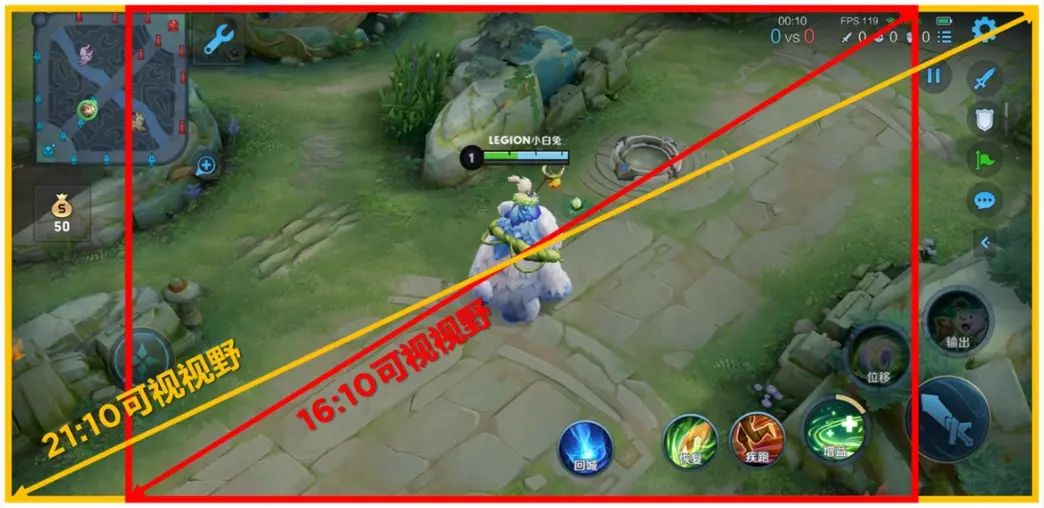
The most recent and arguably most significant disclosure came via detailed software breakdowns provided by Lin Lin and corroborated by industry insiders. Lenovo recognized a fatal flaw in how tablets handle modern mobile titles—specifically, the limitation imposed by standard 16:10 aspect ratios.
To combat this, Lenovo developed the Ultra-Wide Viewing Mode, a software feature allowing users to manually adjust the aspect ratio of games to 21:10. This pivotal revelation shifted the narrative surrounding the Legion Y700 from being just another Android tablet with high refresh rates to a purpose-built competitive tool engineered to level the playing field against smartphone users.
Supporting Context & Technical Metrics
To truly appreciate what Lenovo is attempting to achieve with the Legion Y700, one must analyze the technical metrics of its hardware stack and the physics of competitive mobile gaming.
The Aspect Ratio Dilemma in Mobile Gaming
Most traditional tablets, including the Legion Y700 in its native state, utilize a 16:10 aspect ratio. While this is optimal for productivity tasks, media streaming, and reading, it introduces a severe competitive disadvantage in specific genres—most notably MOBA games like League of Legends: Wild Rift and Honor of Kings, as well as tactical shooters.
+-------------------------------------------------------------+
| Standard Tablet (16:10 Aspect Ratio)                        |
| [ Less horizontal field of view / Vulnerable to flanks ]    |
+-------------------------------------------------------------+

                               VS

+-------------------------------------------------------------+
| Legion Y700 Ultra-Wide Mode (21:10 Aspect Ratio)            |
| [ Expanded horizontal field of view / Tactical parity ]     |
+-------------------------------------------------------------+
When playing these titles on a 16:10 screen, the vertical estate is emphasized at the expense of horizontal peripheral vision. Smartphone users, who frequently game on devices with 20:9 or 21:9 aspect ratios, enjoy a significantly wider field of view. They can spot approaching enemies and map hazards long before a tablet user running native ratios can.
The Solution: Ultra-Wide Viewing Mode
Lenovo’s Ultra-Wide Viewing Mode directly addresses this imbalance. By forcing the display output into a 21:10 aspect ratio, the Legion Y700 artificially expands the horizontal field of view to match modern gaming smartphones.
Moreover, Lenovo’s implementation goes beyond a simple letterboxing or stretching mechanism. Users are given granular control over UI placement, allowing them to position the active gaming content either in the center of the display or shifted toward the bottom. The latter option is particularly ingenious for handheld tablet ergonomics, as it brings touch controls closer to natural thumb resting points when holding a wider device.
Comprehensive Hardware Specifications Table
| Feature / Component | Specification Details | Strategic Advantage |
|---|---|---|
| Display Size | 8.8 inches | Optimal balance between portable ergonomics and immersive screen real estate. |
| Panel Type | High-Refresh LCD | Cost-effective while delivering rapid response times and consistent brightness. |
| Resolution | 2560 × 1600 pixels | Crisp text rendering and sharp game asset definition. |
| Refresh Rate | 120Hz | Ultra-smooth motion handling and reduced motion blur during fast-paced action. |
| Touch Sampling Rate | 240Hz | Minimal input latency for instantaneous command execution. |
| Color Gamut | 100% DCI-P3 | Vibrant, cinematic color reproduction for media consumption and gaming. |
| Processor (SoC) | Qualcomm Snapdragon 870 | Exceptional thermal efficiency, sustained performance, and reliable driver support. |
| Software Feature | Ultra-Wide Viewing Mode (21:10) | Eliminates the traditional tablet field-of-view disadvantage in competitive games. |
Official Statements and Industry Insights
The strategy behind the Legion Y700 reflects a broader industry shift toward specialized hardware categories. For years, the Android tablet market stagnated under the weight of general-purpose devices designed primarily for casual media viewing or light productivity, continually overshadowed by Apple’s iPad lineup.
By carving out a dedicated gaming niche, Lenovo is mirroring the success of its Legion PC and smartphone divisions. Executive communications from figures like Lin Lin emphasize that user feedback is driving these hardware decisions. The focus on the Snapdragon 870, in particular, has drawn widespread praise from tech analysts.
While flagship chips like the Snapdragon 8 Gen 1 offer blistering peak performance, they have frequently been plagued by thermal throttling issues in thin-and-light form factors. The Snapdragon 870, built on a mature and highly optimized 7nm manufacturing process, strikes an ideal balance. It delivers near-flagship performance, exceptional power efficiency, and—crucially for a compact tablet—manageable thermal dissipation characteristics that prevent the chassis from becoming uncomfortably hot during extended gaming sessions.
Future Outlook and Market Implications
As the mobile gaming market continues to mature into a multi-billion-dollar global juggernaut, hardware manufacturers are realizing that one-size-fits-all solutions no longer suffice. The release of the Lenovo Legion Y700 represents a calculated gamble that a dedicated segment of gamers desires a high-performance, highly portable tablet that does not compromise on competitive integrity.
Potential Market Impact
- Revitalizing the Small-Form-Factor Tablet Market: For years, premium Android tablets under 10 inches have been a rare breed. The Legion Y700 could spark a renaissance for compact, high-performance slates.
- Pressure on Competitors: If Lenovo’s aspect-ratio adjustment software proves successful and popular among mobile gamers, rival manufacturers like ASUS (ROG), Xiaomi, and RedMagic will likely be forced to implement similar software-level display modifications in future tablet iterations.
- Ecosystem Synergy: Paired alongside Lenovo’s gaming smartphone initiatives, the Legion ecosystem is solidifying its reputation as a comprehensive cross-platform powerhouse for mobile enthusiasts.
Final Thoughts
While a definitive global release date and pricing structure for the Lenovo Legion Y700 remain under wraps at the time of writing, the cumulative disclosures paint a picture of a remarkably well-thought-out device. By addressing the fundamental ergonomic and visual shortcomings of tablets in competitive multiplayer gaming—while packing a reliable Snapdragon 870 processor, a 120Hz display, and smart software features—Lenovo is poised to deliver a definitive masterclass in portable gaming hardware.
We will continue to monitor developments closely as Lenovo prepares for the official rollout of the Legion Y700. Stay tuned for further updates, hands-on reviews, and launch announcements.









Belum ada komentar. Jadilah yang pertama berkomentar!