

Executive Overview
In the volatile ecosystem of 21st-century music consumption, public opprobrium has transformed from a career-ending crisis into a potent accelerant. No contemporary release exemplifies this phenomenon quite as vividly as the self-titled debut single from Leeds-based upstarts Garage Flower. Officially announced on 17 July, the track’s rollout coincided with a seismic shift in British music discourse. Just a fortnight after the single’s announcement, social media algorithms birthed a viral phenomenon: “indie poo.”
Coined by TikTok creator Angus.Official as a sardonic riposte to the UK drill scene’s “UK poo” meme, the term was deployed to disparage a perceived wave of derivative, hyper-local indie rock acts—including contemporaries like Park Drive, Bilk, and Andy Goodwin. Like wildfire, the label spread across digital platforms, morphing from a tongue-in-cheek TikTok critique into a widespread industry allegation of terminal unoriginality.
Caught dead-center in the crosshairs of this viral vitriol was Garage Flower. Yet, rather than buckling under the weight of internet scorn, the band weaponized the controversy. Fueled by online backlash, meme culture, and algorithmic amplification, the physical sales of their debut single surged to number two on the official UK physical charts before copies had even physically hit store shelves.
This deep-dive investigation examines how Garage Flower navigates the turbulent waters of the “indie poo” era. We dissect the sonic anatomy of a track that pays homage to 1990s Manchester while drawing surprising blood from modern hardcore, evaluate the socioeconomic aesthetic of Northern youth culture lyrics, and contextualize this modern movement within a 25-year lineage of British guitar music—from the glory days of the garage rock revival to the pejorative corridors of "landfill indie."
Detailed Chronology: From The Liabilities to Viral Infamy
To understand how Garage Flower arrived at this cultural flashpoint, one must trace the timeline of their evolution—and recognize that their journey didn’t begin in July 2025.
The Incubation Period (Pre-July 2025)
Long before they adopted their current moniker, the members of Garage Flower operated under the banner of The Liabilities. Rooted in the fertile, guitar-obsessed soil of Leeds—a city with a storied history of breeding gritty, crowd-pleasing indie acts—the band cut their teeth playing local venues, building a modest regional following alongside peers like Indigo Project, The Sheratons, and Don’t Wake the Bear.
During this formative era as The Liabilities, the group released three independent singles and a 2024 EP titled Looking Back is Formidable. While these releases established their competency within traditional guitar-rock boundaries, they largely flew beneath the national radar, operating within the standard constraints of independent gigging and grassroots promotion.
Rebirth and the July Announcement (17 July)
Seeking a fresh sonic identity that leaned harder into archival Britpop and baggy aesthetics, the band rebranded as Garage Flower—a direct nod to Garage Flower, the 1996 archival compilation album by The Stone Roses.
On 17 July, the band formally announced the release of their debut single under this new moniker, "Garage Flower." The campaign was designed to be a standard, albeit ambitious, independent introductory release, capitalizing on the resurgent public appetite for guitar-driven nostalgia stoked by major events like the high-profile Oasis reunion.
The Birth of "Indie Poo" and the Social Media Backlash (Late July)
Just two weeks after the single’s announcement, the cultural landscape shifted dramatically. Following the viral wave of the UK drill-adjacent “UK poo” meme, TikToker Angus.Official targeted the burgeoning wave of fresh-faced, bucket-hat-wearing UK indie acts. Applying the pejorative label "indie poo" to bands like Park Drive, Bilk, and Andy Goodwin, the term weaponized aesthetic tropes—Strongbow dark fruits, government-neglected housing estates, and three-stripe tracksuits—turning them into punchlines.
Because Garage Flower was actively pushing its release campaign during this exact window, the internet’s algorithmic wrath swiftly designated them as the poster children of the movement. Review boards, Reddit threads, and TikTok feeds lit up with accusations that the band was manufacturing generic, derivative nostalgia for clout.
Chart Shock and Commercial Defiance (August)
Rather than paralyzing the campaign, the vitriol acted as rocket fuel. The algorithmic engagement—driven equally by detractors mocking the track and defenders rallying behind the band—hyper-accelerated awareness.
When physical pre-orders and sales were tallied, "Garage Flower" rocketed to number two on the UK physical sales chart, achieving a commercial milestone that traditional indie PR campaigns spend months, if not years, trying to buy. The phenomenon underscored an uncomfortable truth of the social media age: in the attention economy, calculated or organic hate is often the most potent fuel for commercial success.
Sonic Anatomy: Manchester Swing Meets Hardcore Aggression
Musically, "Garage Flower" is a fascinating contradiction. On the surface, it is a masterclass in pastiche, explicitly channeling the late-1980s and mid-1990s Manchester sound.
The Britpop and Baggy DNA
Vocalist Nathan Whitehead adopts a distinctly Liam Gallagher-esque nasal snarl, dripping with the casual, confrontational swagger of early-era Oasis. The rhythm section carries the unmistakable syncopated swagger of The Stone Roses, while the guitar arrangement borrows directly from Noel Gallagher’s compositional playbook: a relentless, driving rhythm guitar anchoring the foundation while lead lines jangle and intersperse blues-infused licks.
The Hardcore Subversion
However, to dismiss the track as mere karaoke emulation is to ignore its undercurrents of speed and aggression. The song’s tempo and physical intensity feel remarkably foreign to traditional Britpop; instead, they owe a heavy debt to the early hardcore leanings of bands like Title Fight.
In particular, the muting pattern utilized in the song’s main riff bears an unmistakable structural resemblance to "Symmetry" by Title Fight. This cross-pollination is emblematic of the 2020s musical landscape. With contemporary hardcore bands like High Vis, Turnstile, and Militarie Gun aggressively adopting indie sensibilities into their heavy frameworks, it was only a matter of time before indie rock returned the favor, injecting aggressive hardcore muscle into nostalgic guitar pop.

The Groove Factor
The crowning jewel of the single’s arrangement, however, is its low end. Bassist Joshua Ndombasi delivers a masterclass in fretboard navigation, weaving ghost-note-filled grooves that function not merely as rhythmic glue, but as primary melodic hooks. So central is this groove to the song’s identity that the rhythm guitar completely drops out during the second verse, deliberately laying bare Ndombasi’s intricate basswork for maximum impact.
Lyrical Analysis & Socioeconomic Aesthetics
If the musical composition bridges Manchester baggy with hardcore velocity, the lyrics dive headfirst into the contentious aesthetic territory of Northern youth culture.
Poeticism or Pillage?
The stylistic lineage of “indie poo” lyrics traces back to Alex Turner’s early Arctic Monkeys chronicles—a sharp, observational adaptation of Libertines-esque poeticism applied to the mundane realities of Northern working-class youth. However, critics of the "indie poo" wave argue that these tropes have devolved from tongue-in-cheek cultural critique into aesthetic commodification. Bucket hats, tracksuits, and neglected housing estates are frequently deployed as virality fodder rather than authentic social commentary.
Garage Flower’s debut track leaps out of the gate with localized bravado:
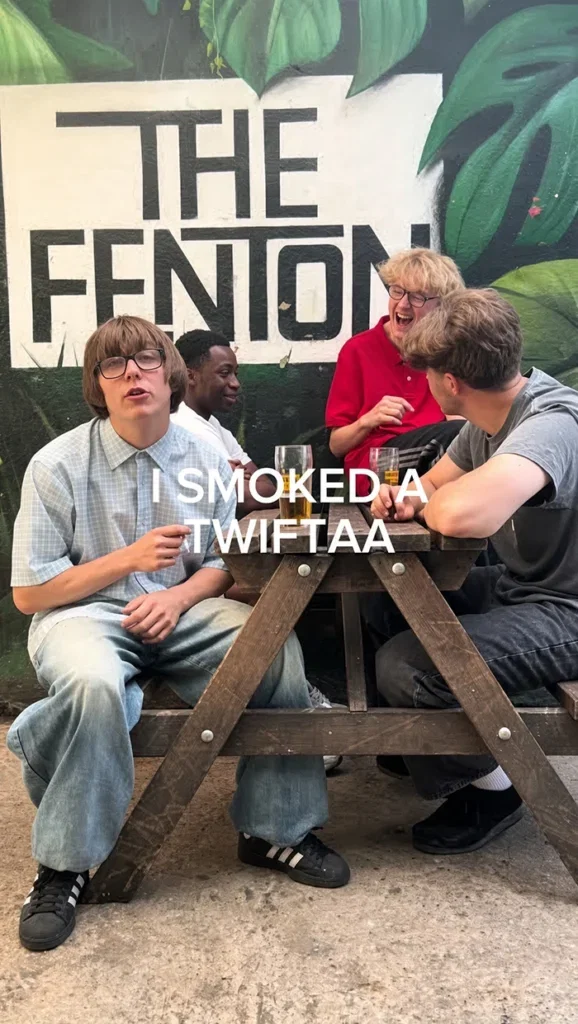
"I smoked a twifta this morning / And Quarry Hill is where I’m going."
The term "twifta" is a remarkably uncommon colloquialism for a marijuana cigarette, even within Leeds. "Quarry Hill" refers to a campus of Leeds City College, situated directly beside Playhouse Gardens—a notorious local hangout spot for skateboarders and cannabis enthusiasts.
The Shibboleths of the Genre
While Garage Flower’s lyrical allusions are arguably more cryptic than some of their peers, they still operate within a well-worn set of cultural shibboleths. Consider the lyrical motifs running rampant across the scene:
- Andy Goodwin: "She turned up in her three stripes and a Fred Perry"
- Ten Hands High: "Baggy tees are as common as petty crime"
- Nathan Whitehead: "Now it’s a very happy Monday" (a direct nod to Happy Mondays) and "I’m in the garage with my flowers" (invoking the very Stone Roses compilation that birthed their name).
Despite these hyper-local signifiers creating the illusion of a documentary about Leeds indie youth culture, the narrative backdrop quickly gives way to universal themes. Beneath the bravado, the song is fundamentally about a relationship. The lyrics may flirt with vapidity, but as music critics have long noted, British youth culture has always treated indie rock as high-energy pop music. The persistent urge to label these lyrics "vapid" often relies on an outdated rockist prejudice dictating that guitar music must inherently carry profound, high-art sociopolitical weight to be deemed legitimate.
Supporting Context & Industry Metrics
To fully appreciate the "indie poo" phenomenon, one must examine the 25-year trajectory of British radio rock that preceded it.
The Evolution of "Landfill Indie"
For the past quarter-century, the dominant force on British commercial radio has been the direct progeny of The Strokes and The Libertines. In the early 2000s, music journalists enthusiastically heralded this movement as the garage rock revival. However, as major labels churned out formulaic imitators to capture lightning in a bottle, the genre was unceremoniously rebranded by critics as "landfill indie."
For generations of young Britons, bands like the Arctic Monkeys served as their foundational introduction to electric guitars. Even during the perceived indie lulls of the 2010s, bands like Foals, The Vaccines, and Catfish and the Bottlemen maintained a permanent residency on commercial radio waves and festival main stages.
The Leeds Music Ecosystem
Garage Flower’s home base of Leeds has consistently served as an incubator for this lineage. Alongside Garage Flower and their sister band, The North (who are currently tracking a similarly rapid trajectory toward mainstream recognition), the city’s clubs have recently birthed waves of guitar-driven hopefuls.
Yet, the current wave—dubbed "indie poo" by internet detractors—represents the second major "landfilling" of indie rock. It is a zeitgeist uniquely informed by two massive cultural catalysts:
- The monumental, highly publicized reunion of Oasis.
- The passing of legendary Stone Roses bassist Gary Mounfield (Gary Mani).
This cultural backdrop has placed unprecedented commercial emphasis on precursors like Britpop and baggy, merging them with contemporary hardcore revivals like Title Fight.
| Metric / Indicator | Contextual Analysis |
|---|---|
| Peak Chart Position | No. 2 on the UK Physical Sales Chart (achieved prior to physical retail distribution). |
| Predecessor Project | Released music under the moniker The Liabilities, culminating in the 2024 EP Looking Back is Formidable. |
| Core Musical Influences | The Stone Roses, Oasis, Happy Mondays, Title Fight. |
| Geographic Hub | Leeds, West Yorkshire (sharing roots with Indigo Project, The Sheratons, The North). |
Future Outlook: Surviving the Meme Economy
The controversy surrounding Garage Flower ultimately exposes a deep-seated exhaustion within music criticism. The accusations of being derivative are less an indictment of outright plagiarism—distinguishable contemporaries like Bayboards, The Guest List, and Strata prove the scene’s internal variety—and more a backlash to national overexposure and internet saturation.
Is "Garage Flower" an example of "indie poo"? If the term simply means catchy, derivative, nostalgia-steeped guitar rock designed for viral consumption, then perhaps it is. But the more pressing question is whether that designation carries any negative weight.
For Garage Flower, the answer is a resounding no. By leaning into the storm rather than running from it, the band has successfully navigated the treacherous waters of 2025 internet culture. They have proven that in the modern musical landscape, being talked about—even derided by cynical internet commentators—is infinitely more valuable than being ignored. As they prepare to transition from viral curiosity to a fully fledged touring and recording entity, the real test will not be whether they can escape the "indie poo" label, but whether they can sustain the blistering momentum that hate-fueled virality so effectively delivered to their doorstep.








Belum ada komentar. Jadilah yang pertama berkomentar!