

Executive Overview
As European urban centers grapple with tightening congestion charges, dwindling parking availability, and a mandate for rapid decarbonization, the anatomy of the urban vehicle is undergoing a seismic shift. Traditional city cars are shrinking, yet the historical landscape of European micro-mobility—once dominated by iconic Italian "yoghurt pots" and domestic ultracompact pioneers—has fundamentally mutated. Today, European streets are increasingly populated by small Chinese electric vehicles (EVs), while legacy ultracompact brands like Smart have shifted their manufacturing operations entirely to the Far East.
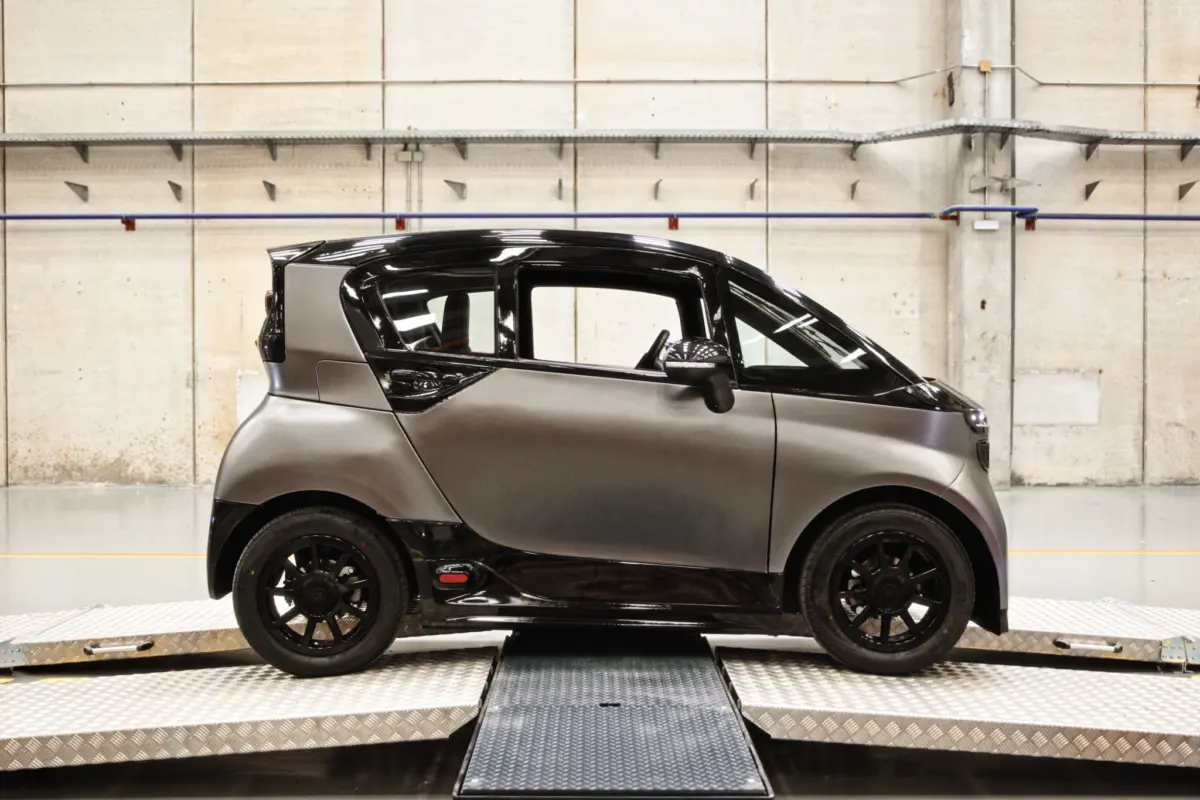
Enter Liux, an ambitious Spanish startup attempting to buck this trend. Rather than capitulating to external manufacturing juggernauts, Liux is carving out a distinctive niche with its upcoming microcar, the Liux Big. Tongue-in-cheek in its moniker, the "Big" is small enough to park at a right angle to the curb, yet it embodies the oversized ambitions of a leadership team refusing to follow the beaten path.
Founded by serial entrepreneurs Antonio Espinosa de los Monteros and David Sancho, Liux has achieved a monumental milestone for the Iberian Peninsula: opening Spain’s first new car manufacturing plant in over three decades. Secured with €16 million (approx. $18.5 million) in funding, including vital European subsidies, the company has successfully cleared Europe-wide homologation for the Liux Big. With over 7,500 prospective buyers already populating its unfee’d waiting list, Liux is preparing to scale production across three Spanish facilities ahead of a commercial launch slated for the first half of next year.
This deep dive explores Liux’s operational philosophy, its groundbreaking approach to sustainable materials—such as its linen-based biocomposite fiber body—and how it plans to navigate a hyper-competitive market currently dominated by low-cost imports.
Detailed Chronology: From the "Animal" to the "Big"
The genesis of Liux is a story of iterative pivoting, elite engineering pedigree, and an unyielding commitment to environmental circularity.
The Founders’ Roots
Co-founder Antonio Espinosa de los Monteros comes from a lineage of real circularity. He previously co-founded Auara, a successful Spanish B Corp specializing in natural mineral water sold in fully recycled and recyclable bottles. Though Auara was eventually acquired by larger beverage conglomerate Hijos de Rivera, Espinosa’s dedication to sustainable product lifecycles remained undiminished.
Meanwhile, co-founder David Sancho brings a high-octane engineering background to the table. Before launching Liux, Sancho’s most notable feat was designing the Bóreas, a high-performance hybrid hypercar unveiled at the 24 Hours of Le Mans in 2017. Following a subsequent departure from his former partners, Sancho joined forces with Espinosa to merge high-end vehicle engineering with uncompromising ecological values.

The 2022 Pivot: The "Animal" Becomes the "Geko," Then the "Big"
Liux’s initial salvo into the automotive world arrived in late 2022 with the unveiling of The Animal—a fully electric, five-seater SUV constructed almost entirely from recycled and plant-based materials. While the prototype captured headlines across Europe, the co-founders quickly realized that scaling an SUV through the arduous European homologation process presented immense hurdles for an early-stage startup.
Recognizing that smaller form factors offered a faster, more viable regulatory pathway, the team pivoted dramatically. They recalibrated their focus toward the ultracompact sector—temporarily codenamed the Geko before evolving into the production-ready Liux Big.
Fast forward to 2026, and that strategic pivot has paid off. Liux has secured complete Europe-wide homologation for the Liux Big, growing its internal team to 65 employees and establishing a lean, highly efficient manufacturing footprint anchored in Azuqueca de Henares, just an hour’s drive from central Madrid.
Supporting Context & Metrics: Engineering, Supply Chains, and Market Dynamics
To understand how Liux intends to disrupt the status quo, one must examine the metrics, supply chain realities, and regulatory frameworks governing its operations.
The Illusion of Sovereignty
When speaking with TechCrunch, Espinosa dropped a startling admission: "The idea of a European car does not exist." Coming from the CEO of a company proudly waving the "Made in Spain" banner, the statement initially sounds counterintuitive.
However, Espinosa and Sancho openly acknowledge that a fully sovereign, closed-loop European automotive supply chain is practically unattainable in the modern global economy. For instance, Liux’s battery cells are sourced externally rather than manufactured natively in Europe. Instead of chasing an impossible illusion of absolute regional self-reliance, Liux focuses its sovereignty where it matters most: vehicle architecture, sustainable body composition, and final assembly processes.
Lean Manufacturing in Azuqueca
Liux’s production strategy draws heavy inspiration from Toyota’s legendary "lean management" principles. Head of production Beatriz Belda González—a Spanish engineer who previously honed her craft with BMW in Munich—oversees the Azuqueca de Henares plant.

The facility is intentionally compact, performing strictly the final assembly phases of production. Despite its modest physical footprint, the facility is designed to scale dynamically, with projected production capacities reaching up to 20,000 vehicles per year by 2030.
Technical Specifications & Homologation
Navigating European regulatory frameworks requires mastering the L-category vehicle classification system. Liux targeted the L7e heavy quadricycle category (differentiated from ultralight L6e vehicles). According to Liux’s head of R&D, Celso Fernández Llorens, weight and size limitations are the ultimate constraints in this category, often resulting in homogenous offerings across the market.
Liux engineered around these constraints to maximize utility:
- Dimensions & Parking: The Liux Big is compact enough to park at a right angle to a standard city curb.
- Storage Capacity: Through meticulous spatial design, the engineering team carved out an impressive 260-liter trunk, besting many traditional city runabouts.
- Battery Configurations: The urban model will launch with two primary battery capacities—15 kWh and 20 kWh—both rechargeable via standard household outlets and compatible with home solar panel arrays.
- Pricing: While final figures depend on localized incentives, Liux has confirmed a baseline retail price below €18,000 (approx. $21,000) before potential EV subsidies. This positions the Liux Big at the premium end of the microcar spectrum, a price tag justified by its unique material science and structural integrity.
The Biocomposite Breakthrough
Perhaps Liux’s most revolutionary feature is its exterior body panels. Constructed from a novel linen-based biocomposite fiber, the material is engineered specifically to facilitate end-of-life extraction and recycling.
Unlike traditional composites that fuse dissimilar materials into an unrecyclable polymer mess, Liux’s approach preserves material integrity. As Espinosa puts it:
"One thing that’s very clear for David and me is that recycling isn’t just a lab concept. You can recycle almost anything in a lab. What makes something recyclable has to do with how it’s built. When you build something, you have to try to preserve the integrity of the material and the components so that a second life is possible."
Official Statements and Visionary Perspectives
Liux’s leadership team is remarkably candid about the hurdles facing European startups, balancing idealism with pragmatic business strategy.

- On Target Demographics: Early insights from the 7,500-strong waiting list reveal that the most represented prospective buyer is an urban dweller aged 55 to 60. Liux anticipates the Big will predominantly serve as a household’s secondary vehicle. While this tempers early dreams of microcars entirely replacing primary car ownership, Espinosa views it as a crucial stepping stone: "You have to pick your battles."
- On Safety and Driving Dynamics: Addressing criticisms that microcars feel flimsy or behave like glorified golf carts, co-founder David Sancho emphasizes that structural safety was a paramount design pillar. Regulatory standards for L7e categories do not mandate official crash tests, yet Liux has rigorously subjected the Big to slalom, braking, and handling tests. The goal is to ensure drivers experience the confidence of a true automobile rather than a two-wheeler prone to toppling during sharp turns.
- On Brand Identity and Showrooms: Head of brand Ana Terrado Leyva points out that Liux’s physical showrooms are designed to actively counter Chinese market penetration through sensory design. Featuring textile screens, interactive 3D models displaying the vehicle’s three distinct color options (two more than Henry Ford offered with the Model T), and linoleum flooring—a deliberate material nod to the car’s linen biocomposite roots—the retail experience is deeply tied to sustainability narrative-building.
Future Outlook: Beyond a One-Car Brand
As Liux prepares to commercialize the urban version of the Liux Big in the first half of next year, the company’s roadmap extends far beyond a single passenger vehicle.
The startup is actively keeping its doors open to strategic partnerships, engaging with B2B fleet management operators and tech firms exploring autonomous driving software integration. Furthermore, pipeline plans include specialized cargo variants tailored for last-mile urban logistics. And given David Sancho’s background in high-performance hypercars, the temptation to eventually revisit high-end performance engineering remains alive—as the company recently teased on LinkedIn: Liux does not intend to be a one-car brand.
By combining lean manufacturing, real circularity through linen biocomposites, and uncompromising structural engineering, Liux is attempting what many deemed impossible: building a genuinely sustainable, locally manufactured European urban vehicle that can stand tall in a crowded global marketplace.
In doing so, Liux is breathing fresh life into an old question, suggesting that perhaps, after all, the idea of a European car does exist.








Belum ada komentar. Jadilah yang pertama berkomentar!