

Executive Overview
Nestled in the southern reaches of Yamagata Prefecture, Yonezawa stands as one of Japan’s most enduringly preserved living testaments to the samurai era. Ruled by the legendary Uesugi clan for nearly three centuries, this historic castle town offers a compelling synthesis of feudal architecture, military history, and world-class culinary traditions. Famed across the archipelago for its iconic "ABC Specialties"—Yonezawa Beef, apples, and carp—the city occupies a unique intersection of agricultural excellence and samurai heritage.
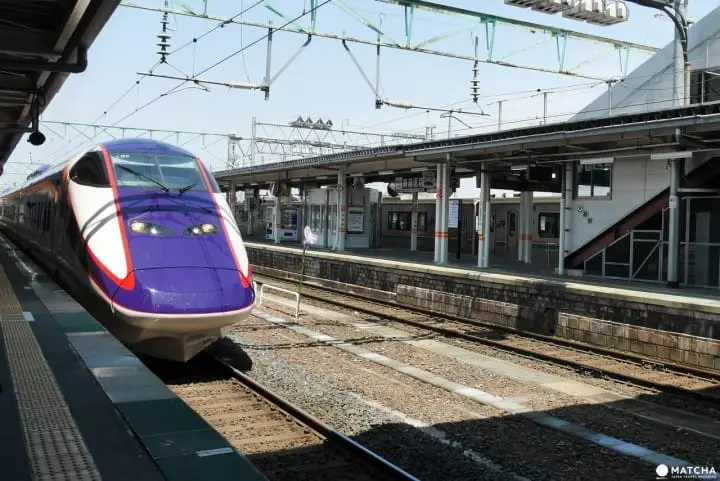
Accessible in approximately two hours from Tokyo via the rail engineering marvel known as the Yamagata Shinkansen, Yonezawa transitions effortlessly from a modern transit destination into a living museum. As travelers step off the platform, they enter a structured grid of historical preservation zones, cultural archives, and culinary institutions that honor a legacy of resilience, visionary governance, and artistic patronage. This report provides an exhaustive examination of Yonezawa’s transit infrastructure, historical lineage, cultural festivals, architectural landmarks, and the socio-economic impact of its world-renowned culinary assets.
Detailed Chronology: The Evolution of a Feudal Stronghold
To understand Yonezawa’s urban layout and cultural identity, one must trace its trajectory through centuries of political upheaval, shifting alliances, and administrative reinvention.
The Sengoku Period and the Uesugi Hegemony
Yonezawa’s destiny became inextricably linked with the Uesugi clan during the tumultuous Sengoku (Warring States) period. In 1600, following their defeat on the losing side of the pivotal Battle of Sekigahara—the engagement that consolidated Tokugawa Ieyasu’s shogunate—warlord Uesugi Kagekatsu faced catastrophic political demotion. Stripped of his vast, lucrative domains in Niigata and Fukushima, Kagekatsu was relocated by the victorious Tokugawa regime to the agrarian periphery of Yonezawa.

Rather than succumbing to political obscurity, Kagekatsu, alongside his brilliant chief advisor Naoe Kanetsugu, laid the foundation for a vibrant castle town. For over two centuries, twelve successive generations of the Uesugi lineage administered the domain, navigating chronic financial crises through radical administrative reforms.
The Era of Uesugi Yozan and Economic Salvation
By the mid-18th century, the Yonezawa domain teetered on the brink of bankruptcy, crushed by structural debt and agricultural failures. The turning point arrived with the ascension of the ninth-generation lord, Uesugi Yozan (born Matsudaira Naonori), in 1767. At age seventeen, Yozan initiated one of the most successful economic turnaround programs in Japanese feudal history.
Rejecting traditional aristocratic extravagance, Yozan imposed strict internal austerity, slashed administrative budgets, and diversified the regional economy. He championed the establishment of the local textile industry, expanded public schooling, and promoted sericulture and fruit cultivation. His visionary governance completely liquidated the domain’s debt, transforming Yozan into a celebrated archetype of people-first leadership (min-pon shugi). His administrative philosophies continue to be studied by modern international economists and political leaders.
The Meiji Restoration and Modern Preservation
The arrival of the Meiji Restoration in 1868 dismantled the feudal domain system. Yonezawa Castle was systematically dismantled, and its defensive fortifications were decommissioned. However, unlike many Japanese cities that sacrificed their historical footprints for rapid industrialization, Yonezawa consciously repurposed its castle grounds into public cultural spaces. The establishment of Matsugasaki Park, the construction of the Uesugi Count’s Residence in 1896, and the continuous preservation of samurai archives have ensured that the city’s architectural integrity remains intact into the 21st century.
Supporting Context & Metrics: Infrastructure and Demographics
The Engineering Marvel of the Yamagata Shinkansen
Reaching Yonezawa is an experience embedded in Japanese railway engineering ingenuity. Operating from Tokyo Station, the Yamagata Shinkansen utilizes a specialized "Mini-Shinkansen" classification to navigate geographic constraints that preclude standard high-speed rail expansion.
[Tokyo Station]
      │ (Tohoku Shinkansen lines)
      ▼
[Fukushima Station] ──(Uncoupling Phase)──► [Tsubasa Train]
                                                  │ (Transitions to Ou Main Line tracks)
                                                  ▼
                                            [Yonezawa Station] (~2 hours total)
The journey begins aboard the Tsubasa train, which departs Tokyo coupled to the Tohoku Shinkansen Yamabiko. At Fukushima Station, passengers are treated to a rare operational spectacle: the mechanical uncoupling of the two nose-to-nose Shinkansen configurations.
Following separation, the Tsubasa transitions from dedicated high-speed infrastructure onto the modified tracks of the conventional Ou Main Line. Because it shares traditional railway corridors equipped with active level crossings, the train’s top operational speeds adjust from the standard 200–300 km/h down to 130 km/h. This seamless integration of high-speed transit and local rail networks underscores Japan’s commitment to regional accessibility.
The "ABC Specialties" Economy
Yonezawa’s economic identity rests firmly on its three signature regional products, officially designated as the Yonezawa ABC Specialties:
- A – Apples: Cultivated in the mineral-rich, volcanic soil of the surrounding Okitama basin, benefiting from dramatic diurnal temperature shifts that enhance sugar content and crisp acidity.
- B – Beef: Globally recognized as Yonezawa Beef, strictly regulated under rigorous marbling and geographical indication standards.
- C – Carp (Koi): Historically introduced as an emergency protein source during feudal sieges and famines, carp aquaculture has evolved into a sophisticated culinary tradition, prepared via soy-sauce simmering (nitsuke) or decorative pond integration.
Official Statements and Cultural Insights
Cultural preservationists and municipal authorities in Yonezawa emphasize that the city’s identity is anchored in active participation rather than passive observation.
Dr. Kenji Sato, a regional architectural historian specializing in Okitama cultural assets, notes:
"Yonezawa is not a museum constructed behind glass. The layout of the original castle town, the irrigation canals dug during the Uesugi administration, and the culinary techniques handed down through generations of samurai retainers operate as a continuous cultural ecosystem. When visitors walk through Matsugasaki Park or dine in a repurposed kominka, they are engaging with an unbroken historical thread."
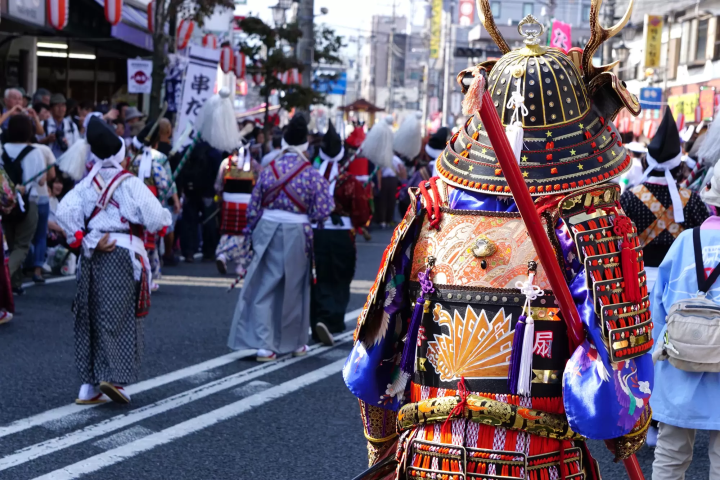
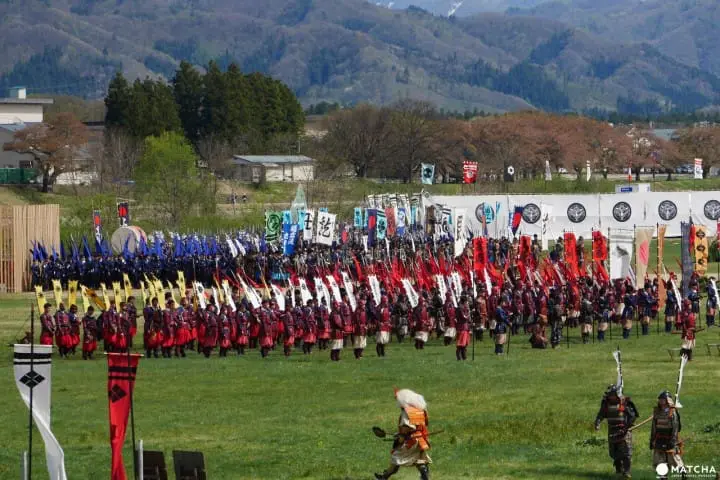
Similarly, municipal tourism representatives underscore the significance of the annual Uesugi Festival, held over five days in early May. The festival acts as a vital bridge between historical research and community engagement. Its centerpiece—the full-scale reenactment of the legendary 16th-century Battle of Kawanakajima—mobilizes hundreds of local participants clad in authentic, hand-crafted samurai armor. The event serves not only as a major tourism driver, bringing hundreds of thousands of visitors to Yamagata Prefecture, but also as a profound exercise in communal identity preservation.
Architectural and Cultural Landmarks
Matsugasaki Park and Uesugi Shrine
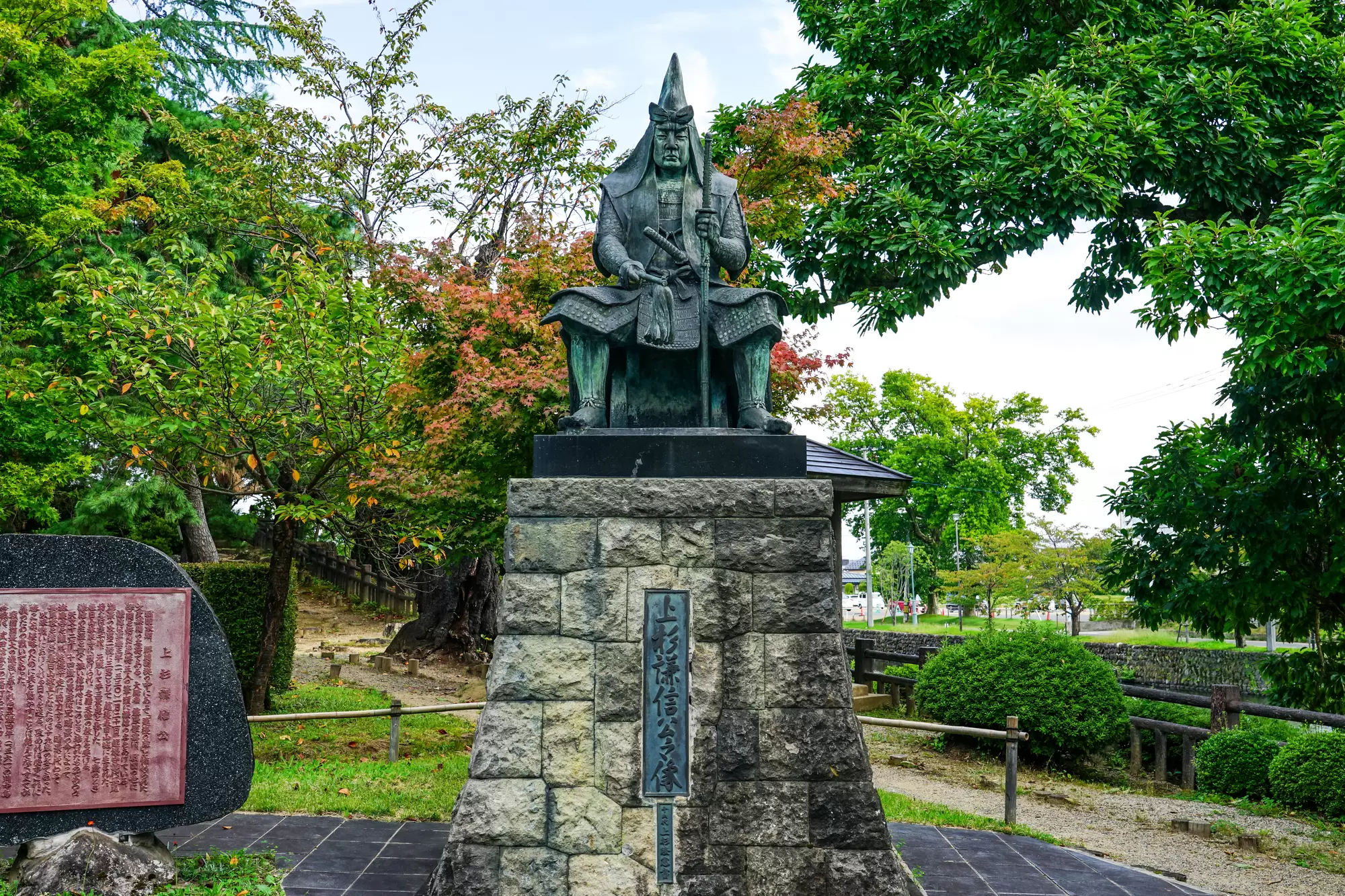
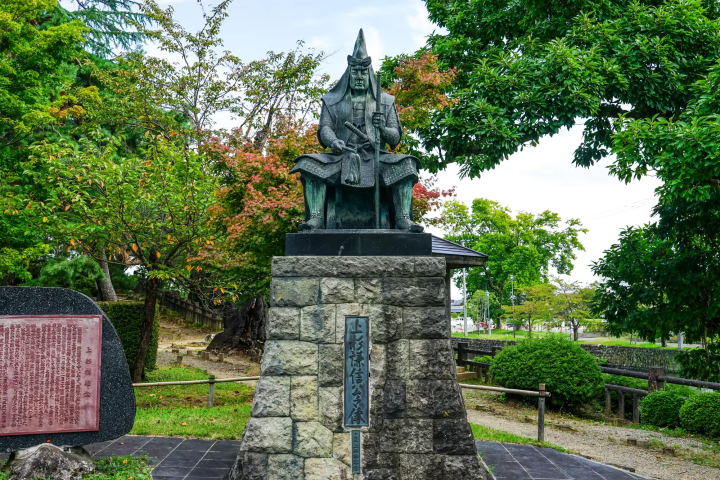
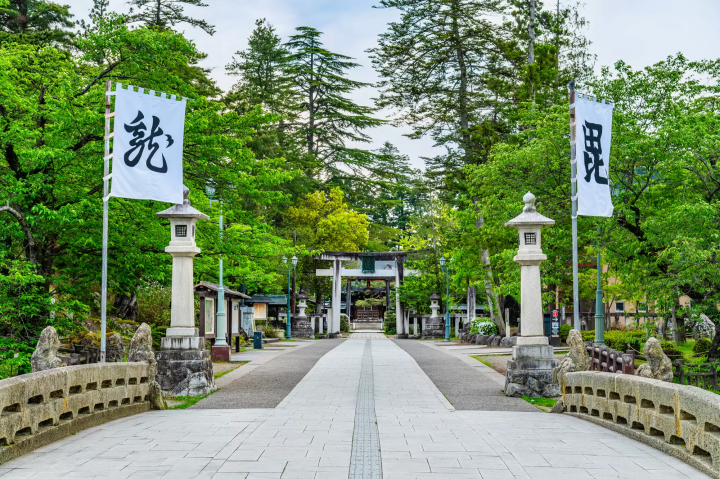
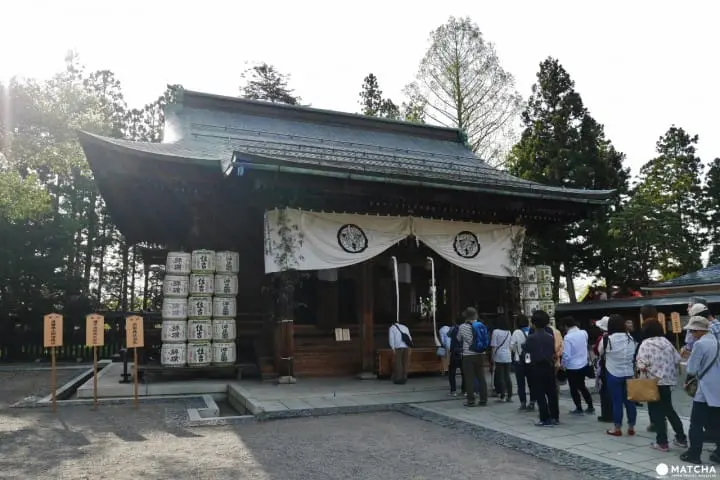
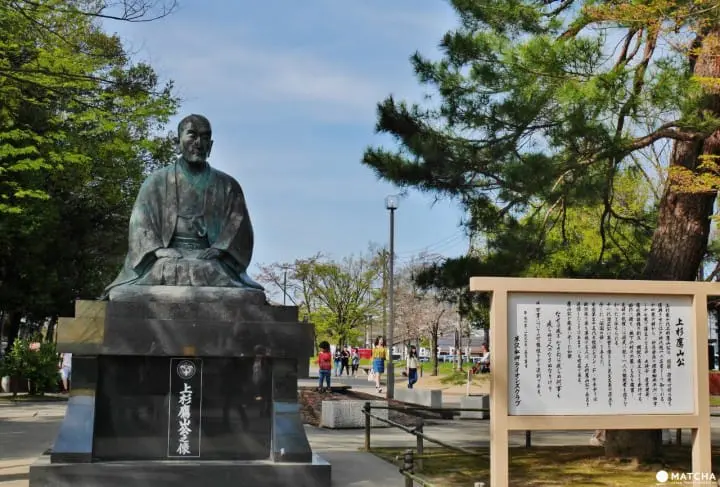
At the heart of the modern city lies Matsugasaki Park, constructed on the former footprint of Yonezawa Castle. The park serves as the primary civic and spiritual nexus of the community. Within its verdant borders stands Uesugi Shrine, dedicated to the deified spirit of warlord Uesugi Kenshin.
Originally established inside the castle ruins, the shrine was relocated in compliance with Meiji-era edicts separating Shinto shrines from Buddhist temples, while Kenshin’s physical remains were moved to the nearby Uesugi Clan Mausoleum. Following a devastating city-wide fire in 1919 that consumed much of historic Yonezawa, the shrine was meticulously rebuilt to its current architectural specifications.
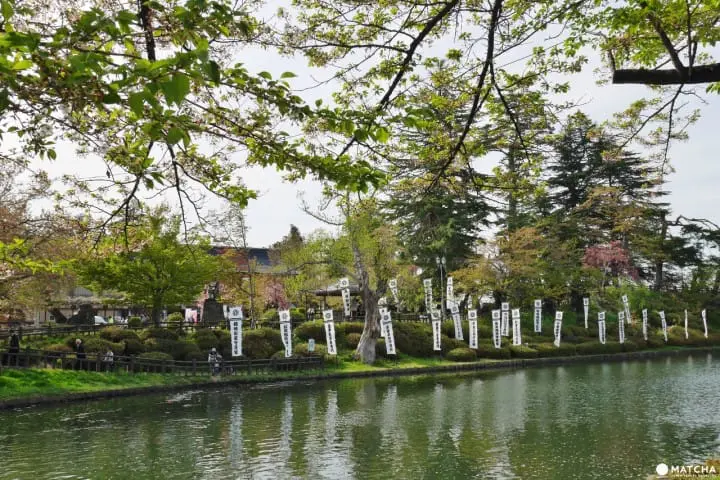
The surrounding park moat is lined with approximately 200 mature cherry trees. During spring, these blossoms create a breathtaking framework for the annual Uesugi Festival. In winter, the grounds transform into a luminous wonderland during the Yonezawa Snow Lantern Festival, where thousands of hand-carved snow lanterns cast a gentle glow across the historic pathways.
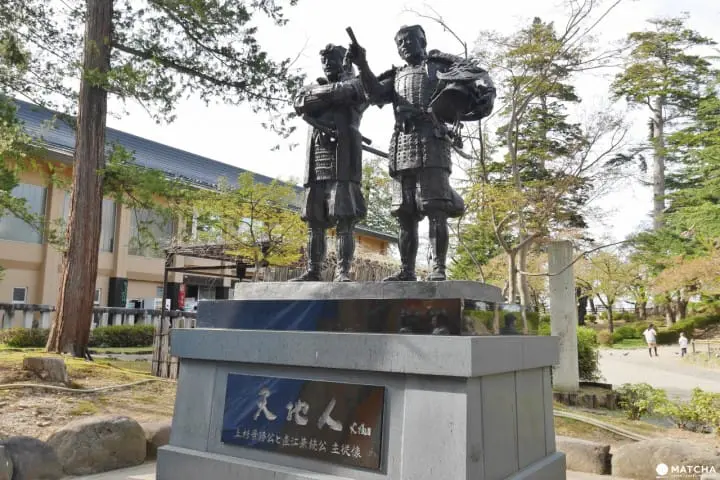
Adjacent to the shrine stands the striking Tenchijin Statue, commemorating Uesugi Kagekatsu and his chief strategist, Naoe Kanetsugu. The statue’s title derives from the philosophical concept of "Heaven, Earth, and Humanity," reflecting Kanetsugu’s progressive, welfare-oriented governance. The monument gained national prominence following the 2009 NHK taiga television drama Tenchijin, driving a resurgence in cultural tourism.
The Uesugi Count’s Residence and Museum Architecture
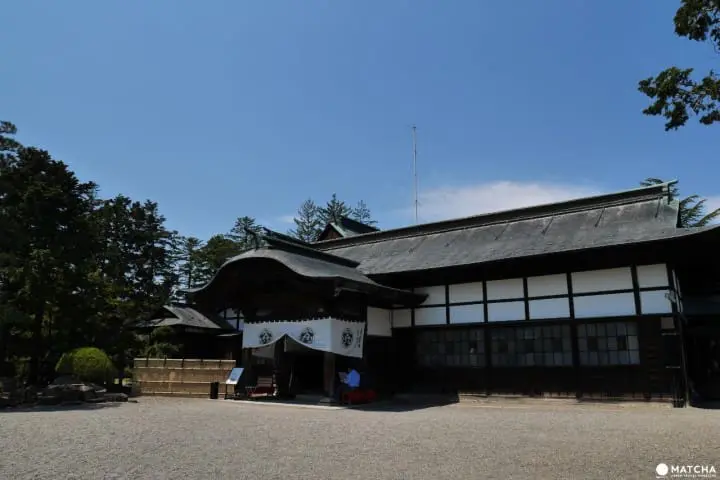
For visitors seeking deeper immersion into elite Meiji-era craftsmanship, the Uesugi Count’s Residence offers an architectural masterclass. Constructed in 1896 on repurposed castle grounds for the 14th head of the Uesugi clan, the estate exemplifies traditional high-status residential design. Though also impacted by the 1919 fire, it was faithfully reconstructed and later transitioned into a cultural preservation facility. In 1997, it was officially designated a Registered Tangible Cultural Property. Today, it operates as a dual-purpose institution, functioning both as a regional museum archive and a high-end dining establishment serving traditional local cuisine.
Complementing this is the Yonezawa City Uesugi Museum (Denkoku no Mori), which houses a peerless collection of clan artifacts, administrative documents relating to Uesugi Yozan’s economic reforms, and archaeological finds from the castle town. The crown jewel of the museum’s permanent collection is the Rakuchu Rakugai-zu Byobu (Scenes in and around the Capital), a designated National Treasure folding screen originally gifted by the hegemon Oda Nobunaga to Uesugi Kenshin, offering an extraordinarily detailed pictorial record of 16th-century urban life in Kyoto.

Culinary Excellence: The Anatomy of Yonezawa Beef
No discussion of Yonezawa is complete without a rigorous examination of its premier culinary ambassador: Yonezawa Beef. As one of Japan’s top three Wagyu brands alongside Kobe and Matsusaka beef, Yonezawa Beef is subject to rigorous certification standards. To bear the name, cattle must be Japanese Black heifers raised within the Okitama region under certified producers for the longest period of their lives, meeting stringent meat-quality score thresholds (Yield Grade A or B, Quality Grade 3 or higher).
Gastronomic Preparations and Tasting Methodologies
Local dining institutions—such as the acclaimed restaurant Bekoya, housed within a restored historical kominka (traditional farmhouse bearing the Yonezawa Landscape Award)—offer multi-faceted tasting experiences designed to showcase the meat’s unique fat composition.
Culinary preparation styles vary across several distinct modalities:
- Yakiniku (Tabletop Grilling): Highlights the low melting point of the intra-muscular marbling. When exposed to direct heat, the fat renders instantly, releasing a rich, buttery aroma without overwhelming the palate.
- Sukiyaki and Shabu-Shabu: Traditional simmering methods where paper-thin slices of beef are immersed in sweet soy-based broths or delicate kelp stocks, softening the rich proteins and blending them with local seasonal vegetables.
- Medium-Rare Steak: Kitchen-seared cuts that achieve a caramelized exterior crust while maintaining a tender, melt-in-your-mouth interior texture entirely devoid of gamey flavors.
- Yonezawa Beef Nigiri Sushi: An innovative culinary presentation that juxtaposes three distinct preparation levels side by side: raw, fully cooked, and lightly torched roast beef sushi. The roast beef variation is particularly prized by culinary critics, as the gentle application of surface heat releases rendered fats that complement the natural sweetness of the raw lean meat.
Diners visiting these establishments are often invited to pre-select their preferred cooking styles during the queuing process, allowing culinary teams to optimize kitchen throughput and table assignments within heritage architectural settings framed by blooming courtyard cherry trees.
Future Outlook
As Japan’s tourism sector experiences unprecedented international growth, Yonezawa faces both opportunities and structural challenges. Municipal planners and tourism boards are actively implementing sustainable tourism frameworks to balance the influx of global visitors with the preservation of fragile historic assets and residential tranquility.
Key strategic initiatives for the upcoming decade include:

- Infrastructure Modernization: Enhancing multilingual digital interpretation signage across Matsugasaki Park, the Uesugi Museum, and historical walking trails to accommodate the rising demographic of independent international travelers.
- Agricultural and Culinary Export Expansion: Leveraging the global reputation of Yonezawa Beef and local agricultural goods to drive international gastronomic tourism, while securing protected geographical indication (GI) statuses in foreign markets.
- Green Heritage Preservation: Implementing energy-efficient climate control systems within historic structures like the Uesugi Count’s Residence and surviving kominka architecture to safeguard paper documents, textiles, and wooden frameworks against climate variability.
- Experiential Heritage Programming: Expanding interactive samurai arts workshops, traditional textile weaving demonstrations, and guided agricultural tours centered on apple orchards and carp aquaculture to encourage longer visitor stays and higher economic yield per traveler.
Through a meticulous commitment to historical fidelity, infrastructure accessibility, and culinary stewardship, Yonezawa ensures that its samurai legacy remains vibrant, authoritative, and profoundly relevant for generations to come.






Belum ada komentar. Jadilah yang pertama berkomentar!