

Executive Overview
For millions of international travelers arriving in Japan via Narita International Airport, Chiba Prefecture serves merely as a transit threshold—an entryway to the capital rather than a destination in its own right. Curiously, many of the region’s most prominent attractions, including Tokyo Disneyland and Tokyo German Village, proudly bear the capital’s name despite sitting entirely within Chiba’s borders. Yet, just beyond these globally recognized amusement parks lies a rugged, culturally rich, and visually arresting landscape: the South Boso Peninsula.
Unfolding across the southern expanse of Chiba Prefecture, South Boso represents an idyllic intersection of dramatic coastal topography, ancient samurai lore, and seasonal natural phenomena. While international tourists frequently flock to Kyoto, Osaka, or the central Tokyo metropolis, domestic travelers and savvy explorers have long utilized the peninsula as a premier weekend retreat. In recent years, the region has experienced a renaissance, driven largely by viral social media phenomena and a growing appreciation for off-the-beaten-path domestic tourism. From the ethereal, heart-shaped sunlight reflections of Nomizo Waterfall to the sheer cliffside drop of Mt. Nokogiri’s "Hell Viewpoint" and the autumnal splendor of Yoro Keikoku Valley, the South Boso Peninsula offers a compelling counter-narrative to Japan’s hyper-urban centers. This comprehensive report explores the geographical identity, historical legacy, key attractions, and future outlook of Chiba’s most captivating coastal frontier.
Detailed Chronology: From FeudalStrongholds to Modern Viral Wonders
To fully understand the South Boso Peninsula, one must trace its evolution through centuries of political transformation, literary myth-making, and digital-age discovery.
The Feudal Era and the Satomi Clan (1467–1603)
Long before it became a weekend escape for Tokyoites, the territory comprising modern-day Chiba Prefecture was divided into three ancient provinces: Awa, Shimosa, and Kazusa. The Boso Peninsula derived its name through a linguistic amalgamation of Kazusa and Awa, the two dominant provinces that occupied the vast majority of the land.

During the tumultuous Sengoku (Warring States) period of the 15th and 16th centuries, the southern portion of the peninsula fell under the fierce dominion of the Satomi feudal clan. Operating from strategic coastal strongholds, the Satomi family exerted immense military and political influence across the region. Though largely omitted from Western history textbooks, the clan’s legacy was permanently enshrined in Japanese cultural consciousness through Nanso Satomi Hakkenden (The Chronicles of the Eight Dogs of the Satomi Clan), an epic literary masterpiece published in 1842 by Bakin Kyokutei during the late Edo period.
Often likened to a traditional Japanese equivalent of The Lord of the Rings or an expansive superhero saga, the tale follows a princess of the Satomi clan and eight heroic samurai warriors born with magical beads, each representing a core Neo-Confucian virtue such as loyalty, duty, and honor. The narrative became a foundational pillar of Japanese popular culture, inspiring generations of theatrical plays, cinematic adaptations, and manga series. Notably, the 1980s cinematic adaptation Legend of the Eight Samurai introduced international audiences to martial arts star Hiroyuki Sanada, cementing the South Boso region’s folklore in global cinema.

The Industrialization and Quarrying Era (1603–1912)
As Japan transitioned from the isolationist Edo period into the rapid modernization of the Meiji era, the topography of South Boso played a direct role in building the nation’s modern infrastructure. Mt. Nokogiri, with its dense deposits of durable stone, was heavily developed as a major quarrying site. Stone extracted from the mountain’s jagged face was shipped across Tokyo Bay to serve as foundational material for iconic national projects, including the construction of Yokohama Port, the historic Odaiba district, and the campus of Waseda University. The geometric tool marks left by Edo-period stonecutters remain visible today, transforming the mountain into an open-air monument to early Japanese industrial labor.
The Digital Renaissance (2016–Present)
For decades, South Boso remained a quiet agricultural and fishing district, visited primarily by dedicated hikers and domestic holidaymakers. However, the mid-2010s marked a dramatic turning point. In 2016, Nomizo Waterfall—specifically Kameiwa Cave—surged to the top of Japanese social media trends across platforms like Twitter, Facebook, and Instagram. Driven by algorithmic sharing and travel photography, thousands of visitors converged on the remote gorge to witness a fleeting, highly specific optical illusion. This digital awakening sparked a broader regional tourism boom, prompting local authorities and transport networks to enhance infrastructure for international visitors eager to explore beyond Japan’s traditional "Golden Route."

Supporting Context & Metrics: Key Attractions and Geographical Data
The South Boso Peninsula packs a remarkable diversity of ecosystems and historical sites into a relatively compact geographical footprint. Below is a detailed breakdown of the region’s four cornerstone attractions.
| Attraction Name | Primary Geographical Feature | Best Time to Visit | Key Highlights & Logistics |
|---|---|---|---|
| Nomizo Waterfall & Kameiwa Cave | Cave river gorge with natural light projection | March & September (Equinoxes), 6:30 AM – 7:30 AM | Heart-shaped sunlight reflection; located in Kimitsu City (Lat: 35.1854, Lng: 140.0601). |
| Yoro Keikoku Valley | Forested river valley and ravine | November (Autumn foliage), April (Cherry blossoms) | Kobundo Cave Ruins, Awamata Falls (Chiba’s tallest waterfall); Otaki-cho, Isumi-gun. |
| Mt. Nokogiri & Nihonji Temple | Coastal mountain peak and ancient stone quarry | Year-round (Clear days offer Tokyo Bay & Mt. Fuji views) | Jigoku Nozoki ("Hell Viewpoint"), 100-foot Hyakushaku Kannon, Great Buddha; Kyonan-cho. |
| Tokyo German Village | Themed rural park and illumination space | Winter (November to March for night illuminations) | Expansive seasonal light displays, family-oriented recreational spaces in Sodegaura. |
The Mechanics of the Nomizo Waterfall Phenomenon
The viral appeal of Nomizo Waterfall hinges on precise astronomical and topographical alignment. The phenomenon occurs when morning sunlight pierces through the hand-carved opening of Kameiwa Cave, casting a luminous reflection upon the water’s surface below.

To witness the complete, symmetrical heart shape, visitors must time their journey with astronomical accuracy. The ideal viewing window occurs approximately 10 days before and after the spring equinox (around March 20) and the autumn equinox (around September 22), when the Earth’s axis is oriented such that the sun passes directly over the equator at a specific angle. Furthermore, timing is restrictive: spectators must arrive between 6:30 AM and 7:30 AM, as the precise angle required to form the heart shape dissipates rapidly, vanishing entirely by 11:00 AM. Visiting during mid-summer results in an inverted light reflection rather than a closed heart, making early-morning equinox excursions a rewarding challenge for dedicated photography enthusiasts.
Geological and Cultural Splendor at Yoro Keikoku Valley
Carved by the meandering flow of the Yoro River, the Yoro Keikoku Valley serves as Chiba’s premier inland nature sanctuary. While drawing massive crowds each November for its vibrant canopy of crimson and gold autumn foliage, the valley remains an active site of geological and historical interest throughout the year.

Prominent features within the valley include the Kobundo Cave Ruins, an architectural anomaly originally excavated as an artificial water bypass for agricultural irrigation. Over time, natural erosion and a partial structural collapse yielded the dramatic, tunnel-like rock formation admired by visitors today. Nearby stands Awamata Falls (also referred to as Takataki), which holds the distinction of being the tallest waterfall in Chiba Prefecture. For travelers pursuing the ambitious goal of visiting the highest waterfall in each of Japan’s 47 prefectures, Awamata Falls is an essential checkpoint.
Vertiginous Heights and Sacred Stones at Mt. Nokogiri
Rising sharply along the western coastline of the Boso Peninsula, Mt. Nokogiri (literally "Sawtooth Mountain") derives its name from the jagged, serrated profile of its peaks—a direct result of centuries of intensive stone quarrying.

Today, the mountain functions as a hybrid site of industrial heritage and sacred Buddhist refuge. The sprawling temple complex of Nihonji, established in the Nara period (710–794), blankets the mountain slopes. Though devastating anti-Buddhist government decrees during the Meiji Restoration (1868–1912) and a catastrophic fire in 1939 destroyed most of the original wooden structures, the mountain’s cliffside stone carvings survived. These include the monumental Great Buddha of Mt. Nokogiri (Nihonji Daibutsu)—measuring over 30 meters in height—and the imposing Hyakushaku Kannon, a 100-foot-tall relief carved directly into the sheer stone face to honor those who lost their lives in the quarries.
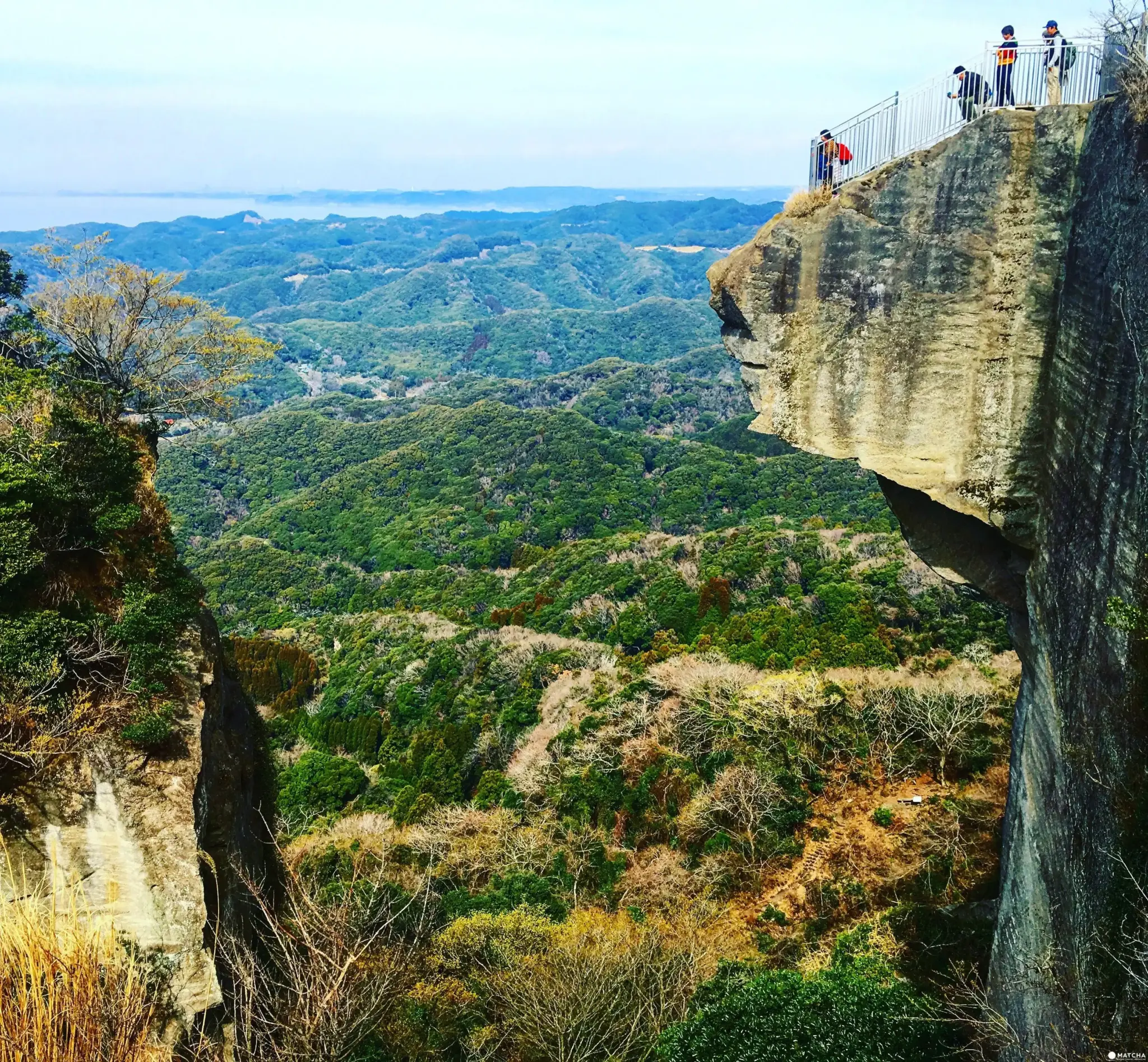
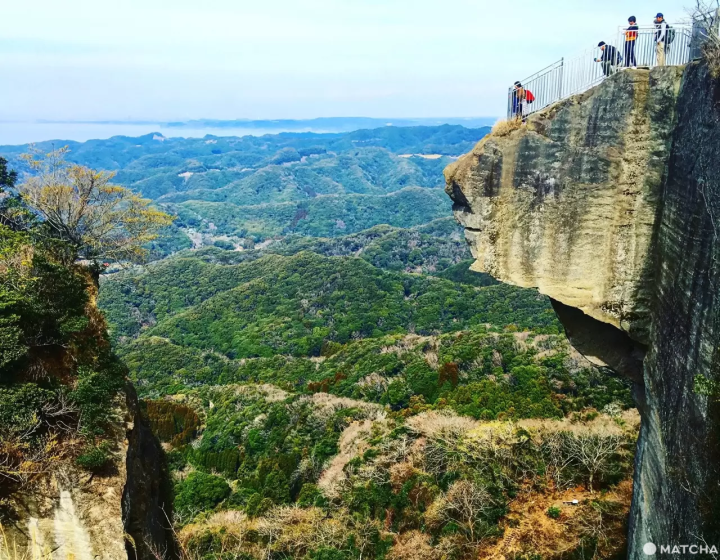
At the highest accessible summit ridge lies Jigoku Nozoki ("Peeking into Hell"), a cantilevered rock outcropping that suspends brave visitors directly over an immense vertical drop. Offering panoramic vistas stretching across Tokyo Bay to the distant silhouette of Mt. Fuji, the viewpoint delivers an intense rush of vertigo. Because the mountain involves navigating steep, uneven stone stairs left behind by historical quarrymen, trekking poles and sturdy footwear are strongly recommended for all visitors.

Official Statements and Regional Tourism Strategies
In response to shifting travel patterns following the global pandemic, local municipal governments and regional tourism boards across Chiba Prefecture have launched concerted initiatives to attract international travelers beyond the Tokyo urban core.
Representatives from the Chiba Prefectural Tourism Bureau emphasize that rebranding the region’s lesser-known interior is a top priority. In a recent regional development briefing, tourism officials noted:

"For too long, international visitors have viewed Chiba merely as an airport transit zone. Our objective is to bridge the psychological gap between Narita Airport, Tokyo, and our coastal territories. By highlighting the rich historical tapestry of the Satomi clan, alongside sustainable eco-tourism initiatives at Yoro Keikoku and Mt. Nokogiri, we are building a multifaceted travel destination that appeals to both domestic weekenders and global explorers seeking authentic Japanese heritage."
Furthermore, regional transportation authorities have collaborated with private railway operators—such as the Kominato Railway, which runs vintage diesel trains through the lush Yoro River valley—to introduce multilingual digital passes and simplified routing guides. These efforts aim to alleviate the navigation hurdles historically faced by foreign tourists attempting to access rural transit networks.

Future Outlook: Sustainable Tourism and Growth Potential
As global tourism to Japan reaches unprecedented volume, destination management has become a critical concern for both metropolitan centers and rural prefectures. Overtourism in core urban hubs like Kyoto and central Tokyo has accelerated the search for viable alternative destinations, positioning the South Boso Peninsula for sustained growth over the next decade.
The region’s future outlook hinges on balancing digital-driven popularity with environmental conservation. Viral attractions like Nomizo Waterfall risk suffering from visitor congestion if foot traffic is not carefully managed. Local conservation groups and municipal councils are actively implementing crowd-control measures, such as designated viewing platforms, improved waste management protocols, and educational signage emphasizing the preservation of surrounding fragile ecosystems.

Moreover, the integration of smart tourism technologies—including real-time crowd-monitoring apps and expanded Wi-Fi connectivity along mountain trails—will play a pivotal role in ensuring that international travelers can navigate the rural landscape safely and independently.
By successfully uniting its dramatic natural landscapes, deep literary roots, and proximity to the world’s most populous metropolitan area, the South Boso Peninsula stands out as a model for regional Japanese tourism. For travelers willing to venture just beyond the airport perimeter, Chiba’s southern coast offers an unforgettable journey into the heart of coastal mythology, natural wonder, and enduring cultural heritage.



Belum ada komentar. Jadilah yang pertama berkomentar!