

Executive Overview
Apple’s ongoing push to solidify its footprint in the modern digital entertainment landscape has taken another incremental step forward. With the official rollout of iOS 26.2 developer beta 2, the Cupertino-based tech giant is delivering a series of targeted refinements aimed directly at its fledgling system utility: the Apple Games app. Introduced earlier in the software cycle with iOS 26 alongside a select group of new home screen apps, the Games app was designed to act as a centralized, cross-platform hub for all gaming activities spanning the iPhone, iPad, and Mac ecosystems.
While the initial release of iOS 26 established the foundational infrastructure for this unified library, user feedback immediately pointed toward necessary quality-of-life adjustments. Addressing these early critiques, iOS 26.2—slated for a public release next month—brings subtle yet impactful enhancements to the platform. Highlighted by a newly introduced splash screen in beta 2, these updates focus on organization, usability, and streamlining how players navigate their increasingly diverse game libraries. Although these modifications do not represent a massive, paradigm-shifting overhaul designed to aggressively capture new demographics, they signal a welcome commitment by Apple to continuously polish its software based on real-world usage patterns. As mobile gaming continues to blur the lines with traditional console and desktop platforms through advanced silicon and titles like Death Stranding and Resident Evil, Apple’s dedication to an optimized software wrapper becomes increasingly vital.
Detailed Chronology of the iOS 26.2 Gaming Updates
The evolution of Apple’s gaming software architecture has been methodical, tracking alongside the broader developmental milestones of the iOS 26 product cycle. Understanding the trajectory of these updates provides crucial context for where the platform stands today.
The Genesis: iOS 26 and the Birth of the Unified Hub
When Apple launched iOS 26 to the public, it introduced two brand-new system applications directly onto millions of iPhone home screens. Among them was the Apple Games app. For years, Apple’s gaming ecosystem felt somewhat fragmented. While Game Center managed achievements, leaderboards, and social profiles in the background, and the App Store served as the primary storefront, users lacked a dedicated, immersive dashboard to track installed titles, launch games, and discover community updates across Apple silicon devices.
The Games app was envisioned to solve this fragmentation by acting as a universal launcher and library organizer. It brought together titles downloaded from the App Store, Apple Arcade subscriptions, and cross-platform achievements into a single pane of glass. However, as is common with version 1.0 software releases, the community quickly identified friction points in user navigation, interface density, and filtering capabilities.
Developer Beta 1: Laying the Groundwork for Refinement
Fast forward to the current software cycle, and Apple is preparing the release of iOS 26.2, projected to arrive for all compatible devices next month. The journey toward this update began quietly with the deployment of developer beta 1. During this initial testing phase, eagle-eyed developers and power users began noticing under-the-hood adjustments and interface tweaks designed to streamline the Games app experience.
These early changes were primarily functional, focusing on reducing the number of taps required to sort through sprawling digital libraries and managing notifications within the app interface. However, because beta 1 often prioritizes core stability and framework adjustments, these features remained understated, awaiting a clearer user-facing introduction.
Developer Beta 2: The New Splash Screen and Visible Improvements
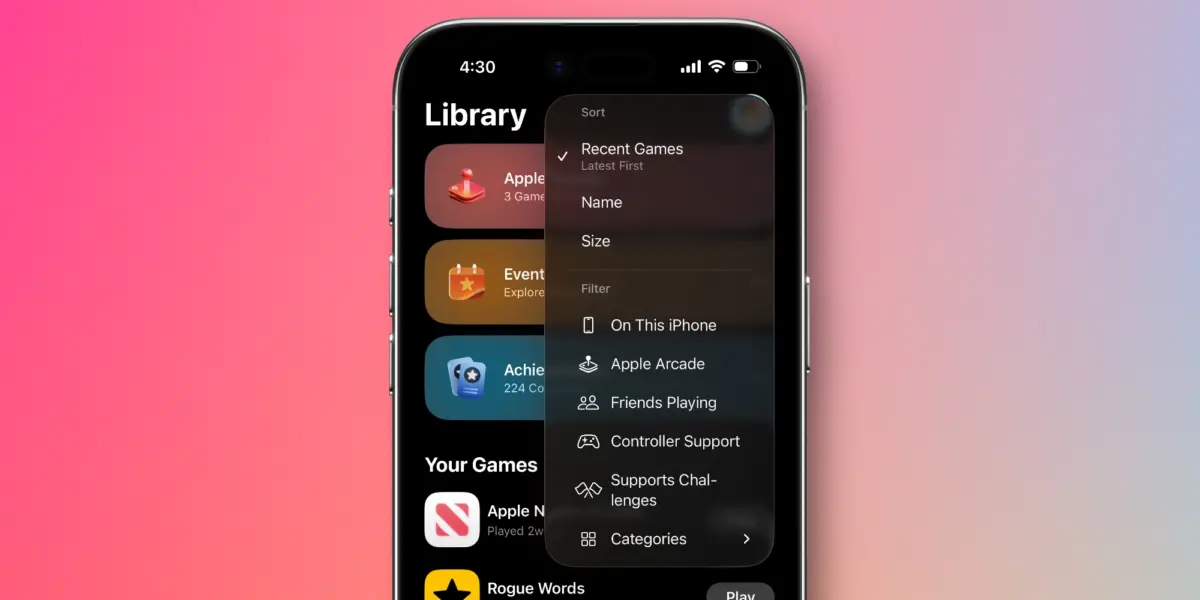
The release of iOS 26.2 developer beta 2 brought these backend adjustments into the spotlight by introducing a dedicated splash screen upon launching the application. This new onboarding and summary screen explicitly details the user-facing refinements baked into the 26.2 build.
The adjustments, while minor in scale, directly target the pain points reported by early adopters. By introducing enhanced filtering mechanisms, more intuitive library management layouts, and tighter integration with Game Center profiles, beta 2 proves that Apple is actively listening to its developer and power-user community. This iterative approach demonstrates a mature software pipeline—one that values continuous, micro-adjustments over waiting for massive annual refreshes to fix interface friction.
Supporting Context & Metrics: The State of iOS Gaming
To fully grasp the significance of these UI tweaks to the Apple Games app, one must examine the broader economic and technological landscape of gaming within the Apple ecosystem. Apple has spent the last half-decade systematically transforming the iPhone and iPad from casual mobile gaming devices into viable platforms for AAA console-quality titles.

[Traditional Casual Mobile Gaming]
       │
       ├──► Apple Arcade Subscriptions (Curated Indie & Family Content)
       │
       └──► AAA Silicon Integration (M-Series / A-Series Pro Chips)
              │
              └──► High-End Ports (Resident Evil, Death Stranding, Assassin's Creed)
                     │
                     └──► Unified Hub Requirement: The Apple Games App
The Shift Toward AAA Mobile Gaming
With the introduction of the A-series Pro chips and the computational powerhouse of M-series processors in iPads and Macs, Apple devices possess raw hardware capabilities that rival current-generation home consoles. Hardware-accelerated ray tracing, MetalFX upscaling, and sustained thermal performance have enabled developers to bring massive, open-world console games directly to mobile hardware.
Titles such as Resident Evil Village, Death Stranding Director’s Cut, and Assassin’s Creed Mirage are no longer theoretical demonstrations; they are commercial realities on the App Store. Consequently, the user experience of managing these massive installations—often ranging from 15GB to upwards of 50GB—requires a robust, organized software hub. A chaotic app drawer is simply insufficient for a device holding multiple multi-gigabyte AAA titles alongside quick-session casual games.
The Role of Apple Arcade and Cross-Platform Continuity
Compounding this hardware evolution is the maturation of Apple Arcade. Offering a curated catalog of over 200 games free of ads and in-app purchases, the service has cultivated a dedicated base of gamers who transition seamlessly between iPhone, iPad, Mac, and Apple TV.
The Apple Games app acts as the connective tissue for this ecosystem. By synchronizing save states, achievements, and recently played titles via iCloud, the app ensures that a gaming session started on an iPhone during a morning commute can be picked up effortlessly on an iPad or Mac at home. Enhancing this hub with better filtering and streamlined navigation directly impacts user retention and satisfaction across these multi-device workflows.
Official Statements and Industry Insights
While Apple typically maintains a guarded stance regarding unreleased software features, preferring to let the code and beta release notes speak for themselves, software engineers and product designers within the company have previously emphasized the vision of a unified entertainment ecosystem.

Industry analysts have been quick to weigh in on the strategic importance of the Games app. According to leading tech market researchers, Apple’s investment in dedicated system-level gaming utilities is a clear indicator of its long-term ambitions in the digital media space.
"Apple is no longer satisfied with merely acting as a tollbooth for third-party developers via the App Store. By curating dedicated system applications like the Games app and Apple Fitness+, Apple is building sticky, proprietary ecosystems that elevate the overall utility of iOS," notes a prominent Silicon Valley software strategist. "Refinements in minor updates like iOS 26.2 show a disciplined, responsive development loop that ensures these new system apps don’t become dead-weight features."
Furthermore, developer community feedback gathered across forums and developer dispatch channels indicates that while the changes in iOS 26.2 are minor, they are profoundly welcome. Developers who rely on the ecosystem to showcase their titles appreciate any platform-level optimization that improves discovery, library management, and user engagement metrics.
Future Outlook: What Lies Ahead for Apple Gaming
As we look past the imminent release of iOS 26.2 next month, the trajectory of the Apple Games app points toward deeper integration, expanded social features, and potentially more robust cloud-gaming or streaming partnerships.
Anticipated Roadmap Features
- Advanced Social Integration: Future iterations of the app are widely expected to expand on Game Center functionality, potentially introducing live activity feeds, integrated voice chat or messaging for multiplayer parties, and streamlined friend-finding mechanics.
- Personalized Discovery Engines: As the digital storefront and library grow, algorithmic recommendations tailored to individual play styles, hardware capabilities, and time spent in-game will become crucial for combating app fatigue.
- Hardware Accessory Synergy: With the ongoing rise of dedicated mobile game controllers (such as Backbone and Razer Kishi) and seamless Bluetooth pairing for PlayStation and Xbox controllers, the Games app could evolve to serve as a hardware configuration dashboard, optimizing haptics, latency, and button mapping on a per-game basis.
Conclusion
The upcoming release of iOS 26.2 may not introduce earth-shattering features or rewrite the rulebook for mobile operating systems, but it represents the kind of diligent, attentive software engineering that underpins successful platforms. By listening to early user feedback and refining the Apple Games app with smarter filters, cleaner layouts, and an improved onboarding splash screen, Apple is ensuring that its unified gaming hub is robust enough to handle the complex future of portable high-end entertainment.

As the lines separating mobile devices from traditional gaming consoles continue to dissolve, having a polished, centralized home for all digital adventures will be more important than ever. Whether you are a casual player checking in on your favorite puzzle game or an enthusiast pushing mobile silicon to its absolute limits with a full-scale AAA port, these iterative improvements promise a smoother, more enjoyable journey through your digital library.









Belum ada komentar. Jadilah yang pertama berkomentar!