Apple’s ongoing crusade to cement the Mac as a viable, high-performance platform for AAA gaming has long been defined by a paradox. On one side of the equation sits Apple Silicon—a hardware marvel boasting incredible architectural efficiency, unified memory structures, and blistering raw performance metrics. On the other side sits a historically underserved gaming community and a notoriously cautious developer ecosystem that has frequently treated macOS as an afterthought.
Despite years of substantial marketing investments, dedicated developer toolkits, and high-profile console ports, the Mac has yet to capture the collective imagination of mainstream gamers in the way Windows-based PCs and dedicated consoles have.
However, the debut of Metal 4 at Apple’s Worldwide Developers Conference (WWDC25) represents a calculated, highly practical pivot in the company’s strategy. Rather than relying solely on brute-force hardware improvements or attempting to force developers to rewrite their pipelines from scratch, Apple is introducing targeted architectural advancements. Chief among these are MetalFX frame interpolation and advanced ray tracing denoising.
These two pillars are designed to solve the most persistent bottlenecks in modern game development: punishing frame-rate limitations and the performance-draining overhead of realistic lighting. By integrating these tools directly into the Metal 4 framework, Apple is equipping developers with the exact kind of efficiency-maximizing utilities that have long driven performance on competing platforms.
For the end user, this evolution promises smoother motion, higher fidelity, and a tangible expansion of AAA titles that can run comfortably on everyday Mac hardware. For the industry at large, Metal 4 signals that Apple is listening closely to the pain points of game studios, trading lofty rhetoric for pragmatic, engineering-led solutions.
Detailed Chronology
To understand the weight of Metal 4, it is necessary to contextualize its arrival within Apple’s broader, decade-long push to modernize its graphics ecosystem.
The Pre-Silicon Era (Pre-2020): For years, macOS relied heavily on OpenGL and older, aging graphics libraries. Developers faced a fragmented landscape where performance optimization was an uphill battle, and Apple’s hardware—frequently reliant on discrete GPUs from third parties with limited thermal envelopes—struggled to maintain sustained gaming loads.
The Introduction of Metal (2014–2020): Apple initially introduced Metal as a low-overhead graphics and compute API designed to replace OpenGL. While it successfully modernized iOS graphics and streamlined macOS application rendering, its adoption in major multiplatform game engines was slow, hampered by the industry’s deep entrenchment in DirectX and Vulkan.
The Apple Silicon Transition (2020): The introduction of the M-series chips (beginning with the M1) fundamentally changed the physical capabilities of Mac hardware. Unified memory architecture and high-performance integrated graphics meant that even thin-and-light MacBooks possessed theoretical gaming horsepower. Yet, software translation layers and performance optimization gaps remained.
The Birth of MetalFX (WWDC22–WWDC23): Recognizing that resolution scaling was key to squeezing frame rates out of integrated silicon, Apple launched MetalFX Upscaling. This spatial and temporal upscaling toolkit gave developers a crucial weapon to render games at lower internal resolutions before blowing them up to native display sizes with minimal visual degradation.
WWDC25 and the Reveal of Metal 4: Marking a mature phase in Apple’s gaming strategy, WWDC25 brought the unveiling of Metal 4. Expanding directly upon the foundation laid by MetalFX upscaling, Apple introduced frame interpolation and ray tracing denoising, addressing the twin titans of modern GPU stress: frame rate generation and realistic lighting calculations.
Supporting Context & Metrics: Deconstructing Metal 4’s Core Technologies
To truly appreciate what Metal 4 brings to the table, one must look under the hood at how upscaling, interpolation, and denoising interact within modern rendering pipelines.
The Baseline: How MetalFX Upscaling Works
Before examining the new additions, it is vital to understand the cornerstone upon which they are built. Rendering high-resolution assets—such as native 4K—consumes an immense portion of a GPU’s processing time. Every pixel calculated demands memory bandwidth and compute cycles that could otherwise be allocated to complex physics, particle effects, or artificial intelligence routines.
As Apple formally detailed in its WWDC25 developer documentation:
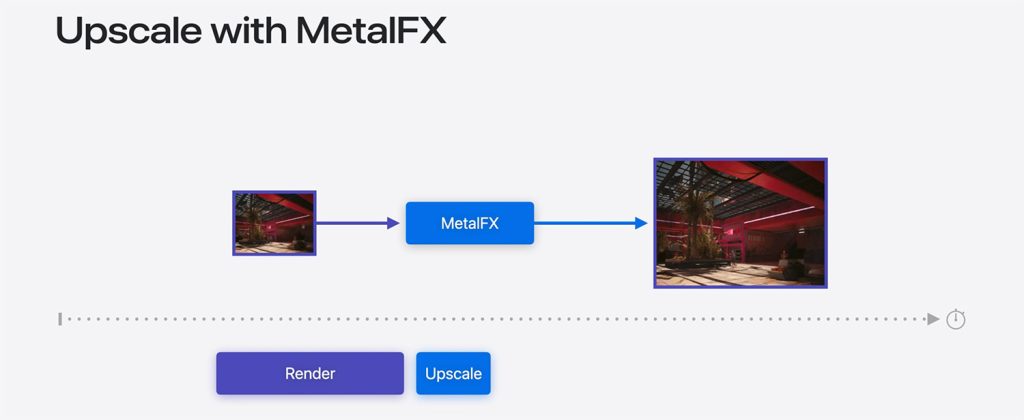
"Rendering high resolution images can consume the GPU for a significant period of time. Instead, your app can render low resolution images and use MetalFX to upscale them. The combined time to render your final image is reduced and that means your app can save time for each frame it renders. You can use the time saved to render the next frame sooner."
This methodology has become the baseline for modern performance-conscious game development across all major operating systems. By rendering a scene at, say, 1080p or 1440p and employing sophisticated algorithms to reconstruct the image to 4K, developers claw back precious milliseconds per frame. MetalFX upscaling established that Apple could achieve competitive results; Metal 4 builds directly on this exact philosophy.
Frame Interpolation: Generating Motion Without Brute Force
If you have ever utilized "frame generation" technologies in contemporary PC gaming environments (or grappled with motion-smoothing settings on modern consumer televisions), you are already familiar with the core concept of interpolation.
Traditionally, every frame displayed on a monitor is independently rendered by the GPU from scratch. As games grow exponentially more complex, achieving high, stable frame rates—such as 90Hz or 120Hz—requires astronomical amounts of compute power.
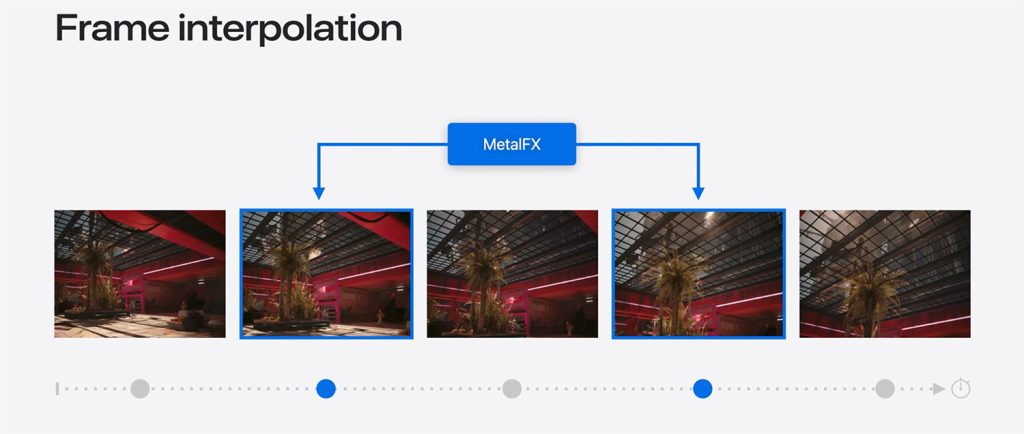
Instead of forcing the GPU to sweat over rendering every single frame entirely from scratch, MetalFX frame interpolation steps in to synthesize intermediate frames. By rigorously analyzing motion vectors and depth data generated by the game engine, the algorithm calculates how objects and textures are shifting from one real frame to the next, intelligently generating smooth in-between frames.
Apple outlines the practical utility of this addition clearly:
"This year, MetalFX adds support for frame interpolation. Your app can use it to generate intermediate frames in much less time than it would take to render each frame from scratch. You can use those intermediate frames to achieve even higher frame rates."
For the player, this translates to fluid, stutter-free animations and a vastly more responsive visual experience, even when the underlying hardware is natively rendering a demanding scene at 30 or 60 frames per second. For the game developer, it offers a pragmatic pathway to deliver high-refresh-rate experiences on Mac hardware without having to halve their geometric or shader complexity.
Ray Tracing Denoising: Squeezing Beauty Out of Fewer Rays
Ray tracing has spent the last several years reigning as the ultimate graphical status symbol in PC and console gaming. By simulating the physical behavior of light—tracing paths from the camera, bouncing them off surfaces, and calculating realistic reflections, shadows, and refractions—ray tracing creates breathtakingly lifelike virtual environments.
However, ray tracing is notoriously demanding. Casting millions of secondary rays to clean up lighting calculations exacts a severe performance penalty, frequently tanking frame rates unless heavy-duty dedicated hardware is brought to bear.
With Metal 4, Apple is introducing denoising directly into the MetalFX pipeline. Rather than forcing a game engine to cast an overwhelming number of rays to achieve a clean image, MetalFX denoising allows developers to render a scene using far fewer rays, resulting in a speckled, "noisy" initial output. The MetalFX pipeline then efficiently cleans up this noise during the upscaling and frame construction process.
This integrated approach yields major dividends:
Reduced Overhead: Developers no longer need to write complex, custom denoising shaders from scratch.
CPU Relief: The heavy lifting is handled natively within the graphics pipeline rather than offloaded to limited CPU processing threads.
Visual Fidelity: Players get pristine, reflection-rich, and shadow-accurate environments without sacrificing playable frame rates.
Official Statements & Developer Integration
Apple’s rollout of Metal 4 was accompanied by deep-dive technical sessions at WWDC25, aimed directly at convincing skeptical engine builders and game studios that the Mac is ready for prime-time optimization.
Engineers from Apple’s graphics framework teams emphasized that Metal 4 was developed in direct consultation with third-party studios. The goal was not to build a closed-garden, proprietary API that required completely foreign codebases, but rather to align Apple’s architecture with industry-standard paradigms found in DirectX 12 and Vulkan. By bridging these gaps, Apple hopes to streamline the porting process, making it frictionless for studios to bring sprawling open-world RPGs and high-octane shooters over to macOS.
Furthermore, Apple confirmed the hardware roadmap for Metal 4 compatibility. The framework will natively support:
Apple Silicon Macs: All systems powered by the M1 chip and later iterations (including M2, M3, and M4 generations).
iOS and iPadOS Devices: Mobile hardware powered by the A14 Bionic chip and later, ensuring that developers building cross-platform Apple ecosystem titles can scale these rendering techniques seamlessly from handheld devices to desktop workstations.
To assist studios in adopting these tools, Apple has strongly encouraged developers to review the technical sessions "Discover Metal 4" and "Go further with Metal 4 games" available through the official Apple Developer portal.
Future Outlook: Can Metal 4 Finally Turn the Tide for Mac Gaming?
The release of Metal 4 is a masterclass in pragmatic engineering, but it does not exist in a vacuum. The historical hurdles facing Mac gaming—ranging from entrenched Windows DirectX dominance and Steam library compatibility to the simple economics of market share—cannot be solved by an API alone.
Yet, there is genuine reason for cautious optimism. As Apple Silicon continues to scale in power—from base-tier MacBook Air models up to ultra-high-end M-series Max and Ultra chips destined for Mac Studios and Mac Pros—the hardware baseline across the installed Mac base has never been more uniform or capable. A developer targeting an M1 Mac today can reasonably assume their user base has access to unified memory architectures and hardware-accelerated graphics capabilities that were unthinkable during the Intel era.
By introducing advanced tooling like frame interpolation and ray tracing denoising via Metal 4, Apple is removing the technical friction that often killed Mac ports during early feasibility assessments. Studios can now achieve competitive performance metrics without compromising their artistic vision or spending excessive engineering hours reinventing upscaling wheels.
Ultimately, Metal 4 will not magically transform every casual laptop into an elite esports arena overnight. However, it provides the vital technical infrastructure required for serious AAA titles to run with the fluidity, fidelity, and stability that modern gamers demand. As studios begin integrating these tools into upcoming development cycles, Metal 4 may well be looked back upon as the turning point where Apple’s long-dormant gaming ambitions finally found their footing.












Belum ada komentar. Jadilah yang pertama berkomentar!