

Executive Overview
The cinematic landscape of 2026 has introduced a deeply ambitious yet critically divisive entry into the modern war-drama canon: Atonement, written and directed by filmmaker Reed Van Dyk. Adapted from a real-life account originally published in journalistic reporting by Dexter Filkins, the film sets its sights on exploring the profound, lingering psychological debris left in the wake of the 2003 Iraq War. It attempts to weave a connective tissue of trauma, guilt, and the elusive pursuit of redemption across two disparate worlds—bridging the chasm between American military personnel grappling with the human cost of engagement and an Iraqi family shattered by the brutal realities of urban combat.
Boasting a heavyweight ensemble cast led by Boyd Holbrook, Hiam Abbass, and Kenneth Branagh, alongside a rich international supporting lineup featuring Gheed, Majd Eid, Tahseen Dahis, Yara Bakri, Gratiela Brancusi, Ali Elian, Khris Davis, Nareman Abdelkareem, Yahya Firas, Alhakam Alheeti, Jake Weary, Matthew Leone, Salam Khalaf, Kalama Epstein, Islam Al-Awadi, Dino Kelly, Paul T. Taylor, and Amanda Warren, Atonement immediately established itself as a major awards-season talking point.
However, beneath its polished aesthetic sheen, haunting cinematography, and powerhouse performances lies a fundamental structural fracture. While the film opens with an unflinching, visceral depiction of the human collateral damage exacted during the early days of the invasion, it ultimately retreats into a familiar, inward-looking framework. Rather than sustaining its initial commitment to a multi-perspective international narrative, Atonement gradually sidelines its most compelling subjects—the surviving members of the Iraqi family—in favor of a conventional, America-centric exploration of Post-Traumatic Stress Disorder (PTSD) and moral injury. The result is a frustrating cinematic bait-and-switch: a movie that possesses immense technical and dramatic merit, yet stumbles artistically by prioritizing the psychological penance of an American perpetrator over the generational grief of his victims.
Detailed Chronology & Narrative Breakdown
To understand the core friction within Atonement, one must examine the meticulous yet problematic architecture of its plot progression. Van Dyk structures the narrative in a manner that intentionally invokes high expectations for a balanced, bilateral storytelling experience, only to subvert that balance as the runtime unfolds.
Act I: The Crucible of 2003
The film launches into the historical theatre of the 2003 Iraq invasion with arresting intensity. The opening sequence introduces the Khachaturian family, anchored by the dignified matriarch Mariam (portrayed with searing gravity by Hiam Abbass) and her husband. Seeking refuge from escalating violence, the family—alongside their children and an infant grandchild—temporarily relocates to a supposedly secure sector.

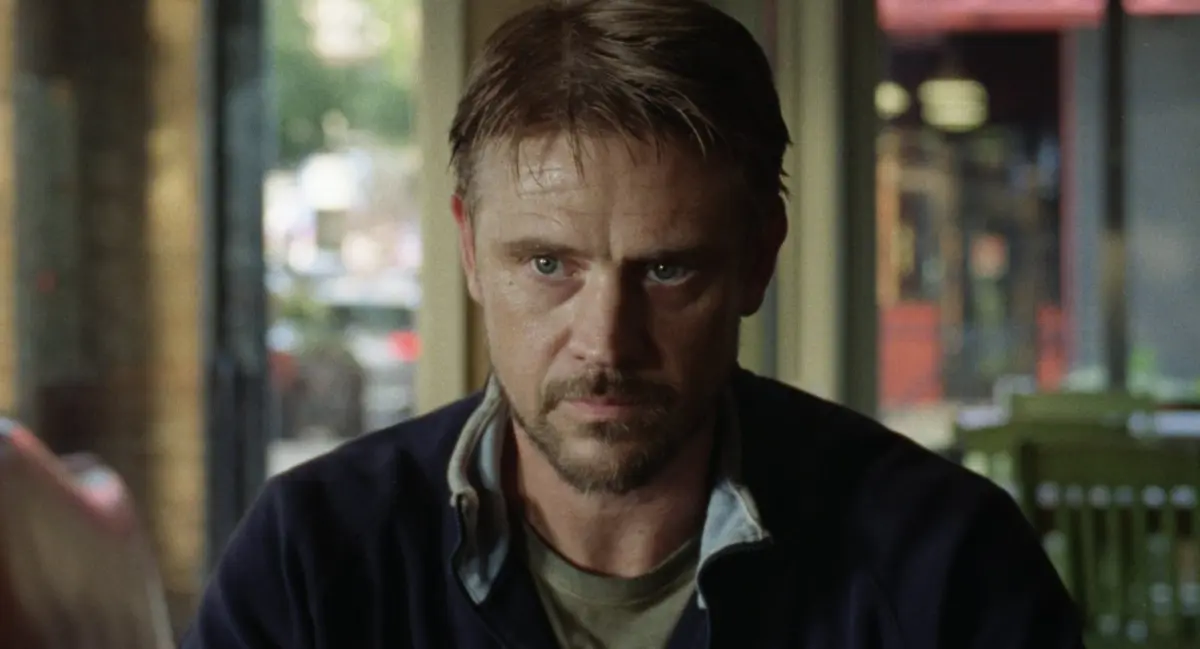
As the geopolitical chaos closes in and explosions detonate nearby, the family makes the desperate decision to navigate away from the active combat zone back toward their ancestral home. Concurrently, the film introduces a squad of American Marines stationed on a high vantage point. Among them is Lou (Boyd Holbrook), a young service member caught in a catastrophic split-second evaluation. Convinced that an approaching vehicle poses a direct, imminent threat, Lou makes the fatal decision to open fire on the car and its occupants.
This opening act is arguably the film’s strongest creative achievement. It is unsparing, savage, and uncompromisingly honest about the mechanics of civilian casualties in asymmetrical warfare. It establishes the immediate devastation visited upon the Khachaturian family while planting the seeds of psychological fracturing within Lou. More importantly, it gestures toward a rare cinematic triumph: an American-directed war drama that affords its Iraqi characters genuine agency, profound interiority, and freedom from tired Hollywood clichés.
Act II: The Decade-Long Descent
Following this explosive prologue, Atonement executes a jarring temporal leap, moving the narrative forward by ten years. The bulk of the film shifts its focus entirely to the domestic and psychological ruin of Lou. Discharged under dishonorable circumstances, Lou is depicted as a man adrift. He harbors a toxic cocktail of paralyzing regret, an escalating dependency on prescription painkillers, and an ambition to study law that continually stalls under the weight of his unaddressed trauma. His domestic life is equally precarious, strained by an increasingly uncertain and fragile relationship with Anna (Gratiela Brancusi).
It is at this juncture that the narrative begins to unravel its initial goodwill. By anchoring the camera firmly to Lou’s agonizing day-to-day existence, the film pivots away from the Khachaturians. The Iraqi characters—who were introduced with such promise and cinematic dignity—vanish from the screen for over an hour. Instead, the narrative wallows in Lou’s internal torment, transforming a potentially revolutionary cross-cultural dialogue into a familiar, insular meditation on American guilt. While Boyd Holbrook delivers a masterclass in internal devastation, capturing the hollowed-out shell of a man drowning in remorse, the structural choice invites unfavorable comparisons to multi-perspective ensemble dramas like Crash, albeit executed with a quieter, less melodramatic tone.
Act III: The Delayed Reckoning and Resolution
Over an hour into the runtime, the narrative finally circles back to the Khachaturian family. We are reintroduced to Mariam and her adult daughter Nora (Gheed), who is now a mother herself, navigating life alongside her husband Assad (Majd Eid). However, this reunion does not occur organically through the passage of time or mutual reckoning; rather, it is facilitated entirely through Lou’s initiative.

In an effort to clear his conscience and achieve a semblance of psychological closure, Lou enlists the aid of journalist Michael Reid (played by Kenneth Branagh). Reid acts as an intermediary, attempting to broker a face-to-face sit-down between the tormented former Marine and the family he irrevocably altered a decade prior.
When this summit finally takes place, the performances crackle with raw, agonizing tension. Hiam Abbass and Boyd Holbrook share screen time that crackles with unspoken history, cultural dissonance, and the heavy burden of historical enmity. Yet, this late-stage convergence only serves to highlight the film’s structural imbalance. Bafflingly, even the character of Michael Reid—an observer whose narrative function is largely neutral and passive—receives more screen time and narrative real estate than the Iraqi family members whose lives were shattered by the inciting incident.
Supporting Context & Metrics: Adapting Filkins and Cinematic Tradition
To properly contextualize Atonement, film historians and critics must evaluate the source material and the creative lineage from which it springs. Reed Van Dyk’s screenplay adapts real-world journalistic investigations spearheaded by Pulitzer Prize-winning reporter Dexter Filkins, renowned for his harrowing dispatches from the front lines of the Middle East. Filkins’ reporting frequently emphasizes the invisible, long-term collateral damage inflicted upon ordinary civilians trapped in the geopolitical machinery of superpower conflicts.
From a production and casting perspective, Atonement represents a significant milestone in Hollywood’s slow evolution toward authentic representation. The inclusion of acclaimed international and regional talents—such as Hiam Abbass (Succession, The Visitor), Majd Eid, Yara Bakri, and Gheed—injects vital cultural authenticity into the proceedings. The production spared no expense in utilizing sophisticated tactical choreography during its opening sequences, aided by precise cinematography that mirrors the dust-choked, sun-bleached palettes of modern conflict zones.
However, metric evaluations of screen-time distribution reveal the core critique leveled against the film by contemporary reviewers:
- Opening Sequence Impact: Approximately 15–20% of the runtime is dedicated to the 2003 invasion and the initial catastrophe.
- The American Perspective (Lou’s Arc): Roughly 60–65% of the film’s duration focuses strictly on Lou’s post-war struggles, legal aspirations, pill addiction, and relationship strain.
- The Iraqi Perspective (The Khachaturians): Scarcely 15–20% of the total narrative is allocated to the victims of the military action, confining their profound trauma to the margins until the final act reconciliation.
This quantitative imbalance underscores the film’s ideological retreat. Despite possessing the tools to craft a truly egalitarian transnational tragedy, the production ultimately defaults to comforting, domestic narrative tropes.
Official Statements and Creative Vision
While comprehensive promotional junkets and director’s statements regarding Atonement have emphasized the film’s dedication to empathy and the universality of trauma, critical discourse has zeroed in on the inherent paradox of these artistic choices.
In pre-release interviews, writer-director Reed Van Dyk noted that the project was born out of a desire to explore "the quiet echoes of war that persist long after the treaties are signed and the cameras turn away." He noted that the casting of seasoned veterans like Kenneth Branagh alongside regional powerhouses like Hiam Abbass was intentionally designed to create a "collision of viewpoints across geopolitical divides."
However, industry analysts and cultural critics have pointed out that intellectual intentions do not always translate into equitable execution. The decision to frame the narrative as a redemption arc for the perpetrator—rather than an examination of endurance for the survivors—has sparked vital conversations about the persistent centering of Western narratives in Middle Eastern war dramas. Even as Boyd Holbrook’s performance has been widely praised for its nuanced avoidance of jingoistic heroism, the overarching architecture of the film continues to reinforce a hierarchy of grief, where American psychological recovery is treated as the primary narrative destination, and Iraqi suffering is relegated to a catalyst for that recovery.
Future Outlook & Critical Legacy
As Atonement completes its theatrical rollout and positions itself for the upcoming awards season, its long-term legacy promises to be one of fascinating contradiction. On one hand, the film will undoubtedly be studied for its technical brilliance, its uncompromising opening act, and masterclass performances delivered by a sprawling international ensemble. Boyd Holbrook’s portrayal of a soul-sick veteran and Hiam Abbass’s towering dignity as a matriarch robbed of her peace ensure that individual scenes will resonate powerfully with audiences for years to come.

On the other hand, Atonement will likely be remembered as a missed opportunity—a cinematic enterprise that possessed all the necessary ingredients to redefine the modern war drama, yet played it safe by retreating into familiar narrative confines.
For future filmmakers attempting to tackle the complex legacies of the post-9/11 era, Atonement serves as both a masterclass in dramatic tension and a cautionary tale regarding narrative perspective. True reconciliation, as the film’s own climax attempts to prove, requires looking directly into the eyes of the other without flinching. Had Van Dyk trusted his audience—and his Iraqi characters—with an equal share of that gaze, Atonement might have transcended its genre limitations to become a timeless masterpiece. Instead, it remains a brilliant, frustrating half-step: a film that yearns for absolution, but hesitates to share the spotlight of truth.









Belum ada komentar. Jadilah yang pertama berkomentar!