

Executive Overview
The Wikimedia Foundation, the non-profit organization behind the world’s largest and most comprehensive crowd-sourced encyclopedia, has officially brought its engaging daily historical trivia game, "Which came first?", to the Apple iOS ecosystem. Following a successful rollout on Android devices, the feature is now integrated directly into the latest version of the official Wikipedia iOS application, marking a significant step in the platform’s ongoing evolution from a static reference archive to an active, gamified learning environment.
Designed to test users’ temporal reasoning and global history knowledge, "Which came first?" presents players with a daily curation of five historical questions. Crucially, every event featured in the daily challenge is tied directly to significant occurrences that took place on the exact current calendar day throughout world history. By blending edutainment with daily habit-forming mechanics—reminiscent of the viral puzzle craze sparked by games like Wordle—Wikipedia aims to deepen user engagement, encourage exploration of lesser-known historical articles, and foster a daily habit of discovery among millions of iPhone and iPad users worldwide.
Detailed Chronology: From Android Genesis to iOS Integration
The journey of gamifying Wikipedia’s vast repository of human knowledge did not happen overnight. For years, the Wikimedia Foundation has sought innovative ways to make its exhaustive database more accessible, digestible, and compelling for younger or more casual digital consumers accustomed to bite-sized, interactive media.
The Android Pilot Phase
Prior to its arrival on Apple’s mobile operating system, "Which came first?" debuted as an experimental feature within Wikipedia’s Android application. The development team sought to test user appetite for lightweight, chronology-based puzzle mechanics. Android users quickly embraced the concept, finding joy—and occasional frustration—in trying to determine whether a scientific breakthrough preceded a political treaty or a cultural milestone that occurred centuries apart on the very same calendar date.
The success of the Android pilot provided the crucial metric-driven validation required by product leads to greenlight a full cross-platform deployment. Developers fine-tuned the user interface, optimized touch targets, and streamlined the connection between the trivia questions and the underlying Wikipedia articles, ensuring that a wrong guess naturally led to an informative rabbit hole of historical reading.
The iOS App Store Launch
Beginning today, iPhone and iPad users running the latest version of the Wikipedia iOS app can access the game natively. Rather than requiring a separate application download or forcing users to navigate away to a web browser, "Which came first?" is seamlessly embedded into the app’s central Explore feed.
Upon opening the app, users are greeted by the game module, inviting them to dive into the day’s historical chronology. The transition from Android to iOS required strict adherence to Apple’s Human Interface Guidelines, resulting in a polished, fluid native experience that matches the high visual standards expected by the Apple user base.
Gameplay Mechanics, Features, and User Experience
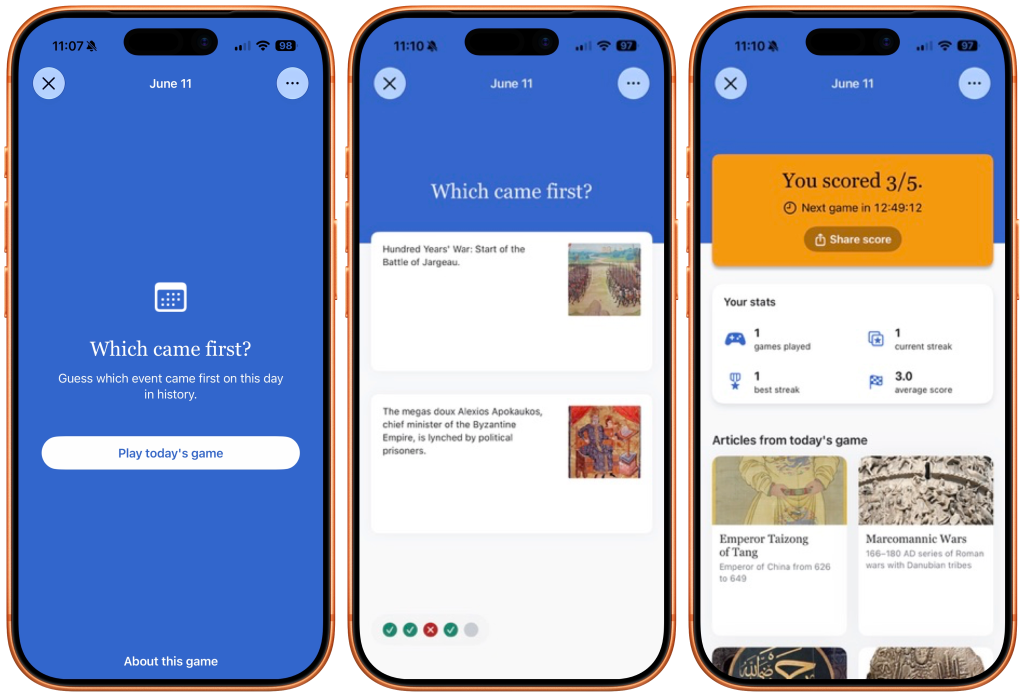
At its core, "Which came first?" is deceptively simple yet historically rigorous. The gameplay loop is designed to challenge cognitive biases and historical assumptions by pitting two or more seemingly unrelated events against one another on a timeline.
How the Game Works
- Five Daily Challenges: Every single day, players are presented with a fresh slate of five chronological puzzles.
- Thematic Grounding: Every event chosen for the daily challenge shares a unique bond—they all happened on the exact same calendar day (e.g., June 14th) across different years in human history.
- Temporal Sorting: Users must deduce the correct historical sequence of events, testing their grasp of centuries past.
Progress Tracking and Archival Access
To keep players coming back day after day, Wikipedia has incorporated robust statistical tracking into the iOS release. Users can monitor:
- Gameplay Streaks: Encouraging consecutive days of historical engagement.
- Average Scores: Providing a benchmark for long-term improvement.
- The Archive: For those who missed previous days or simply cannot get enough trivia, a fully accessible archive allows players to test their knowledge on past dates, ensuring unlimited replay value.
Supporting Context & Metrics: The Shift Toward Gamified Education
The introduction of "Which came first?" to the Wikipedia iOS app is part of a broader, industry-wide shift toward gamified learning. In an era dominated by short-form video algorithms and rapidly fragmenting attention spans, static encyclopedias face intense competition for user mindshare.
Combating Information Fatigue
By transforming historical facts into a low-stakes, high-reward puzzle, Wikipedia bridges the gap between passive reading and active problem-solving. Education experts have long noted that retention rates skyrocket when users are emotionally or competitively invested in uncovering an answer. When a user incorrectly guesses whether the invention of the printing press preceded a specific medieval battle, the immediate revelation of the truth—backed by a tap-through to the full Wikipedia article—turns an error into a powerful learning moment.
Mobile-First Engagement
With mobile traffic accounting for the overwhelming majority of Wikipedia’s global readership, optimizing the app experience is paramount. The Explore feed has historically served as a dynamic jumping-off point for serendipitous discovery, featuring "On this day" highlights, featured pictures, and trending articles. Integrating "Which came first?" directly into this feed capitalizes on real estate that users already check daily, organically driving up daily active user (DAU) metrics for the application.

Official Statements and Industry Reception
While the Wikimedia Foundation has traditionally taken a measured, understated approach to product marketing compared to commercial tech giants, the reception from the mobile tech and educational communities has been overwhelmingly positive.
Early reviewers and beta testers have praised the game for its clean, ad-free design—a stark contrast to the monetization-heavy casual games currently flooding the Apple App Store. True to Wikipedia’s mission statement, the game remains entirely free, free of tracking bloat, and dedicated solely to the promotion of freely accessible knowledge.
Tech commentators have drawn favorable comparisons to games like Wordle and LinkedIn’s recent wave of professional puzzle games, noting that Wikipedia’s offering stands out due to its profound educational depth. Instead of testing vocabulary or lateral thinking, "Which came first?" tests humanity’s collective memory, offering a humbling reminder of the vast expanse of history that preceded the digital age.
Future Outlook: What’s Next for Wikipedia on Mobile?
The successful cross-platform deployment of "Which came first?" raises exciting questions about the future of interactive features within the Wikipedia ecosystem. As mobile applications continue to serve as the primary gateway for global information consumption, the Wikimedia Foundation is uniquely positioned to experiment further at the intersection of gaming, artificial intelligence, and crowdsourced knowledge.

Potential Roadmap Enhancements
Industry analysts speculate that future updates to the Wikipedia app could include:
- Multiplayer or Social Challenges: Allowing friends to compare daily streaks and scores directly through iOS messaging integration or Game Center.
- Category-Specific Editions: Expanding beyond general history into niche subjects such as science, cinema, literature, or geography.
- Localized Content: Scaling daily historical events across multiple linguistic editions of Wikipedia, allowing global users to experience region-specific chronological puzzles in their native languages.
For now, however, the focus remains firmly on perfecting the daily ritual. As millions of iPhone and iPad users update their apps and check the Explore feed, "Which came first?" promises to spark countless dinner table conversations, classroom debates, and late-night digital rabbit holes.
To try the game yourself, ensure your Wikipedia app is updated to the latest version via the iOS App Store and check the Explore feed to begin your historical streak today.









Belum ada komentar. Jadilah yang pertama berkomentar!