The landscape of historical strategy and political simulation gaming is expanding to include more nuanced, granular interpretations of pivotal 20th-century geopolitical moments. Developed by Morningrise Games, Red Echoes: Berlin is a striking upcoming political simulator slated for a Q1 commercial release. The title transports players directly to the volatile atmosphere of post-World War I Weimar Germany, focusing specifically on the suppressed communist revolt known as the 1919 Spartacist Uprising.
By combining the structural mechanics of a tabletop board game with the narrative depth of a visual novel, Red Echoes: Berlin offers an intricate examination of revolution, state-sponsored suppression, and the immense human cost of ideological struggle. Eschewing the conventional "Great Man" historical framework—which typically casts the player as monumental figures like Rosa Luxemburg or Karl Liebknecht—Morningrise Games anchors its narrative in the lived experiences of everyday citizens. Players step into the shoes of dockworkers, radicalized journalists, and war-weary mothers, navigating a shifting socio-political landscape where every tactical decision carries profound moral and logistical weight.
Ahead of its full launch, a playable demo has offered critics and strategy enthusiasts an early glimpse into the title’s mechanical ecosystem, visual design philosophy, and narrative execution. While early impressions suggest the introductory phases may offer a forgiving learning curve, the game’s distinctive aesthetic, rigorous historical grounding, and synthesis of board game board-control mechanics with interactive fiction mark it as one of the most intriguing indie strategy projects on the horizon.
Detailed Chronology: The Historical Backdrop of January 1919
To understand the conceptual weight of Red Echoes: Berlin, one must examine the precarious geopolitical fault lines of Weimar Germany during the winter of 1918–1919. The collapse of the German Empire at the end of World War I left a profound political vacuum. The nation was battered by economic blockade, military defeat, and widespread disillusionment with the imperial government of Kaiser Wilhelm II.
The November Revolution and the Rise of the Councils
In November 1918, mutinies among sailors in Kiel sparked a nationwide revolution that rapidly dismantled the imperial structure. Workers’ and soldiers’ councils (Räte) sprang up across major urban centers, mirroring the early phases of the Russian Revolution of 1917. Power was ostensibly up for grabs, split uneasily between the moderate leadership of the Social Democratic Party of Germany (SPD)—led by Friedrich Ebert—and more radical socialist factions advocating for a profound restructuring of the German economy and society.
Ebert’s provisional government, aiming to restore public order and prevent a complete socio-economic collapse, entered into an uneasy alliance with the conservative military establishment, led by General Wilhelm Groener. This arrangement preserved the officer corps and set the stage for violent clashes between the fledgling republic’s security apparatus and radical left-wing revolutionaries.
The tension culminated in early January 1919. Following the dismissal of Berlin’s police president, Emil Eichhorn—a member of the Independent Social Democratic Party (USPD) who refused to suppress striking workers—mass demonstrations erupted in the capital. The Communist Party of Germany (KPK, co-founded by the Spartacist League) joined forces with the USPD and revolutionary shop stewards to call for a general strike and the overthrow of the Ebert government.
What followed was a week of intense street fighting in Berlin. The insurgents, lacking unified military leadership, sufficient armaments, or a cohesive tactical plan, seized newspaper offices and public buildings. In response, the Ebert administration deployed loyalist military units alongside the Freikorps—nationalist, anti-communist paramilitary organizations composed of demobilized soldiers.
The uprising was brutally crushed by January 12. In the immediate aftermath, prominent revolutionary leaders Rosa Luxemburg and Karl Liebknecht were captured, interrogated, and summarily executed by Freikorps officers on January 15. Their deaths dealt a devastating blow to the German revolutionary left and permanently fractured the labor movement, paving the way for the deep political polarization that would plague the Weimar Republic throughout its existence.
Supporting Context & Metrics: Mechanics and Design Philosophy
Red Echoes: Berlin translates this turbulent historical chapter into a hybrid mechanical framework that merges tactical board-game logistics with narrative decision-making.
The Board-Game and Visual Novel Synthesis
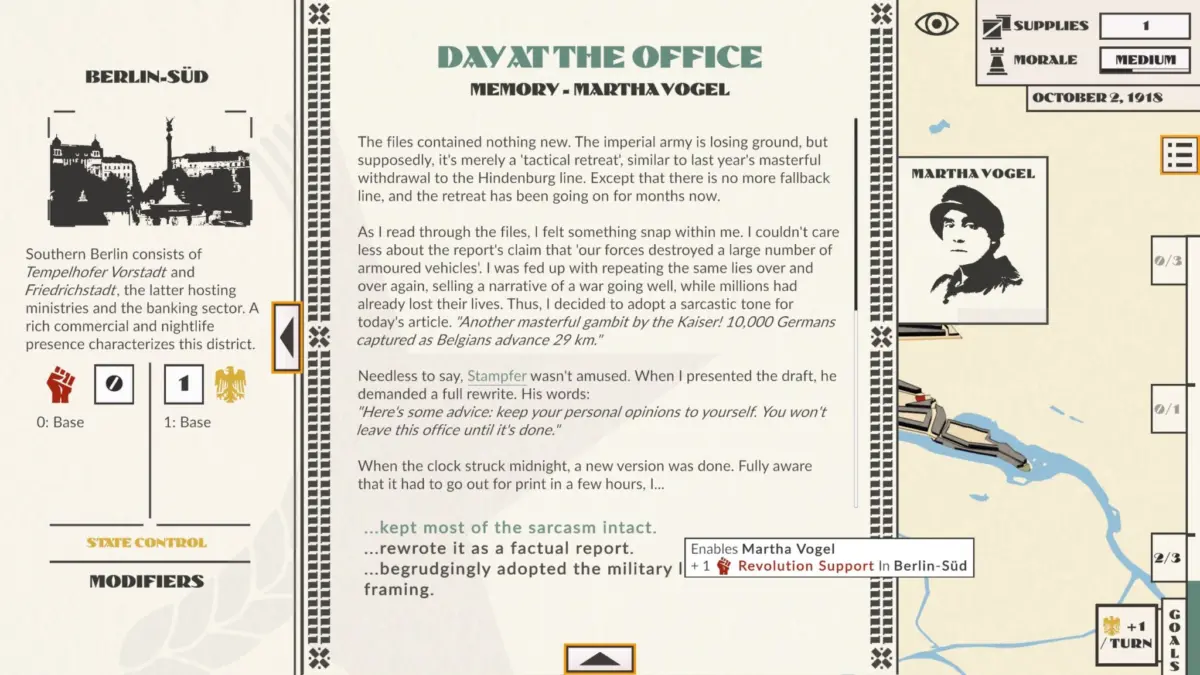
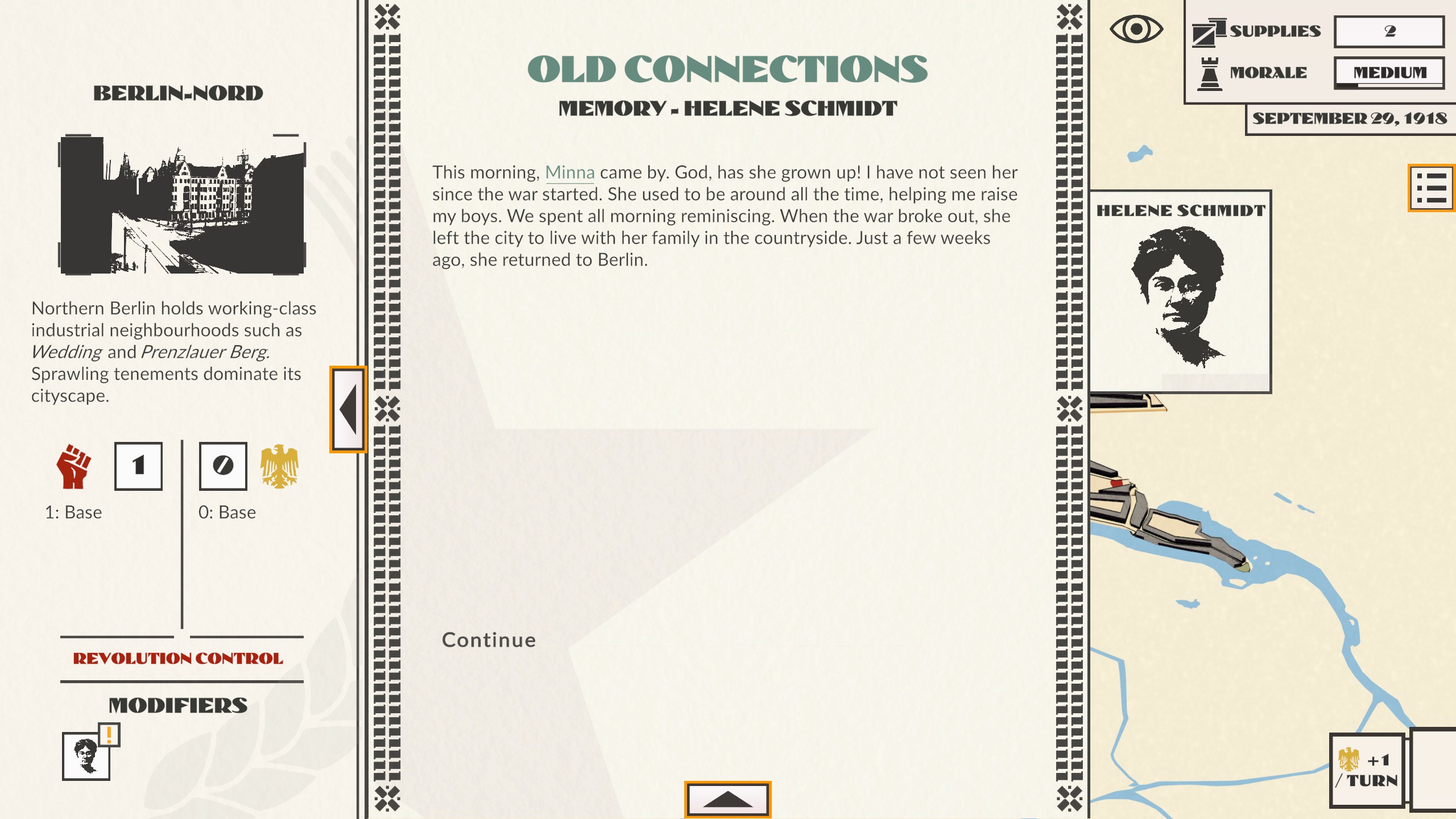
At its core, the game challenges players to manage spatial control across a map of Berlin. Rather than commanding armies on a traditional war-map, players direct a roster of distinct characters across urban districts. Each character possesses specialized abilities designed to influence local metrics:
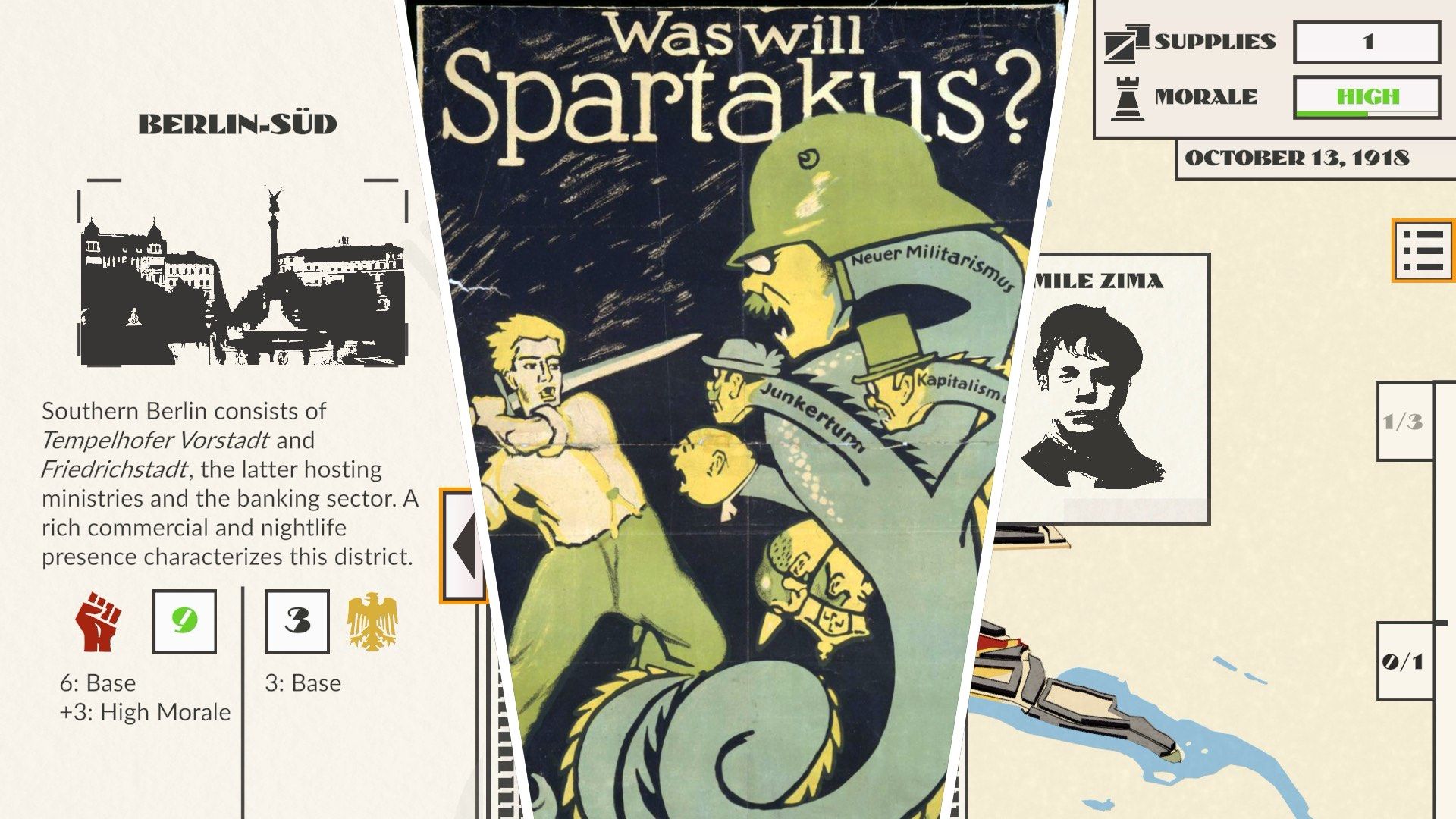
Fervor and Reaction: Players must constantly balance the growth of revolutionary sentiment (represented by expanding pools of red on the map) against the counter-revolutionary backlash (represented by yellow zones of reaction).
Character Placement: The tactical loop revolves around deploying characters to districts where their unique abilities—such as amplifying revolutionary agitation, suppressing reactionary organizing, or mitigating operational pressure on allied agents—can be most effectively utilized before a turn concludes.
Moving Away from "Great Man" History
A defining structural choice by Morningrise Games is the exclusion of iconic historical leaders from the primary player perspective. By focusing on working-class protagonists, the game shifts the historiographical lens:
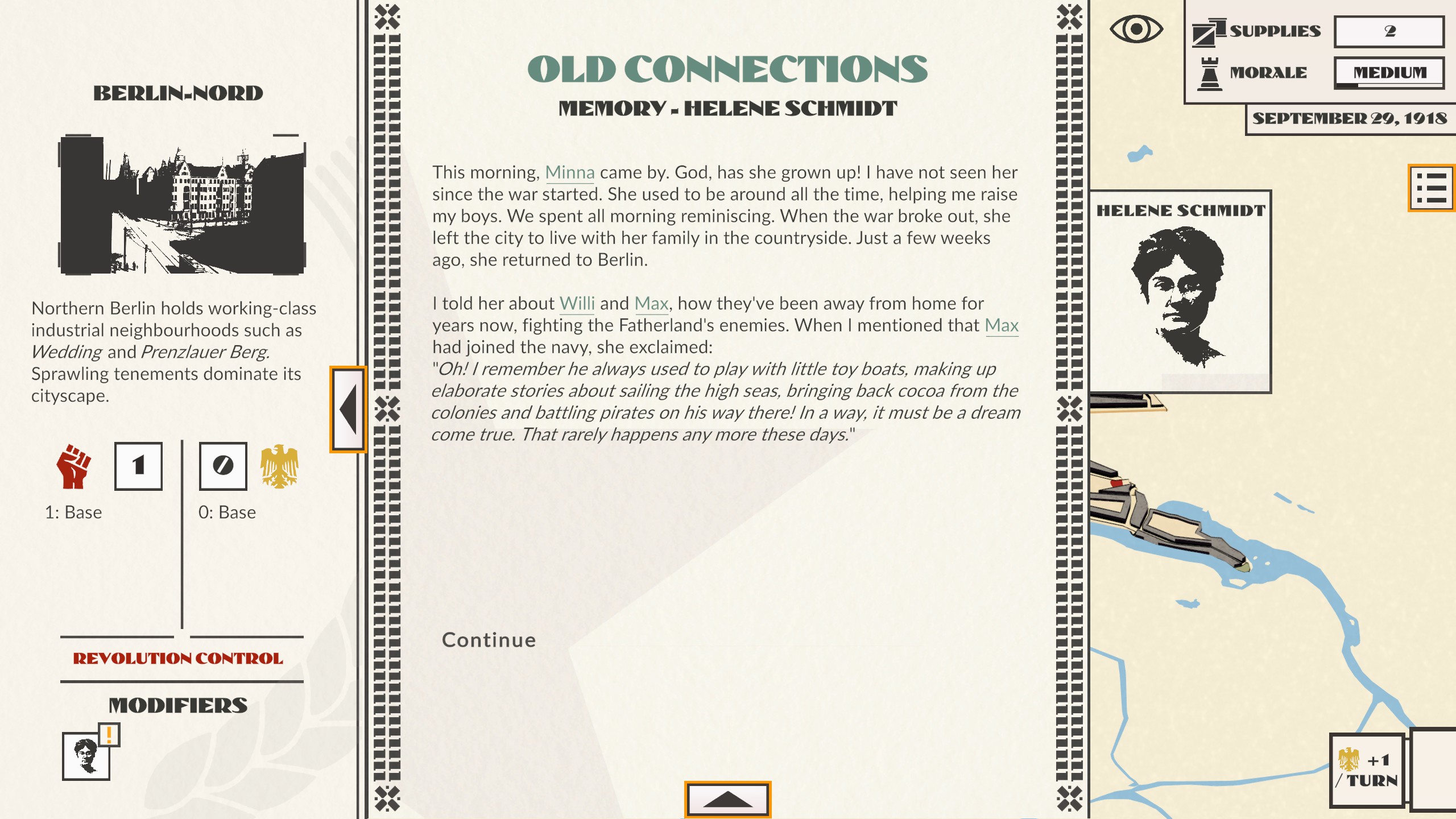
Helene: A politically radicalized journalist whose platform shapes public discourse and ideological alignment.
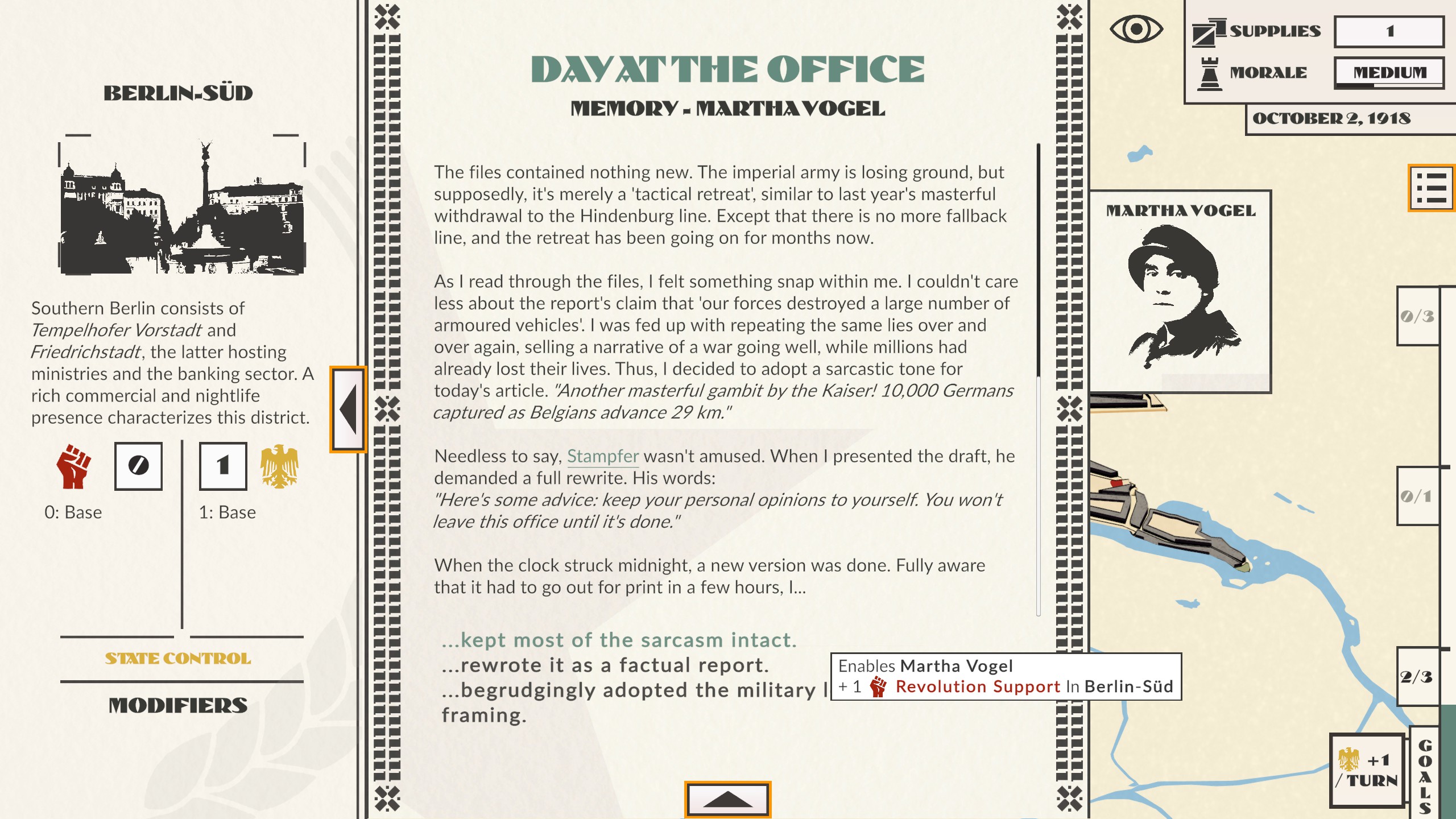
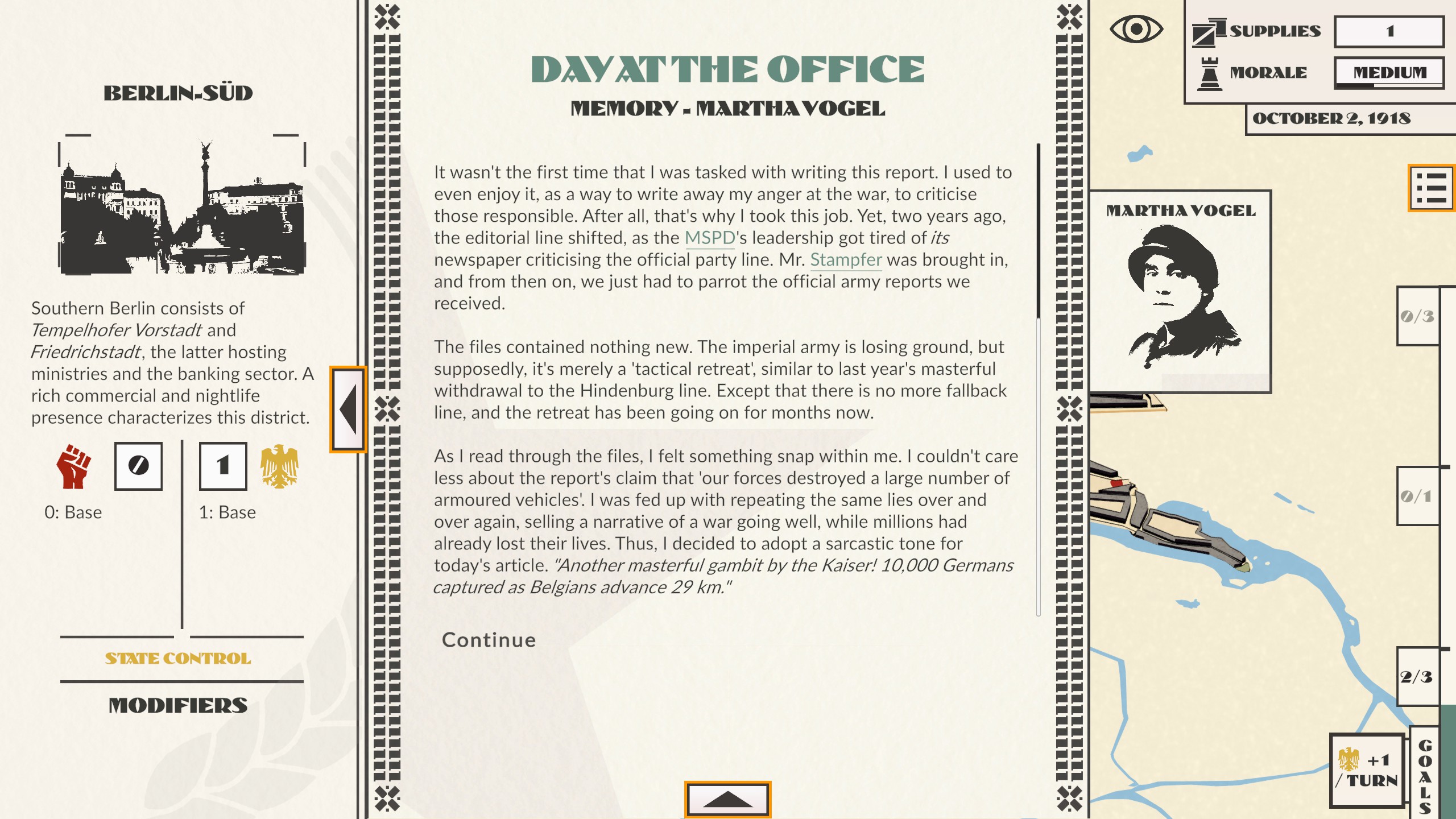
Martha: A working-class mother whose sons are casualties of the imperial war machine, grounding the high-stakes political maneuvers in the immediate tragedy of daily survival.
Unnamed Proletarians: Dockworkers and laborers whose collective actions drive the foundational momentum of the strike.
This perspective elevates the collective nature of social upheaval, emphasizing that revolutions are sustained or broken by the endurance of ordinary citizens rather than the pronouncements of elite ideologues.
Aesthetic and Narrative Execution
The visual identity of Red Echoes: Berlin draws heavily upon Weimar-era graphic design and constructivist art traditions. The stark typography, limited color palettes, and geometric map overlays evoke the political posters and agitprop of the era, creating an immersive atmospheric baseline.
Narratively, the text avoids heavy-handed exposition. The dialogue and scenario writing reflect the authentic anxieties, theoretical debates (such as references to historical labor congresses like the Zimmerwald Conference), and practical dilemmas faced by radical organizers in 1919.
Official Statements and Developer Insights
While Morningrise Games has maintained a focused development cycle leading up to the Q1 release, early developer notes and community updates shed light on their design ethos.
The studio has emphasized that the game is not designed as a deterministic historical reenactment, but rather as an interactive exploration of counterfactual history. In developer commentary surrounding the demo release, the team noted:
"Our goal was to capture the claustrophobia and urgent calculations of a revolutionary moment without reducing history to simple binary choices. The player is constantly forced to weigh short-term moral purity against long-term pragmatic survival. In 1919 Berlin, holding your ground often meant accepting compromises that felt antithetical to the ultimate goal of the revolution."
Furthermore, early playtesters have pointed out that while the opening acts of the demo present a manageable difficulty curve, the developers intend to scale the friction significantly in the full release. The tension between maintaining grassroots support and managing the aggressive infiltration of state-backed paramilitary forces is expected to tighten considerably as the calendar advances toward the fateful days of mid-January.
Future Outlook
As Red Echoes: Berlin approaches its commercial launch in the first quarter of next year, anticipation is building within the strategy and narrative-sim gaming communities. Titles that successfully marry granular political simulation with high-literary storytelling—such as Disco Elysium, Suzerain, and Social Democracy: An Alternate History—have carved out a dedicated audience hungry for intellectual depth over simplistic combat loops.
The game’s brief runtime—estimated at three to four hours per complete playthrough—positions it as a tightly focused, highly replayable experience. By encouraging multiple attempts to steer the Spartacist Uprising toward a different historical outcome, Morningrise Games provides players with an analytical sandbox to explore the counterfactuals of 20th-century history.
For strategy veterans and history enthusiasts alike, Red Echoes: Berlin promises a compelling synthesis of aesthetics, mechanics, and historical inquiry. Whether players will succeed in rewriting the grim fate that befell the German revolutionary left in 1919 remains to be seen, but the journey through the barricades of Berlin will undoubtedly offer a masterclass in political simulation design.











Belum ada komentar. Jadilah yang pertama berkomentar!