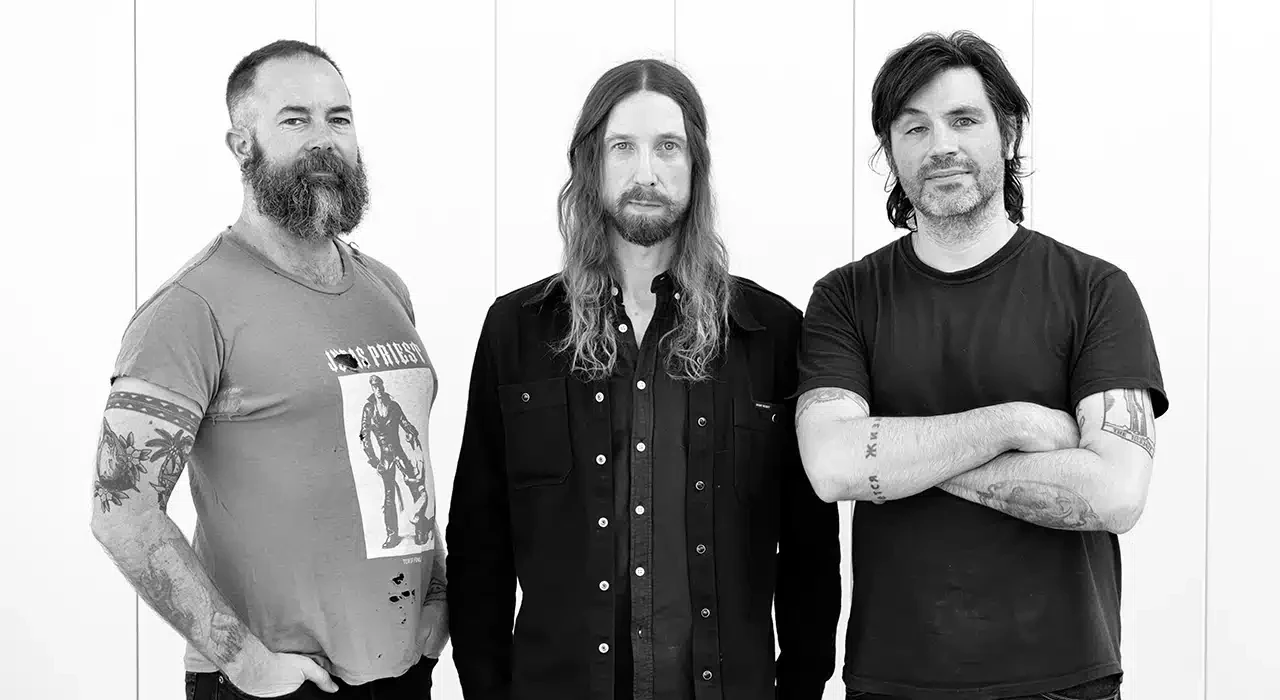
Empros, Blood Year, Station, Gnosis, Enter. For over twenty years, the terse, utilitarian album titles issued by Chicago-based instrumental outfit Russian Circles have functioned almost like cryptographic passcodes designed to unlock an underground bunker. Comprising guitarist Mike Sullivan, bassist Brian Cook, and drummer Dave Turncrantz, the trio operates within the frosty, expansive terrain of post-metal—a genre stripped of traditional vocals, where heavy, downtuned, and heavily distorted notes bear the entire weight of narrative and emotion.
Yet, with the release of their ninth studio album, Nine (via Sargent House), the band departed from their characteristic obliqueness. Choosing a literal numerical title, the trio acknowledged a profound milestone in a career defined by relentless evolution and uncompromising artistic integrity. In an in-depth interview following the release of Nine, guitarist Mike Sullivan opened up about the serendipitous significance of numbers, the band’s unique collaborative dynamic, their meticulous recording process alongside producer Kurt Ballou, and the grueling yet grounding realities of maintaining a two-decade-long career in modern heavy music.
Detailed Chronology: From Enter to Nine
To understand Russian Circles is to trace a linear, sequential trajectory that spans nearly twenty years. Emerging from the vibrant Chicago underground, the band captured attention with their 2006 debut LP, Enter. Setting a high-water mark for instrumental heaviness, the record established a framework that balanced crushing walls of guitar distortion with delicate, loop-driven ambient passages.
In 2007, bassist Brian Cook joined Sullivan and Turncrantz, solidifying the classic lineup for their sophomore outing, Station. From there, a steady succession of critically acclaimed releases followed, charting the band’s maturation across the heavy music landscape:
2006:Enter (Debut full-length)
2008:Station (Cook’s studio debut)
2009:Geneva
2011:Empros (A career-defining peak, earning universal critical acclaim)
2013:Memorial (A towering achievement featuring guest vocals from Chelsea Wolfe)
2016:Guidance (Marking a pivotal sonic shift engineered by Kurt Ballou)
2019:Blood Year
2022:Gnosis (Expanding on cyclical motifs and dense black metal textures)
2024–2026:Nine and the approach of the band’s 20-year anniversary.
As Russian Circles marches toward its twentieth anniversary in the fall of 2026, the release of Nine acts as both a culmination of past motifs and a bridge to future exploration. Unlike milestone records that buckle under the weight of commemorative expectations, Nine serves simply as another vital step in the band’s aesthetic evolution.
Supporting Context & Metrics: The Sargent House Era and Structural Tethers
Reflecting on the span of these nine LPs invites a look back at pivotal moments in modern heavy music history. A prime example occurred at a landmark 2012 showcase at Los Angeles’ El Rey Theater, headlined by Russian Circles. That single evening served as a prophecy for 2013—a year in which several Sargent House roster acts would release era-defining masterpieces.
Opening the night was Deafheaven, whose subsequent 2013 release Sunbather came to define the "blackgaze" subgenre. They were followed by Irish rockers And So I Watch You From Afar, whose kinetic exuberance was captured on All Hail Bright Futures, and Chelsea Wolfe, whose haunting aesthetic blossomed on Pain is Beauty. Capping the evening off on the heels of their superb 2011 record Empros, Russian Circles proved they had reached a distinct peak just prior to releasing Memorial.
The Physics of "Tethers"
One of the most fascinating features of Russian Circles’ recent output is the presence of internal "tethers"—thematic handshakes where a riff or motif from one record seeds an idea that comes to fruition on the next.
For instance, Nine’s second single, the epic "Eluvial," shares a distinct family resemblance to the title track of 2022’s Gnosis. Both tracks span nearly ten minutes, opening with reflective, atmospheric soundscapes before building to a volcanic, black-metal-infused crescendo.
According to Sullivan, the back half of "Eluvial" was actually conceptualized during the Gnosis sessions. "The latter half of that song was in place right after Gnosis," Sullivan explains. "It makes sense that it sounds like that era. But the first half of the song took years to find."
Eventually, Sullivan and Turncrantz collaborated on the front half, while Cook added bubbling electronic keyboards—introducing an entirely new sonic palette to the trio’s traditional guitar, bass, and drum arrangement.
Furthermore, Nine features a striking acoustic micro-interlude entitled "Arletta." Running just two minutes long, the echoey acoustic piece acts as a direct variation of the black metal tremolo-picking found in "Eluvial." Inspired by classical guitarist John Williams’ interpretation of Mikis Theodorakis’ Epitafios No. 3 in D Minor, Sullivan reverse-engineered the melody, demonstrating how the band continually recontextualizes their foundational motifs.
Official Statements & Creative Process
Despite their status as veterans of the post-metal community, Sullivan speaks about the band’s longevity with striking humility and gratitude:
"To me, it’s immense gratitude that people still care about us, and that we can prepare and tour records in a day and age where there’s so many bands and subgenres… It’s almost humorous, like, ‘This is funny, but let’s keep going, make sure that we take this seriously.’"
"Opening the Marriage": The Collaborative Dynamic
The internal chemistry of Russian Circles relies on radical trust and openness. Comparing the trio’s dynamic to a modern artistic partnership, Sullivan notes:
"We trust each other: if Brian came up with a great banjo part, it’s whatever’s cool to us. If Dave pulled out a solo drum part, we’d be cool with that. We’ve done everything, so everything’s open. It’s like we’re opening the marriage or something: try it out! We’re very aware of what we like, but we’re very hesitant to say no; we’ll try out every idea before we say no."
This democratic ethos extends to their work with producer Kurt Ballou (of Converge), who has engineered every Russian Circles record since 2016’s Guidance. Sullivan credits Ballou with refining the band’s guitar distortion, noting that Ballou’s primary skill lies in his ability to leave ample room for each musician to sound distinctly like themselves.
"He doesn’t have a bag of tricks he relies upon where he’s using some specific filter or piece of gear," Sullivan observes. By pairing Hiwatt amplifiers—the live staple of Sullivan’s setup—with Ballou’s deep technical expertise, the band has achieved a signature crushing tone that remains unmistakably their own.
Future Outlook: The Road Ahead
As Russian Circles looks past the cycle for Nine and toward their upcoming 20-year anniversary in late 2026, the band remains clear-eyed about the realities of the modern music industry. Touring today is a far cry from the glamorous, mythologized rock-and-roll lifestyle of the 1970s. Sullivan candidly likens the grueling logistics of van-touring to "helping a friend move apartments."
"We’re not a ‘bus band,’" Sullivan explains. "So it’s very much a laborious tour for us. There’s not much fucking around in parking lots at venues… We’re just chatting with our buds in the van all day long, then you get to the club, make sure your gear works, eat dinner, play the show, pack up, and go to the next city. We have limitations, and limitations are our strengths."
Rather than resting on their laurels, Sullivan views the future through the lens of continuous education and musical expansion:
"My goal is not so much [to be] a guitarist, but a musician: write better music, keep going. I’m a firm believer in educating yourself, learning more; you don’t have to apply it always, but you never know when it’ll make its way in by osmosis… Expression is the name of the game. Are you making someone feel something? I like to build suspense, build tension and release it. The human element of music is what I appreciate."
With nine landmark albums, an unyielding dedication to their craft, and a bond forged through two decades of creative risk-taking, Russian Circles continue to prove that instrumental music, at its core, requires no words to speak volumes.












Belum ada komentar. Jadilah yang pertama berkomentar!