

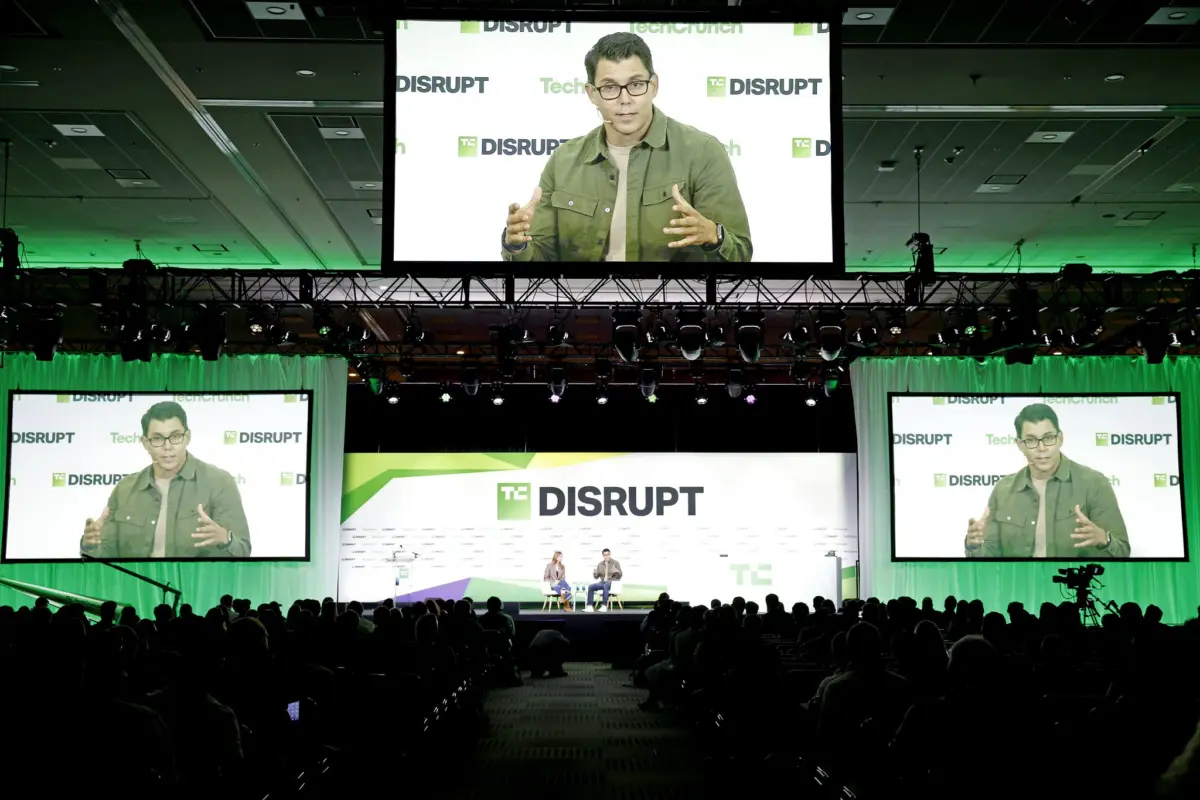
SAN FRANCISCO — Day 2 of TechCrunch Disrupt 2026 kicked off this morning at Moscone West, drawing a bustling crowd of more than 10,000 technology leaders, visionary founders, and elite venture capitalists. As the premier global stage for early-stage innovation, the second day of the conference has rapidly evolved into a masterclass on how artificial intelligence is breaking out of software sandboxes and embedding itself deeply into physical infrastructure, heavy enterprise systems, and real-world robotics.
With high-stakes discussions covering everything from autonomous hardware design to the changing dynamics of the Series A landscape, Day 2 has cemented itself as a vital checkpoint for the technology ecosystem. For attendees navigating the multi-floor venue, the day offers a rigorous mix of live startup pitches, hands-on demonstrations, AI-powered matchmaking, and unvarnished insights from some of the most influential minds in global tech and finance.
Executive Overview: The Maturation of the AI Economy
The prevailing narrative at TechCrunch Disrupt 2026 is clear: the era of novelty AI is officially in the rearview mirror. As artificial intelligence models mature, the conversation across Moscone West’s numerous stages has shifted from mere capability to rigorous implementation, edge computing limits, hardware optimization, and the economic viability of autonomous agents.

Day 2’s programming reflects this pivot. Industry heavyweights from Nvidia, Waabi, Flock Safety, and Ricursive Intelligence are leading conversations that challenge conventional wisdom regarding how software and hardware intersect. Simultaneously, legendary venture firms like Benchmark have brought their entire partnership to the stage to decode where the next breakout startups will emerge in an increasingly constrained and selective funding market.
Beyond the headliner keynotes, the Expo Hall is currently teeming with over 300 cutting-edge startups and solution providers. Founders are leveraging the venue’s AI-powered matchmaking application to secure vital meetings, evaluate competitors, and forge strategic partnerships that could define their trajectories for the remainder of the decade.
Detailed Chronology and Stage Highlights
Morning Sessions: Setting the Strategic Agenda
Doors opened sharply at 8:00 a.m. PT at the Level 1 registration lobby, quickly funneling thousands of attendees into the Level 2 Expo Hall and the various dedicated stage areas.

The Disrupt Stage
The central Disrupt Stage opened with heavy-hitting panels addressing societal integration, systemic risk, and foundational technology shifts:
- AI, Surveillance, and the Future of Public Safety: Flock Safety CEO Garrett Langley took the stage to dissect the delicate balance between modern surveillance technologies, community protection, and evolving regulatory frameworks.
- What We Believe Now: In one of the morning’s most anticipated sessions, Benchmark’s full partnership—featuring Jack Altman, Peter Fenton, Chetan Puttagunta, Everett Randle, and Eric Vishria—offered a rare, collective look at their current investment theses and the macroeconomic signals they are monitoring most closely.
- When AI Starts Designing Its Own Hardware: Anna Goldie and Azalia Mirhoseini of Ricursive Intelligence outlined the monumental shift toward automated silicon design, exploring how machine learning algorithms are accelerating the creation of next-generation computer hardware.
The Real World AI Stage & Robotics Demonstrations
Moving AI from abstract code into physical reality dominated the Real World AI Stage throughout the morning.
- Building AI Systems When Failure Is Not an Option: Nathan Michael (Shield AI), Mikell Taylor (General Motors), and Raquel Urtasun (Waabi) addressed the high-stakes deployment of autonomous systems in environments where software bugs carry catastrophic physical consequences.
- Live Humanoid and Hardware Debuts: Aaron Edsinger brought Hello Robot’s "Stretch 4" to life in a live, on-stage demonstration built for real-world utility rather than sterile laboratory conditions. Later, Jonathan Hurst of Agility Robotics showcased the practical applications of humanoid robots, proving that bipedal automation has officially cleared the prototype phase and entered commercial deployment.
Afternoon Explorations: Builders, Breakouts, and Battlefields
As the afternoon progresses, the focus shifts toward execution, scaling strategies, and direct investor scrutiny.

Startup Battlefield 200: Healthtech, Life Sciences, and Enterprise Security
The grueling Startup Battlefield 200 competition continued its fierce multi-day run on Day 2, focusing heavily on healthtech, life sciences, enterprise software, and security startups. Competitors are currently facing rigorous questioning from a panel of expert judges, all vying for a coveted spot in the finals and the ultimate prize: $100,000 in equity-free funding. For observers, the sessions provide an invaluable blueprint for crafting concise pitches and surviving intense investor evaluation.
The Builders Stage: Navigating the 2027 Funding Climate
For early-stage founders looking to survive and scale in a tighter economic climate, the Builders Stage offered tactical masterclasses:
- The Series A in 2027: Index Ventures’ Jahanvi Sardana, Peak XV’s Shailendra Singh, and Bessemer Venture Partners’ Janelle Teng Wade broke down the shifting metrics required to successfully close a Series A round in the coming macroeconomic environment.
- How to Win When You’re Not Building AI: Yuri Sagalov (General Catalyst), Shan Shan (Baillie Gifford), and Chris Yu (ALSO) provided a refreshing counter-narrative for founders building outside the generative AI bubble, highlighting how traditional software and hard tech companies continue to capture market share.
Interactive Roundtables and Breakout Q&As
Mid-day breakout sessions and closed-door roundtables allowed attendees to dive deep into niche operational challenges. Discussions ranged from The $100 Billion Entry Fee: Can Anyone Still Compete in AI? led by Harrison Rolfes of PitchBook, to practical financial strategies like Grow Like a Founder, Think Like a CFO hosted by Marshall Egger of Spacemilk.

Supporting Context and Metrics: The Ecosystem in Numbers
- 10,000+ Attendees: TechCrunch Disrupt 2026 continues to hold its status as a premier global hub, uniting founders, operators, LPs, and media personnel under one roof at Moscone West.
- 300+ Exhibiting Startups: The Expo Hall features a diverse cross-section of early-stage disruptors spanning quantum computing, space infrastructure, AI-driven logistics, and climate tech.
- $100,000 Equity-Free Prize: The stakes remain exceptionally high for the finalists of the Startup Battlefield 200, offering non-dilutive capital to jumpstart product-market fit.
- Multi-Vertical Stage Architecture: The conference features specialized programming across six core tracks—Disrupt, Builders, Real World AI, AI, Breakouts, and Roundtables—tailored specifically to the complexities of the current technology cycle.
Official Statements and Industry Insights
The sentiment across Moscone West is one of cautious optimism tempered by operational discipline. As venture capitalists tighten their belts while simultaneously deploying record amounts into foundational AI infrastructure, leaders are emphasizing sustainability alongside hyper-growth.
"We are no longer asking whether generative AI can generate interesting outputs; we are interrogating whether these systems can operate autonomously in edge environments where latency, power constraints, and safety are non-negotiable," noted a leading venture partner during a mid-day panel on enterprise deployment.
Similarly, discussions surrounding hardware sovereignty and the staggering costs of compute infrastructure underscore a growing divide between well-capitalized frontier labs and agile application-layer startups.

Future Outlook: Looking Ahead to Day 3 and Beyond
As Day 2 draws to a close, attention is already turning toward the evening’s informal networking circuits and side events—including the Peak XV-hosted Ecosystem Mixer, the Augment and Mintz Liquid Assets gathering, and The Afterward by Backblaze and Flamethrower. These side events offer crucial environments for founders to solidify relationships initiated through the conference’s AI matchmaking app.
With Day 3 on the horizon, the final stretch of TechCrunch Disrupt 2026 promises to deliver the climactic Startup Battlefield finals, definitive outlooks on the future of autonomous systems, and essential guidance for navigating the global venture capital ecosystem for the remainder of the decade.
For those still looking to join the action, discounted passes and hybrid access options remain available online, offering tech professionals a front-row seat to the future of global innovation.







Belum ada komentar. Jadilah yang pertama berkomentar!