

Executive Overview
As democratic norms fracture and political institutions face unprecedented stress under the weight of rising autocracy, political opposition frequently shifts from initial disorientation to pragmatic resistance. In the contemporary United States, traditional checks and balances have been heavily compromised. With the legislative branch gridlocked or controlled by the architects of illiberal governance, and a judiciary increasingly permissive of executive overreach, ordinary citizens have taken up the mantle of accountability.
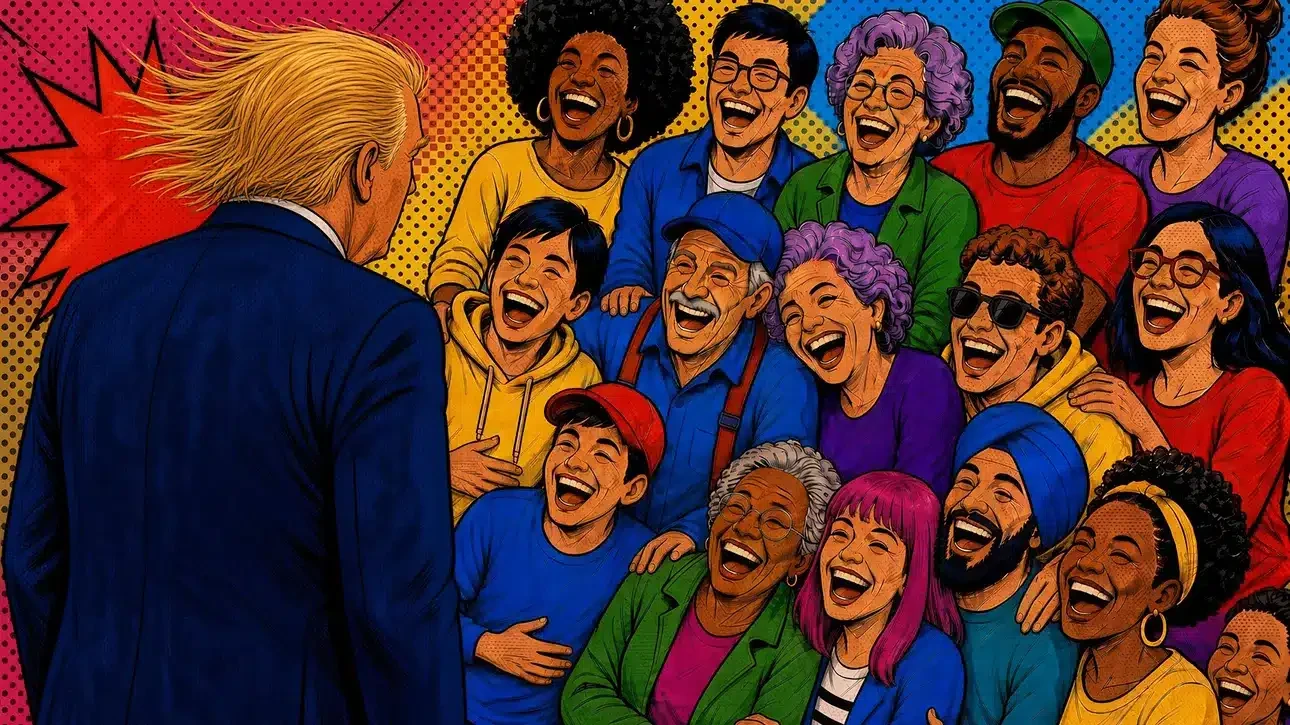
Among the most potent, yet unconventional, instruments of this resistance is political humor. From grassroots street protests featuring satirical iconography to late-night television monologues drawing millions of viewers, comedy has emerged as a vital counterweight to authoritarianism. This dynamic recently culminated in a high-stakes constitutional and cultural showdown involving late-night host Jimmy Kimmel, federal regulatory bodies, and corporate media conglomerates.
This report examines the historic lineage of political satire as a tool against oppression, explores the psychological and cognitive incompatibilities between authoritarianism and humor, details the chronology of the recent assault on late-night broadcasting, and assesses the future of free speech in an increasingly polarized media landscape.
Supporting Context & Metrics: The Philosophy and History of Satirical Resistance
The Cognitive Kryptonite of Autocrats
Cognitive science and historical precedent demonstrate that humor is fundamentally antithetical to rigid, authoritarian regimes. As philosopher and scholar John Morreall observes in Taking Laughter Seriously, "[People] with a sense of humor can never be fully dominated." Authoritarianism demands uniform obedience, solemn hero worship, and the cultivation of an environment driven by fear and manufactured outrage. Conversely, satirical humor exposes hypocrisy, subverts unwarranted claims of omnipotence, and highlights incongruities.
Autocrats and wannabe dictators project an image of infallible superiority and absolute seriousness. When a comedian punctures that illusion with a well-timed punchline, the psychological foundation of authoritarian control begins to crack. This explains why authoritarian figures throughout history—from the Soviet commissars who punished citizens for innocuous jokes to modern populist leaders demanding regulatory retaliation—react to satire not merely as insult, but as a direct threat to their authority.
+-----------------------------------+-----------------------------------+
|      AUTHORITARIAN SYSTEMS        |          HUMOR & SATIRE           |
+-----------------------------------+-----------------------------------+
| Requires unthinking obedience     | Cultivates independent thought    |
| Relies on fear, anger, & division | Fosters joy, relief, & unity      |
| Demands absolute solemnity        | Exposes hypocrisy & grandiosity   |
| Suppresses dissent via coercion   | De-escalates tension via ridicule |
+-----------------------------------+-----------------------------------+
A Deep Historical Lineage
The weaponization of comedy against unchecked power is hardly a modern phenomenon. Comic poets in 6th-century BC Athens helped navigate early democratic systems, while medieval carnivals routinely mocked repressive monarchs. In the United States, political cartoonists provided crucial cultural momentum during the American Revolution, a tradition carried forward by figures such as Benjamin Franklin, Mark Twain, and successive generations of broadcast satirists.
Over the decades, late-night television evolved from light variety entertainment into a significant vehicle for socio-political critique. From Steve Allen and Johnny Carson to Jon Stewart, Stephen Colbert, and Jimmy Kimmel, late-night hosts have filled a vacuum left by institutional journalism. As media scholar Geoffrey Baym noted in his analyses of discursive integration, late-night satirists provide a "rhetoric of challenge" that engages audiences on a moral level, outperforming traditional news formats in cultivating civic awareness and accountability.
Detailed Chronology: The Escalation and Showdown Over Late-Night Broadcasting
The Squeeze on Corporate Media
The tension between the executive branch and late-night comedians escalated sharply as regulatory agencies began aligning with political imperatives. In mid-2025, systemic pressure on major broadcasting networks became impossible to ignore. CBS’s parent company, Paramount, seeking crucial government approval for a major business merger, faced an environment where political alignment was heavily scrutinized. This climate directly impacted Stephen Colbert, whose program faced cancellation pressures amid shifting corporate priorities.
However, the most explosive confrontation materialized in the fall of 2025, ignited by intense political fallout following the assassination of conservative activist Charlie Kirk.
The Kimmel-Kirk Saga and Regulatory Retaliation
In the wake of the Kirk assassination, the political atmosphere grew volatile. During his September 25, 2025 monologue, Jimmy Kimmel addressed the reaction from far-right media silos, warning that political actors were exploiting the tragedy to score partisan points and suppress dissent.
The response from the administration was swift:
- Regulatory Threats: Federal Communications Commission (FCC) Chairman Brendan Carr immediately signaled potential regulatory repercussions for ABC and its parent company, Disney, citing alleged abuses of the public airwaves.
- Corporate Compliance: Pressured by both the FCC threat and pending corporate mergers requiring federal sign-off, Nexstar Media Group pulled Jimmy Kimmel Live! from its ABC-affiliated stations. Disney subsequently ordered ABC to suspend Kimmel’s broadcast indefinitely.
- Public Outcry: A triumphant administration celebrated the removal of a prominent critic, but the maneuver miscalculated the resilience of public sentiment and consumer power.
Official Statements and Responses
The suspension of a major television host over political commentary triggered immediate, cross-industry condemnation and a massive public mobilization:
- The Comedy Community: Rival networks, independent comedians, and talk-show hosts rallied in unison, issuing strong denunciations of the administrative overpressure and defending freedom of the press.
- Public & Consumer Reaction: Trust earned by late-night satirists over decades translated directly into immediate civic action. Viewers and consumer advocacy groups threatened widespread boycotts of Disney products, leading to a sharp, immediate drop in the corporation’s stock valuation.
- The Administration: Initially celebrating the move as a victory for public discourse, executive officials ultimately misjudged the economic blowback. Faced with plunging corporate valuations and mounting constitutional challenges, the administration and its corporate partners were forced into a strategic retreat.
Kimmel returned to the airwaves shortly thereafter, welcomed as a national figure of resistance against government censorship, with public approval ratings climbing significantly.
Future Outlook: The Fragility of Free Expression
The events surrounding the 2025 late-night broadcasting crisis offer profound lessons regarding the resilience of democratic societies under stress. While aspiring autocrats retain potent levers of administrative and economic coercion—ranging from regulatory intimidation to pressure on corporate boards—they face an equally formidable counter-force: organized public resistance and consumer leverage.
Moving forward, the intersection of entertainment, journalism, and politics will remain a primary battleground. Several key trends will define this landscape:
- Decentralized Media Resilience: As traditional corporate networks face mounting regulatory vulnerabilities, independent digital platforms and alternative distribution models will likely absorb displaced satirists, rendering total censorship increasingly difficult.
- Corporate Backbone in Question: The rapid capitulation of media giants like Disney and Paramount underscores the fragility of corporate journalism and entertainment when faced with state-backed economic threats. Future regulatory frameworks must be strengthened to insulate broadcasting licenses from partisan weaponization.
- The Indispensable Role of Satire: So long as traditional journalistic institutions struggle with self-censorship and fear of exclusion, political comedy will continue to serve as a vital moral compass and a primary vehicle for truth-telling in the public square.
Ultimately, the preservation of democratic norms depends not merely on institutional safeguards, but on an informed, vigilant citizenry willing to utilize economic and civic power to defend the First Amendment against authoritarian erosion.








Belum ada komentar. Jadilah yang pertama berkomentar!