

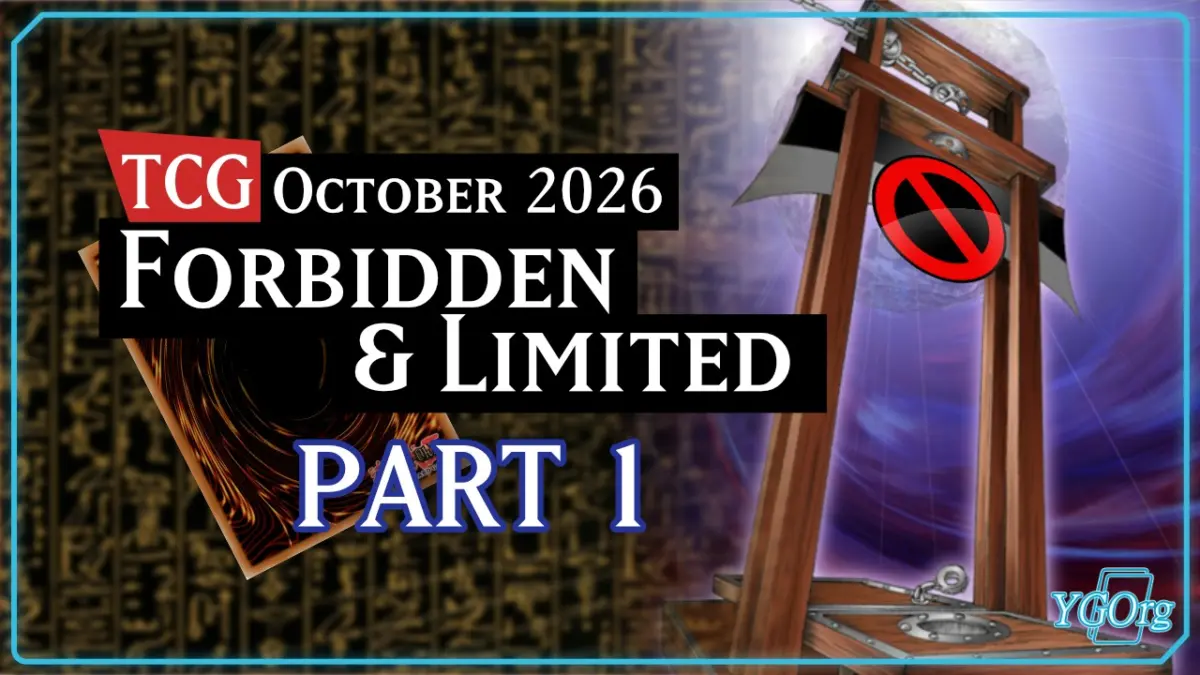
Dateline: October 2026 — In a move that has sent immediate shockwaves through the competitive Yu-Gi-Oh! Trading Card Game community, tournament organizers and card designers have dropped a massive update to the Forbidden & Limited (F&L) List. Unveiled during the high-stakes broadcast of YCS Houston 2026, the forthcoming update—slated to go into effect on Monday, October 19, 2026—targets some of the most pervasive floodgates, combo extenders, and defensive staples in the modern game.
Most notably, the list introduces aggressive bans on oppressive floodgate monsters like Amorphage Sloth and Amorphage Goliath, removes the ubiquitous defensive crutch Called By the Grave, and marks a historic milestone for the game by introducing an OCG-exclusive card directly to the TCG Limited list for the first time in over a decade.
This extensive report provides a deep investigative dive into the October 2026 F&L list changes, offering a detailed chronology of the announcement, a granular examination of the affected cards, historical context regarding regional card legality, and an authoritative outlook on the future competitive landscape.
1. Executive Overview
The October 19, 2026, Forbidden & Limited List update represents a watershed moment for competitive Yu-Gi-Oh!デュエリスト (Duelists). For months, players at Regional, National, and Championship levels have voiced mounting frustrations regarding the stifling nature of high-end competitive play. Games have increasingly been decided by asymmetrical floodgates that lock opponents out of core game mechanics, alongside defensive disruption tools that rendered going-second strategies utterly non-viable.
The new list delivers a decisive response from the balance teams. By sweeping away problematic main-deck boss monsters (Amorphage Sloth, Amorphage Goliath, Aerial Eater), dismantling a premier Extra Deck utility piece (Albion the Branded Dragon), neutralizing a niche rogue tool (Zenna’s Deceiving Doll Maidens), and finally cutting down the legendary hand-trap counter Called By the Grave, Konami has fundamentally altered deck-building philosophies. Furthermore, the decision to semi-restrict Droll & Lock Bird and place the historically OCG-bound Perfectron Hydradrive Dragon directly onto the Limited tier underscores a willingness to experiment with cross-format card pools and hand-trap regulation.
Below is the official breakdown of the upcoming F&L list adjustments:
Forbidden (Cannot be used in Decks)
- Amorphage Sloth
- Amorphage Goliath
- Aerial Eater
- Albion the Branded Dragon
- Zenna’s Deceiving Doll Maidens
- Called By the Grave
Limited (Maximum 1 copy permitted)
- Droll & Lock Bird
- Perfectron Hydradrive Dragon
2. Detailed Chronology of the Announcement
The unfolding of the October 2026 F&L list was orchestrated as a masterclass in live-event drama. As thousands of competitive duelists tuned into the official livestream for YCS Houston 2026, anticipation was already running high due to the volatile state of the format. Mid-way through the tournament’s second day, right before the commencement of the Top Cut rounds, the broadcast paused standard match coverage to deliver the tournament-shaking news.
The YCS Houston Reveal
The announcement was integrated directly into the event’s stream schedule, capturing the raw, unfiltered reactions of top-tier professional players, commentators, and viewers worldwide. The digital chatrooms and social media feeds erupted instantly as the slide displaying the newly Forbidden cards appeared on screen.
The inclusion of Called By the Grave on the Forbidden list sent an immediate tremor through the competitive community, as the card had spent years anchoring defensive line-ups against dominant hand-traps. Simultaneously, the outright ban of the Amorphage dragons signaled an end to heavily polarizing, lock-out-oriented strategies that had begun to creep back into mainstream competitive viability.
Following the initial broadcast, the official rule documentation was updated, confirming the hard implementation date of Monday, October 19, 2026. This brief window gives regional competitors just enough time to pivot their strategies, acquire alternative tech choices, and completely re-engineer their side and main decks ahead of the next major tournament cycle.
3. Supporting Context & Metrics: Analyzing the Banlist Additions
To understand the profound weight of this update, one must examine the specific mechanical impact and meta-relevance of every single card touched by the October 19 list.
Forbidden Additions: Clearing the Board of Oppression
Amorphage Sloth & Amorphage Goliath
For years, the Amorphage archetype sat on the fringes of playability, largely viewed as an archaic Pendulum strategy. However, modern engines discovered terrifying ways to cheat these dragons out or utilize their Pendulum/Monster effects to lock down the opponent entirely.
- Amorphage Sloth shuts down special summoning from the Extra Deck for both players under specific conditions, while Amorphage Goliath completely prevents players from special summoning monsters from the Extra Deck altogether if it is on the field.
- The Impact: By sending both to the Forbidden tier, the design team has firmly signaled that one-sided, game-ending floodgates tied to easily accessible summoning conditions have no place in modern competitive play.
Aerial Eater
A potent enabler in graveyard-reliant and machine-type strategies, Aerial Eater has acted as a silent powerhouse, facilitating explosive combo lines and generating immense resource loops without sufficient counterplay. Its removal aims to curb the sheer consistency and ceiling of decks that leveraged its specific dumping and summoning capabilities.
Albion the Branded Dragon
The inclusion of Albion the Branded Dragon on the Forbidden list is arguably the most surprising and impactful systemic hit to a Tier-1 narrative archetype in recent history. As a cornerstone of the Despia and Branded strategies, Albion facilitated seamless Fusion summons, resource recycling, and access to the wider Branded toolbox directly from the Extra Deck.
- The Impact: Banning Albion effectively dismantles the foundational lines of Branded decks as players have known them for years. It forces loyalists of the archetype to completely reinvent how they bridge their fusion plays, drastically reducing the deck’s resilience and flexibility.
Zenna’s Deceiving Doll Maidens
Though a more niche entry compared to heavyweights like Albion, Zenna’s Deceiving Doll Maidens has quietly served as a disruptive engine piece in specialized rogue strategies. Its removal prevents unforeseen loop exploits and ensures tighter design boundaries for upcoming expansions.
Called By the Grave
Perhaps the most monumental single hit on the list, Called By the Grave has been a staple of competitive TCG deck-building since its inception. Serving simultaneously as an offensive counter to opponent’s hand-traps (Ash Blossom & Joyous Spring, Effect Veiler, etc.) and a defensive tool to banish dangerous graveyard threats, the card has long been criticized for creating non-games.
- The Impact: Moving Called By the Grave from Unlimited to Forbidden completely reshapes the interaction between going-first and going-second players. Hand-traps will now resolve with significantly higher reliability, and graveyard setups will possess newfound security, fundamentally altering the pacing and interaction density of every match.
Limited Additions: Regulation and Historical Milestones
Droll & Lock Bird
Moving from Unlimited down to Limited (1 copy), Droll & Lock Bird has long been a polarizing silver bullet against search-heavy combo decks. When drawn, it completely halts modern deck progression, often ending an opponent’s turn instantly. By restricting it to one copy, players can no longer rely on seeing multiple copies in opening hands, reducing its oppressive gatekeeping while still retaining it as a searchable, high-impact tactical option.
Perfectron Hydradrive Dragon
In many ways, the crown jewel of the technical announcements is the restriction of Perfectron Hydradrive Dragon. This marks the first time an OCG-Only card has been released directly as Limited in the TCG since Sixth Sense on the October 2013 Forbidden & Limited list.
- Historical Significance: Historically, the OCG (Official Card Game, primarily played in Asia) and the TCG (Trading Card Game, covering North America, Europe, and other regions) maintain separate card pools, rarities, and banlists. Bridging this gap by introducing an OCG-exclusive card directly into the TCG limited pool represents a fascinating paradigm shift in global card management. Duelists will now have to carefully evaluate Perfectron Hydradrive Dragon‘s explosive cybernetic capabilities and adapt their strategies to incorporate a piece of history that was previously restricted across oceans.
4. Official Statements and Community Reception
The immediate aftermath of the YCS Houston broadcast saw an outpouring of commentary from prominent community figures, judges, and content creators.
Tournament veterans noted that the removal of Called By the Grave is a double-edged sword. While combo players rejoice at the newfound safety of their graveyard resources and hand-traps, players who rely on breaking heavy established boards expressed anxiety over the lack of universal interaction tools against floating effects.
Regarding the ban of Albion the Branded Dragon, community sentiment has been overwhelmingly stunned. The Branded archetype has enjoyed remarkable longevity, adapting to countless format shifts over the years. Social media timelines flooded with tributes to the iconic dragon, alongside deep-dive theorycrafting threads attempting to map out alternative post-Albion deck profiles.
On the competitive health front, tournament organizers have universally praised the removal of the Amorphage dragons and the targeted hit on Droll & Lock Bird. By curbing absolute floodgates and mitigating auto-win hand-trap polarization, the October 19 list is widely being interpreted as a deliberate effort by Konami to foster longer, more interactive, and skill-testing duels.
5. Future Outlook: Navigating the Post-October 2026 Format
As the competitive community counts down the days to October 19, 2026, duelists across the globe are staring down the barrel of a complete meta reset. The adjustment period will test the adaptability of professional players and casual competitors alike.
Strategic Shifts in Deck Building
- The Death of Universal Staples: With Called By the Grave gone, main-deck compositions will undergo radical experimentation. Defensive utility must now be derived from alternative quick-play spells, cross-counter hand-traps, or dedicated board-breakers like Dark Ruler No More and Forbidden Droplet.
- The Re-Engineering of Fusion Strategies: Branded players face an existential crisis. The loss of Albion demands creative substitution using alternative fusion spells and extra deck monsters to bridge resource deficits. Expect innovative regional lists to emerge within weeks of the list going live.
- Global Card Integration: The introduction of Perfectron Hydradrive Dragon as a Limited TCG card opens the door for futuristic theories regarding cross-format card sharing. If this experiment proves successful, it could signal a new era of unified card accessibility between the OCG and TCG spheres.
Conclusion
The October 19, 2026, Forbidden & Limited list is far more than a routine seasonal update; it is a calculated intervention designed to steer the Yu-Gi-Oh! TCG toward a healthier, more interactive future. By cutting away the rot of unfair floodgates, dismantling historical format pillars, and embracing cross-format experimentation, Konami has proven that no card is too sacred to touch in the pursuit of competitive integrity. As duelists ready their modified lists for the upcoming regional qualifiers, one thing is certain: the meta will never be the same again.







Belum ada komentar. Jadilah yang pertama berkomentar!