

Executive Overview
On August 21, 2026, a structural inversion of modern rock history played out across the diamond of Detroit’s Comerica Park. My Chemical Romance, the definitive architects of mid-2000s emo-theatricality, stood at the apex of a massive stadium tour celebrating the twentieth anniversary of their diamond-certified landmark, The Black Parade. Yet, before Gerard Way and his meticulously uniformed ensemble could command the stage to resurrect their grand, pitch-black rock opera, the audience was confronted with a phenomenon far older, far more dangerous, and vastly less interested in the polite confines of nostalgia: James Newell Osterberg Jr., better known to the world as Iggy Pop.
On paper, the bill felt like an ingenious, if slightly surreal, match of stylistic DNA. My Chemical Romance spent their formative years building a sonic universe around alienation, existential dread, the theater of mortality, and the radical acceptance of the societal outcast. Iggy Pop had spent nearly six decades living those exact impulses, stripping away the baroque flourishes to expose the raw, bleeding nerve underneath.
Yet, as the summer evening settled over downtown Detroit, the true weight of the event revealed itself. My Chemical Romance was there to curate a monument to the past, faithfully executing a meticulously plotted cultural memory. Iggy Pop, at seventy-nine years old, stood before tens of thousands of fans as living, violently kinetic proof of punk rock’s primordial source code. This was not merely an aging legacy act warming up a crowd for a modern stadium headliner. It was an explicit collision between the lineage of raw, industrial nihilism and the polished theatricality it ultimately birthed. For roughly forty-six minutes, the Godfather of Punk did not open a concert; he held a masterclass in how to stare down time and refuse to blink.
Detailed Chronology: The Detroit Takeover
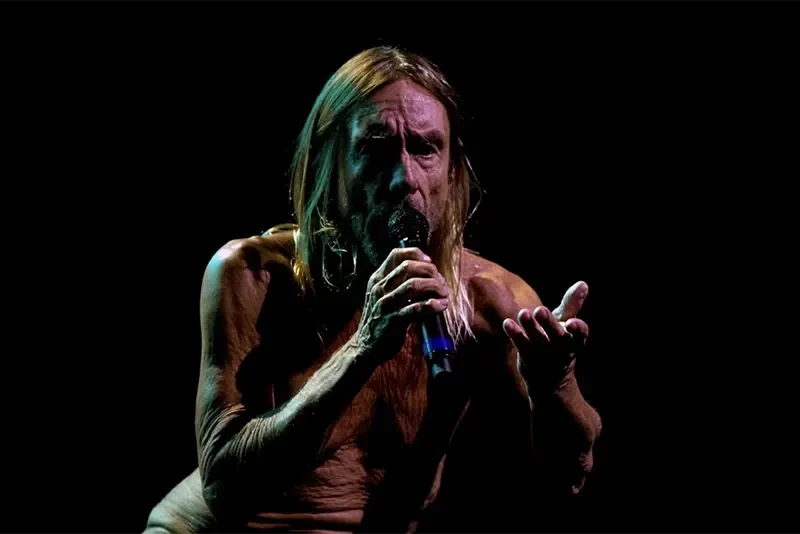
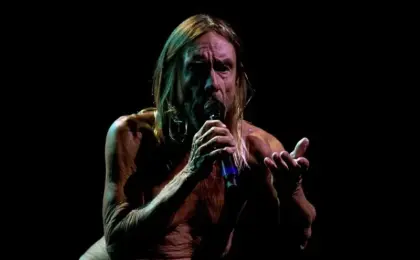
The evening began not with the swell of orchestral strings or the martial snare rolls that typically announce The Black Parade, but with the lacerating, stuttering opening chords of "T.V. Eye." There was no introductory voiceover, no preamble, and no pandering to the multi-generational crowd of My Chemical Romance devotees trying to find their seats in the massive stadium. Iggy Pop strode onto the stage stripped to the waist, his torso bearing the carved map of a lifetime spent turning bodily kineticism into a weapon.
Without breaking stride, the band tore directly into "Raw Power," followed by "I Got a Right" and "Gimme Danger." The sequence was a masterclass in pacing, establishing a sonic architecture built entirely on repetition, overwhelming volume, physical menace, and an unflinching refusal to accommodate comfort. There was no attempt to curate a polite "greatest hits" journey through his sprawling discography; instead, Pop zeroed in on the primal core of his catalog: the abrasive, feedback-drenched output of The Stooges, the volatile solo eruptions of the mid-1970s, and the anthemic solo peaks of his post-Berlin era.
As the setlist transitioned smoothly into "The Passenger" and "Lust for Life," the stadium’s massive LED screens captured the uncanny reality of a man defying biological constraints. But the true inflection point of the performance arrived when the unmistakable, grinding bassline of "I Wanna Be Your Dog" echoed through Comerica Park.
Rather than maintaining the safe distance of the elevated stage, Pop did what he has done since the late 1960s: he dissolved the boundary between performer and observer. Moving toward the barricades, he engaged directly with a crowd largely born decades after the song’s initial recording. "I Wanna Be Your Dog" does not function like a conventional rock-and-roll track; its power relies entirely on hypnotic, bludgeoning repetition. The riff does not develop politely—it insists. By descending toward the audience, Pop weaponized that insistence, transforming an open-air baseball stadium into an intimate, sweaty Detroit basement club for a few breathless minutes.
The set concluded with a ferocious one-two punch of Stooges-era classics, "1969" and "1970," leaving the stadium lights temporarily blinded by the sheer wattage of the performance. When Pop finally exited the stage, he left behind a charged atmosphere that fundamentally altered the emotional temperature of the venue. The stage was now set, but the terms had been rewritten.
Supporting Context & Metrics: A Lineage of Defiance
To understand the profound historical irony of Iggy Pop opening for My Chemical Romance, one must examine the deep cultural geography of southeastern Michigan. Detroit has never been a city comfortable with polite musical genealogies. From the assembly lines of the mid-twentieth century to the avant-garde electronic pulses of the techno revolution, the city’s artistic output has consistently functioned as a direct translation of industrial friction into cultural expression.
When The Stooges emerged from Ann Arbor and Detroit in the late 1960s, their music was commercial anathema—abrasive, confrontational, and explicitly designed to antagonize the blossoming corporate rock industry of the era. Their recorded output, spearheaded by the harrowing production of 1969’s self-titled debut and 1973’s catastrophic-sounding Raw Power, was largely ignored by mainstream radio at the time. Yet, those records laid the blueprint for everything that followed: punk, hardcore, grunge, alternative rock, and post-punk.
| Era / Milestone | Cultural Context | Musical Impact |
|---|---|---|
| Late 1960s / Early 1970s | The Stooges emerge from the industrial collapse of southeastern Michigan. | Establishes the blueprint for abrasive, physical, and confrontational rock performance. |
| 2006 | My Chemical Romance releases The Black Parade, defining 2000s alternative culture. | Transforms adolescent alienation and mortality into grand theatrical spectacle. |
| August 21, 2026 | Comerica Park, Detroit: Iggy Pop opens for My Chemical Romance’s 20th-anniversary tour. | Bridges the generational gap between the architects of punk and its theatrical descendants. |
The lineage connecting The Stooges to My Chemical Romance is not strictly chronological; it is emotional and ideological. While The Stooges tore rock music apart from the inside out using distortion, feedback, and sheer physical abandonment, My Chemical Romance took those same core anxieties—alienation, depression, fear of death, and the desperate need for outsider community—and dressed them in marching bands, black uniforms, and grand narrative mythologies.
Both acts understood a fundamental truth about rock and roll: it is a sanctuary for those who feel displaced by the world around them. Where Iggy Pop gave that displacement a raw, bleeding throat, My Chemical Romance gave it a cinematic stage. Placing the two on the same bill in Detroit made that invisible family tree startlingly, undeniably visible. Furthermore, performing songs like "1969" in the heart of Detroit in 2026 carried a heavy socio-historical resonance. Those dates are not abstract historical markers in Michigan; they evoke an era of political upheaval, racial conflict, and industrial transformation whose echoes still reverberate through the region’s streets.
Official Statements and Industry Reception
The pairing of these two monumental acts generated considerable discourse across the global music community, drawing praise from critics, cultural historians, and fellow musicians alike. Industry analysts noted that while stadium tours celebrating milestone album anniversaries often run the risk of sliding into sterile, self-congratulatory exercises in corporate nostalgia, the inclusion of Iggy Pop completely subverted that expectation.
In reviews published in the wake of the Detroit concert, critics highlighted the audacity of booking a living legend who refuses to treat his own legacy as a museum piece. Representatives for Comerica Park and local promoters noted that ticket demand surged significantly following the announcement of the special guest appearance, proving that cross-generational curation remains a powerful draw in the modern live music economy.
While neither Iggy Pop nor Gerard Way issued formal, exhaustive press releases breaking down the theoretical underpinnings of the tour pairing, stage banter and subsequent interviews offered glimpses into their mutual reverence. Way has frequently cited the foundational influence of proto-punk and Iggy Pop’s unbridled physical fearlessness on the development of My Chemical Romance’s stagecraft. By inviting Pop to share the stage on the Detroit leg of The Black Parade 2026 tour, the band effectively bypassed the standard hierarchy of modern stadium lineups, choosing instead to pay direct homage to the man who made their entire career possible.
Cultural commentators writing for outlets such as The Detroit News and PopMatters emphasized that Pop’s performance successfully bridged the gap between two distinct eras of alternative music culture. One reviewer noted:
"My Chemical Romance were the headliners, filling the stadium for a defining album of 2000s alternative culture. Yet Iggy Pop represented something deeper in the evening’s history—the exact moment when rock stopped behaving itself and decided to tear down the fourth wall forever."
Future Outlook: The Evolution of Live Rock Spectacle
The reverberations of the August 21, 2026 concert extend far beyond a single night in a Detroit ballpark. As the music industry continues to grapple with an aging demographic of foundational rock icons, the question of how legacy acts interact with contemporary touring structures becomes increasingly urgent. Too often, legendary artists are slotted into opening positions as token nostalgic curiosities—polite, muted versions of their former selves meant to keep early-arriving crowds entertained.
Iggy Pop’s performance at Comerica Park shatters that cynical paradigm. By demonstrating that seventy-nine can still look, sound, and feel like a direct threat to public safety, he established a new benchmark for how legacy artists can engage with younger generations of fans. Rather than relying on technological trickery, digital de-aging, or prerecorded backing tracks, Pop relied on the oldest, most reliable currency in rock and roll: absolute physical commitment, volume, and emotional authenticity.
Looking forward, this event signals a shifting approach to stadium-scale curation. As bands from the 2000s alternative and emo explosions—such as My Chemical Romance, Fall Out Boy, and Paramore—step firmly into their legacy years, the imperative to contextualize their own work within the broader history of rock rebellion will only grow. They are no longer just the young upstarts breaking the rules; they are the caretakers of a rich, complex musical lineage.
By bringing Iggy Pop into their orbit, My Chemical Romance didn’t just share a bill; they anchored their theatrical grandiosity in the brutal, unpolished reality of Detroit proto-punk. When the lights finally shifted at Comerica Park, and the horns of The Black Parade began to echo across the stadium, the synthesis was complete. The parade was never just about looking backward into the comforting mists of 2006. It was a demonstration of what happens when the dangerous, unresolved noise of one generation is fearlessly inherited, transformed, and weaponized by the next.



Belum ada komentar. Jadilah yang pertama berkomentar!