


Executive Overview
The gaming landscape on Apple’s macOS platform has historically been defined by compromise. For decades, Mac users looking to dive into the latest AAA titles faced immense hurdles: long porting delays, performance penalties due to translation layers, or the total absence of support for major industry releases. While Windows users enjoyed day-one access to cinematic epics, Mac owners were frequently left on the sidelines, waiting months—or often years—for indie ports or heavily delayed adaptations.
However, the upcoming release of Crimson Desert on March 19 represents a paradigm shift. Developed by renowned South Korean studio Pearl Abyss, this expansive open-world action-adventure is slated to launch on macOS simultaneously with its debuts on PlayStation 5, Xbox Series X|S, and Windows PC. This day-one multiplatform release marks a watershed moment in Apple’s aggressive, multi-year campaign to transform the Mac into a viable, high-performance gaming platform.
Set against the backdrop of an impending hardware refresh—featuring expected launches of new MacBooks powered by cutting-edge M5 Pro and M5 Max silicon—the arrival of Crimson Desert is not just a win for consumers. It is a critical stress test for Apple’s graphics architecture, utilizing advanced APIs like MetalFX Upscaling and hardware-accelerated ray tracing. As the industry watches closely to see if macOS can finally shed its reputation as a productivity-only ecosystem, Crimson Desert stands ready to prove whether Apple silicon can genuinely trade blows with dedicated gaming rigs and next-generation consoles.
Detailed Chronology: From Concept to a Historic macOS Debut
The journey of Crimson Desert to macOS is years in the making, reflecting both the evolution of Pearl Abyss’s proprietary game engine and Apple’s systematic pivot toward high-end gaming.

The Genesis of an Epic
Initially conceptualized as a prequel to Pearl Abyss’s massively multiplayer online role-playing game (MMORPG) Black Desert Online, Crimson Desert underwent a significant creative evolution during development. The studio pivoted the project away from a traditional MMO framework into a single-player, open-world action-adventure game infused with rich narrative depth, sprawling territories, and visceral, real-time combat mechanics. Powered by Pearl Abyss’s next-generation "BlackSpace Engine," the game quickly caught the attention of the global gaming community thanks to its hyper-realistic visuals, dynamic weather systems, and seamless blending of cinematic storytelling with sandbox exploration.
Apple’s Strategic Pivot and the 2025 Reveal
For years, Apple’s relationship with the gaming industry was strained by the deprecation of OpenGL, the transition to Apple silicon, and a historical lack of developer tools tailored for heavy graphics pipelines. That narrative began to shift dramatically at Apple’s Worldwide Developers Conference (WWDC) and subsequent hardware showcases, where the tech giant introduced the Game Porting Toolkit and doubled down on its Metal graphics API.
The milestone moment for Crimson Desert and Apple enthusiasts arrived in the summer of 2025. During a major platform showcase, Apple officially announced that Crimson Desert would be joining an elite lineup of nine blockbuster titles slated to land on macOS. Unlike past announcements that touted vague "coming soon" windows, this rollout underscored a tighter collaboration between Apple engineers and AAA developers. Apple specifically highlighted how Pearl Abyss optimized the BlackSpace Engine to leverage the powerful M3 and M4 chip families, ensuring that macOS users would not receive a stripped-down port, but a fully realized visual experience complete with hardware-accelerated ray tracing.
The March 19 Global Launch
Fast forward to early 2026, and the anticipation has reached a fever pitch. Pre-orders went live on Steam with standard editions priced at $69.99 and deluxe editions commanding $79.99. Crucially, the release date has been locked in for March 19, confirming that Mac users will log in to the treacherous continent of Pywel on the exact same day as players on PlayStation 5, Xbox Series X|S, and PC.

Furthermore, industry insiders anticipate that Apple will prominently feature Crimson Desert during next week’s hardware announcements—which are expected to unveil new MacBook Pro models equipped with M5 Pro and M5 Max chips—providing a live demonstration of how far macOS gaming hardware has evolved.
Supporting Context & Metrics: Technical Specifications and the Silicon Advantage
To truly understand the magnitude of Crimson Desert launching on macOS, one must examine the technological underpinnings that make such a feat possible. Historically, translating complex DirectX or Vulkan-based games to Apple’s unified memory architecture resulted in significant performance bottlenecks. Today, Apple silicon and the Metal API have completely rewritten the rules of engagement.
Hardware Requirements and Performance Profiles
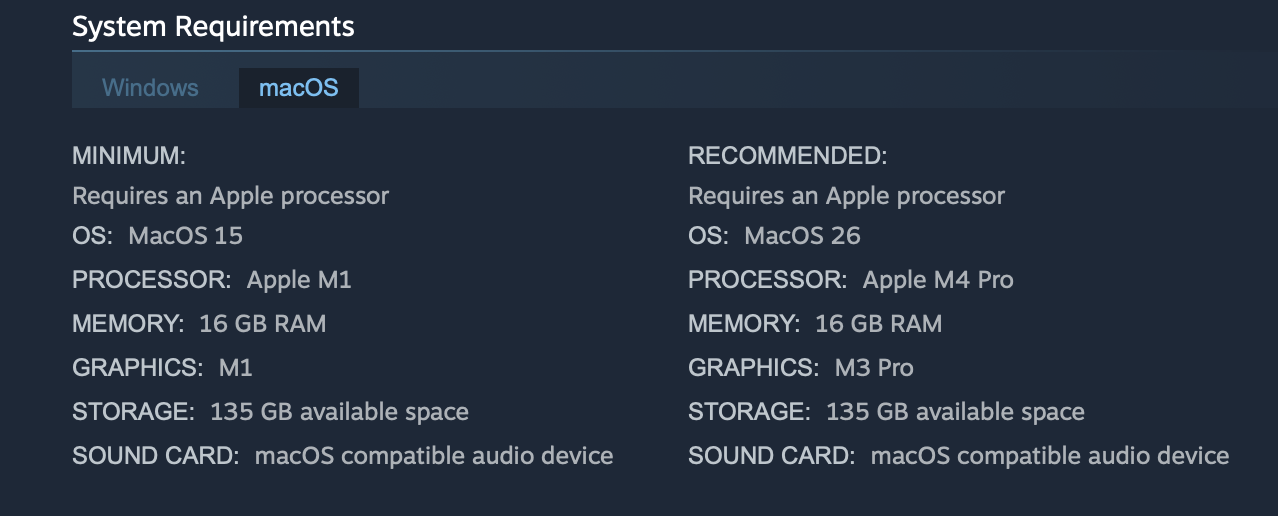
An analysis of the official system requirements released for Crimson Desert highlights the heavy lifting required to render its sprawling open world. While traditional PC builds demand dedicated high-end GPUs from Nvidia or AMD alongside robust desktop processors, the Mac version leverages the unique advantages of Apple’s System on a Chip (SoC) design:
- Unified Memory Architecture (UMA): Unlike traditional PCs where the CPU and GPU maintain separate pools of VRAM and system memory, Apple silicon utilizes a shared high-bandwidth memory pool. This allows Crimson Desert to load massive texture assets and streaming open-world environments with virtually zero latency.
- MetalFX Upscaling: To achieve high frame rates at native Retina resolutions without melting internal components, Pearl Abyss has integrated Apple’s MetalFX Upscaling. Similar to DLSS or FSR on PC, this spatial and temporal upscaling technology renders the game at a lower internal resolution before intelligently reconstructing the image, delivering crisp, high-definition visuals with minimal performance overhead.
- Hardware-Accelerated Ray Tracing: Introduced heavily with the M3 generation and refined across the M4 and upcoming M5 families, hardware-accelerated ray tracing allows for realistic global illumination, accurate reflections, and dynamic shadows in Crimson Desert’s rugged landscapes, dusty badlands, and medieval fortresses.
The Economic and Ecosystem Metrics
The financial commitment required to play Crimson Desert—with standard pricing set at $69.99—places it squarely in the upper echelon of modern AAA pricing tiers. For Apple, securing a day-one launch at this price point is vital. It signals to major publishing houses that the Mac user base is willing to pay full market value for premium gaming content, dismantling the long-held industry belief that Mac users are exclusively casual gamers accustomed to free-to-play mobile titles or deep discounts.
Official Statements and Industry Implications
The convergence of Pearl Abyss’s technical ambitions and Apple’s hardware roadmap has generated substantial commentary across the tech and gaming sectors.
When Apple initially showcased Crimson Desert as part of its curated wave of AAA titles, company executives emphasized the seamless integration of software and hardware:
"Mac users will experience breathtaking worlds by leveraging powerful software technologies like MetalFX Upscaling to accelerate performance and deliver high-quality visuals, alongside the M3 and M4 family of chips with hardware-accelerated ray tracing for an unmatched immersive experience."
Industry analysts view this partnership as a litmus test for the future of the platform. For years, game developers cited the low install base of high-performance Macs as a primary deterrent against investing millions of dollars into macOS ports. By bridging the architectural gap through advanced developer toolkits and working closely with studios during the development cycle, Apple is systematically removing those friction points.

If Crimson Desert achieves commercial and critical success on macOS on March 19, it could serve as a powerful catalyst. Other major publishers currently sitting on the fence regarding macOS support may view Pearl Abyss’s day-one launch as proof that the platform is finally economically viable and technologically capable of supporting world-class entertainment properties.
Future Outlook: What Crimson Desert Means for the Next Era of Mac Gaming
As the countdown to March 19 ticks away, the implications of Crimson Desert stretch far beyond a single video game release. It represents a critical inflection point for Apple’s ongoing crusade to conquer the living room, the desk setup, and the competitive gaming market.
The Ripple Effect on Future AAA Releases
The successful deployment of the BlackSpace Engine on macOS opens the floodgates for future multiplatform engines, such as Unreal Engine 5 and Unity, to run natively with optimized Metal support. When developers realize that optimizing for Apple silicon requires an iterative adjustment rather than a ground-up rebuild—thanks to robust translation layers and unified architecture—the timeline for Mac ports will inevitably shrink. We are rapidly approaching an era where "Mac version available later this year" could transform into standard day-and-date releases across the board.
Hardware Synergy: The M5 Era
Next week’s anticipated hardware unveilings—bringing the blistering performance of M5 Pro and M5 Max chips to Apple’s MacBook lineup—could not be timed better. As users unbox these high-end machines, Crimson Desert will instantly serve as the ultimate "benchmarking" title to showcase what these new laptops can achieve when pushed to their absolute limits. It shifts the marketing narrative of the Mac from a sterile, corporate workstation back into a multi-purpose powerhouse capable of professional video editing by day and high-fidelity open-world exploration by night.

Conclusion
Crimson Desert is more than just an anticipated action-adventure game; it is a declaration of intent. For Mac enthusiasts who have waited decades for industry parity, March 19 will be a day to remember. Whether you are scaling sheer cliffs, engaging in brutal medieval skirmishes, or simply marveling at the ray-traced lighting reflecting off the desert sands, you will be witnessing history: the day macOS officially claimed its seat at the high table of modern gaming.
Are you planning to dive into the world of Pywel on your Mac, or will you be sticking to console and PC? Let us know your thoughts and hardware setups in the comments below!









Belum ada komentar. Jadilah yang pertama berkomentar!