


Executive Overview
For decades, the personal computer gaming landscape has maintained a stark dichotomy: Windows PCs reigned supreme as the unequivocal home for high-end, resource-intensive AAA titles, while Apple’s macOS was relegated to casual gaming, indie darlings, and retro ports. Historically, Mac users grew accustomed to watching major multi-platform blockbusters debut on PlayStation, Xbox, and Windows, only to wait months—or in many cases, years—for an optimized macOS version, if one arrived at all.
That historical narrative is undergoing a radical and deliberate rewrite.
As the technology industry looks toward a massive week for Apple hardware hardware rollouts—including the highly anticipated launch of next-generation MacBooks and the unveiling of the M5 Pro and M5 Max chip families—the software ecosystem is matching this hardware evolution stride for stride. Headlining this shift is Crimson Desert, the sprawling, visually jaw-dropping open-world action-adventure title developed by South Korean powerhouse Pearl Abyss.
Slated for release on March 19, Crimson Desert is not just another port testing the waters of Apple Silicon. It represents a watershed moment for the platform: a simultaneous, day-one global release on macOS alongside Windows PC, PlayStation 5, and Xbox Series X|S. Priced at $69.99 for the Standard Edition and $79.99 for the Deluxe Edition via platforms like Steam, the title stands as one of the most anticipated releases of the year. Its arrival on macOS on day one signals a fundamental pivot in how major game publishers view Apple’s unified architecture, marking a critical turning point in Apple’s multi-year crusade to transform the Mac into a premier destination for hardcore gamers.

Detailed Chronology: From Silicon Valley Promises to Day-One Reality
To fully understand the gravity of Crimson Desert launching on macOS, it is essential to trace the deliberate chronology of Apple’s recent gaming renaissance. The journey from Apple Silicon’s debut to day-one AAA cross-platform parity has been meticulously engineered through a combination of proprietary hardware innovation and developer relations.
The Apple Silicon Shift (2020–2022)
When Apple transitioned away from Intel processors and introduced its custom-designed Apple Silicon (starting with the M1 chip in late 2020), the tech giant quietly laid the foundation for a gaming revolution. By adopting a unified memory architecture—where the CPU, GPU, and high-bandwidth RAM share a single pool of memory—Apple created hardware intrinsically capable of handling modern graphics workloads with unprecedented efficiency and thermal performance. However, hardware capability alone does not build a game library. In the early days of Apple Silicon, developers remained hesitant to invest the capital required to build native macOS versions of their games due to the legacy of low market share in traditional gaming sectors.
Laying the Groundwork: Game Porting Toolkit (2023)
Recognizing that the friction of porting code was the primary barrier to entry, Apple dropped a bombshell at WWDC 2023: the Game Porting Toolkit (GPTK). This developer-facing translation layer allowed game studios to run their existing, un-modified Windows DirectX games on macOS almost instantly, giving developers a window into how well their titles could perform on Apple Silicon without writing a single line of Mac-specific code beforehand. Alongside the GPTK, Apple introduced Metal 3, featuring advanced developer tools designed to extract every ounce of performance from M-series chips.
The Turning Point: The 9-Game Initiative (Summer 2025)
The momentum culminated in a major strategic push last summer, when Apple officially announced a slate of nine high-profile AAA titles slated to land on macOS within a condensed timeframe. Among them, Crimson Desert was singled out as a crown jewel. Apple’s engineering teams collaborated directly with Pearl Abyss, focusing heavily on how the game could natively leverage proprietary software technologies like MetalFX Upscaling to drastically accelerate frame rates while maintaining pristine visual fidelity. Furthermore, Apple highlighted how the game would harness hardware-accelerated ray tracing natively embedded within the M3 and M4 families of chips, promising an immersive visual experience that could trade blows with high-end desktop gaming rigs.

The March 19, 2026 Milestone
Now, that multi-year cultivation process reaches its apex. On March 19, millions of Mac users globally will be able to download and play Crimson Desert the exact same second as players on Windows rigs, PlayStation 5s, and Xbox Series X|S consoles. For an industry that has long dismissed macOS as an afterthought, this day-one parity is nothing short of a seismic shift.
Supporting Context & Metrics: Under the Hood of Crimson Desert
What makes the day-one arrival of Crimson Desert on macOS so impressive—and technologically challenging—is the sheer scale of the game itself.
The World of Pywel
Developed by Pearl Abyss (the studio globally renowned for the massive MMORPG Black Desert Online), Crimson Desert drops players into the continent of Pywel, a vast, unforgiving, and beautifully rendered open world. The game blends high-fantasy elements with gritty, realistic medieval combat, focusing on the harrowing journey of mercenary Macduff as he fights to survive in a war-torn landscape. Featuring seamless transitions between exploration, tactical melee combat, horseback riding, and dynamic environmental interactions, the game demands immense graphical and computational power.
Technical Requirements and Apple Silicon Integration
Bringing such a graphically demanding, next-generation engine to macOS requires deep optimization. According to the official system requirements released via Steam, running Crimson Desert on a Mac will necessitate robust hardware specifications, leaning heavily on the advanced capabilities of Apple’s upper-tier processors.
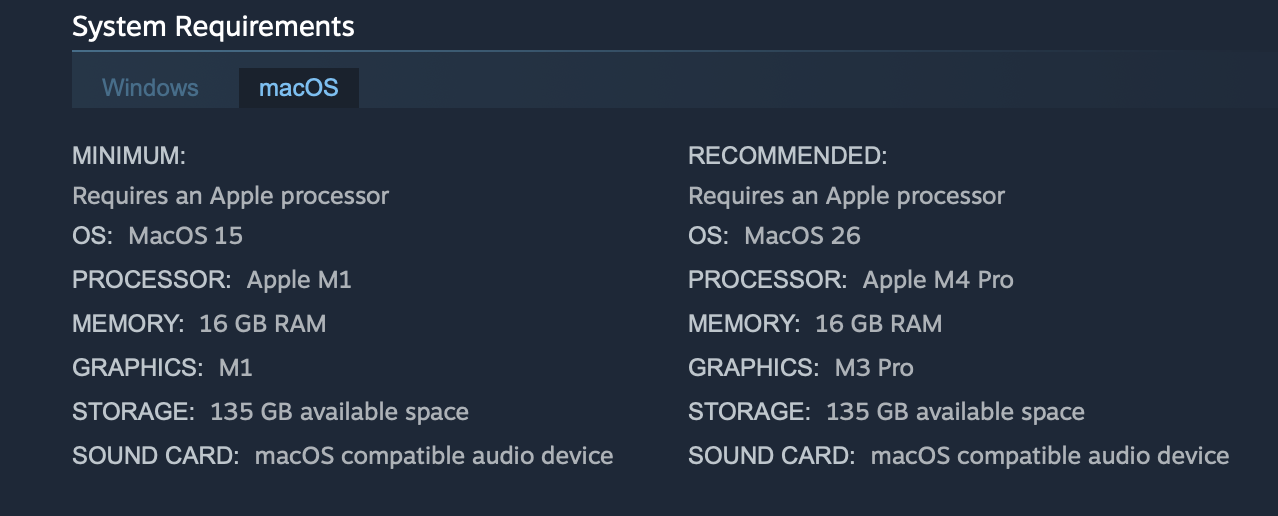
- The Silicon Advantage: The game is architected to take full advantage of Apple’s Metal API. By bypassing traditional translation bottlenecks and utilizing native Metal code paths, Pearl Abyss has ensured that the game scales gracefully across Apple’s hardware lineup.
- Ray Tracing & MetalFX: On M-series configurations equipped with hardware ray-tracing accelerators (found across the M3, M4, and anticipated M5 hardware families), lighting, shadows, and reflections in Pywel render with breathtaking realism. Meanwhile, MetalFX Upscaling allows systems to render at lower internal resolutions before intelligently upscaling the image to 4K or retina resolutions, ensuring buttery-smooth frame rates without sacrificing visual sharpness.
Pricing and Availability
For players eager to dive into Pywel, pre-orders are currently live on Steam. The pricing structure is aligned with modern AAA industry standards:
- Standard Edition: $69.99
- Deluxe Edition: $79.99 (includes supplementary in-game bonuses, cosmetic items, and early-access utility packs)
Given Apple’s history of utilizing major product showcases to spotlight high-profile software partners, industry analysts widely anticipate that Crimson Desert will command significant stage time during Apple’s imminent M5 Pro and M5 Max MacBook announcements, serving as the ultimate benchmark to demonstrate the raw horsepower of Apple’s newest silicon.
Official Statements & Industry Impact
The convergence of high-end Mac hardware updates and simultaneous AAA software releases has not gone unnoticed by industry veterans and market analysts alike. While Apple has historically kept a tight lid on internal gaming metrics, executive messaging over the past few hardware cycles has made the company’s ambitions crystal clear.
During previous developer conferences and hardware briefings, Apple representatives repeatedly emphasized that the modern Mac is no longer just a productivity machine for video editors, software engineers, and musicians.

"We are building hardware that rivals, and in many cases surpasses, traditional desktop gaming architectures while maintaining the energy efficiency and thermal boundaries unique to Apple Silicon," noted a software engineering lead during an ecosystem briefing. "With tools like Metal 3 and MetalFX, and visionary partners like Pearl Abyss willing to push the boundaries, we are proving that the Mac is a premier, first-class platform for the world’s most demanding developers and players."
Pearl Abyss, too, has expressed immense confidence in the scalability of Apple’s platform. Bringing an entirely new intellectual property—built on their proprietary next-generation engine—to macOS simultaneously with consoles and PC required a profound commitment to cross-platform optimization. By embracing Apple Silicon’s unified memory pool, Pearl Abyss engineers were able to streamline asset streaming across the CPU and GPU, circumventing the traditional memory-bottleneck hurdles that historically plagued Mac ports.
Game industry analysts view this partnership as a potential tipping point. For years, a vicious cycle persisted: gamers didn’t buy Macs for gaming because there were no games, and developers didn’t port games to macOS because there was no established gaming audience. By securing day-one releases for tier-one blockbusters like Crimson Desert, Apple is actively breaking this cycle, offering publishers a lucrative, untapped demographic of high-end hardware owners hungry for AAA experiences.
Future Outlook: The Next Frontier for macOS Gaming
As the technology sector looks toward March 19 and beyond, the implications of Crimson Desert’s day-one macOS launch extend far beyond a single game release. It establishes a repeatable blueprint for how major studios can bring complex, modern PC and console titles to Apple Silicon with minimal friction and maximum visual fidelity.

What Lies Ahead for Mac Gamers
- Accelerated Publisher Confidence: Following the successful deployment of the nine-game initiative announced last summer—with Crimson Desert acting as its vanguard—other major publishers are closely monitoring sales figures, performance metrics, and user reception. A strong commercial debut on macOS could open the floodgates for subsequent 2026 and 2027 AAA multi-platform announcements.
- Hardware Synergy: With the imminent rollout of next-generation MacBooks featuring M5, M5 Pro, and M5 Max chips, Apple is coupling its software victories with unmatched processing power. Gamers investing in these new machines are practically guaranteed a future-proof rig capable of handling ray-traced, high-frame-rate experiences out of the box.
- The Evolution of Metal: As Apple continues to iterate on its proprietary graphics APIs, we can expect even tighter integration between game engines (such as Unreal Engine and Unity) and macOS, reducing porting timelines from months to mere weeks—or, as demonstrated here, achieving true day-one global parity.
Conclusion
The narrative that "Macs aren’t for gaming" is rapidly becoming an obsolete relic of the past. When Crimson Desert launches on March 19, it will do so not as a compromised afterthought or a late-to-the-party port, but as a premier, high-fidelity experience running natively on Apple Silicon. For Mac enthusiasts, hardware aficionados, and hardcore gamers alike, the desert has never looked greener.
Are you planning to dive into the world of Pywel on your Mac, or will you be sticking to traditional consoles and PCs? Let us know your thoughts in the comments below.









Belum ada komentar. Jadilah yang pertama berkomentar!